
For the serious investor or aspiring landowner, purchasing a tract of Wisconsin land is one of the most significant decisions you’ll make. But how do you move beyond a simple acreage number to truly understand a property’s worth? The difference between a good investment and a great one lies in the details-the soil quality, the historical yields, and the long-term income potential that isn’t always obvious. Many buyers find themselves overwhelmed, unsure where to begin their search for the best farmland in Wisconsin or what metrics truly matter.
As Wisconsin’s Land & Property Sales Specialists, we’ve built our reputation on a deep, authentic understanding of the ground beneath our feet. In this definitive guide, we will cut through the noise and reveal the top counties for agricultural investment. You will learn to evaluate soil productivity, analyze crop yield data, and confidently identify properties that offer both immediate returns and lasting value. Consider this your expert brief for making a sound and successful land purchase.
What Defines the ‘Best’ Farmland? Key Factors for Wisconsin Buyers
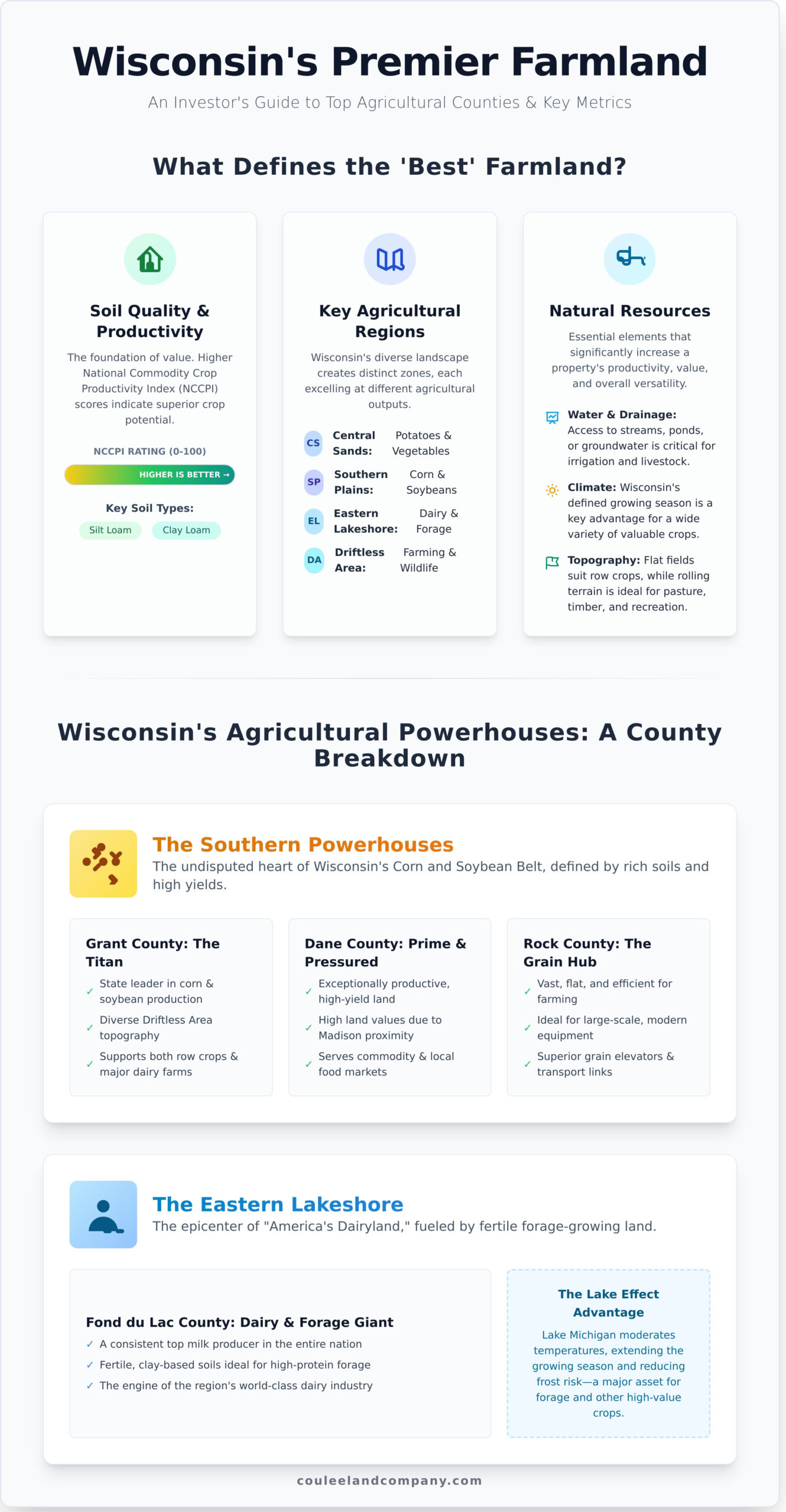
When searching for the best farmland in Wisconsin, seasoned buyers understand that acreage alone tells only a fraction of the story. True agricultural value-and long-term investment potential-is determined by a combination of critical factors. To make a superior investment, you must look beyond the property lines and analyze the land’s inherent capabilities. Whether your goal is generating maximum crop yield, establishing a premier hunting property with food plots, or securing a tangible asset for your portfolio, understanding these metrics is non-negotiable.
Soil Quality and Productivity Ratings
The foundation of any productive farm is its soil. The most reliable metric for this is the National Commodity Crop Productivity Index (NCCPI), a simple 0-100 rating that assesses a soil’s inherent capacity to produce major commodity crops. Higher scores indicate superior potential. Look for parcels dominated by nutrient-rich soil types like silt loam and clay loam, which offer an ideal balance of water retention and drainage. You can access detailed soil maps and NCCPI data for any parcel through the USDA’s Web Soil Survey.
Key Agricultural Regions and Their Specialties
Wisconsin’s agricultural identity is incredibly diverse, with distinct regions excelling at different outputs. For a complete Overview of Wisconsin Agriculture, you’ll see a state defined by its varied production. The Central Sands region is known for potatoes and vegetables, while the fertile Southern Plains are the heart of corn and soybean production. To the east, dairy operations and forage crops dominate the landscape. The unglaciated Driftless Area presents a unique mix of tillable valleys and wooded bluffs, creating amazing opportunities for both farming and wildlife management.
Water, Climate, and Topography
Reliable water access, proper drainage, and suitable topography are essential for success. The presence of streams, ponds, or access to groundwater for irrigation can significantly increase a property’s value and productivity. Wisconsin’s climate provides a defined growing season that favors specific crops. Finally, topography dictates use. While vast, flat fields are ideal for large-scale row cropping, rolling terrain is perfectly suited for pasture, timber, and creating the ultimate recreational and hunting tracts that define Wisconsin’s famed Bluff Country.
The Southern Powerhouses: Wisconsin’s Corn and Soybean Belt
When experienced operators and savvy investors search for the best farmland in Wisconsin, their attention inevitably turns to the southern tier. This region, often called the state’s Corn and Soybean Belt, is the undisputed heart of cash crop production. It is defined by deep, rich prairie soils and a favorable climate that consistently delivers high yields. This agricultural prowess creates a highly competitive market for land acquisition and leasing. Furthermore, its strategic location offers unparalleled access to major markets in Madison, Milwaukee, and Chicago, enhancing the value and logistical efficiency of any operation based here.
Grant County: Leader in Production and Diversity
Situated in the state’s southwest corner, Grant County is a true agricultural titan. It consistently leads the state in both corn and soybean production, a fact well-documented by the official Wisconsin Agricultural Statistics. Located within the fertile Driftless Area, the county’s landscape offers a powerful combination of productive ridgetops and rich valley bottoms. This diverse topography supports not only large-scale row crop operations but also a significant number of the state’s leading dairy farms, making it a cornerstone of Wisconsin’s agricultural economy.
Dane County: Prime Land Meets Urban Proximity
Dane County represents the intersection of premier soil quality and intense market demand. The land here is exceptionally productive, consistently ranking among the highest in the state for crop yields. However, its proximity to the rapidly growing city of Madison creates a unique economic environment. This urban pressure drives up land values and cash rental rates significantly, but it also opens up lucrative opportunities. Farmers in Dane County are uniquely positioned to serve both the high-volume commodity markets and a thriving local food scene that values fresh, locally sourced products.
Rock County: A Hub for Grain Farming
For those focused on high-volume grain production, Rock County is a prime destination. The county is renowned for its vast, efficient corn and soybean operations, built upon a landscape that is predominantly flat and easily farmable. This allows for large, contiguous fields that maximize the efficiency of modern equipment. This natural advantage is supported by superior infrastructure, including a robust network of grain elevators and excellent transportation links, which are critical for moving large quantities of grain to market efficiently and profitably.
The Eastern Lakeshore: Heart of America’s Dairyland
When you mention Wisconsin agriculture, the image that comes to mind for most is the iconic dairy farm, and for good reason. The Eastern Lakeshore region, with its counties bordering the vast expanse of Lake Michigan, is the undisputed epicenter of this legacy. The lake itself is a powerful agricultural asset, creating a unique microclimate that moderates temperatures. This “lake effect” extends the growing season, reduces the risk of damaging frosts, and provides superior conditions for a variety of high-value crops.
The region’s agricultural identity is built on a powerful synergy between livestock and land. To support a world-class dairy industry, you need world-class feed, and these counties possess some of the best farmland in wisconsin for exactly that purpose. The fertile soils found here are exceptionally productive for forage crops. Sprawling fields of nutrient-dense alfalfa and high-tonnage corn silage are a common sight, providing the essential fuel for the state’s dairy herds. This focus on forage is the engine that drives the region’s immense productivity and agricultural value.
Fond du Lac County: A Dairy and Forage Giant
A true titan of the dairy industry, Fond du Lac County consistently ranks as a top milk producer in the nation. This dominance is built on a foundation of fertile, clay-based soils that are ideal for growing the high-protein forage that dairy cattle require. The county’s agricultural strength is amplified by a powerful network of support industries-from nutritionists to equipment dealers-making it a highly efficient and productive environment for any farm operation.
Manitowoc County: Diverse Crops and Strong Values
Stretching along the Lake Michigan shoreline, Manitowoc County showcases a more diversified agricultural profile while maintaining its strong dairy roots. The moderating lake effect is particularly pronounced here, creating superior growing conditions not only for corn and soybeans but also for specialty vegetables. This agricultural diversity, combined with its prime location, underpins consistently high land values and strong rental income, marking it as a strategic investment for those seeking valuable and productive parcels.
Western Wisconsin: Where Productive Farmland Meets Recreation
While other regions of the state are known for vast, uninterrupted fields, Western Wisconsin’s famed “Bluff Country” offers a different and, for many, a more rewarding type of agricultural investment. This is our specialty. Here, the landscape is a dramatic mix of fertile valleys, tillable ridge tops, and wooded bluffs, creating a unique synergy between production and world-class recreation. For buyers seeking more than just a return on investment-for those pursuing a lifestyle-this region presents the ultimate opportunity.
These properties are diversified assets, providing a stable income stream from cash-rented cropland while simultaneously offering personal access to some of the most sought-after hunting ground in the entire country. It’s an investment in your portfolio and your passion.
Trempealeau County: Valley Farms and Sandy Loam Soils
The river valleys of Trempealeau County are defined by highly productive, well-drained sandy loam soils that are ideal for corn, soybeans, and supporting the area’s strong dairy heritage. This agricultural base is complemented by the economic influence of frac sand mining. But the true value emerges when you look up from the fields to the towering bluffs, which provide incredible habitat and travel corridors for massive whitetail deer and flocks of wild turkeys.
Buffalo County: World-Class Hunting with Tillable Income
As Wisconsin’s Land & Property Sales Specialists, we can state with authority that Buffalo County is in a class of its own. Dominating the Boone and Crockett record book for trophy whitetails, this is where agricultural land serves a powerful dual purpose. The tillable acreage on ridge tops and in valley bottoms doesn’t just generate reliable income; it functions as the ultimate food source for managing a world-class deer herd. This unique combination arguably creates the best farmland in Wisconsin for the buyer focused on a total lifestyle investment. You aren’t just buying a farm; you’re acquiring a turnkey hunting paradise with a built-in revenue stream. See agricultural properties in Buffalo County.
How to Find and Evaluate Farmland for Sale in Wisconsin
Identifying the counties with the most productive soil is the first step. The next, more critical phase is understanding how to properly evaluate and acquire a specific property. Securing the best farmland in Wisconsin requires a meticulous process of due diligence to ensure your investment is sound and aligns with your long-term goals, whether they are purely agricultural, recreational, or a blend of both.
Due Diligence: Researching a Property Before You Buy
Before you ever make an offer, thorough research is non-negotiable. This critical phase goes beyond a simple walkthrough and digs into the very foundation of the property’s value and potential. A serious buyer must investigate several key areas:
- Soil Quality Analysis: Utilize powerful tools like the USDA Web Soil Survey to access objective data on soil types, productivity indexes (like the NCCPI), and potential limitations. This data verifies a property’s true agricultural capabilities beyond what you can see.
- Zoning and Land Use: Scrutinize local county zoning ordinances and uncover any existing land use restrictions or conservation easements. These regulations can dictate everything from building eligibility to specific land management practices.
- Water Rights and Access: Confirm all water sources, legal access rights, and any existing drainage agreements with neighboring properties. In farming, reliable water is as valuable as the soil itself.
The Importance of a Local Land Specialist
Navigating this complex process alone is a significant risk. While a general real estate agent understands residential transactions, they often lack the specialized knowledge required for rural land. A true Wisconsin land specialist operates on a different level, possessing an intimate understanding of the local market, including current cash rental rates and precise land values that can vary from one hollow to the next.
For buyers with multifaceted goals, this expertise is invaluable. A specialist can identify properties with superior tillable acreage that also offer incredible recreational and hunting opportunities-a combination that defines the dream for many of our clients. They don’t just sell land; they understand its wildlife capabilities and its agricultural output. If you’re serious about your investment, your first call should be to an expert. Ready to turn your vision into a deed? Talk to a Wisconsin Land Specialist today.
Finding Your Piece of Wisconsin’s Agricultural Legacy
Wisconsin offers a rich tapestry of agricultural opportunities, from the powerful corn and soybean belts in the south to the iconic dairy operations of the eastern lakeshore. As we’ve explored, identifying the ideal property hinges on a clear understanding of your investment goals and the unique characteristics of each region. Finding the best farmland in wisconsin is not just about soil quality; it’s about securing a legacy and a productive asset for the future.
Navigating this complex landscape requires a partner with proven expertise. As specialists in Western Wisconsin land sales, our deep knowledge extends to both high-yield agricultural tracts and premier recreational properties. The team at Coulee Land Company has a proven track record of successful land transactions because we understand the true value of the land beyond the sale price. We are Wisconsin’s Land & Property Sales Specialists, and we are ready to put our authentic, on-the-ground knowledge to work for you.
Your ideal Wisconsin farm is waiting. Let us help you find it.
View our available Wisconsin farm and agricultural properties.
Frequently Asked Questions About Wisconsin Farmland
What is the average price per acre for good farmland in Wisconsin?
The price for quality Wisconsin farmland varies significantly based on location, soil productivity, and access. In the southern agricultural powerhouse counties, you can expect to see prices from $8,000 to over $14,000 per acre for top-tier tillable ground. In the famed Bluff Country of Western Wisconsin, prices are also driven by the superior recreational and hunting value, which can command a premium. Our specialists can provide a precise valuation based on your target area.
What is a typical cash rent rate for Wisconsin farmland?
Cash rent is a direct reflection of the land’s productivity and current commodity prices. For high-quality, productive ground, annual cash rents typically range from $200 to over $350 per acre. This provides a consistent income stream for landowners, helping to offset property taxes and other ownership costs. Establishing a fair rental agreement is a key component of a successful land investment, ensuring your asset works for you from day one.
Can I get financing to purchase agricultural land?
Absolutely. Securing financing for agricultural and recreational land is a well-established process, though it differs from a standard home mortgage. We have deep relationships with specialized lenders like Compeer Financial and other agricultural credit services. These institutions understand the unique value of land and can structure loans that align with your goals, whether you plan to farm the ground, rent it out, or manage it for trophy whitetails.
How does Wisconsin’s ‘Use Value Assessment’ affect property taxes on farmland?
Wisconsin’s Use Value Assessment is a critical advantage for landowners. This law mandates that agricultural land be assessed based on its ability to produce income from farming, rather than its potential market value for development. This results in significantly lower property taxes compared to residential or commercial land, making it more affordable to own and manage large tracts of productive ground. It’s a key financial benefit for long-term land stewardship.
What role do government programs (like CRP) play in farmland ownership?
Programs like the Conservation Reserve Program (CRP) offer a powerful tool for both income generation and wildlife management. Landowners receive annual payments for enrolling eligible cropland into conservation practices, such as planting native grasses and pollinator habitats. This not only provides a stable income source but dramatically improves the habitat for deer, pheasants, and other wildlife, turning your property into a premier hunting destination while you get paid.
Is tillable land a good investment if I’m primarily a hunter?
Without question. Acquiring a property with productive tillable acres is the ultimate strategy for the serious hunter. The income from cash-renting the fields can cover your property taxes and mortgage payments. More importantly, it gives you complete control over food plot placement and crop rotation, allowing you to attract and hold trophy whitetails. Finding the best farmland in Wisconsin often means you’ve also found some of the best hunting ground in the country.