
Why are some 40-acre parcels in Buffalo County commanding over $12,000 per acre while neighboring tracts sit stagnant on the market? You likely bought your land to see mature bucks and enjoy the quiet of the Northwoods, but staring at a wall of overgrown, unmanaged timber is frustrating. It’s common to feel overwhelmed by DNR regulations or worry that a harvest will leave your sanctuary looking like a disaster zone. However, understanding how a timber management plan increases wisconsin property value is the secret to turning stagnant woods into a high-performing asset.
We’re here to show you how a professional strategy transforms thick, unproductive acreage into a “turn-key” wildlife sanctuary that slashes your tax bill and attracts world-class deer. This 2026 guide breaks down the latest MFL tax rates, explains how strategic timber stand improvements create immediate forage, and provides a roadmap for maximizing your property’s ROI. From navigating the 2026-2027 hunting season framework to securing cost-sharing grants, you’ll learn exactly how to build a legacy property that stands out in the competitive Wisconsin market.
Key Takeaways
- Learn why a wildlife-centric management plan focuses on forest succession and long-term habitat health rather than just immediate commercial harvest profits.
- Identify specific Timber Stand Improvement (TSI) tactics that release high-production White Oaks to provide a massive nutritional anchor for your local deer herd.
- Understand how a timber management plan increases wisconsin property value by providing the “proof of stewardship” that sophisticated land buyers prioritize.
- Discover the tactical benefits of edge feathering to create the thick, secure travel corridors that keep mature bucks on your property during daylight hours.
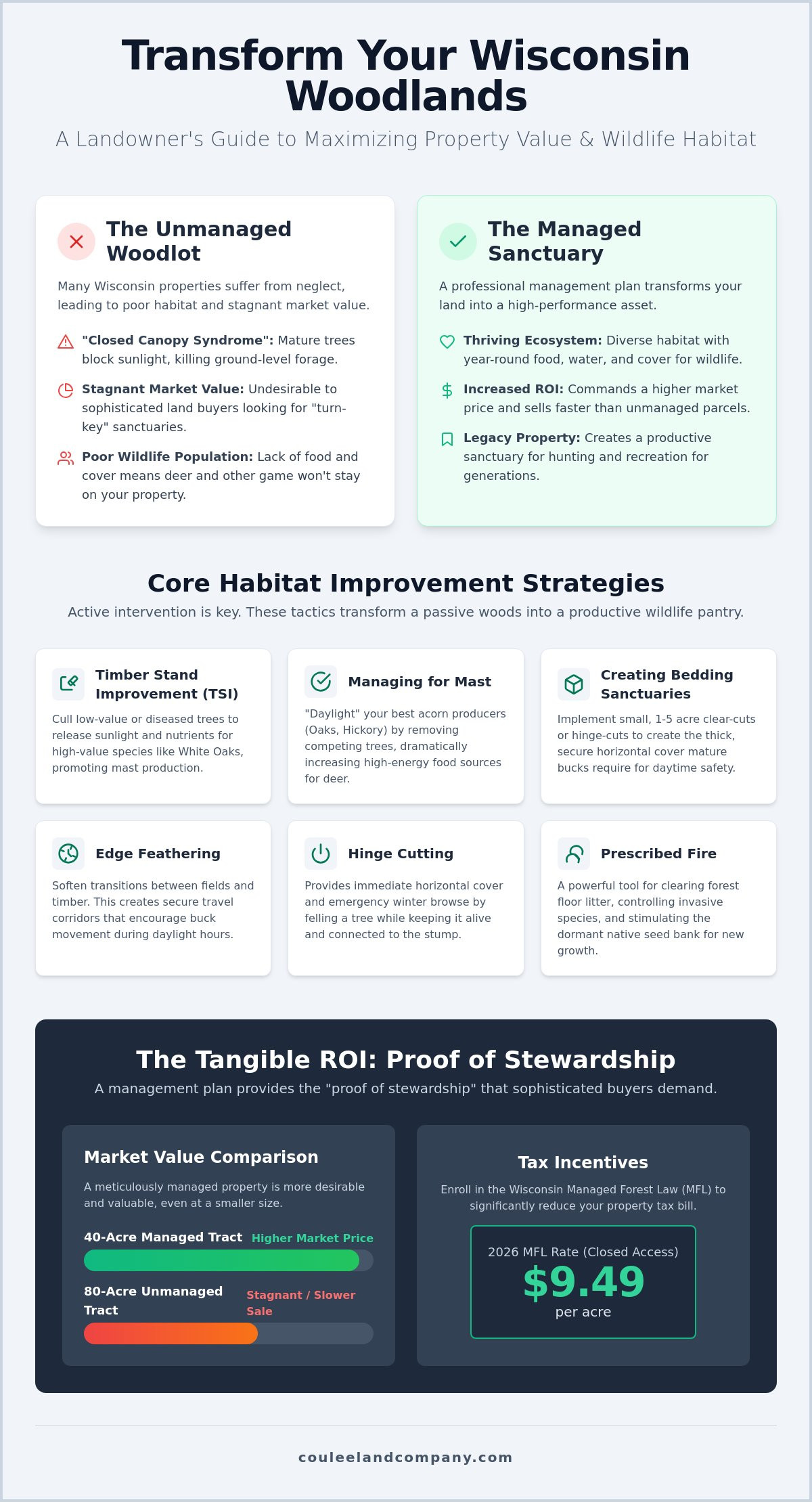
- See why a meticulously managed 40-acre tract often commands a higher market price and faster sale than an unmanaged 80-acre property.
What is a Wisconsin Timber Management Plan for Wildlife?
A timber management plan is a written roadmap designed to manipulate forest succession for the benefit of specific game species. While a standard commercial harvest focuses primarily on immediate stumpage value, a wildlife-centric plan prioritizes long-term habitat quality and the carrying capacity of the land. For 2026, these plans are typically drafted by certified private foresters and approved by the Wisconsin DNR to ensure they meet both ecological and regulatory standards. Integrating these professional strategies is a primary factor in how a timber management plan increases wisconsin property value, as it transforms a passive investment into a high-performance hunting asset.
Many Wisconsin woodlots suffer from “closed canopy syndrome,” where mature trees block sunlight from reaching the forest floor. This lack of ground-level forage is the missing link on most properties. By applying principles of Wildlife Management, landowners can restart the clock on specific areas to create the thick cover and browse that mature bucks require. It’s the difference between owning a scenic woods and owning a productive sanctuary.
The Role of Forest Succession in Habitat Diversity
Diverse age classes are essential for year-round security and forage. “Young forest” components, such as early-succession aspen or thick brush, provide critical whitetail bedding and nesting cover for ruffed grouse. Our Wisconsin land management for wildlife guide offers deeper context on how these varied habitats function together. When your land offers a mix of thermal cover, succulent browse, and hard mast, you create a property that deer don’t want to leave. This structural diversity is a magnet for wildlife and a major selling point for future buyers.
Tax Incentives: Leveraging the Managed Forest Law (MFL)
Enrolling in the Wisconsin MFL program is a strategic move for any serious landowner. It offers substantial property tax reductions, with current rates for land entered in 2005 or later set at $9.49 per acre for closed access. A wildlife-focused plan is perfectly compatible with MFL requirements. You can satisfy the mandate for commercial timber production while specifically targeting harvests that improve hunting quality. This dual-purpose approach is exactly how a timber management plan increases wisconsin property value for sophisticated buyers who demand both low carrying costs and elite habitat.
Core Strategies for Improving Wildlife Habitat Through Timber
Transforming a property from a “pretty woods” into a high-octane hunting tract requires active intervention. This is where the rubber meets the road regarding how a timber management plan increases wisconsin property value. By adhering to the Wisconsin Forest Management Guidelines, landowners can implement Timber Stand Improvement (TSI) to cull low-value species or diseased trees that choke out native growth. Edge feathering further enhances the land by softening harsh transitions between fields and timber, creating secure corridors where mature bucks feel safe moving during daylight hours.
Tactical tools like hinge cutting provide immediate horizontal cover and emergency winter browse by keeping the tree alive while it rests on the ground. For those managing larger acreage, prescribed fire is a powerful method to clear forest floor litter and stimulate the dormant seed bank. These actions ensure your land isn’t just a static landscape but a living, breathing pantry for wildlife. If you’re looking to acquire a tract with this level of potential, exploring our current hunting properties is a great first step.
Managing for Mast and High-Value Browse
Prioritize species like White Oak, Red Oak, and Hickory. These are the primary energy sources for trophy whitetails. “Daylighting” involves removing competing trees from around your best mast-producers to give their crowns full access to sunlight. This practice dramatically increases acorn yields, effectively bringing high-quality food down to a deer’s level by opening the canopy and allowing sunlight to reach the forest floor. Successful landowners don’t just wait for acorns; they actively manage the canopy to ensure a bumper crop every season.
Creating Bedding Sanctuaries in Bluff Country
In the rugged terrain of Buffalo County, strategic bedding is everything. We recommend small, targeted clear-cuts of 1 to 5 acres to encourage the dense, thicket habitat that big deer crave for security. Position these cuts on south-facing slopes or near thermal cover to maximize their effectiveness. Thermal cover is a specific habitat type, such as dense conifers, that provides a survival necessity by shielding wildlife from wind and extreme cold during Wisconsin winters. Creating these sanctuaries is a proven way to increase the holding capacity of your land.
The ROI of Habitat: How a Timber Management Plan Increases Wisconsin Property Value
A documented timber management plan is far more than a regulatory requirement; it’s a strategic asset that builds significant equity. It serves as undeniable “proof of stewardship” for sophisticated buyers who demand a history of intentional land care. This is exactly how a timber management plan increases wisconsin property value. In the current market, a meticulously managed 40-acre tract with established bedding and high-quality forage often commands a higher price per acre than an unmanaged 80-acre tract. Buyers recognize that habitat quality dictates the hunting experience, and they’re willing to pay a premium for the work you’ve already completed.
Periodic timber income from selective harvests can significantly offset the initial purchase price or annual taxes of hunting properties. For additional guidance on optimizing these benefits, the University of Wisconsin-Extension offers excellent Wildlife and Forest Management Resources for private landowners. Specialists like Mike Law understand how to evaluate these improvements during the appraisal process, ensuring that every TSI project and hinge cut is reflected in the final valuation. This expert evaluation is critical for capturing the true market worth of your managed acreage.
The Market for Turn-Key Hunting Properties
In the premium real estate landscape of Western Wisconsin, “turn-key” means the heavy lifting is finished. 2026 buyers are focused on properties where TSI and food plots are already established. They want to hunt high-quality habitat immediately, not wait years for a canopy to open. If you’re preparing to move on to your next project, check out our guide on Selling Hunting Land in Wisconsin to see how established management translates into a faster, more profitable sale.
Working with a Wisconsin Land Specialist Broker
Standard residential realtors often miss the intrinsic value of a well-executed timber plan. They see a stand of trees; we see a mature buck factory. We encourage sellers to document their entire management history when listing their land to provide a clear narrative of the property’s potential. An expert like Bryan Lemke knows how to market these specific forest improvements to a niche audience of serious hunters. How a timber management plan increases wisconsin property value is best demonstrated through specialized marketing that highlights record-breaking wildlife potential and long-term forest health.
Building Your Legacy in the Wisconsin Woods
A strategic timber management plan is the definitive blueprint for any landowner who wants to see more mature bucks while building real equity. By prioritizing Timber Stand Improvement and mastering the nuances of forest succession, you create a property that stands out as a premier sanctuary in the competitive Western Wisconsin market. It’s clear that understanding how a timber management plan increases wisconsin property value is the most effective way to ensure your investment pays dividends both in the field and at the closing table.
As specialists in Buffalo County trophy whitetail land with deep expertise in the Western Wisconsin Bluff Country, we’ve seen firsthand how managed acreage outperforms the rest. Our team is endorsed by industry-leading hunting personalities because we live this lifestyle every day. Whether you’re looking to sell a managed tract or find your next project, we’re here to guide you through every step of the process with authority and diligence.
Ready to find a property with elite habitat potential? Browse our exclusive hunting land listings.
Your journey toward owning a premier wildlife sanctuary starts with a single, intentional step. We look forward to seeing you in the woods.
Frequently Asked Questions
Does a timber management plan mean I have to clear-cut my land?
A professional management plan rarely requires clear-cutting your entire property. Most wildlife-centric strategies focus on selective thinning, timber stand improvement, or small patch cuts that range from one to five acres. These targeted harvests create the early-successional “young forest” habitat that whitetails and grouse require for bedding and nesting without sacrificing the visual appeal of your mature timber stands.
How much does it cost to have a professional forester write a plan in Wisconsin?
The cost for a certified plan writer depends on the total acreage and the specific complexity of your stewardship goals. It’s a strategic investment that often pays for itself through tax savings and increased land equity. Many landowners utilize the Wisconsin Forest Landowner Grant Program (WFLGP), which can provide up to 50% cost-sharing for non-commercial management practices. This professional documentation is a major factor in how a timber management plan increases wisconsin property value by proving the land’s potential to future buyers.
Can I manage my timber for wildlife and still participate in the MFL program?
You can absolutely prioritize wildlife habitat while remaining fully compliant with the Managed Forest Law (MFL) program. The DNR requires a written stewardship plan for MFL enrollment, and a certified forester can tailor that plan to emphasize deer bedding, mast production, and travel corridors. This allows you to enjoy the lowest property tax rates in the state while you actively build a high-value hunting sanctuary.
What is the best time of year to perform timber stand improvement (TSI) for deer?
Late winter is the premier time for TSI projects because trees are dormant and the frozen ground prevents soil compaction. Cutting during the dormant season is critical for preventing the spread of diseases like oak wilt, which is a major concern in the Driftless Region. Additionally, felling trees in February or March provides immediate, high-quality winter browse for deer during the most nutritionally challenging months of the year.