
Last November, a landowner in Buffalo County discovered a neighbor’s new partition fence sat exactly 30 feet inside his timber line, potentially triggering a legal headache that could threaten his property rights. It’s a nightmare scenario for anyone who has invested their heart and soul into a piece of the driftless region. Understanding wisconsin property line laws and disputes isn’t just about legal jargon; it’s about protecting the integrity of your hunting grounds and your family legacy.
You likely believe that a clear deed and a firm handshake should be enough to keep your borders secure. We agree that your land is your sanctuary and shouldn’t be subject to the whims of an encroaching neighbor or common local misconceptions. This guide provides the expert insights you need to command Wisconsin’s boundary regulations, including the 20 year threshold for adverse possession claims and the specific financial obligations outlined in WI Chapter 90. You’ll learn how to identify encroachment early, handle fence cost sharing with confidence, and take the necessary steps to resolve a dispute before it reaches a courtroom. Protecting your dirt is our priority.
Key Takeaways
- Secure your legacy in the Coulee Region by mastering how legally recorded boundaries and plat maps safeguard your land ownership.
- Protect your hunting grounds from the 20-year adverse possession rule by understanding the critical legal pillars that define unauthorized land use.
- Navigate wisconsin property line laws and disputes with confidence by applying the traditional “Right-Hand Rule” to your rural partition fence maintenance.
- Learn the “Self-Help” rule for managing encroaching timber and how the Purple Paint Law provides a superior defense for your property lines.
- Establish a pragmatic plan for conflict resolution using Certified Survey Maps and professional mediation to keep your land investments secure.
Understanding Wisconsin Property Line Laws: The Basics of Ownership
Ownership in the Driftless Area begins with a legal description filed at the County Register of Deeds. These recorded boundaries define your acreage. In Wisconsin, property lines are legal facts, not mere suggestions. The rugged terrain of Bluff Country often creates a disconnect between historical records and modern reality. Original surveys from the 1830s might reference landmarks that disappeared a century ago. While your deed description provides the legal framework, the physical boundary on the ground can vary significantly. Understanding Adverse Possession is vital because long-standing physical markers can sometimes override what’s written on paper if left unchallenged for the statutory 20-year period. This legal complexity makes wisconsin property line laws and disputes a critical topic for any serious landowner in 2026.
To better understand the legal nuances of how boundaries can shift over time, watch this helpful video:
Common Boundary Markers in Rural Wisconsin
Markers in Buffalo County aren’t always shiny metal pins. You’ll find iron pipes, rusted fence wire embedded in old-growth timber, or witness trees notched by surveyors in the early 20th century. Modern suburban pins are precise, but rural markers carry historical weight that Wisconsin courts respect. Don’t rely solely on a digital app. Tools like OnX are excellent for scouting, but they lack the legal authority of a professional land survey. A local surveyor uses high-grade GPS and historical research to pin a line that holds up in a 2026 courtroom. Relying on a phone screen instead of a recorded survey is a recipe for a wisconsin property line laws and disputes headache.
Why Accurate Boundaries Matter for Hunting Land
For those investing in hunting properties, boundary clarity is everything. You’re protecting a high-value asset. In 2024, land prices in prime whitetail corridors reached record highs, making every foot of “edge” valuable. Clear lines prevent unintentional trespassing during the 2026 whitetail season. You don’t want a neighbor’s stand overlooking your best food plot because of a 30-foot discrepancy. Clear, undisputed lines enhance the market value of trophy whitetail land by providing clean title and peace of mind for future buyers. Well-marked boundaries also facilitate better land management, allowing you to plant screens and bedding cover right up to the legal edge of your dirt.
Adverse Possession in Wisconsin: The 20-Year Rule
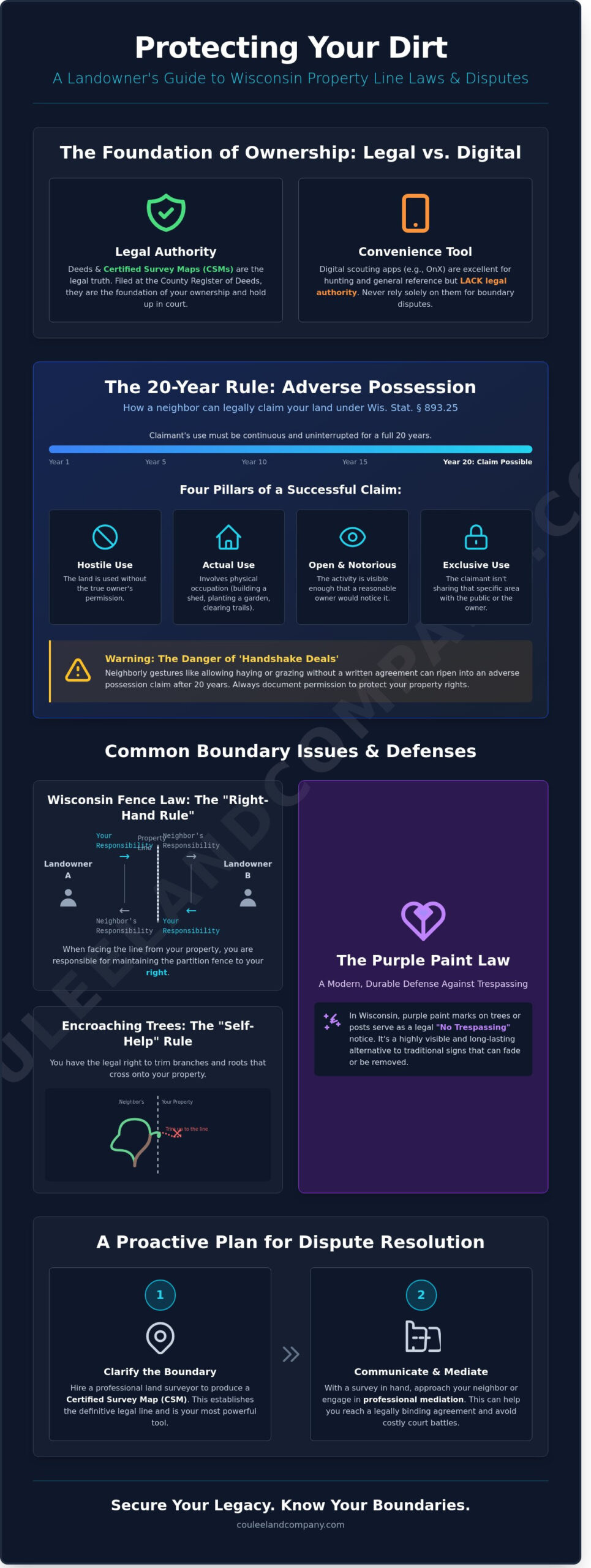
Wis. Stat. § 893.25 is the primary statute governing adverse possession, a legal principle that allows a person to claim ownership of land they do not hold the deed for. This law is central to many wisconsin property line laws and disputes, especially when dealing with generational family farms or large hunting tracts. To successfully claim land through adverse possession, a claimant must prove their use was hostile, actual, open and notorious, and exclusive for a full 20-year period.
Hostile use does not require a confrontation; it simply means the land is being used without the true owner’s permission. Actual use involves physical occupation, such as building a shed, planting a garden, or clearing a trail. Open and notorious use ensures the activity is visible enough that a reasonable owner would notice it. Exclusive use means the claimant isn’t sharing that specific area with the public or the owner. If these conditions persist for 20 years, the legal boundary can shift permanently. In some cases, “acquiescence” occurs, where neighbors treat an incorrect line, like a crooked treeline or a ridge top, as the boundary for two decades. Under Wisconsin law, this mutual mistake can legally redefine the property line without ever stepping into a courtroom.
The Danger of ‘Handshake Deals’ and Old Fences
Handshake deals are part of the culture in Western Wisconsin, but they often create legal vulnerabilities. You might allow a neighbor to hay a back field or graze cattle on a hillside as a neighborly gesture. If that arrangement lasts for 25 years without a written contract, the neighbor could potentially claim that land as their own. The law distinguishes between “license,” which is revocable permission, and a “right” gained through adverse use. Woodlots in the Bluff Country are particularly prone to these issues. A hunter might place a permanent stand ten yards over the line, and if that stand remains for 20 years alongside a cleared shooting lane, it could form the basis of a claim. This is why understanding the specifics of Wisconsin Statutes Chapter 90 is so important, as it outlines the legal expectations for partition fences that often trigger these disputes.
Protecting Your Land from Adverse Claims
Active ownership is the only way to prevent losing ground to a neighbor. You should walk your boundaries at least twice a year, specifically looking for new signage, cleared brush, or moved fence posts. If you discover a neighbor is using your land, you must document it immediately. One of the most effective strategies is providing a written “Permission to Use” agreement. This simple document proves the use is not “hostile,” effectively resetting the 20-year clock. For those managing complex terrain or thick timber, land specialists like Mike Law can provide the boots-on-the-ground expertise needed to identify encroachment risks before they become permanent. If you are looking to secure your legacy, consider browsing our current hunting properties to see how professional land management keeps boundaries secure. Protecting your acreage requires a proactive approach and a clear understanding of the local landscape.
Wisconsin Fence Laws: Chapter 90 and the ‘Right-Hand Rule’
Wisconsin property line laws and disputes often center on the physical barriers that define our legendary Bluff Country acreage. Wisconsin Chapter 90 serves as the primary legal framework for partition fences. It dictates that when two landowners use their land for farming or grazing, they must share the cost of building and maintaining a boundary fence. The law is designed to be pragmatic, ensuring that neither party carries an unfair burden when managing their territory. Our team at Coulee Land Company has seen these laws provide clarity for decades, preventing local friction before it starts.
The ‘Right-Hand Rule’ is the bedrock of Wisconsin fence tradition. To apply it, you and your neighbor stand at the midpoint of your shared boundary line. You look toward your neighbor’s property, and the half of the fence to your right is your responsibility to maintain. Your neighbor is responsible for the half to their right. This simple 50/50 split has settled countless arguments across Western Wisconsin, providing a clear, visual way to divide labor and costs without needing a surveyor on site for every minor repair.
When disagreements arise, the law empowers Town Supervisors to act as ‘fence viewers.’ These officials function as local referees. They visit the property, inspect the terrain, and issue a formal ‘determination’ on who owns which section or how costs should be divided. Their decision is legally binding and can be recorded with the local Register of Deeds. This ensures the agreement stays with the land when it changes hands, protecting future buyers from inheriting a headache.
Partition Fences for Agricultural vs. Recreational Land
In 2026, the distinction between livestock owners and recreational landowners remains vital. Traditionally, if you don’t own livestock, you aren’t strictly required to contribute to a partition fence. However, as more people invest in country homes with surrounding acreage, the lines blur. If your neighbor grazes cattle and you don’t, they generally bear the cost. Understanding Wisconsin property boundaries is essential here, as the cost-sharing mechanism only kicks in when both parties benefit from the enclosure or both keep livestock on their respective sides.
Resolving Fence Disputes Without Litigation
Courtrooms are expensive and often unnecessary for settling boundary issues. The formal process of calling in fence viewers offers a streamlined path to resolution. Once the viewers make their determination, you should record the fence agreement with the Register of Deeds. This binds future owners to the same maintenance schedule. Clear, well-maintained lines are essential when you are selling hunting land in Wisconsin. Buyers in Buffalo County want to know exactly where their sanctuary begins, and a documented fence agreement adds significant value to the transaction by proving the property is managed with diligence.
Trees, Encroachments, and the Purple Paint Law
Boundary lines in the Coulee Region are rarely just lines on a survey map; they’re often defined by the massive timber that characterizes our landscape. Wisconsin follows a strict “Self-Help” rule regarding vegetation. You have the legal right to prune overhanging branches or encroaching roots up to your property line. However, you must stop exactly at the boundary. If your trimming kills the tree or causes it to become unstable, you face significant legal exposure under wisconsin property line laws and disputes.
The stakes are even higher with “Timber Trespass” under Wisconsin Statute 26.09. If you harvest or destroy a neighbor’s tree without express consent, a court can award double or triple the market value of the timber. In Buffalo County, where a single 150-year-old white oak provides essential mast for trophy whitetails, these damages reach five figures quickly. We’ve seen cases where unauthorized clearing for a shooting lane resulted in massive settlements because the landowner didn’t verify the line before starting the chainsaw.
The Purple Paint Law: A Modern Boundary Tool
Since 2014, Wisconsin Statute 943.13 has provided landowners with a cost-effective alternative to traditional “No Trespassing” signs. To comply, you must apply purple paint in vertical lines at least one foot long. These marks must be placed between three and five feet above the ground and spaced no more than 75 feet apart on forest land. This method is superior for large tracts because paint doesn’t fade, blow away, or get destroyed by weather, ensuring your boundary remains visible to hunters and neighbors year-round.
Dealing with Encroaching Structures
Encroachments like a neighbor’s deer stand, a misplaced shed, or a fence that veers ten feet onto your side create “clouds” on a property title. If a neighbor refuses to move a structure, you may need to file an “Ejectment” action. This is a formal legal process to prove ownership and force the removal of the unauthorized object. This reality makes the buyer’s due diligence process critical. We always recommend a fresh survey if there’s any doubt about where a permanent structure sits, as an unresolved encroachment can stall a sale or lead to a lawsuit years after the closing date.
Don’t let a boundary dispute ruin your peace of mind or your property value. Contact our expert land specialists to ensure your investment is protected by local expertise.
Resolving Property Line Disputes in Wisconsin
Resolving property line disputes in Wisconsin requires a tactical approach to protect your investment in Bluff Country. When disagreements arise over a legacy fence line or a shared access point, landowners should follow a structured three-step process to reach a resolution without draining their bank accounts. These conflicts often involve decades of history, making a clear-headed strategy essential for any hunter or farmer.
First, commission a Certified Survey Map (CSM). This document provides the definitive data needed to settle wisconsin property line laws and disputes by establishing physical markers based on legal descriptions recorded at the county level. A professional survey typically costs between $2,000 and $5,000, but it serves as the ultimate piece of evidence. Second, engage in professional mediation. This allows neighbors to negotiate terms before involving high-priced attorneys who charge $300 per hour. Third, if negotiations fail, utilize a Quiet Title action to settle the matter in court. Litigation should remain the absolute last resort for rural neighbors. A typical boundary lawsuit in Western Wisconsin can exceed $25,000 in legal fees and last 18 months, often destroying the community trust essential for successful land management and hunting cooperation.
The Role of a Land Specialist in Dispute Resolution
Land specialists like Bryan Lemke provide a level of expertise that general real estate agents lack. They use historical aerial imagery dating back to the 1930s to prove long-term usage patterns, which is critical for understanding wisconsin property line laws and disputes. Often, a simple ‘Boundary Agreement’ recorded with the county serves as a faster, cheaper alternative to court. This document legally fixes the line where both parties agree it should be, saving everyone thousands in litigation costs and preserving the peace during the November rut.
Preparing Your Land for a Clean Sale in 2026
Smart sellers resolve every boundary question before the sign goes in the ground. Boundary clarity directly impacts appraisals and financing for hunting land, where a 5-acre discrepancy can change a property’s value by $30,000 or more in high-demand areas like Buffalo County. Banks rarely approve loans for 2026 buyers if a neighboring owner contests the acreage or a shared driveway. Ensuring your corners are pinned and your title is clear is the only way to command top dollar. A Quiet Title is a legal action to establish a party’s title to real property against anyone and everyone.
Protect Your Boundary and Your Investment
Navigating wisconsin property line laws and disputes requires more than just a map; it demands a clear understanding of the 20-year adverse possession rule and the specific fence requirements found in Chapter 90. Whether you’re managing a 40-acre parcel or a 500-acre estate, maintaining boundary integrity ensures your land remains a private sanctuary for generations. Buffalo County continues to dominate the Boone and Crockett record books, and protecting the perimeter of these premier whitetail properties is essential for effective land management. We’ve spent years specializing in Buffalo County trophy properties, earning the trust of leading outdoor television personalities through our commitment to diligent land stewardship. Don’t let a simple misunderstanding over a shared fence line or the Purple Paint Law compromise your wildlife capabilities or your property value. Our team brings expert knowledge to every transaction, ensuring your borders are secure and your land is optimized for success. Take the next step toward owning the finest ground in Bluff Country.
Secure your legacy in Bluff Country; view our exclusive hunting land listings today.
Your dream of owning a piece of Wisconsin’s legendary landscape is within reach when you have the right experts by your side.
Frequently Asked Questions About Wisconsin Property Line Laws
What is the ‘Purple Paint Law’ in Wisconsin and how does it affect my property lines?
The Wisconsin ‘Purple Paint Law’ under Wis. Stat. § 943.13 allows you to mark your boundaries with purple paint to signify “no trespassing” to the public. You must place vertical lines at least 8 inches long between 3 and 5 feet above the ground on trees or posts. This provides a durable, visible warning for hunters entering your Bluff Country acreage. It carries the same legal weight as a sign and helps protect your trophy whitetail habitat.
Can a neighbor claim my land if they’ve used it for 20 years in Wisconsin?
A neighbor can legally claim your land through adverse possession if they occupy it for 20 continuous years under Wis. Stat. § 893.25. They must prove their use was hostile, open, and notorious. If they have a written deed that mistakenly includes your land, this timeline drops to 10 years. Understanding wisconsin property line laws and disputes is vital for protecting your 40-acre parcels from these permanent claims. You should check your boundaries every 12 months.
Who is responsible for maintaining a line fence between two properties in WI?
Wisconsin Statute Chapter 90 dictates that neighbors share the cost and maintenance of a line fence equally. If you use your land for grazing or farming, you’re legally bound to maintain the right half of the fence as you face it from your property. This “right-hand rule” has governed Wisconsin farm and timber land since the 1800s. Failing to maintain your 50 percent share can lead to legal disputes and potential liability if livestock escapes into a neighbor’s field.
Can I cut down a neighbor’s tree branches if they hang over my property line?
You have the legal right to trim tree branches that hang over your property line, but you can’t kill the tree in the process. Wisconsin common law allows this self-help remedy to clear views or protect structures. However, if you cross the line to cut the trunk, you could face triple damages under Wis. Stat. § 26.09. It’s best to talk to your neighbor before taking a saw to a 50-year-old oak tree on the boundary.
What should I do if I find a neighbor’s deer stand on my property?
Finding a neighbor’s deer stand on your property is a clear violation of Wis. Stat. § 943.13, which governs trespassing. You should document the stand’s location with GPS coordinates and photos before contacting the owner or local warden. If the stand is within 50 yards of your line, it might be an honest mistake, but unauthorized structures compromise your hunting strategy. Most disputes are settled by providing the neighbor with a copy of your recent boundary survey.
How much does a boundary survey cost for a 40-acre parcel in Wisconsin?
A boundary survey for a 40-acre parcel in Western Wisconsin typically costs between $2,500 and $4,500 in 2026. Prices fluctuate based on the density of the timber, the steepness of the coulees, and the availability of original section corner monuments. Professional surveyors in Buffalo County often charge more for rugged terrain where they must clear brush to establish sightlines. Investing this amount ensures your wisconsin property line laws and disputes are settled with survey-grade precision.
Is a handshake agreement on a property line legally binding in Wisconsin?
Handshake agreements regarding property lines aren’t legally binding in Wisconsin due to the Statute of Frauds. Wis. Stat. § 706.02 requires all real estate transfers or boundary changes to be in writing and signed by both parties. Even if you’ve agreed on a line for 15 years, a new owner can challenge it without a recorded document. Always formalize boundary adjustments through a recorded boundary line agreement to protect your land’s long-term market value.
What are ‘Fence Viewers’ and when do I need to call them?
Fence Viewers are your local town supervisors who act as authorized arbitrators in line fence disagreements. You should call them when you and your neighbor can’t agree on the cost, placement, or maintenance of a shared fence under Chapter 90. They charge a fee, often around $25 to $50 per hour, to inspect the site and issue a binding written decision. Their ruling is filed with the town clerk and stays with the land’s deed for future owners.