
That property tax bill arrives every year, a stark reminder of the cost of owning your personal piece of Wisconsin’s hunting paradise. You’ve likely heard about the Managed Forest Law (MFL) and its potential for significant tax savings, but the complexities can be daunting. For landowners dedicated to enhancing their property for trophy whitetails, understanding the wisconsin managed forest law pros and cons is not just beneficial-it’s essential for making a sound financial and land management decision.
As Wisconsin’s Land & Property Sales Specialists, we’ve guided countless hunters through this exact process. This guide cuts through the confusion. We’ll dissect the critical differences between ‘Open’ and ‘Closed’ designations, explore how a well-managed plan can improve timber health for superior wildlife habitat, and provide a clear analysis of the 2026 exit penalties. Our goal is to equip you with the expert knowledge to confidently decide if the MFL program aligns with your vision for your land, ensuring the tax savings don’t come at the cost of your control.
Key Takeaways
- Determine if the MFL program’s massive tax savings are worth sacrificing total control over your hunting parcel by understanding its core trade-offs.
- This guide breaks down the Wisconsin Managed Forest Law pros and cons from a hunter’s perspective, focusing on how the rules impact habitat management for trophy whitetails.
- Uncover the critical long-term commitment and the severe financial penalties for early withdrawal, which could impact future plans to build, subdivide, or sell your property.
- Find out why enrolling land in the Bluff Country requires special strategic consideration and how a management plan addresses challenges like steep terrain and access.
What is the Wisconsin Managed Forest Law (MFL) Program in 2026?
The Wisconsin Managed Forest Law (MFL) is a landowner incentive program designed to encourage sound forestry practices on private lands, which form the backbone of our state’s timber economy and wildlife habitat. At its core, the program offers a substantial property tax reduction in exchange for a landowner’s long-term commitment to a sustainable timber management plan. As land values continue to rise in 2026, participation is at an all-time high, making a clear understanding of the wisconsin managed forest law pros and cons essential for any serious property owner or buyer.
To see how this program works in practice, this video from a Wisconsin forester offers an excellent overview:
The Core Philosophy: Sustainable Forestry vs. Landowner Rights
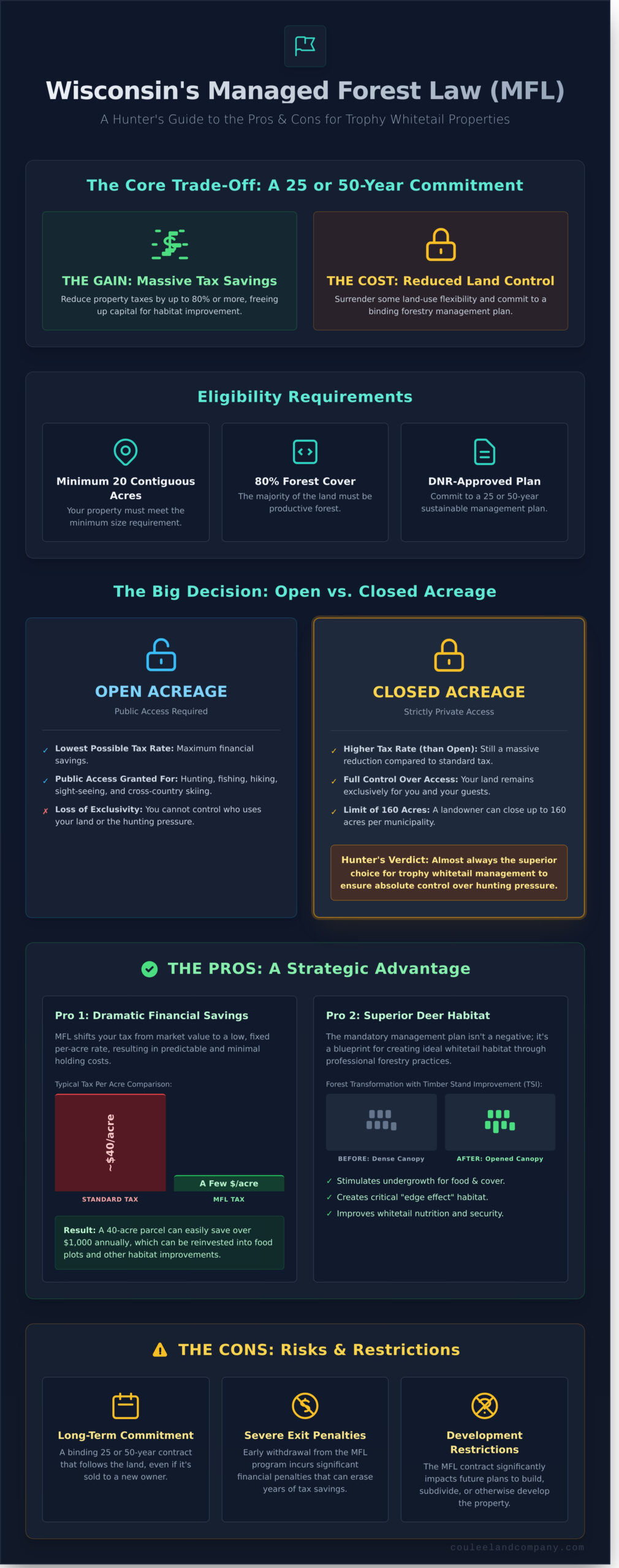
The MFL program is built on a fundamental trade-off: you gain significant financial liquidity today through lower taxes, but you surrender some land-use flexibility for tomorrow. To enroll a property of at least 20 contiguous acres (with 80% forest cover), you must work with a DNR Forester to create a mandatory 25 or 50-year management plan. This plan is your roadmap to practicing effective sustainable forest management, dictating timber harvests and other practices to improve forest health and productivity, which benefits the entire state’s ecosystem and timber industry.
Open vs. Closed Acreage: The Public Access Debate
When enrolling in MFL, you must designate your land as either ‘Open’ or ‘Closed’ to public access, a critical decision with major tax implications. The choice directly impacts how you can manage your property, especially for hunting.
- Open Land: Offers the lowest property tax rate. In exchange, the land must be open to the public for hunting, fishing, hiking, sight-seeing, and cross-country skiing.
- Closed Land: Carries a higher tax rate than ‘Open’ land but keeps the property strictly private, with no public access granted. A landowner can close up to 160 acres per municipality.
For landowners dedicated to cultivating superior habitat for trophy whitetail bucks, the ‘Closed’ designation is almost always the superior choice, as it ensures exclusive access and absolute control over hunting pressure.
The Pros: Why MFL is a Game-Changer for Wisconsin Landowners
For landowners serious about maximizing their property’s potential, understanding the wisconsin managed forest law pros and cons is non-negotiable. The ‘pros’ side of the ledger reveals a program that is far more than a simple tax break; it’s a strategic tool for enhancing both your financial bottom line and your land’s wildlife capabilities. The benefits are tangible, creating a powerful incentive for long-term stewardship that aligns perfectly with the goals of any hunter or outdoor enthusiast.
Financial Incentives and Tax Math
The most immediate and dramatic benefit of enrolling in MFL is the substantial reduction in property taxes, often by 80% or more. Instead of paying the standard ‘Ad Valorem’ tax based on your land’s assessed market value, MFL properties are taxed at a significantly lower, fixed per-acre rate. This creates predictable, rock-bottom holding costs. For example, you might go from paying $40 per acre under standard taxation to just a few dollars per acre in the MFL program. A typical 40-acre parcel in Western Wisconsin can easily see annual property tax savings of over $1,000, money savvy hunters immediately reinvest into habitat improvements like establishing high-protein food plots for whitetail deer.
Superior Deer Habitat through Mandatory Management
Many landowners initially view the mandatory harvest plan as a drawback, but for the serious hunter, it’s a powerful advantage. This isn’t clear-cutting; it’s strategic Timber Stand Improvement (TSI) guided by a professional forester. These required thinnings open the forest canopy, allowing sunlight to stimulate the undergrowth and create the critical ‘edge effect’ and early successional growth that mature whitetails require for security and nutrition. This synergy between MFL practices and effective whitetail land management is undeniable. Furthermore, your MFL plan will identify and prioritize high-value mast-producing trees, ensuring your property’s most important natural food sources-like mature white and red oaks-are protected and enhanced for future generations of trophy bucks.
Ultimately, the MFL program forces a long-term vision that rewards landowners twice: first with immediate tax relief, and second with a healthier, more productive forest that holds more game and produces higher-value timber in the future.
The Cons: The Restrictions and Risks You Need to Know
While the tax savings of the Managed Forest Law are significant, they come at a steep price: your autonomy. For landowners who prize total control over their property, especially those managing for trophy whitetails, the restrictions can be a deal-breaker. A thorough review of the wisconsin managed forest law pros and cons reveals that the “cons” are heavily weighted toward long-term commitment and loss of flexibility.
Before enrolling your cherished piece of Bluff Country, you must understand that you are signing a legally binding contract with the state for 25 or 50 years. This partnership comes with serious limitations:
- Loss of Total Control: Your forest management plan, approved by the DNR, dictates your actions. You cannot harvest timber, clear a new food plot, or even cut extensive trails outside of this plan without state approval.
- Mandatory Cutting: The plan will require you to conduct timber harvests at specific times. You must proceed with the cut, even if timber prices are at rock bottom, potentially forcing you to sell your assets at a loss.
- Strict Building Restrictions: The MFL program severely limits new construction. Any plans for a new cabin, pole shed, or permanent deer stand must be carefully considered, as they may be prohibited on enrolled acreage.
- The Withdrawal Tax: Exiting the program early triggers a massive penalty, often making it financially impossible. This tax is substantial enough to deter potential buyers who aren’t interested in forestry, effectively locking you into the contract.
Navigating the DNR Oversight and Paperwork
Working with the DNR means your land management goals must align with theirs. While state foresters are knowledgeable, their primary objective is sustainable forestry, which can conflict with a hunter’s desire to create a sanctuary with minimal disturbance. The required paperwork, like cutting notices and harvest reports, adds another layer of bureaucracy to managing your own land.
The Financial Trap: Withdrawal and Yield Taxes
The financial penalties are the sharpest teeth in the MFL program. Beyond the daunting withdrawal fee, you will pay a 5% yield tax on the value of all timber harvested. These costs directly impact your property valuation and marketability, as a buyer inherits your MFL obligations. Understanding these financial realities is the most critical part of weighing the wisconsin managed forest law pros and cons for your specific situation.
MFL in the Bluff Country: Strategic Considerations for Western WI
Nowhere are the wisconsin managed forest law pros and cons more distinct than in the legendary Bluff Country of Western Wisconsin. The steep, rugged terrain of Buffalo County and its surrounding ridges presents a unique set of challenges and opportunities for landowners. A standard MFL plan won’t cut it here; success requires a strategic approach that balances timber management, wildlife enhancement, and long-term property value.
The sheer topography of the Driftless Area is a primary factor. MFL management plans must incorporate specific practices for erosion control on steep hillsides and address the logistical challenges of timber harvesting on bluffs. Access is everything. For the serious hunter, one of the most powerful MFL strategies is the careful placement of ‘Closed’ acreage. By designating up to 160 acres as private, you can strategically protect critical top-access routes to your prime treestand locations, ensuring your hunting sanctuary remains undisturbed while the rest of the land generates income and tax benefits.
Terrain and Timber: The Driftless Area Advantage
The north-facing slopes of these ridges grow some of the world’s most valuable hardwoods, including Black Walnut and White Oak. A well-crafted MFL plan can maximize the health and value of these stands. However, the program’s regeneration requirements can be difficult to meet in areas with high deer density-a common reality in Buffalo County. Your plan must be customized to include wildlife-friendly harvest techniques and potentially deer exclusion practices to ensure young trees survive and thrive.
MFL and Property Resale Value
The impact of MFL on the market for Buffalo County WI land for sale is nuanced. Sophisticated investors often see an existing MFL plan as a significant asset, appreciating the reduced tax burden and professional forestry guidance. Recreational buyers, however, may be hesitant about the ‘Open’ land requirements. Successfully conveying the benefits of a well-structured plan to a prospective buyer is critical. Highlighting the lower holding costs and improved habitat can turn a perceived negative into a powerful selling point. This is where expertise matters. An MFL-savvy broker like Mike Law or Bryan Lemke can expertly navigate these details, ensuring you realize the full value of your managed property during a sale.
Is MFL Right for You? A Decision Framework for 2026
The Managed Forest Law is a powerful tool for Wisconsin landowners, but it’s not a one-size-fits-all solution. Making the right choice requires a clear-eyed assessment of your property, your finances, and your long-term vision. Before committing to a 25 or 50-year plan, walk through this proven decision framework to weigh the wisconsin managed forest law pros and cons for your specific situation.
A strategic evaluation involves five key steps:
- Audit Your Tax Bill: Calculate your current property tax liability against the potential MFL rates. Understand the exact dollar-for-dollar savings you stand to gain annually.
- Review Your 10-Year Goals: Be brutally honest. Do you have any plans to build, subdivide, or sell a portion of the property? MFL enrollment places significant restrictions on development and can trigger substantial penalties for early withdrawal.
- Evaluate Your Timber: Is your timber mature enough for a commercially viable harvest? An MFL plan will mandate cuts, and timing is critical for maximizing both forest health and financial return.
- Consult a Land Specialist: MFL enrollment can impact a property’s market value. A specialist who understands the Bluff Country sub-market can advise you on how buyers perceive MFL land in your specific area.
- Interview a Private Forester: Not all management plans are created equal. Find a forester who understands your goals-whether that’s creating superior bedding cover for trophy whitetails or promoting oak regeneration-and can draft a plan that prioritizes wildlife capabilities over just board feet.
When to Say Yes to MFL
For the ‘Legacy Landowner’-someone holding property for long-term family enjoyment, hunting, and habitat improvement-MFL is often a perfect fit. The tax savings can be substantial, effectively offsetting the holding costs of high-value parcels like premier waterfront properties. Consider a 160-acre legacy farm in Buffalo County: by enrolling, the owner saved over $4,000 annually while using the mandatory timber stand improvement (TSI) to double the acreage of secure bedding cover for deer.
When to Avoid Enrollment
If you’re a ‘Short-Term Investor’ looking to flip a property within 5-10 years, the restrictions and withdrawal penalties of MFL make it a non-starter. Likewise, landowners with aspirations to build an extensive country home or develop multiple building sites will find the program’s limitations too restrictive. For parcels under 40 acres, the tax benefit may not be significant enough to justify the loss of control and administrative burden that comes with the program.
Ultimately, a careful analysis of the wisconsin managed forest law pros and cons is the mark of a truly savvy landowner. If you need help analyzing your property’s potential, the specialists at Coulee Land Company are ready to assist.
The Final Verdict: Is MFL Right for Your Wisconsin Hunting Property?
The Wisconsin Managed Forest Law program presents a powerful opportunity for landowners, offering substantial tax relief in exchange for a commitment to sustainable forestry. However, this decision carries significant weight, balancing financial incentives against critical obligations like mandatory timber harvests and potential public access. Ultimately, weighing the wisconsin managed forest law pros and cons is not just a financial calculation; it’s a strategic decision about the future of your hunting legacy and land management goals, especially in the unique terrain of the Bluff Country.
Navigating these complexities requires specialized expertise. The team at Coulee Land Company lives and breathes this world. As Wisconsin’s Land & Property Sales Specialists, endorsed by leading outdoor television personalities, we possess unparalleled expertise in MFL land transfers and valuations, particularly for the Buffalo County trophy whitetail properties that define a hunter’s dream. Ready to buy or sell MFL land in Wisconsin? Contact Coulee Land Company today. Let us help you make the confident, informed choice that secures your piece of Wisconsin’s legendary hunting heritage for generations to come.
Frequently Asked Questions About Wisconsin’s Managed Forest Law
Can I build a house or cabin on land enrolled in MFL?
Generally, you cannot build new structures on land actively enrolled in the MFL program. When first enrolling a property, you can exclude up to five acres for existing or future buildings. If your land is already in the program and you decide to build, you must withdraw that specific acreage. This action will trigger a withdrawal tax and a penalty, so it’s a significant financial decision that requires careful planning with your DNR forester and a trusted land specialist.
What happens to the MFL status when I sell my Wisconsin land?
Understanding the Wisconsin Managed Forest Law pros and cons is critical when selling, as the MFL order is tied to the land, not the owner. The new landowner inherits the management plan and all its obligations. They must continue to follow the plan or face significant withdrawal penalties. The new owner is required to submit a Report of Transfer (Form 2450-159) to the DNR within 30 days to formally accept the MFL responsibilities and continue the program.
Can I change my land from ‘Open’ to ‘Closed’ after I enroll?
Once your land is designated as ‘Open,’ you cannot change it to ‘Closed’ for the duration of the 25 or 50-year MFL order. This is a binding decision made at the time of enrollment. The only potential path is to withdraw the land from the program, pay all associated penalties and back taxes, and then attempt to re-enroll it as ‘Closed.’ This is a costly and complex process with no guarantee of approval, underscoring the importance of your initial choice.
How much are the penalties for cutting trees without DNR approval?
Cutting trees outside of your approved MFL management plan is a serious violation with substantial financial penalties. You will be assessed a penalty equal to 5% of the timber’s value, known as a yield tax, on the unapproved harvest. This is on top of potential civil penalties for timber theft. Severe or repeated violations can lead the DNR to forcibly withdraw your land from the MFL program, triggering the full withdrawal tax and penalty, which can easily be thousands of dollars.
Does the MFL program expire, or is it permanent?
The MFL program is not permanent; it operates on long-term contracts. Landowners enroll their property for a term of either 25 or 50 years. As the end of your contract approaches, the DNR will notify you of your options. You can choose to re-enroll the land in a new MFL order, let the contract expire and return the land to the standard property tax roll, or withdraw it, though early withdrawal before the term ends still carries a penalty.
Can I still hunt my own land if it is designated as ‘Open’?
Yes, you absolutely retain the right to hunt your own land, even when it is designated as ‘Open’ to the public. The ‘Open’ status simply grants public access for specific recreational activities like hunting, fishing, hiking, and cross-country skiing. Your ownership rights, including your personal right to hunt and manage the property according to your MFL plan, remain fully intact. You are sharing access for specific uses, not surrendering your own privileges on your land.
How do I find out if a property I want to buy is in MFL?
Verifying a property’s MFL status is a key due diligence step for any serious buyer. The easiest method is to use the DNR’s online mapping application, which shows all private forest lands open to public recreation, including MFL-Open parcels. For definitive confirmation on any property, ‘Open’ or ‘Closed,’ you should contact the local DNR forester for the county where the land is located. They can confirm its status and provide details of the binding management plan.
Are there specific tree species I am required to plant under MFL?
The MFL program does not mandate planting specific tree species across the board. Instead, a customized management plan is developed for your unique property by a certified plan writer. This plan is based on your land’s specific characteristics, soil type, and your long-term goals as a landowner. While the plan may require tree planting to reforest an area or improve a stand, the chosen species will be those best suited for the site to ensure a healthy and productive forest.