
For every serious hunter and land investor in Wisconsin, the ultimate challenge is timing the market. Is now the right time to secure that dream property in the Bluff Country, or is this the peak moment to sell your recreational tract for maximum return? Navigating these decisions without a clear compass can mean overpaying or missing a critical opportunity. That’s precisely why we’ve leveraged our deep-rooted expertise as Wisconsin’s Land & Property Sales Specialists to deliver an authoritative forecast on Wisconsin land values per acre 2026, giving you the clarity to act with confidence.
But this analysis goes far beyond typical agricultural reports. We understand that the true value of a prime hunting parcel is driven by far more than soil type and crop yields. In this comprehensive breakdown, you will get our expert forecast for hunting, recreational, and agricultural land. We’ll dissect the unique market drivers that create trophy whitetail hotspots, identify the regions poised for significant growth, and equip you with the insider knowledge needed to make a sound, strategic investment in your outdoor legacy.
Key Takeaways
- Get our definitive forecast for Wisconsin land values per acre 2026 to strategically position yourself in the market, whether you’re buying or selling.
- Uncover the specific attributes that make elite hunting and recreational land a superior investment, often outpacing even the best tillable ground in value.
- Navigate the 2026 market with confidence by understanding how key economic forces, including projected interest rates, will directly influence land financing and prices.
- Pinpoint the best opportunities with our detailed regional analysis, which breaks down value projections from the Northwoods to the prized hunting grounds of Western Wisconsin.
2025 Wisconsin Land Market in Review: Setting the Stage for 2026
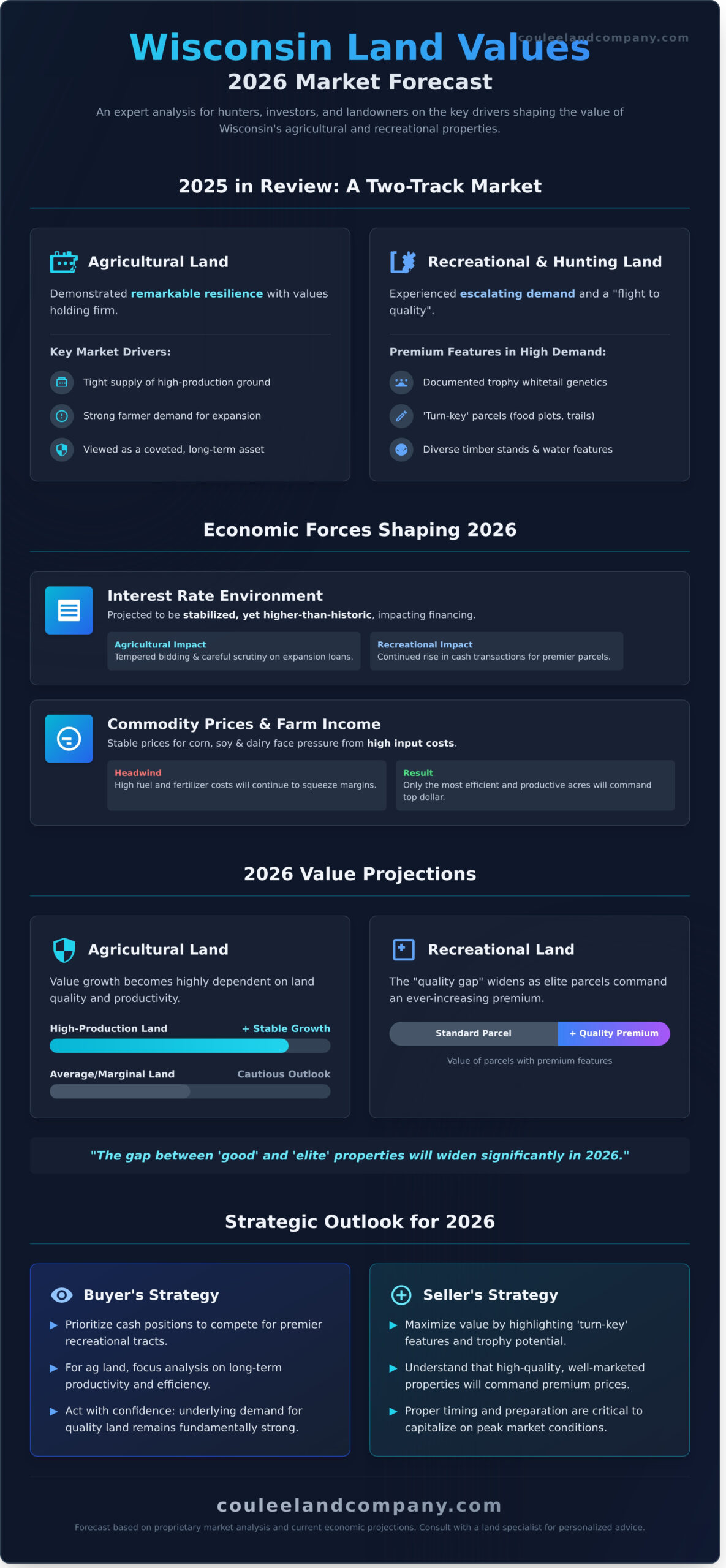
To accurately forecast land values for 2026, we must first understand the powerful currents that shaped the 2025 market. Last year was defined by a distinct bifurcation: agricultural and recreational land marched to the beat of different drummers. While shifting interest rates introduced a new layer of complexity for buyers, creating a more measured sales pace compared to previous years, the underlying demand for quality Wisconsin dirt remained fundamentally strong. This created a nuanced landscape where different property types saw vastly different pressures and opportunities.
To better understand the core factors influencing land prices from both a buyer’s and seller’s perspective, this overview from Market to Market provides excellent context:
Agricultural Land: A Story of Stability
Despite fluctuations in commodity prices for corn and soybeans, Wisconsin’s tillable land market demonstrated remarkable resilience. Reports from the USDA and UW-Madison confirmed that values for quality farmland held firm throughout 2025. This stability was largely a function of tight supply; there simply isn’t enough high-production ground to meet farmer demand for expansion. The deep-rooted legacy of Agriculture in Wisconsin ensures that productive acreage remains a coveted, long-term asset, insulating its value from short-term market volatility.
Recreational Land: The Quest for Quality
On the recreational side, the story was one of escalating demand for premier properties. The flight to quality was undeniable. Buyers showed a distinct preference for ‘turn-key’ hunting parcels-properties with established food plots, trail systems, and proven wildlife capabilities. In the famed Bluff Country, land with documented trophy whitetail genetics commanded a significant premium. Parcels boasting diverse timber stands and critical water features like creeks or ponds were, and continue to be, the most sought-after properties on the market.
This two-track market is the essential backdrop for our 2026 forecast. The drivers for a 160-acre dairy farm are fundamentally different from those for a 160-acre hunting paradise in Buffalo County. Understanding these separate but parallel trends is the key to projecting the wisconsin land values per acre 2026 with accuracy and providing our clients with a superior strategic advantage.
Economic Headwinds & Tailwinds: Key Factors Influencing 2026 Values
Understanding the future of Wisconsin land values requires looking beyond the property lines and into the powerful economic forces at play. A complex mix of national monetary policy, global commodity markets, and federal agricultural programs creates both headwinds and tailwinds for buyers. For those aspiring to own a piece of Wisconsin’s famed bluff country, navigating these factors is paramount. The shrewdest investors will be those who recognize how these dynamics will shape wisconsin land values per acre 2026 and position themselves accordingly.
The Interest Rate Environment
Financing costs remain a critical lever in the land market. Projected interest rate policies for 2026 suggest a stabilized, yet higher-than-historic, borrowing environment. For large-scale farm operators, this means expansion plans will be scrutinized more carefully, potentially tempering aggressive bidding on prime agricultural tracts. For the individual recreational buyer, however, the story may be different. We anticipate a continued rise in cash transactions, particularly for premier hunting parcels, as well-capitalized buyers leverage their position to sidestep financing hurdles and secure legacy properties.
Commodity Prices and Farm Income
The profitability of Wisconsin’s agricultural sector is directly tied to land demand. While the outlook for corn, soybean, and dairy prices in 2026 shows potential for stability, high input costs for fuel and fertilizer will continue to squeeze margins. This dual impact means that only the most efficient and productive acres will command top dollar from farm operators. For recreational landowners, this has a secondary effect: strong farm income makes tillable acreage leased to local farmers a more valuable asset, enhancing the overall return on investment for a hunting property that also generates income.
Government Policy and Conservation Easements
Federal and state programs play a significant role in a property’s utility and value. The next Farm Bill will dictate funding for conservation programs like CRP, which can provide guaranteed income on marginal acres, making a property more attractive. In Wisconsin, the Managed Forest Law (MFL) is a particularly powerful tool, offering substantial property tax reductions for owners who commit to a sustainable timber management plan. For those looking to maximize the wildlife capabilities and long-term value of their timbered land, organizations like the Wisconsin Woodland Owners Association offer essential guidance. Properly leveraging these programs can fundamentally alter a property’s bottom line and is a key variable in forecasting wisconsin land values per acre 2026.
Forecast: Agricultural Land Values Per Acre in 2026
As we analyze the key drivers shaping wisconsin land values per acre 2026, the agricultural sector remains a powerful and stabilizing force. While commodity prices fluctuate, the intrinsic value of productive land holds firm, attracting both legacy farm operators and savvy investors. Our expert analysis, which builds upon foundational USDA data, points toward continued, steady appreciation across all classes of agricultural property, though performance will vary significantly by land type and location.
Prime Cropland (Class I & II Soils)
We forecast that top-tier tillable land, particularly in the fertile southern and eastern corridors of Wisconsin, will command prices ranging from $12,500 to over $16,000 per acre by 2026. These premium values are directly supported by robust cash rental rates, which often serve as a benchmark for what an operator can afford. Competition for these parcels is intense, as they represent the most productive and reliable agricultural assets in the state.
Pasture and Grazing Land
Land best suited for livestock operations is expected to trade in the $4,500 to $7,500 per acre range. The health of Wisconsin’s renowned dairy and beef industries is a primary driver for this market segment. Parcels with good fencing, reliable water sources, and strategic proximity to processing facilities will command a premium, as they reduce operational costs and improve efficiency for producers.
The Investor Outlook
Institutional investors and private funds continue to view Wisconsin farmland as a premier hard asset-a reliable hedge against inflation and market volatility. We project a continued rise in sale-leaseback arrangements, where investors purchase property and lease it back to established operators. This strategy provides farmers with working capital while giving investors a stable, long-term return. Our specialists can help you analyze the ROI of agricultural properties to determine if they align with your portfolio goals.
Beyond the Plow: Forecasting Recreational & Hunting Land Values in 2026
While agricultural land trends provide a baseline, forecasting recreational and hunting land values requires a deeper, more specialized understanding. This is our core expertise. The passion for the outdoors and the pursuit of trophy whitetails creates a market where elite parcels can command prices far exceeding the best farmland. A standard appraisal often misses this crucial element; the true value of these properties lies in their potential to deliver an unparalleled outdoor experience. This passion-driven market is a key variable when forecasting wisconsin land values per acre 2026.
Trophy Whitetail Potential as a Value Multiplier
A property’s ability to produce mature, trophy-class bucks is a powerful value multiplier. This potential is determined by a combination of its location, management history, and quality habitat. Land in renowned areas like Buffalo County, which dominates the Boone & Crockett record books, carries an immense premium. Buyers in 2026 will continue to pay top dollar for proven genetics, a history of low hunting pressure, and established food plots that hold deer year-round.
The Role of Water, Timber, and Topography
Beyond the wildlife, the land’s physical characteristics are critical. The presence of water-whether it’s river frontage, a private pond, or a spring-fed trout stream-adds significant monetary and recreational value. A diverse landscape featuring mature hardwoods for mast crops, thick cover for bedding, and the unique ridges and valleys of Wisconsin’s ‘Bluff Country’ is ideal. This topography creates the natural funnels and travel corridors that are the hallmark of a superior hunting property.
Access, Infrastructure, and Turn-Key Properties
Practical features can make or break a property’s value. Deeded, year-round legal access is non-negotiable, and its absence can render a parcel nearly worthless. In contrast, existing infrastructure like a well-maintained trail system, a rustic cabin, or a pole barn for equipment adds immediate utility and a significant premium. The demand for turn-key recreational properties is escalating, a trend that will be a key driver shaping the premium end of wisconsin land values per acre 2026.
Regional Spotlight: 2026 Land Value Projections Across Wisconsin
A statewide average tells only part of the story. Wisconsin’s diverse landscape creates distinct real estate markets, each with its own set of value drivers and opportunities. For a serious buyer, understanding these regional dynamics is the difference between a good investment and a great one. As we look toward 2026, the character of the land-from bluff to forest to field-will dictate its trajectory. Here is our expert breakdown of the key regions to watch.
The Driftless Area (Bluff Country): The Gold Standard
This is where legends are made. Centered around Buffalo, Trempealeau, and Vernon counties, the Driftless Area remains the undisputed epicenter for trophy whitetail hunting in North America. Its dramatic topography of deep coulees, sharp ridges, and hardwood timber creates unparalleled deer habitat and strategic hunting opportunities. We project continued intense demand and premium pricing for top-tier hunting parcels here, especially those with established food plots and proven herd genetics. This region will continue to set the benchmark for recreational wisconsin land values per acre 2026.
The Northwoods: Water and Wilderness
The allure of the Northwoods is rooted in its vastness and natural beauty. Here, value is driven by two powerful forces: timber and water. Large timber tracts will continue to be a stable asset, offering both long-term appreciation and immediate income potential from sustainable harvesting. Simultaneously, the market for lakefront properties and remote, secluded cabins remains robust, fueled by buyers seeking a true wilderness escape. The dual-use nature of these properties-offering both recreational enjoyment and commodity value-provides a solid foundation for price stability and growth.
Central Sands & Southern Farmland: A Mixed Bag
Wisconsin’s agricultural heartland presents a more varied and accessible market. Prime tillable land values will remain stable, closely tied to agricultural commodity prices and rental rates. However, for the discerning hunter, this region holds incredible “sleeper” potential. Wooded parcels and marshlands mixed within the agricultural landscape can produce outstanding wildlife at a more approachable price point. In the southern counties, proximity to urban centers like Madison and Milwaukee will continue to exert upward pressure on land values, creating a competitive market for both recreational tracts and future development.
Ultimately, your ideal property depends on your specific goals. Understanding these regional nuances is the first step toward making a wise investment. For unparalleled expertise in navigating the premier hunting grounds of the Driftless Area, contact the specialists at Coulee Land Company.
Strategic Outlook: What This Means for Buyers & Sellers in 2026
Understanding the forecast for Wisconsin land is one thing; turning that knowledge into a successful transaction is another. As we look toward 2026, the market won’t simply be a “buyer’s” or “seller’s” market-it will be a specialist’s market. The stable yet competitive environment means that premier recreational and hunting properties will continue to command top dollar, rewarding well-positioned sellers. For buyers, opportunities will exist, but they must be pursued with strategy and speed. Navigating the nuances of the projected wisconsin land values per acre 2026 will require expert guidance to either find true value or maximize your sale price.
Advice for Land Buyers in 2026
For those looking to purchase their piece of Wisconsin’s famed Bluff Country, preparation is paramount. High-quality hunting tracts with proven wildlife capabilities will attract significant interest, so you must be ready to act decisively. This starts with having your financing pre-approved, signaling to sellers that you are a serious, capable buyer. More importantly, aligning with a true land specialist gives you a critical advantage, providing access to off-market properties and the expertise to evaluate a parcel’s potential far beyond its listing price. Let our team guide you through the land buying process.
Guidance for Land Sellers in 2026
In 2026, achieving the highest possible return on your land investment hinges on superior marketing. It’s no longer enough to just list acres and a price; you must tell the story of your property’s unique legacy and potential for trophy whitetails. Professional assets-including aerial drone footage, detailed mapping of food plots and access points, and stunning photography-are essential to capture a buyer’s imagination and justify a premium price. Pricing correctly from the start is crucial, and that requires a deep, authentic understanding of the current wisconsin land values per acre 2026. Get a no-obligation property valuation from Wisconsin’s experts.
Your Strategic Advantage in the 2026 Wisconsin Land Market
As we look toward 2026, the Wisconsin land market presents a complex landscape of both opportunity and challenge. The key takeaway is that while broad economic factors will influence the market, the deep-seated demand for quality agricultural land and premier recreational tracts-especially in the famed Driftless Area-remains a powerful driver of value. Understanding these nuances is the difference between a good investment and a great one, as the definitive forecast for wisconsin land values per acre 2026 ultimately hinges on property-specific attributes.
Whether you’re aiming to capitalize on your investment or acquire the legacy property of your dreams, an accurate valuation is your most critical tool. As Wisconsin’s #1 Land & Property Sales Specialists, our dedicated team of passionate hunters and land experts offers unmatched expertise in Buffalo County and beyond. We don’t just sell land; we live and breathe it. To make an informed decision with confidence, partner with the pros who know Wisconsin soil.
Thinking of Selling in 2026? Get a Professional Land Valuation.
Frequently Asked Questions About Wisconsin Land Values
How much is an acre of wooded land worth in Wisconsin in 2026?
Forecasting precise wisconsin land values per acre 2026 for wooded parcels is complex, but we project a range of $4,500 to over $9,000. The highest values are consistently found in premier hunting regions like the Bluff Country, where proven trophy whitetail potential, timber quality, and good access dictate the price. A property with established food plots, a solid trail system, and a history of mature bucks will always command a premium, reflecting its superior recreational and long-term investment quality.
Are Wisconsin land prices expected to decrease in 2026?
A significant decrease in Wisconsin land prices is highly unlikely in 2026. The demand for high-quality recreational and hunting properties continues to outpace the limited supply of available land. Parcels are a tangible asset that serve as a proven hedge against economic inflation, and the desire to own a private piece of Wisconsin’s outdoors is stronger than ever. We anticipate continued market stability and steady appreciation, especially for properties with superior wildlife habitat.
What part of Wisconsin has the most expensive land per acre?
For premier hunting ground, nothing surpasses the famed “Bluff Country” of Western Wisconsin. Counties like Buffalo, Trempealeau, and Vernon consistently command the highest per-acre prices for recreational land due to their world-class trophy whitetail genetics and breathtaking topography. While development pressure drives up prices near urban centers, this is the heart of Boone and Crockett territory, and the land values here reflect that legendary status among serious hunters and land investors.
Is buying land in Wisconsin a good long-term investment?
Absolutely. Buying land in Wisconsin is a superior long-term investment because it is a finite, tangible asset that you and your family can enjoy while it appreciates. Unlike volatile paper assets, a quality parcel provides a lasting legacy-a private retreat for hunting, recreation, and creating memories. The inherent value of private land, coupled with strong and steady demand from passionate outdoorsmen, makes it one of the most reliable and rewarding investments you can make.
How does the presence of Chronic Wasting Disease (CWD) affect hunting land values?
While Chronic Wasting Disease (CWD) is a critical consideration for herd management, its impact on land values has been less significant than many assume. Demand in prime CWD-affected counties remains exceptionally strong, driven by the proven trophy genetics in these renowned areas. Knowledgeable buyers understand that proactive land and herd stewardship are key. The primary drivers of value remain the quality of the habitat, access, and the overall wildlife capabilities of the property itself.
What’s the difference in value between tillable and recreational land?
The core difference is utility and driver of value. Tillable land value is primarily determined by its agricultural potential-soil productivity ratings, drainage, and expected crop yields. In contrast, recreational land value is dictated by hunting quality, aesthetics, topography, water features, and timber. Often, the most sought-after properties offer a strategic mix of both, where productive tillable acreage is used for income or converted into dynamic food plots to maximize a property’s trophy hunting potential.