
A 170-inch whitetail doesn’t care about a “For Sale” sign; he cares about the pinch points and thermal cover that 90 percent of generic listings fail to mention. You’ve likely spent hours scrolling through wisconsin land for sale, only to find properties that look like “dead” land once you finally walk the ridges. It’s frustrating to navigate the complexities of Managed Forest Law (MFL) or guess if a specific valley actually holds consistent deer movement. We understand that you aren’t just looking for dirt; you’re looking for a legacy.
We’ve spent over 20 years boots-on-the-ground in Buffalo and Trempealeau counties to ensure you don’t make a six-figure mistake. This guide will show you how to evaluate topography like a professional land manager and secure a high-quality property that appreciates as fast as the local buck age structure. We’ll break down the 2026 market trends, tax strategies, and the specific terrain features that define a true Bluff Country trophy tract.
Key Takeaways
- Analyze the 2026 market landscape to distinguish between high-performing recreational tracts and stable agricultural investments.
- Uncover the science behind why Western Wisconsin’s Bluff Country remains the undisputed leader in trophy whitetail production and record-book entries.
- Identify the best Wisconsin land for sale by evaluating “top-access” logistics and the strategic impact of surrounding agricultural practices.
- Learn to leverage the synergy between tillable acreage and wildlife capabilities to create a property that offers both income and elite hunting.
- Understand why working with a specialized land broker is essential for navigating the complexities of high-value acreage in the Mississippi River valley.
Understanding the Wisconsin Land Market in 2026
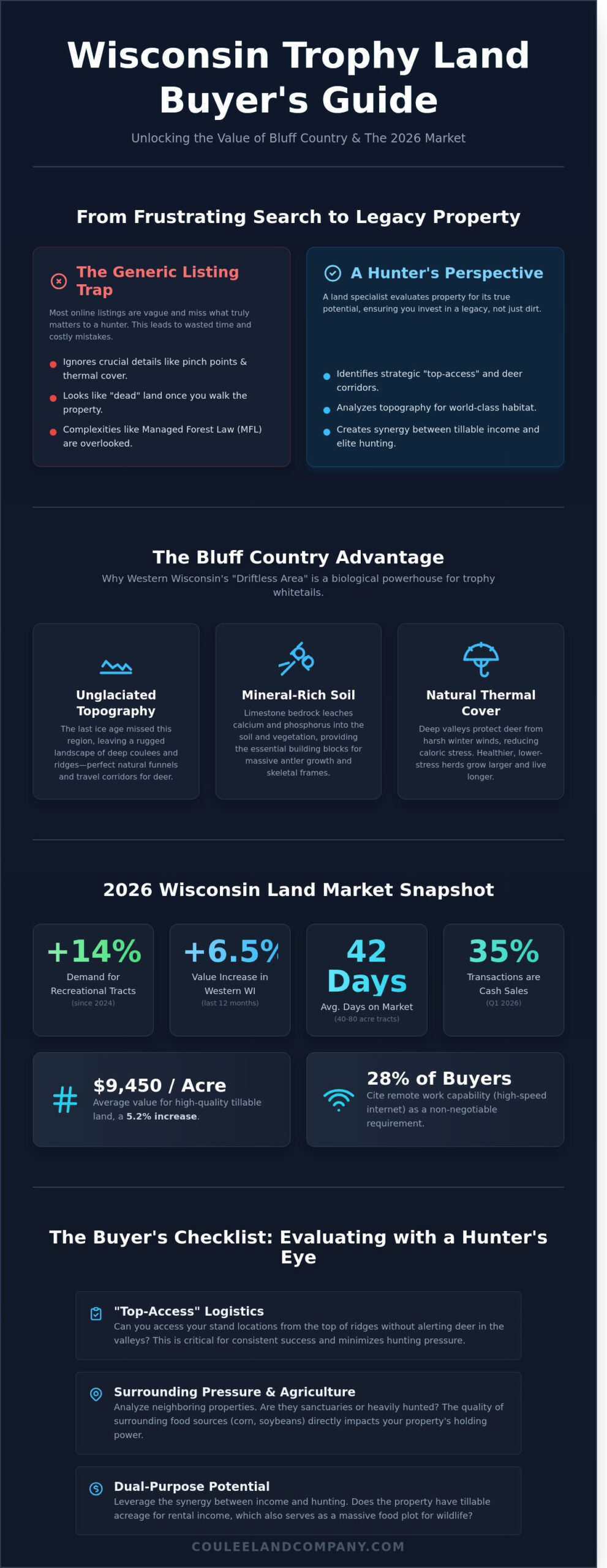
Wisconsin’s landscape offers a diverse profile that caters to specific investment goals, stretching from the 1.5 million acres of the Chequamegon-Nicolet National Forest in the north to the 9 million acres of productive cropland in the south. Searching for wisconsin land for sale in 2026 requires an understanding of these regional shifts. We’ve seen a 14% increase in demand for recreational tracts since 2024, driven by hunters seeking legacy properties that offer both seclusion and superior wildlife capabilities. Agricultural land remains a pillar of the state’s economy, but the competition for "dual-purpose" acreage, land that provides both tillable income and trophy whitetail habitat, has reached an all-time high.
Western Wisconsin continues to stand as the premier destination for serious land buyers. This region’s unique topography creates a natural sanctuary for wildlife that you won’t find in the flat plains of the Midwest. Investors recognize that land is a tangible asset. It provides a hedge against inflation that paper assets simply can’t match. With the 2025 year-end reports showing a 4.2% average annual appreciation for Wisconsin acreage over the last decade, the market’s stability is proven.
To better understand the scale and potential of these properties, watch this walkthrough of a premier landholding:
Defining “Bluff Country” and the Driftless Area
The Driftless Area is a biological anomaly. This unglaciated terrain escaped the flattening effects of the last ice age, leaving behind a rugged landscape of deep coulees and limestone ridges. These vertical elevation changes create thermal cover and travel corridors that produce world-class deer. Buffalo County remains the epicenter of this region, consistently dominating the Boone and Crockett record books. Owning a piece of Bluff Country isn’t just a real estate transaction. It’s an entry into a lifestyle defined by the sunrise over a mist-filled valley and the challenge of managing a timber stand for the next generation.
2026 Market Outlook for Land Buyers
Inventory levels in 2026 have tightened as long-term holders recognize the increasing scarcity of high-quality parcels. The expansion of high-speed fiber-optic internet into rural townships has transformed the market, with 28% of rural land buyers in 2025 citing remote work capability as a non-negotiable requirement. This shift has turned seasonal cabins into year-round residences, bolstering property values in previously isolated areas.
Current market data shows:
- Recreational land values in Western Wisconsin rose by 6.5% in the last 12 months.
- Average days on market for premium 40 to 80-acre tracts has dropped to 42 days.
- Cash sales accounted for 35% of all rural land transactions in the first quarter of 2026.
According to the 2026 Census of Agriculture, Wisconsin land values for high-quality tillable acreage reached an average of $9,450 per acre, reflecting a 5.2% increase from the previous reporting cycle. This growth underscores why wisconsin land for sale remains the gold standard for those looking to secure their financial future while enjoying the best hunting the country has to offer.
The “Bluff Country” Advantage: Why Western Wisconsin Dominates
Western Wisconsin isn’t just scenic; it’s a biological powerhouse for whitetail deer. The Mississippi River valley creates a unique environment that consistently produces world-class bucks. This success starts with the soil. The Driftless Area is rich in limestone, which leaches calcium and phosphorus into the local vegetation. These specific minerals are the building blocks for massive skeletal frames and heavy antler growth. When you evaluate wisconsin land for sale in this region, you aren’t just buying dirt. You’re investing in a geological advantage that most of the country simply cannot replicate.
The science of the “Bluff Country” extends to the micro-climates found within the coulees. These deep valleys protect deer from the harsh winds that sweep across the flat prairies of the Midwest. This shelter reduces caloric stress on the herd during the winter months. Healthy, unstressed deer grow larger and live longer. Our team at Coulee Land Company understands that these biological factors are exactly what make Western Wisconsin the premier destination for serious land buyers.
Buffalo County: The Ultimate Prize
Buffalo County holds a legendary status among hunters. It’s the top-producing county in the United States for Boone and Crockett record-book entries. This isn’t a recent trend or a statistical fluke. Data from the last several decades confirms that Buffalo County consistently outpaces every other region in North America for trophy quality. This consistent performance has created the “Buffalo County mystique,” a reputation that significantly bolsters property resale values. Land here is a blue-chip investment because the demand from the outdoor community never wavers.
Owning a piece of this territory means you’re part of a tradition of excellence. You can explore the specifics of this region on our Buffalo County community page to see current opportunities. Before you head into the field, it’s vital to review the latest Wisconsin deer hunting regulations to stay informed on harvest limits and season dates. The combination of strict local management and superior genetics makes this county the gold standard for any land portfolio.
The Role of Topography in Land Quality
The steep ridges and deep coulees of the bluffs do more than provide a view; they dictate deer movement with surgical precision. Topography creates natural funnels and pinch points that are predictable year after year. While a flat 80-acre farm might allow deer to roam anywhere, a 40-acre bluff property often “hunts” much larger. The vertical gain creates layers of habitat that stack on top of each other, allowing for more bedding areas and travel corridors in a smaller footprint. Key features to look for include:
- South-Facing Slopes: These areas catch the winter sun, providing critical thermal cover and bedding when temperatures drop below zero.
- Bench Systems: These flat shelves located halfway up a bluff act as natural highways for mature bucks who want to travel while maintaining a vantage point.
- Ridge Tops: These serve as primary travel routes and often hold the best locations for food plots near heavy bedding cover.
The complexity of this terrain is why many buyers seek out wisconsin land for sale specifically in the Driftless region. The land does the work for you by funneling deer into specific, huntable locations. It’s a pragmatic choice for the hunter who wants to maximize their success rate. If you’re ready to experience the unique advantages of the bluffs, you can view our current bluff country listings to find a property that fits your vision.
Comparing Land Types: Hunting, Agricultural, and Country Homes
Finding the right wisconsin land for sale starts with a clear objective. You’re either looking for a recreational retreat, a steady income stream, or a permanent homestead. Often, the best properties in the Coulee Region combine these goals into a single investment. Tillable acreage doesn’t just provide a lease check; it acts as a massive food plot for trophy whitetails. According to 2023 data on Wisconsin agricultural land values, the market remains robust because savvy buyers recognize this dual utility. A parcel with 40 acres of high-quality soil can fund your taxes while providing the thermal cover needed to hold mature bucks year-round.
A signature country home in the Driftless Area must balance aesthetics with rugged functionality. You want the panoramic views of the bluffs, but you also need a mudroom designed for heavy boots and a shop large enough for a tractor or UTV. Aesthetics sell the dream, but functionality sustains the lifestyle. We see many buyers prioritize south-facing slopes for home sites to maximize natural light and reduce heating costs during Wisconsin winters.
Waterfront properties along the Mississippi River and its tributaries like the Black or Chippewa rivers offer a unique tier of value. These corridors serve as natural travel routes for wildlife and offer world-class fishing. A property with direct water access or a trout stream running through it typically commands a 20% to 35% premium over landlocked parcels. This isn’t just about the view; it’s about the diverse ecosystem that water creates on your doorstep.
Hunting Land vs. Investment Timber
Many buyers overlook the financial benefits of standing timber. Balancing habitat management with sustainable harvesting ensures your woods stay healthy and profitable. The Managed Forest Law (MFL) is a vital tool for Wisconsin landowners. It can reduce property taxes by nearly 80% for those who follow a certified management plan. This program makes owning large tracts of wisconsin land for sale significantly more affordable for the average hunter. You can explore these opportunities in our current hunting properties listings.
Rural Residential: The Best of Both Worlds
Moving to the country requires looking under the hood of the property. Infrastructure costs for a new build on raw land can quickly exceed $35,000 for a basic well, septic system, and power hookup. Buying a turnkey home often saves significant time and capital. Turnkey properties also allow you to enjoy the land from day one rather than spending your first three seasons managing contractors. Our curated list of country homes for sale features established sites where the heavy lifting is already finished, letting you focus on the hunt or the harvest.
The Buyer’s Checklist: Evaluating Property with a “Hunter’s Eye”
When you evaluate wisconsin land for sale, you aren’t just looking at acreage and price points; you’re analyzing a biological system. A property that looks beautiful on a summer afternoon might be a tactical nightmare during a November rut. Success starts with access. Top-access properties are the gold standard in the Bluff Country of Western Wisconsin. They allow you to slip into a ridge-top stand while the morning thermals pull your scent upward and away from the bedding areas in the valley. Bottom-access often forces you to walk through the very zones where deer congregate, potentially blowing out the entire valley before the sun even rises.
Neighboring land use dictates how deer will utilize your specific parcel. If the adjacent 200 acres consists of standing corn and soybeans, your property’s value lies in its ability to provide thick, high-stem-count security cover. Conversely, if you’re surrounded by dense timber, a well-placed 2-acre food plot becomes a powerful magnet. Examine the water sources closely. While a large creek is a great feature, a small, secluded natural spring or a hidden pond site often provides better “kill-site” potential because it concentrates movement into a predictable, small radius.
Food plot potential isn’t just about finding a clearing. You need to verify the soil quality. Wisconsin’s Driftless Area can vary wildly in soil composition. A soil pH of 6.5 to 7.0 is your target for high-protein crops like clover or alfalfa. If the soil is too acidic, sitting below a 5.5 pH, you’ll need to account for the cost of hauling tons of lime into remote locations. Always look for “soft edges” where timber meets clearings, as these 20-foot transition zones are where mature bucks feel most comfortable during daylight hours.
Strategic Scouting and Mapping
Modern land buying requires more than a pair of boots; it requires LiDAR technology. These high-resolution maps strip away the leaf canopy to reveal hidden benches, old logging roads, and micro-topography. You’re looking for “wind-leeward” ridges. Mature bucks frequently bed on the downwind side of a ridge, just below the crest. This allows them to smell anything approaching from behind while seeing everything in the valley below. You must walk the land with a specialist who understands these nuances. A property might look great on a flat map, but a 60-degree slope can make 30% of that acreage virtually unusable for hunting or management.
Legal and Regulatory Due Diligence
Rural Wisconsin counties like Buffalo, Trempealeau, and Vernon have specific zoning laws that can impact your plans. If you intend to build a cabin, you must verify the “Managed Forest Law” (MFL) status of the property, as this significantly affects both your taxes and your right to restrict public access. Check for existing easements that might grant neighbors or utility companies access across your best bedding thickets. Our team provides expert buyer services to ensure that mineral rights, property lines, and building permits are fully vetted before you sign. We don’t just find you a piece of dirt; we find you a secure investment.
Don’t settle for a generic real estate experience when you can work with the specialists who live and breathe the land. If you’re ready to find a property that performs as well as it looks, contact our team of land specialists today to start your search.
Why Partner with a Wisconsin Land Specialist?
Buying a residential home requires a standard realtor, but securing high-quality wisconsin land for sale demands a specialist who understands topography, soil health, and wildlife behavior. A generic agent often lacks the field experience to identify a property’s true potential for land management or trophy whitetail production. Coulee Land Company operates as the “Hunter’s Realtor,” a persona built on the reality that our team spends as much time in the deer stand as we do in the office. We evaluate a 160-acre tract based on thermal cover and pinch points, not just tax records and square footage.
The difference lies in the details that a typical agent misses. We don’t just show you a map; we walk the ridges to identify bedding areas and travel corridors. This boots-on-the-ground approach ensures you aren’t just buying dirt, but investing in a functional ecosystem. Our deep roots in Western Wisconsin allow us to provide insights into local neighborhood dynamics and historical harvest data that you won’t find on a standard listing site. We’ve helped hundreds of clients navigate the nuances of “Bluff Country” real estate, ensuring every transaction is backed by authentic outdoor expertise.
Expert Negotiation in the Land Market
Land transactions often involve complexities that go far beyond a standard closing. We specialize in navigating multi-parcel deals and tax-deferred 1031 exchanges, which are critical for investors looking to preserve capital. Our deep local relationships often uncover “off-market” opportunities before they ever hit the public portals. Whether you are navigating the intricacies of a complex multi-parcel acquisition or a 1031 exchange, Mike Law provides the expert guidance necessary to close high-stakes land deals with total confidence.
Selling Your Legacy: The Coulee Land Process
When it’s time to sell, your property deserves more than a “For Sale” sign and a few cell phone photos. We create customized marketing plans that target the high-net-worth hunting community across the Midwest. Our strategy includes professional drone cinematography and detailed land management breakdowns to highlight the “wildlife capabilities” of your acreage. To see how we position your property for a premium return, visit our seller services page to learn about our signature marketing approach.
Our track record is defined by real-world success stories from the bluffs. Consider these results from our recent transactions:
- Closed a 240-acre trophy tract in Buffalo County at 12% above the initial market appraisal by identifying hidden timber value.
- Facilitated an off-market 400-acre acquisition for a conservation-minded buyer within 14 days of the initial inquiry.
- Successfully managed a three-party 1031 exchange involving agricultural and recreational parcels in Trempealeau County.
- Utilized targeted social media campaigns to reach over 50,000 active hunters for a single signature listing.
Choosing a specialist means you’re working with a peer who shares your passion. We don’t view land as a commodity; we view it as a legacy. Our team understands that the right piece of wisconsin land for sale is a place where memories are made and conservation happens. We provide the pragmatic, results-oriented service you need to navigate the competitive Wisconsin market. Don’t leave your land investment to chance. Partner with the experts who live and breathe the lifestyle they sell.
Secure Your Legacy in the Heart of Bluff Country
Investing in the 2026 market requires more than just a search for acreage; it demands a strategic eye for land that produces results. Western Wisconsin remains the gold standard for trophy whitetail potential, especially in Buffalo County. This region consistently leads the Boone and Crockett Record Book for typical and non-typical entries, making it the most coveted territory for serious hunters. Success in this landscape depends on mastering MFL tax structures and implementing advanced land management strategies that maximize wildlife capabilities. You aren’t just buying dirt. You’re acquiring a managed asset designed for superior performance.
Coulee Land Company stands as the premier authority for wisconsin land for sale, backed by endorsements from leading outdoor television personalities who trust our “hunter’s realtor” approach. We’ve built our reputation on being hands-on guides who understand the specific nuances of these bluffs. Don’t leave your investment to chance when you can partner with specialists who live and breathe this terrain every day. Your piece of the legendary Driftless Area is waiting. View Our Exclusive Wisconsin Land Listings and secure your future in the woods today.
Frequently Asked Questions
Is Buffalo County really the best place for hunting land in Wisconsin?
Buffalo County is the undisputed leader for trophy hunting because it holds over 150 Boone and Crockett whitetail entries. This count exceeds any other county in the United States, making it the premier destination for serious hunters. The unique combination of steep limestone bluffs and fertile valley floors creates the perfect environment for growing world-class bucks. When you buy here, you aren’t just buying dirt; you’re investing in the most proven big buck genetics in the country.
How much does an acre of hunting land cost in Wisconsin in 2026?
Current projections show that quality Wisconsin land for sale will average between $4,500 and $8,500 per acre by 2026. Premium tracts in the Driftless Area or Buffalo County often hit the higher end of that range due to their proven wildlife capabilities. These prices reflect a steady 5% annual appreciation seen since 2023. Factors like established trail systems, tillable acreage, and existing food plots will continue to drive individual property valuations upward.
What is the Managed Forest Law (MFL) and how does it affect my taxes?
The Managed Forest Law is a state program that reduces your property taxes by approximately 80% in exchange for a commitment to sustainable forestry. Landowners enter into 25 or 50-year contracts and must follow a specific department of natural resources management plan. This plan often includes timber harvests that actually improve hunting habitat by creating early successional growth. It’s a powerful tool for land buyers who want to minimize carrying costs while enhancing their property’s long-term timber value.
Can I build a house on land zoned for agricultural or recreational use?
You can build on agricultural or recreational land if you meet the specific township’s minimum acreage and road frontage requirements. In many Western Wisconsin counties, A-1 zoning mandates a minimum of 35 acres for a residential building permit to be issued. You’ll also need a certified soil test to prove the ground can support a private septic system. Always verify the 2024 zoning ordinances with the county land use office before you finalize any purchase agreement.
What should I look for in a land specialist broker?
You should choose a broker who has closed at least 50 land-specific transactions and possesses deep knowledge of soil productivity indexes. A true land authority understands more than just price; they recognize bedding thickets, travel corridors, and thermal cover. Look for a “hunter’s realtor” who uses advanced mapping software like OnX to analyze terrain features. Their ability to evaluate a property’s wildlife potential is what ensures you make a sound investment for your future.
How do I finance the purchase of raw land in Wisconsin?
You finance raw Wisconsin land for sale through specialized agricultural lenders like Compeer Financial or local credit unions that understand rural property values. These lenders typically require a down payment between 20% and 30% with loan terms ranging from 15 to 20 years. Traditional big-box banks often struggle to appraise raw land correctly, so working with a specialist lender is essential. They’ll consider the value of the timber and tillable acreage, which can help you secure better financing terms.
What are the most important features for a trophy whitetail property?
A premier trophy property must have a 3:1 ratio of thick security cover to open food sources to keep mature bucks on the land. You need at least 5% of the total acreage dedicated to high-quality food plots like clover or standing corn. Permanent water sources and south-facing slopes for winter bedding are also critical for holding deer year-round. Without these specific habitat components, your land is just a pass-through for deer instead of a true sanctuary for giants.
Does Wisconsin land hold its value during economic downturns?
Wisconsin land has proven to be a resilient asset, often outperforming the stock market during periods of high inflation or recession. During the 2008 financial crisis, recreational land values in the Bluff Country remained flat or even grew by 2% in certain counties. Because land is a finite resource with high demand from hunters and farmers, it doesn’t suffer the same volatility as residential housing. It’s a tangible investment that provides recreational dividends while its market value remains stable over time.