
The most coveted trophy whitetail ground in the world doesn’t always wait for a traditional listing; it goes to the highest bidder in a matter of minutes. In regions like Buffalo County, where the landscape dominates the Boone and Crockett Record Book with 135 entries, the auction block is where legacies are secured. You likely recognize that a land auction is the fastest way to acquire prime acreage, yet the fear of an “as-is” purchase or the pressure of a 30-day closing can feel paralyzing. It’s difficult to make a six-figure decision when you’re unsure if a property is an absolute sale or has a hidden reserve price, and this wisconsin land auction guide is built to eliminate that uncertainty.
We’ve designed this resource to be your professional roadmap for mastering the 2026 market. We’ll provide the specific due diligence timeline and bidding strategies used by Wisconsin’s land and property sales specialists to help you win. From analyzing soil maps to understanding the unique topography of the Coulee Region, you’ll gain the expert knowledge required to stand your ground and bid with confidence when the gavel falls.
Key Takeaways
- Learn how the 2026 shift toward digital bidding platforms has accelerated the market and how to position yourself for success in this high-speed environment.
- Master the 5-step bidding process with this wisconsin land auction guide, from securing your bidder’s packet to maximizing the 30-day due diligence window.
- Discover how to evaluate topography and whitetail habitat like a professional to identify natural funnels and set your maximum bid on “Bluff Country” tracts.
- Demystify auction financials by learning how to leverage traditional financing and prepare for the 10% non-refundable earnest money requirement.
- Understand why partnering with a land specialist is vital for uncovering hidden property flaws and determining the true market value of prime recreational acreage.
Understanding the Wisconsin Land Auction Landscape in 2026
Owning a piece of Western Wisconsin’s Bluff Country is the ultimate goal for serious hunters and land investors. In 2026, the auction method has become the standard for moving high-quality hunting properties. This wisconsin land auction guide explores why the traditional “for sale” sign is being replaced by digital bid clocks. Auctions provide a transparent, time-bound environment where the market dictates the true value of specialized land.
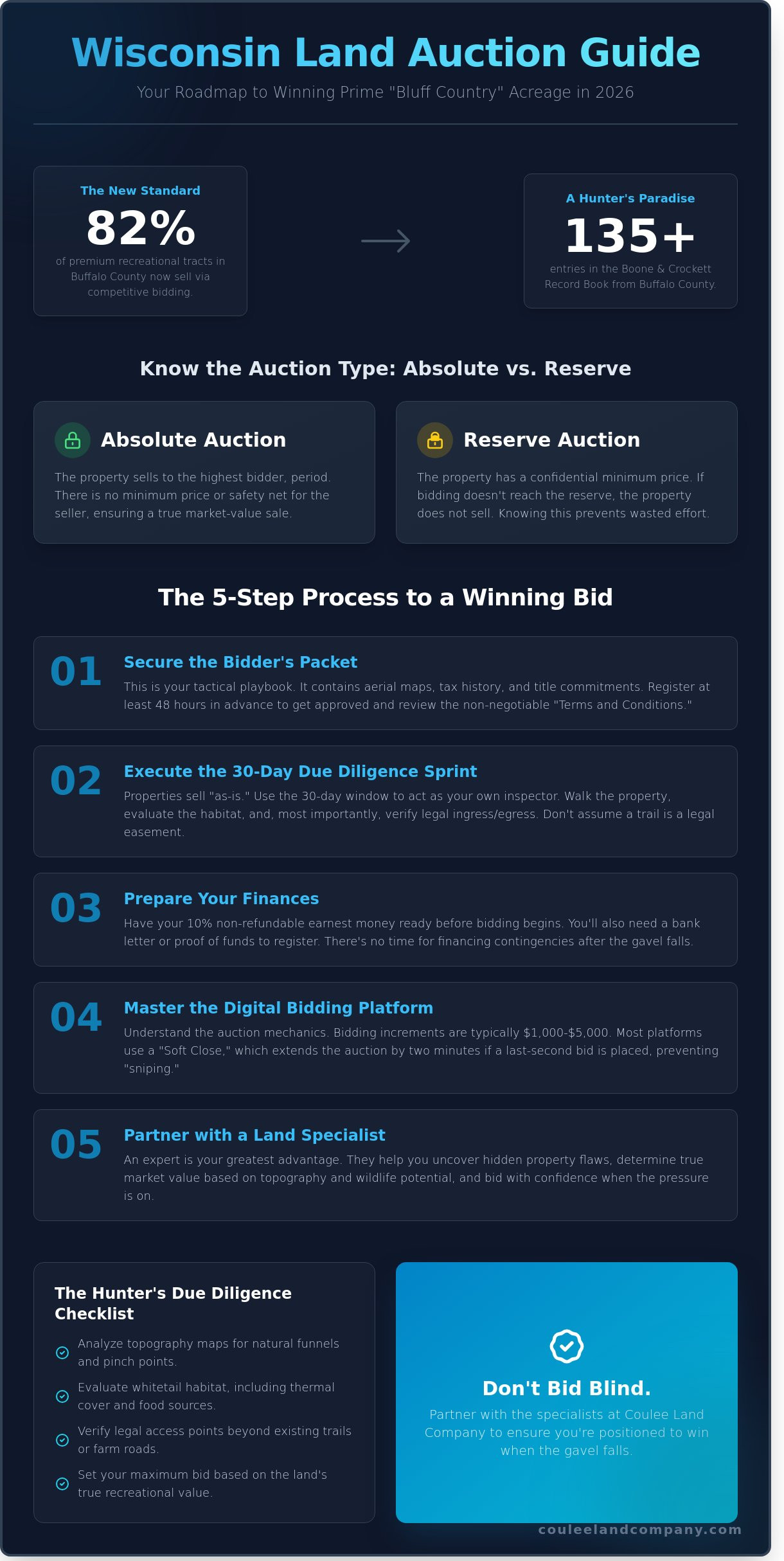
The landscape changed significantly between 2023 and 2026. Data from local land sales shows that 82% of premium recreational tracts in Buffalo County now sell through competitive bidding. This shift happened because auctions eliminate the “wait and see” game. Western Wisconsin’s Bluff Country requires a specialized approach because the land’s value isn’t just in acreage; it’s in the topography, thermal cover, and wildlife capabilities that only an expert can quantify during a fast-paced sale. If you’re looking to enter this market, you must understand the mechanics of the modern auction.
Absolute vs. Reserve: What’s the Difference?
Prospective buyers must identify the auction type before placing a bid. An absolute auction means the property sells to the highest bidder, regardless of the final price. There is no safety net for the seller. A reserve auction includes a minimum price; if bidding stops at $450,000 but the reserve is $500,000, the land doesn’t sell. Knowing the “floor” helps you set a realistic budget and prevents wasted effort on properties that won’t trade below a specific threshold.
The Rise of Online and Hybrid Auctions
You can now secure a legacy property from your deer stand. Most 2026 auctions use hybrid models, combining live event energy with digital accessibility. You’ll need to provide “proof of funds” or a pre-approval letter at least 48 hours before the start. This wisconsin land auction guide emphasizes the technical preparation required to compete effectively.
- Registration: Complete your profile and verify your identity on the specific platform used by the broker.
- Bidding Increments: These are often set at $1,000 or $5,000 intervals to keep the momentum moving.
- Soft Close: If a bid is placed in the final two minutes, the clock resets for another two minutes. This prevents last-second “sniping” and ensures every bidder has a fair opportunity to respond.
Success in the Bluff Country market requires more than just a high bid. It requires a deep understanding of the local terrain and the auction rules that govern these high-stakes transactions. Our team at Coulee Land Company specializes in these nuances, ensuring you are positioned to win when the gavel falls.
The 5-Step Process to Buying Land at Auction in Wisconsin
Buying land at auction isn’t like a traditional real estate listing. It’s a high-stakes race where the finish line is a deed to some of the most coveted hunting ground in the nation. To win in the Bluff Country, you need a plan that accounts for speed and precision. This wisconsin land auction guide details the path from the first flyer to the final signature on the deed.
Step 1: The Bidder’s Packet and Registration
A professional bidder’s packet serves as your tactical playbook. In 95% of successful sales, the packet includes detailed aerial maps, property tax history, and preliminary title commitments. You should register at least 48 hours before the event to ensure your credentials are approved by the auction firm. Review the “Terms and Conditions” with a critical eye. These rules govern the entire transaction and outline the non-refundable nature of the deposit. Technical delays on auction day can cost you the property, so getting your bidder number early is a non-negotiable requirement.
Step 2: The Due Diligence Sprint
Wisconsin auctions typically provide a 30-day window for inspections. During this time, you act as the inspector, surveyor, and appraiser. Because auction properties sell “as-is,” the seller won’t be making repairs or clearing title issues after the gavel falls. Schedule your walk-through to look for more than just trophy buck sign. You must verify legal ingress and egress. Don’t assume an existing tractor trail is a legal easement. Our team of specialists often helps serious buyers identify these critical access points and wildlife capabilities before they ever step into the auction room.
Step 3: Financial Preparation
You must have your earnest money ready before the first bid is cast. In the driftless region, this is usually a flat fee or 10% of the purchase price. Most auctioneers require a bank letter or proof of funds dated within the last 15 days. Remember, there are no financing contingencies in an auction contract. If you’re the high bidder, that money is committed immediately.
Step 4: The Auction Event
The auction event is fast and intense. When the gavel drops, the high bidder is legally bound to the sale. You’ll move immediately to the paperwork table to sign the Purchase Agreement and hand over the earnest money check. It’s a professional environment where clarity and confidence are your best assets.
Step 5: Closing the Deal
The final step is a 30 to 45-day sprint to the closing table. This period allows the title company to finalize the deed transfer and ensure the land is free of encumbrances. While the auction happens in minutes, this final month ensures your investment in the Wisconsin woods is secure for generations.
The Hunter’s Due Diligence: Evaluating Land Quality Before Bidding
A successful strategy in any wisconsin land auction guide begins with understanding that not all acreage is created equal. In the world of elite whitetail hunting, the habitat determines the financial ceiling of your bid. This is especially true in Buffalo County, which holds more than 1,000 entries in the Boone and Crockett record books. You aren’t just bidding on a parcel; you’re investing in a specific biological capacity to produce and hold mature bucks.
Before the auction starts, you must analyze the topography. Use high-resolution contour maps to identify natural funnels where multiple ridges converge into a single valley. These are the high-traffic corridors where big wood meets agricultural edges. Identify bedding areas on south-facing slopes. These spots provide essential thermal cover during the late season, ensuring your property remains a destination when temperatures drop below zero.
Soil quality is another non-negotiable factor. Review USDA soil surveys to confirm the land can support high-protein food plots like clover or brassicas. If the soil is too acidic or rocky to grow quality forage, the land won’t support a trophy herd regardless of the price. Additionally, look at the neighbors. If the surrounding properties are managed for age structure and high-quality habitat, your land’s value increases. A 40-acre tract surrounded by 500 acres of QDM-managed land often outperforms a 100-acre tract in a high-pressure area.
Habitat and Wildlife Capabilities
Ridge-and-valley terrain offers the diverse browse and security cover needed for Boone and Crockett potential. Look for hidden assets like spring-fed seeps or year-round creeks that don’t always appear clearly on a standard plat map. Mature timber, particularly white oak stands, provides immediate mast for wildlife and serves as a financial hedge through future timber harvests. You can learn more about our hunting properties and what makes them elite by studying our curated selection of Western Wisconsin listings.
Access and Topography Challenges
Bluff Country presents unique logistical hurdles. You must determine if you can realistically get a 50-horsepower tractor or a lime truck to the ridge tops. Steep access roads often suffer from heavy erosion, which can lead to thousands of dollars in annual maintenance costs. Many parcels in this region are enrolled in the Wisconsin Managed Forest Law (MFL) program. While this can reduce your property tax burden by 80 percent, it’s vital to know if the land is “Open” or “Closed” to public access before you place your first bid.
Financial and Legal Strategies for Auction Success
Winning a property in the Driftless Area requires more than just a fast hand. It demands a tactical approach to your capital and a firm grasp of Wisconsin real estate law. This wisconsin land auction guide emphasizes that your financial strategy must be set in stone weeks before the gavel falls. You aren’t just bidding on dirt; you’re executing a binding legal contract the moment the auctioneer shouts “Sold!”
Financing Your Auction Purchase
Cash isn’t the only way to win. While many believe you need a suitcase full of hundreds to compete, a large percentage of land buyers in the Coulee Region successfully utilize specialized financing. You must distinguish between a pre-qualification and a pre-approval. A pre-qualification is a surface-level estimate. A pre-approval is a verified commitment from a lender. At a high-stakes auction, only a hard pre-approval letter carries weight.
Big-box banks often shy away from raw land because they don’t understand the value of a trophy whitetail ridge. You’ll find better success with agricultural credit associations or local Wisconsin banks that specialize in land. Before you head to the auction site, read our guide for buyers to understand the specific financial hurdles associated with rural acreage. Having your lender on speed dial during the due diligence period is a non-negotiable step for serious contenders.
The ‘As-Is’ Legal Reality
Wisconsin land auctions operate on an “as-is, where-is” basis. This means there are zero inspection contingencies. If you discover a boundary dispute or a hidden easement after the hammer falls, it’s your problem to solve. You must perform all timber cruises, soil tests, and property line checks before the auction date. Most sellers provide a preliminary title commitment. Review this document with a Wisconsin land specialist to ensure you’re buying clear title rather than someone else’s tax debt or legal headache.
- Earnest Money: Expect to pay a 10% non-refundable deposit immediately after winning. On a $600,000 parcel, you need $60,000 liquid and ready.
- No Contingencies: You cannot add “subject to sale of current home” or “subject to bank financing” clauses to an auction purchase agreement.
- The Walk-Away Number: Bidding psychology is a real threat. Set a firm limit based on the land’s actual wildlife capabilities and stick to it.
The purchase agreement you sign at an auction is a simplified, aggressive version of a standard WB-13 Vacant Land Offer to Purchase. It’s designed to protect the seller’s certainty. Following this wisconsin land auction guide ensures you don’t lose your earnest money due to a lack of legal preparation. When you win, you’re expected to close within 30 to 45 days, making your choice of a diligent legal and brokerage team vital.
Ready to find your own piece of the Coulee Region? View our current hunting land listings to see what’s hitting the market today.
Why Partnering with a Wisconsin Land Specialist is Your Best Bid
Winning at a land auction requires more than a high bid; it demands a deep understanding of the dirt beneath your boots. Our team at Coulee Land Company acts as your boots on the ground. We identify habitat flaws like poor thermal cover or invasive species that others overlook. This wisconsin land auction guide emphasizes that value isn’t just about the gavel price. It’s about the long-term potential of the ridge tops and food plot locations. We see the opportunities for timber stand improvement or better access points that can instantly increase a property’s worth.
We track the data that matters for hunters and investors. In 2026, prime Buffalo County tillable and timber tracts are fetching between $8,200 and $13,500 per acre depending on access and deer density. We don’t just look at house comps. We speak the language of bedding areas and travel corridors. This “Hunter’s Realtor” advantage ensures you aren’t overpaying for a property with limited wildlife capabilities. Our professional network also grants you access to “pocket” auctions and off-market opportunities before they ever hit a public listing site.
Our Buffalo County Expertise
We focus heavily on the Mississippi River “Bluff Country” corridor because it consistently produces the world-class whitetails our clients demand. Explore the unique opportunities in Buffalo County to see why this region remains the gold standard for land ownership. Our specialists, including Mike Law, personally walk every auction tract. We evaluate how the wind hits a specific stand site or how a neighbor’s agricultural practices will impact your hunting success. This granular level of detail is what separates a lucky bid from a strategic investment.
The Coulee Land Company Difference
We stay with you from the initial scouting trip to the final closing signature. Our service doesn’t end when the hammer falls and the paperwork is signed. We help you build a comprehensive land management plan to maximize your new investment immediately. Whether you need to design a new trail system or install a 5-acre clover plot, we provide the resources and expertise to make it happen. Ready to find your dream property? Contact our land specialists today and let’s get to work on securing your piece of Wisconsin.
Claim Your Stake in Wisconsin’s Premier Hunting Grounds
Success at a land sale requires more than a high bid; it demands a strategy rooted in the 5-step process for the 2026 market. You must prioritize due diligence by evaluating wildlife capabilities and timber value before the auctioneer starts the clock. Buffalo County continues to dominate the Boone and Crockett Record Book for trophy whitetail entries, making every acre a high-stakes investment. This wisconsin land auction guide provides the framework you need to navigate these competitive waters with confidence.
Coulee Land Company offers over 25 years of combined land management and brokerage experience to ensure you don’t overpay or overlook critical details. Our team is endorsed by leading outdoor television personalities who trust us to find superior properties in the heart of Bluff Country. We’ve helped hundreds of hunters secure their legacy through expert negotiation and deep regional knowledge. It’s time to put our specialized expertise to work for your future trophy property.
View Our Exclusive Wisconsin Hunting Land Listings
The ridges are calling, and your piece of the Driftless Area is waiting for you to take the lead.
Frequently Asked Questions
Can I get a mortgage for land bought at a Wisconsin auction?
You can use a mortgage to buy auction land, but you must have a firm pre-approval in place before the bidding starts. Most Wisconsin land auctions require a closing within 30 days of the sale date. Since 85% of traditional lenders struggle with this tight timeline, we recommend working with a specialized agricultural or land lender. These institutions understand the “as-is” nature of auction contracts and can move fast enough to meet the deadline.
What happens if I win the auction but can’t close the deal?
If you win the bid but fail to close, you’ll forfeit your entire earnest money deposit to the seller. This deposit is typically 10% of the final contract price and is legally non-refundable. Beyond losing your cash, the seller has the right to sue for “specific performance” to force the sale or seek damages if the property later resells for a lower price. It’s a binding legal commitment that requires 100% financial certainty before you participate.
Are there any hidden fees when buying land at auction in WI?
Fees aren’t hidden if you read the bidder’s packet, but you must account for specific closing costs and title expenses. Buyers typically pay a $30 recording fee per deed in Wisconsin and may share the cost of title insurance with the seller. If the property is enrolled in the Managed Forest Law program, you’ll owe a $300 transfer fee to the Wisconsin DNR to maintain those tax benefits. Always calculate these costs before setting your maximum bid.
How much earnest money do I typically need for a Wisconsin land auction?
You’ll typically need 10% of the high bid price as earnest money, payable immediately after the hammer falls. This wisconsin land auction guide emphasizes that this payment is usually required as a cashier’s check or a personal check backed by a bank letter of guarantee. For a $500,000 piece of Buffalo County timberland, you’d need $50,000 ready to deploy. This deposit proves you’re a serious buyer and secures your interest in the property.
Is it possible to view the property before the auction starts?
Property inspections are almost always allowed during designated preview periods scheduled by the auction house. Most companies set 2 specific weekend dates for public walks, usually 14 days and 7 days before the event. We recommend bringing a land specialist to evaluate the trophy whitetail potential and soil quality during these windows. You won’t have an opportunity to inspect the acreage or negotiate repairs once the bidding process begins.
What is a ‘buyer’s premium’ and how does it affect my final price?
A buyer’s premium is an additional percentage added to your winning bid that covers the auction company’s commission. In the Wisconsin market, this fee is usually 10% of the hammer price. If you bid $100,000, your actual contract price becomes $110,000. You must factor this 10% increase into your maximum budget so you don’t overextend your bank account during the excitement of the auction.
Can I bid on Wisconsin land auctions if I live out of state?
Out-of-state bidders are welcome and currently represent 45% of buyers in the Western Wisconsin region. Most modern auctions use digital platforms like Proxibid to allow real-time participation from any location. You’ll need to register at least 48 hours in advance to verify your identity and provide proof of funds. This accessibility ensures that prime hunting land reaches its true market value among national enthusiasts and investors.
What is the most important thing to look for in a bidder’s packet?
The preliminary title commitment is the most critical document to review in your bidder’s packet. This report reveals any existing liens, easements, or encroachments that could restrict how you use the land. This wisconsin land auction guide recommends looking specifically for Schedule B-II exceptions. These 5 to 10 pages detail exactly what rights you’re buying, such as utility access or existing logging contracts that could impact your long-term land management strategy.