
The most pristine ridge in Buffalo County isn’t truly yours if your name isn’t on the deed. You’ve likely spent years scouting, planting, and passing on young bucks only to have a lease sold out from under you or find a stranger’s truck in your spot on opening morning. It’s a frustrating cycle that many hunters accept as the cost of doing business. When you weigh a wisconsin hunting lease vs buying, you aren’t just looking at a place to park your truck; you’re deciding between a temporary permission slip and permanent control over the landscape.
We understand the drive to secure a piece of the famed Bluff Country where Boone and Crockett records are written every season. This guide helps you discover the critical differences between leasing and owning Wisconsin dirt so you can stop renting your success and start building a hunting legacy. We will break down the financial reality of land ownership and the management freedom required to grow 170-inch whitetails on your own terms for the 2026 season and beyond.
Key Takeaways
- Understand the critical distinction between temporary access and building permanent equity in Wisconsin’s premier hunting grounds.
- Analyze the financial and tactical trade-offs of a wisconsin hunting lease vs buying to determine which path secures your trophy in 2026.
- Discover how land ownership provides total control over whitetail land management, allowing you to shape the habitat and build a lasting hunting legacy.
- Learn how to leverage the Wisconsin Managed Forest Law (MFL) to slash property taxes and transform your land into a strategic financial asset.
- Apply the “Bluff Country Test” to determine if you are ready to stop renting your success and finally claim your piece of the famed Coulee Region.
The Wisconsin Hunting Landscape: Leasing vs. Owning in 2026
Wisconsin’s hunting culture is undergoing a significant shift as we move through 2026. The central debate regarding wisconsin hunting lease vs buying land has become a top priority for serious whitetail enthusiasts. Public land pressure has reached a boiling point. During the 2024 season, hunter density in many western counties made it difficult to manage mature bucks effectively. This reality drives the transition toward private holdings. A look at the history of Hunting in the United States shows that private land is the only way to truly curate a trophy-class environment.
To better understand the financial side of these options, watch this helpful video:
The legendary “Bluff Country” of Western Wisconsin offers a unique advantage that leases often can’t fully capture. Buffalo County and its neighbors dominate the record books because of the rugged topography and nutrient-rich soil. In 2026, we see a marketplace where recreational demand is high, but savvy buyers are finding value in properties with diverse wildlife capabilities. This year is a turning point. Interest rates have settled and the desire for “dirt therapy” is stronger than ever among those who value a legacy over a temporary permit.
The Lease Model: Pay-to-Play Access
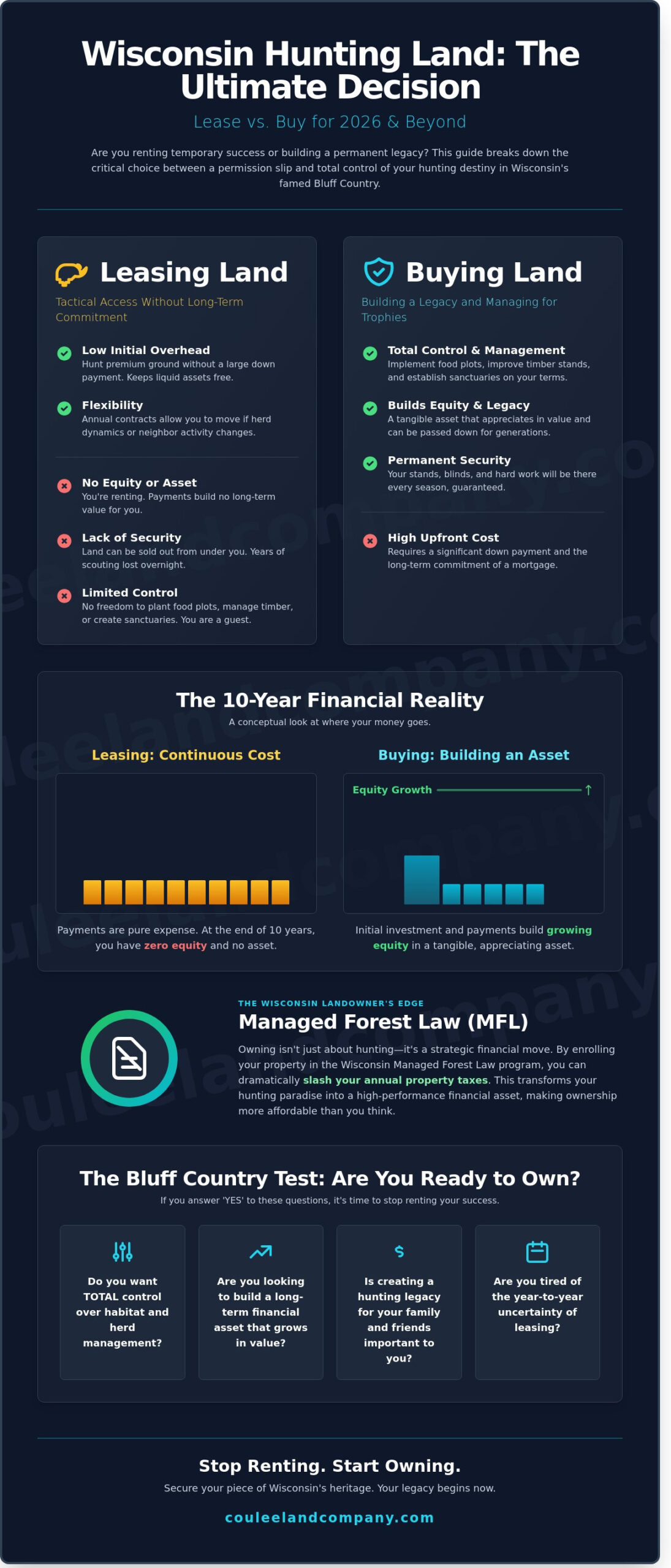
Hunters weighing the pros of wisconsin hunting lease vs buying often view the lease as a low-risk trial. It provides a flexible entry point into premium counties without the long-term debt of a mortgage. Most Wisconsin leases operate on annual or three-year contracts. This model offers a tactical advantage. If a neighbor clear-cuts their timber or the local deer herd shifts due to disease, you can move your operation the following season. It’s an ideal strategy for hunters who are still scouting different townships to find their perfect ridge.
- Annual Contracts: Provides the highest level of flexibility.
- Multi-Year Agreements: Offers a bit more stability for food plot investments.
- Low Initial Overhead: Allows you to hunt prime dirt without a massive down payment.
The Ownership Model: The Hunter’s Legacy
Owning land is the ultimate goal for those dedicated to serious whitetail management. When you own the dirt, you control the habitat. You can plant food plots, implement timber stand improvements, and establish sanctuary zones without asking for a landlord’s permission. There is a profound emotional security in knowing your stands will be there every October. Beyond the hunt, it’s a tangible asset that builds equity. Explore our current listings of hunting properties to see what’s available in the legendary Coulee Region. We don’t just sell land; we help you secure a piece of Wisconsin’s heritage.
Hunting Leases in Wisconsin: Tactical Access Without the Long-Term Commitment
Leasing provides a tactical entry point into high-quality deer woods without the immediate requirement of a 20% down payment. It’s a popular choice for hunters who want to secure exclusive rights to a property while keeping their liquid assets available for other investments. However, when evaluating a wisconsin hunting lease vs buying, you have to acknowledge the lack of long-term security. You aren’t building equity. You’re simply renting a sunset; if the landowner decides to sell the property or pass the farm to an heir who doesn’t hunt, your years of scouting and stand placement vanish overnight.
Vetting a lease requires boots-on-the-ground diligence. You shouldn’t sign a contract based on trail camera photos from three years ago. Over-hunted dirt is a common reality in the leasing market. Look for signs of excessive pressure like old stands left in every pinch point or fresh tire tracks in sensitive bedding areas. Most leases also come with strict handcuffs. You likely won’t have the freedom to clear shooting lanes, plant diverse food plots, or execute a timber harvest to improve bedding cover. You’re a guest on the land, not the steward of it.
Testing the Dirt: Leasing as a Scouting Tool
Think of a lease as a high-stakes test drive. A one-year agreement allows you to analyze local genetics and gauge neighbor pressure before committing to a thirty-year mortgage. This is especially valuable in Buffalo County, where the topography is as challenging as the trophy potential is high. Testing the bluff country ensures you understand the thermal shifts and deer travel patterns unique to Western Wisconsin. It’s the ultimate due diligence move before you look for permanent hunting properties in the area.
The Hidden Costs of Leasing
Leasing isn’t as cheap as it looks on a spreadsheet. Annual price hikes are common; many hunters see 5% to 10% increases year over year as demand for private access climbs. You also face mandatory insurance requirements. Most Wisconsin landowners require a liability policy, often starting at $250 annually for a small club. Staying current with Wisconsin hunting regulations is vital whether you’re a tenant or an owner, but only the owner reaps the rewards of land management. Every dollar spent on a lease is a lost investment that never returns to your pocket. While you’re tagging bucks, the property owner is the one benefiting from property appreciation and tax advantages.
Buying Wisconsin Hunting Land: Building Equity and Managing for Trophy Whitetails
Buying land in the Driftless Area represents a strategic shift from being a temporary visitor to becoming a permanent steward of the resource. While the debate of a wisconsin hunting lease vs buying often centers on upfront costs, the long-term advantages of ownership are undeniable. You gain the freedom to implement comprehensive strategies on your hunting properties without seeking permission from a landlord. This total control allows you to transform a standard timber tract into a premier whitetail destination tailored to your specific goals.
Ownership is a powerful hedge against inflation and a diversifying asset that offers more than just recreational value. Beyond the hunt, the land provides multi-use potential that a lease can’t match. You can’t build a permanent country home or a custom log cabin on leased ground. These improvements turn a seasonal property into a year-round family retreat, creating a legacy that preserves the hunting tradition for the next generation.
Habitat Engineering: The Secret to Boone & Crockett Bucks
Trophy potential in Western Wisconsin is largely a product of age and nutrition. Ownership allows for multi-year projects like establishing perennial food plots, planting thermal cover, or conducting Timber Stand Improvement (TSI) to increase natural browse. These efforts don’t just grow bigger deer; they significantly boost the property’s resale value by proving the land’s wildlife capabilities. Sanctuary areas are strictly designated, low-impact zones where human intrusion is prohibited to ensure mature bucks feel secure on your property throughout the season.
The ROI of Recreational Land
Recreational land in Western Wisconsin has shown incredible resilience as an investment. Over the last 10 years, land values in prime regions like Buffalo and Trempealeau Counties have seen consistent appreciation, often ranging from 6% to 10% annually. Owners can offset holding costs through several passive income streams:
- Leasing tillable acreage to local farmers for corn or soybean production.
- Participating in the Voluntary Public Access program to receive annual payments for public walk-in access.
- Enrolling in government conservation programs that pay for habitat restoration.
When it’s time to exit the investment, having a well-managed property with documented trophy history puts you in a position of strength. You can consult our sellers guide to see how habitat improvements and strategic land management translate into a higher asking price when you decide to bring your property to market.
The Financial Reality: Comparing the True Costs Over 10 Years
Crunching the numbers on a wisconsin hunting lease vs buying reveals a stark contrast in long-term wealth. A lease is a straight expense. If you spend $4,000 annually on a quality lease, you’ve spent $40,000 after a decade with nothing to show but memories. Buying land requires a larger upfront commitment, but it transforms that annual outflow into an investment. Property taxes and mortgage interest are the primary costs, yet these are often offset by land appreciation and the build-up of equity. In many parts of Western Wisconsin, land values have historically trended upward, meaning the cost of ownership is frequently recovered through the rising value of the asset itself.
Waiting to buy carries a heavy price. If land values increase by even 4% annually, a $300,000 property will cost over $444,000 in ten years. That $144,000 gap represents the cost of missed opportunity. By purchasing now, you lock in your cost basis and ensure that every dollar spent on habitat improvements or trail systems directly increases your net worth. You aren’t just paying for a place to hunt; you’re securing a tangible asset that protects your capital against inflation.
Tax Incentives for Wisconsin Landowners
Wisconsin offers powerful programs to lower the carrying costs of recreational land. The Managed Forest Law (MFL) is a premier tool for owners. By enrolling in a forest management plan, landowners can reduce their property taxes by approximately 80% compared to standard rates. Conservation easements also provide potential tax deductions for those willing to protect the land’s natural state. For investors looking to roll profits from one property into another, a 1031 tax-deferred exchange allows you to sell a property and reinvest the proceeds into a new piece of land without immediate capital gains tax liability.
Financing the Dream
Making the Choice: Is it Time to Stop Renting Your Success?
The debate regarding a wisconsin hunting lease vs buying often comes down to your stage in life and your long term goals for the dirt beneath your boots. While a lease provides immediate access, it lacks the permanent security that defines true land ownership. To decide if it is time to move from tenant to title holder, apply the “Bluff Country” Test. Ask yourself these three questions. First, are you tired of asking permission to move a stand or plant a food plot? Second, does your current hunting budget disappear into someone else’s mortgage every year? Third, do you want to leave a physical legacy for your children that exists beyond a digital photo gallery? If you answered yes to these, you are ready to buy.
Leasing still serves a purpose for specific hunters. It’s a great tool for young hunters just entering the workforce or professionals with transient careers who might move out of state within 24 months. It also allows you to test new regions, like the rugged terrain of Buffalo County, before committing to a seven figure investment. However, you must realize that the “perfect” property is rarely found; it’s built through years of diligent land management. When you lease, you’re paying for someone else’s hard work. When you buy, you’re investing in your own vision.
The Transition Plan: From Lease to Legacy
You don’t have to quit your lease the day you start looking for land. Use your final seasons as a tenant to refine your “must-have” list. Look for “sleeper” properties that others overlook because they lack curb appeal. These parcels often have the highest wildlife potential because they’ve been left undisturbed. We help you identify these diamonds in the rough by analyzing thermal cover and bedding security. Start your journey by reading our Hunting Land for Sale in Wisconsin: The Ultimate Buyer’s Guide to understand what to look for in a permanent tract.
Why a Land Specialist is Non-Negotiable
A neighborhood realtor understands school districts and square footage. A “hunter’s realtor” understands how a north wind affects a specific ridge top and why certain soil types produce bigger racks. At Coulee Land Company, we evaluate wildlife capabilities beyond the property lines, looking at how neighboring parcels impact your deer herd. We aren’t just selling acres; we’re selling the opportunity to own a piece of the finest whitetail habitat in the world. Ready to see what’s available? View our exclusive Wisconsin listings and find your permanent camp today.
Secure Your Future in the Bluff Country
Deciding on a wisconsin hunting lease vs buying is the difference between being a temporary visitor and a permanent steward of the land. While a lease provides tactical access for the 2026 season, it doesn’t offer the long-term equity or the management control essential for producing world-class whitetails. Buffalo County has recorded over 1,000 Boone and Crockett entries, proving that the right “dirt” is a hunter’s most valuable asset. Ownership allows you to utilize Managed Forest Law (MFL) programs to lower tax burdens while implementing the land management strategies that top outdoor television hosts rely on for success. We’ve built our reputation as Wisconsin’s Land and Property Sales Specialists by identifying properties with superior wildlife capabilities. It’s time to stop chasing someone else’s dreams and start building your own legacy on a foundation you control. You deserve a piece of the Bluff Country that belongs to you alone.
Find Your Legacy Property: Explore Our Wisconsin Hunting Land Listings
The hunt for your own piece of paradise starts today, and we’re ready to lead the way.
Frequently Asked Questions
Is it cheaper to lease or buy hunting land in Wisconsin over 5 years?
Leasing is cheaper in terms of immediate cash outlay, but buying builds long-term wealth through equity. A lease might cost $3,000 annually, totaling $15,000 over five years, while a land purchase requires a 20 percent down payment and interest. However, Wisconsin land values in the Driftless Area have historically appreciated at rates of 4 to 7 percent annually. Owners often recoup their costs through appreciation that lessees never experience.
Can I manage habitat or plant food plots on a Wisconsin hunting lease?
Your ability to plant food plots depends entirely on the specific language in your written agreement. While 65 percent of private landowners allow some form of habitat improvement, many prohibit the use of heavy equipment or timber removal. When comparing a wisconsin hunting lease vs buying, remember that ownership provides total control over land management strategies like hinge cutting or establishing perennial clover stands without needing a landlord’s signature.
What is the average cost of a hunting lease in Buffalo County, WI?
Hunting leases in Buffalo County typically range from $30 to $60 per acre depending on the quality of the timber and field edges. For a 40-acre parcel, you can expect to pay between $1,200 and $2,400 per year. These premium prices reflect the county’s status as the top producer of Boone and Crockett whitetails in the United States. It’s the most expensive leasing market in the state for a reason.
Does owning hunting land in Wisconsin count as a good financial investment?
Wisconsin hunting land is a robust financial investment that offers both recreational value and capital appreciation. According to the USDA Land Values 2023 Summary, Wisconsin agricultural and forest land values increased by 13.9 percent over the previous year. Unlike volatile stock markets, a piece of Bluff Country provides a stable hedge against inflation. It allows you to grow your net worth while you’re out harvesting trophy bucks.
What is the Managed Forest Law (MFL) and how does it help landowners?
The Managed Forest Law is a landowner incentive program that encourages sustainable forestry on private lands by offering a 90 percent reduction in property taxes. Landowners enter into a 25 or 50-year contract with the Wisconsin DNR to follow a specific forest management plan. This program makes owning large tracts of timber much more affordable by significantly lowering the annual carrying costs. It’s a powerful tool for serious land managers.
What happens if the property I lease gets sold mid-season?
Most Wisconsin hunting leases terminate immediately upon the sale of the property unless the contract specifically includes a succession clause that binds the new owner. If the land sells in October, you could lose your access just as the rut begins. This uncertainty is a primary reason hunters move from a wisconsin hunting lease vs buying their own ground. Ownership ensures your season isn’t cut short by a real estate transaction.
How much of a down payment is typically required for Wisconsin raw land?
Lenders typically require a down payment of 20 to 30 percent for raw land purchases in Wisconsin. Because vacant land is considered a higher risk than residential property, traditional banks rarely offer the low down payment programs common in home buying. For a $300,000 parcel in the Coulee Region, you should be prepared to bring at least $60,000 in cash to the closing table to secure your financing.
Can I hunt my own land if it is enrolled in the MFL program?
You can hunt your own land in the MFL program, but your privacy depends on whether the land is designated as Open or Closed. Landowners can close up to 320 acres per municipality to public access, keeping the hunting rights exclusive to themselves and their guests. If you choose to keep the land Open to the public for hunting and hiking, you receive a larger tax break but lose exclusive control.