
What if you could effectively triple your hunting footprint without paying a single extra cent in property taxes? Most buyers see a shared boundary with state forest as a liability, fearing that high pressure will ruin their season or lead to unwanted trespassing. You’ve likely shared those same concerns while searching for wisconsin hunting land bordering public land, wondering if the neighbors will ultimately push the deer off your dirt. We understand that hesitation, but the most successful land managers in the Driftless and the Northwoods know that a public border is actually a strategic force multiplier.
This guide will show you how to leverage those boundaries to your advantage, turning public acreage into a natural sanctuary while your private land serves as the primary food source. You’ll learn how to secure trophy whitetails by managing the edge correctly and gain total clarity on the latest 2026 DNR boundary regulations. We’ll examine the legalities of Wisconsin markers, tactical property layouts that capitalize on public pressure, and the specific ways you can use 6.6 million acres of state ground to expand your reach.
Key Takeaways
- Leverage the “force multiplier” effect to expand your effective hunting footprint far beyond your deeded acreage by positioning your land as the primary food source.
- Master the vetting process for wisconsin hunting land bordering public land by identifying “dead zones” where limited public access creates a de facto private sanctuary.
- Navigate the nuances of DNR-managed tracts, National Forest boundaries, and MFL-Open programs to ensure your property choice aligns with the state’s 2026 management regulations.
- Apply the “Bedding vs. Buffet” tactical framework to transform your private dirt into the premier nutritional hub for local trophy whitetail populations.
- Utilize advanced screening methods, including strategic switchgrass and conifer plantings, to maintain total privacy and shield your high-value food plots from public view.
The Strategic Advantage: Why Wisconsin Hunting Land Bordering Public Land is a Force Multiplier
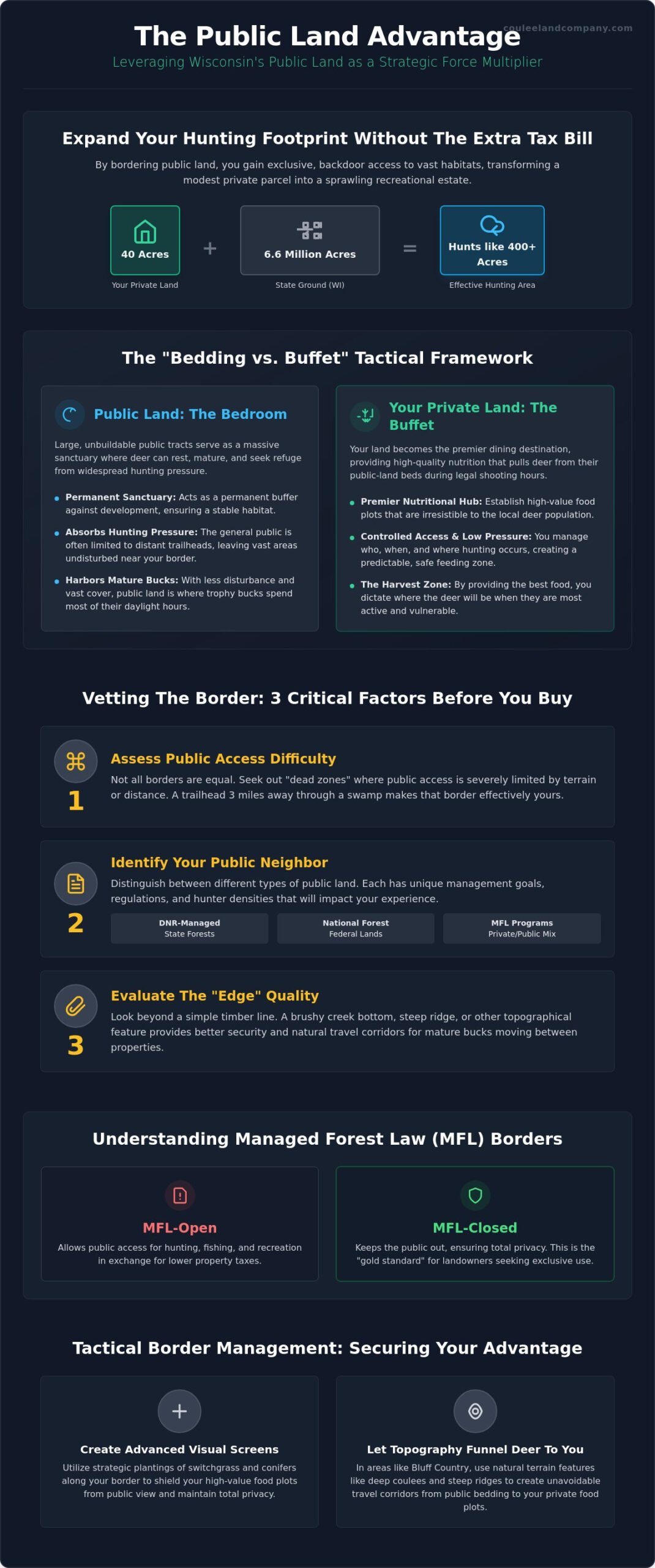
Owning a parcel of wisconsin hunting land bordering public land transforms a modest investment into a sprawling recreational estate. When you secure a boundary against thousands of state-managed acres, your 40-acre tract begins to hunt like a 400-acre sanctuary. This force multiplier effect occurs because you gain exclusive, backdoor access to massive blocks of habitat that the general public can only reach through distant, high-traffic trailheads. Understanding What is Public Land and how it’s managed provides the foundation for this strategy, as these areas offer permanent buffers against residential sprawl and commercial development.
To better understand the dynamics of these shared boundaries, watch this helpful overview from the Wisconsin DNR:
Adjoining public land is a strategic asset for trophy whitetail management in 2026 because it provides a permanent, unbuildable buffer that absorbs hunting pressure and harbors mature bucks. In Western Wisconsin’s Bluff Country, the psychological advantage is even more pronounced. Public land serves as a massive bedroom for deer, while your private acreage provides the high-quality kitchen they crave during legal shooting hours.
Expanding Your Footprint Without the Property Tax
You can utilize public access points for off-season scouting and tracking wounded game without ever disturbing the heart of your private sanctuary. This strategy is particularly effective in regions like Buffalo County, where the dramatic topography creates natural funnels. Deep coulees and steep ridges often force deer to travel from public bedding areas directly onto private food plots. You’re essentially letting the state pay the taxes on the primary habitat while you harvest the results on your own dirt. By leveraging these natural travel corridors, you ensure that wisconsin hunting land bordering public land remains a top-tier investment for serious outdoorsmen.
Vetting the Border: 3 Critical Factors Before You Buy
Not every parcel of wisconsin hunting land bordering public land is a guaranteed trophy producer. You must scrutinize the boundary with a tactical eye before signing a deed. The first factor to assess is the difficulty of public access. If the nearest state parking lot is three miles away through a cedar swamp, that border is effectively yours. However, if a well-maintained trailhead sits 100 yards from your line, you aren’t buying a sanctuary; you’re buying a front-row seat to someone else’s hunt.
The type of public neighbor matters just as much as the distance. You need to distinguish between DNR-managed tracts, National Forest, and county land, as each has different timber management goals and hunter densities. Referencing the Wisconsin Public Access Lands database is the first step in identifying who your neighbor really is. Evaluating the “edge” quality is your third priority. A hard timber line might look good on a map, but a brushy creek bottom or a steep ridge provides better security for mature bucks moving between properties. Consulting with a Wisconsin land specialist allows you to verify boundary history and understand local hunter behavior before you commit to a purchase.
Understanding Wisconsin’s Managed Forest Law (MFL) Borders
Managed Forest Law (MFL) is a critical factor when vetting adjacent parcels. You’ll encounter “MFL-Open” land, which allows public access for hunting, and “MFL-Closed” land, which keeps the public out in exchange for a higher tax rate. For 2026, MFL-Closed borders remain the gold standard for privacy, though MFL-Open tracts can still offer private-like management if the terrain is sufficiently rugged. Your choice between MFL-Open and MFL-Closed status directly dictates your 2026 property tax obligations and the level of hunting privacy you can expect throughout the season.
The ‘Pressure Check’: Scouting the Public Side
Don’t just scout your own dirt. Walk the public side to identify “truck-stop” hunters who rarely leave the sight of their vehicles. Serious backcountry trekkers are your real competition, and their boot tracks will tell you exactly where the pressure is coming from. Use historical DNR harvest data to gauge whether a specific area is over-pressured or a hidden gem. If you’re ready to find a property that fits these criteria, we’re here to help you find the right hunting land for your goals.
Tactical Border Management: Keeping Trophy Bucks on Your Side
Managing wisconsin hunting land bordering public land requires a shift from hunting the deer to hunting the pressure. You want to establish a “Bedding vs. Buffet” dynamic. While public land often provides thousands of acres of unpressured bedding, it rarely offers the high-protein nutritional hubs found on managed private ground. By focusing your efforts on high-value food plots away from the boundary, you give deer a reason to cross onto your dirt during legal shooting hours. This strategy effectively turns the state’s acreage into your personal bedding area while you control the kitchen.
Visual security is just as vital as nutrition. You should plant thick screens of switchgrass or conifers along the public line to block the view of any passing hunters or hikers. This prevents “line jumping” and makes your deer feel safe enough to feed in the open during the early season. For deeper insights into habitat improvement, check out our hunting land resources. Position your stands internally, targeting the specific “leaks” or trails where deer transition from public security into your private feeding zones. This keeps your presence hidden and ensures the deer don’t associate your land with danger.
Creating a Sanctuary on the Public Line
Resist the urge to hang stands directly on the fence. Hunting the actual border line often pushes deer deeper into the public interior where you lose your tactical advantage. Instead, create a 50-yard buffer of thick security cover on your side of the line. This acts as a welcoming mat for deer fleeing public pressure, drawing them into your sanctuary before they ever reach your primary hunting zones. When the orange army hits the public woods, your thickets will become the preferred escape route.
Legal Boundary Defense and Signage
Clear boundaries are your best defense against accidental trespassing. For 2026, ensure you’re compliant with Wisconsin’s purple paint law by applying vertical stripes on trees or posts at the required intervals. This provides a legally recognized “no trespassing” notice that’s more durable and visible than traditional paper signs. Building a professional rapport with local DNR wardens also helps deter bad actors and ensures your property remains a private haven. Ready to find your piece of Bluff Country? View our exclusive hunting land listings to see what’s currently available.
Secure Your Strategic Advantage in the Northwoods and Driftless
Mastering the boundary between private investment and public resource is the hallmark of a sophisticated land steward. You now understand that a shared fence line isn’t a liability but a tactical advantage that expands your footprint and creates a permanent buffer against development. By vetting access points and implementing strategic screening, you can transform your property into the ultimate nutritional hub for the region’s most reclusive bucks. Finding the right wisconsin hunting land bordering public land is the first step toward building a property that out-hunts its acreage year after year.
At Coulee Land Company, we specialize in Buffalo County’s legendary trophy whitetail habitat. Our team of land specialists consists of active hunters and stewards who live and breathe this dirt, and we’ve earned overwhelming social proof from successful buyers across Western Wisconsin. It’s time to stop dreaming about the perfect border and start hunting it. Start your search for Wisconsin hunting land with the Bluff Country experts and secure a legacy that will last for generations.
Frequently Asked Questions
Can I legally hunt on the public land side if my property borders it?
Yes, you have the same rights to hunt public land as any other citizen, provided you hold the correct 2026 licenses and follow all state season regulations. Your shared boundary simply gives you a tactical advantage for easier access to remote sections of state ground that are often unreachable for others. You must still adhere to all DNR rules, such as those regarding portable stands or baiting, which may differ from the rules on your private acreage.
How do I know where the exact property line is between my land and the DNR land?
You can identify the legal boundary by looking for official DNR signs, survey pins, or the purple paint markers required by state law. While digital mapping apps provide a solid baseline for scouting, they can occasionally be off by several feet. For absolute certainty, we recommend reviewing a certified survey or looking for the specific yellow and white boundary markers that the state typically maintains along its borders with private owners.
Does bordering public land decrease the resale value of my hunting property?
Quite the opposite is true. Investing in wisconsin hunting land bordering public land often increases your resale value because it offers a “force multiplier” effect that savvy buyers prioritize. The ability to access thousands of acres for scouting and tracking while only paying taxes on a smaller parcel is a massive selling point. In premier trophy counties, these properties often sell faster and for higher prices than isolated tracts because of this expanded footprint.
What happens if a deer I shoot on my land runs onto the public land?
You are legally permitted to track and recover your harvested game on public land without seeking additional permission. Because these lands are open for public use, you can move freely to retrieve your deer. Just ensure you follow standard safety protocols, such as keeping your firearm unloaded or cased during the recovery process if required by local regulations. It’s a seamless transition that simplifies the recovery of trophy whitetails in the thickest cover.