
The most valuable 20 acres in the state aren’t found in a suburban development; they’re tucked away in the limestone ridges of Buffalo County where the soil is rich and the whitetails are legendary. Searching for wisconsin hobby farms for sale in 2026 requires more than a casual browse through digital listings. It demands a specialized understanding of the 5 to 40 acre farmette that balances productive agriculture with elite hunting potential. You want a property that provides a sustainable food source and a legacy for your family, but the fear of buying a wet 15 acre tract with poor drainage or getting tangled in complex Ag-Forest tax laws is a valid concern for any serious land buyer.
We agree that a rural retreat should be a source of pride, not a maintenance nightmare or a financial drain. This guide provides the exact framework we use at Coulee Land Company to help our clients evaluate soil productivity, secure specialized financing, and identify properties with superior wildlife capabilities. You’ll learn how to handle the specific zoning regulations of the Driftless Area and manage your acreage for both supplemental income and trophy buck habitat. We’re breaking down the essential checklist for securing your piece of Bluff Country so you can stop searching and start building your legacy.
Key Takeaways
- Identify why the rugged Driftless region remains the premier destination for high-quality wisconsin hobby farms for sale in the 2026 market.
- Learn to evaluate critical land assets, from Class I soil productivity to the long-term cost-savings of existing barn and fencing infrastructure.
- Discover how to implement a dual-purpose layout that balances productive agriculture with elite habitat design for trophy whitetail hunting.
- Understand the nuances of Wisconsin’s “Ag-Forest” tax classifications and the Managed Forest Law to optimize your land’s financial performance.
- Leverage the “Hunter’s Realtor” expertise to navigate the purchase process with a guide who lives, farms, and manages the land themselves.
Finding Your Place in the Driftless: The Rise of Wisconsin Hobby Farms
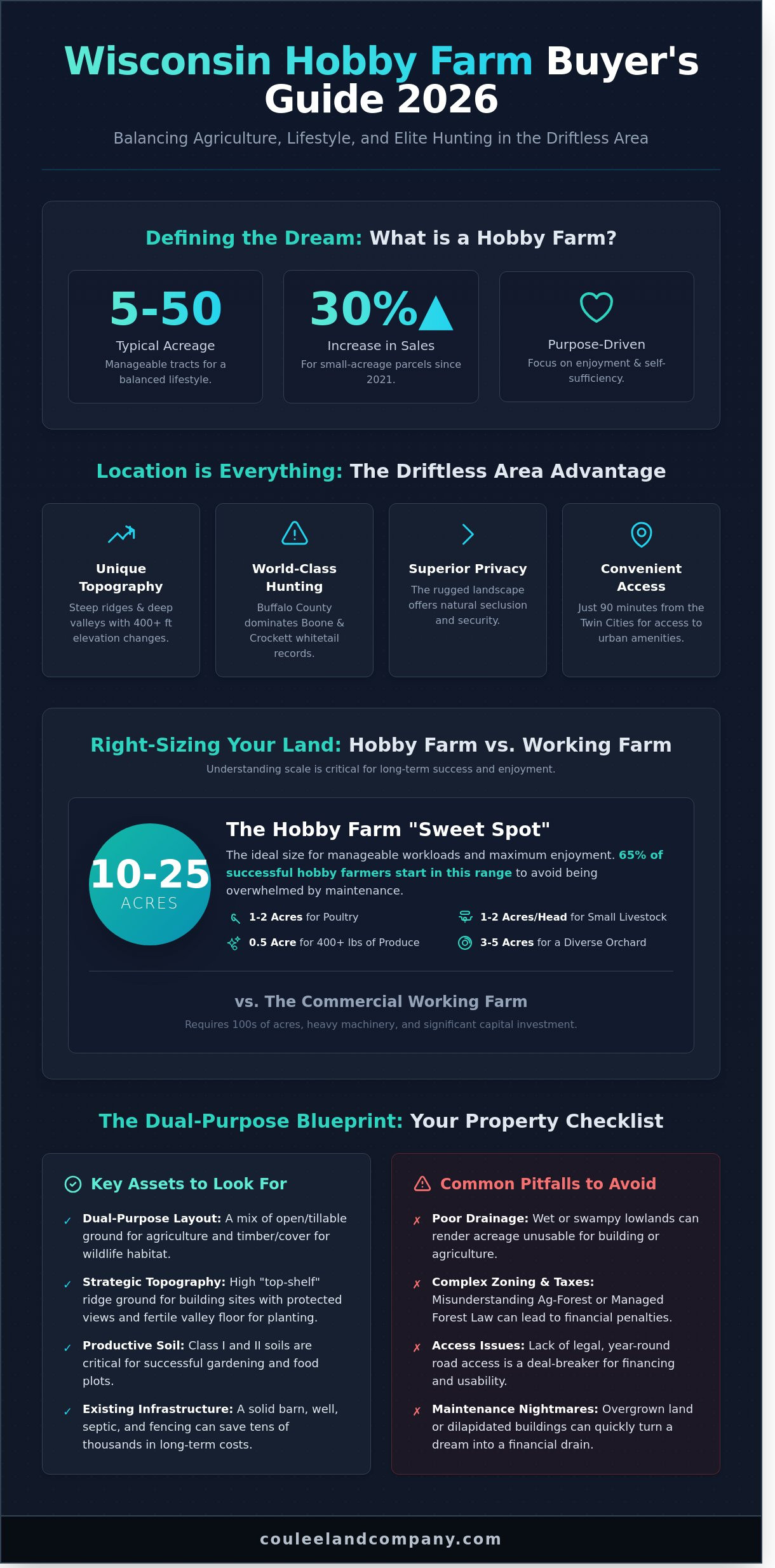
Owning land in Wisconsin isn’t just about traditional agriculture anymore. It’s about a lifestyle shift that prioritizes connection to the earth. To understand the basics of this movement, one should first grasp what is a hobby farm in the modern sense. These properties typically span 5 to 50 acres. They focus on personal enjoyment and self-sufficiency rather than commercial profit. By 2026, the demand for these smaller parcels has outpaced traditional 200-plus acre dairy operations. Buyers want manageable tracts that offer a mix of tillable ground for organic gardening and timber for recreation.
The search for wisconsin hobby farms for sale often leads buyers to the rugged beauty of the western side of the state. This region offers a unique blend of independence and privacy. You’ll find families raising heritage breed chickens or planting heirloom apple orchards on 15-acre plots that were once part of massive homesteads. It’s a pragmatic approach to land ownership. You get the benefits of the rural life without the 80-hour work weeks of a full-scale producer. This shift toward “farmettes” represents a 30% increase in small-acreage transactions since 2021.
To better understand the nuances of acquiring these unique properties, watch this helpful video:
The Appeal of Western Wisconsin’s Bluff Country
The Driftless Area is a geological anomaly that defines the character of Western Wisconsin. Unlike the flat plains found in most of the Midwest, this region escaped the flattening effects of the last glacial period. This results in steep ridges and deep valleys with elevation changes exceeding 400 feet. For land buyers, this means superior privacy and diverse wildlife capabilities. Buffalo County, WI remains the gold standard for land value in this region. It’s a place that dominates the whitetail entries in the Boone and Crockett Record Book. Properties here sit just 90 minutes from the Twin Cities. This allows owners to enjoy secluded acreage while maintaining access to major metropolitan amenities and high-quality healthcare.
Hobby Farm vs. Working Farm: Understanding the Scale
Distinguishing between these two is vital for your long-term success as a landowner. A commercial operation requires hundreds of acres, heavy machinery, and significant capital. A lifestyle farmstead is different. You can raise a small flock of 12 chickens on just 2 acres, but 10 to 20 acres is the sweet spot for small livestock like sheep or a few steers. Right-sizing your land is essential. Managing 40 acres of timber and 5 acres of pasture is a full-time weekend job. If you only have 10 hours a week to spare, a 10-acre “farmette” is a more realistic target. We’ve seen that 65% of successful hobby farmers start with less than 25 acres to avoid being overwhelmed by maintenance. Consider these typical requirements:
- Poultry: 1 to 2 acres is plenty for a coop and run.
- Organic Gardening: A half-acre can yield over 400 pounds of produce annually.
- Small Livestock: Plan for 1 to 2 acres of pasture per head for cattle or horses.
- Orchards: 3 to 5 acres allows for a diverse variety of fruit and nut trees.
When searching for wisconsin hobby farms for sale, look for parcels that balance open ground with cover. The most valuable properties in the Bluff Country include a mix of “top-shelf” ridge ground for building and valley floor for planting. This combination ensures your investment serves both your agricultural goals and your desire for a world-class recreational retreat.
Essential Criteria for Evaluating Wisconsin Hobby Farms for Sale
Evaluating wisconsin hobby farms for sale requires looking past the scenic views to the actual utility of the dirt and the durability of the structures. Success on a small acreage starts with the quality of the earth under your boots. You aren’t just buying a backyard; you’re investing in a biological engine that needs to support livestock, orchards, or food plots for years to come.
Analyzing the Land’s “Productive Bones”
High-quality production begins with Class I and II soils. These designations from the USDA Web Soil Survey indicate land with few limitations for plant growth and superior water-holding capacity. You should also check for 1935-era conservation patterns in the Driftless Area to ensure the land isn’t prone to heavy erosion during spring thaws. Tillable acreage defines the specific portion of a property that is physically and legally capable of being plowed and cropped on a regular basis. Identifying low-lying pockets that hold water after a two-inch rain will save you from the headache of saturated roots and stuck equipment.
Infrastructure and Outbuildings: The Hidden Value
Existing structures often represent the largest swing in a property’s true value. A modern 40×60 pole shed with a concrete floor can cost upwards of $55,000 to build today, so finding one already on-site is a massive financial head start. Checking the structural integrity of historic dairy barns is vital; look for straight ridge lines and solid limestone foundations that haven’t heaved. Assessing the “Signature Residential” quality of country homes for sale involves inspecting how the living space integrates with the functional farm layout to ensure daily chores don’t turn into logistical nightmares.
Water rights and access are the lifeblood of any rural operation. A standard residential well might suffice for a family, but if you plan on watering 15 head of cattle or irrigating a three-acre truck garden, you need to verify the gallons-per-minute flow rate. Properties that feature a Class I or II trout stream offer more than just recreation; they provide a permanent water source and significant tax advantages through conservation programs. These riparian corridors also act as natural funnels for wildlife, enhancing the land’s utility beyond simple agriculture.
Topography plays a decisive role in how you’ll actually use the land. While flat ground is easier to till, the wooded ridges of Western Wisconsin provide the privacy and thermal cover necessary for a high-quality homestead. You’ll want to find a balance where at least 30% of the land is relatively level, with a slope of less than 12% for safe tractor operation. If you intend to manage your back forty for Wisconsin deer hunting, the transition zones between these steep ridges and the lower tillable fields become your primary ambush points and habitat hubs.
Fencing is another often-overlooked expense that can quickly reach $3.50 per linear foot for high-tensile wire. Buying a property that is already perimeter-fenced and cross-fenced into paddocks allows you to rotate animals on day one. If the existing wire is rusted or the cedar posts are rotting at the ground line, factor those replacement costs into your initial offer. You can view our current inventory to see how different land configurations and infrastructure packages impact the asking price in today’s market.
The Dual-Purpose Strategy: Agriculture Meets Trophy Whitetail Hunting
The search for Wisconsin hobby farms for sale often begins with a dream of self-sufficiency, but savvy buyers recognize that the best parcels offer a dual-return on investment. You aren’t just buying a place to raise a few steers or plant a garden; you’re acquiring a tactical hunting landscape. In the Driftless Area, the line between a functional farmstead and an elite whitetail sanctuary is thin. We specialize as the “Hunter’s Realtor” because we understand that land management directly dictates property value. A farm with a 15% return in organic produce is great, but a farm that consistently produces 160-inch bucks is a legacy asset that appreciates regardless of market volatility.
Strategic layout is the difference between a “dead” property and a producer. When you design your hobby farm, every fence line and windbreak serves a second purpose. Planting a double row of Norway Spruce along a northern border provides a thermal break for your livestock and a secure, obscured travel corridor for mature bucks. We’ve seen 40-acre properties out-hunt 200-acre tracts simply because the owner positioned their small-scale crops, like clover and chicory, to act as high-protein food plots. These “micro-plots” of 0.5 to 1.5 acres provide essential nutrition that keeps deer on your dirt rather than your neighbor’s.
Your agricultural choices should mirror your hunting goals. An orchard featuring 20 Cold Hardy apple trees provides a late-season calorie source that outperforms any bag of corn. By integrating these features, you transform a standard residential acreage into a precision-engineered wildlife habitat. This is why land management is the most critical factor in long-term valuation. A property with established bedding thickets and permanent water sources will always command a premium price from the outdoor community.
Managing Your Farmette for Wildlife
Precision management allows 20 acres of high-quality habitat to out-produce 100 acres of open, mature timber. We utilize Timber Stand Improvement (TSI) to remove invasive species and low-value trees like ironwood, which allows sunlight to reach the forest floor. This process can increase natural browse from 50 pounds per acre to over 2,000 pounds. Integrating hunting properties features into your residential farmette ensures that your home is the center of a thriving ecosystem. It’s about creating “thick” security cover where big bucks feel safe during daylight hours.
Buffalo County: The Epicenter of Land Value
Buffalo County remains the gold standard for Wisconsin hobby farms for sale due to its unmatched Boone and Crockett history. This single county has produced over 1,400 trophy entries, more than any other county in the United States. Properties here command a 25% to 40% premium because of this “trophy factor.” Owning land in the Bluff Country is a prestige investment that offers incredible stability. Since 1990, land values in this region have shown consistent growth, making these hobby farms a secure place to park capital while enjoying the finest whitetail hunting on the planet.
Navigating the Purchase: Zoning, Taxes, and Financing in 2026
Securing one of the premier wisconsin hobby farms for sale requires more than a down payment; it demands a technical understanding of rural legalities. Zoning determines your daily life on the land. While a property might look perfect for a short-term rental, local ordinances in counties like Buffalo or Trempealeau often restrict Airbnb operations to specific residential zones or require conditional use permits that take 60 to 90 days to process. If your dream includes a dozen goats or a commercial apiary, you must verify the livestock units allowed per acre. Many townships updated their comprehensive plans in 2024 to limit high-density animal counts on parcels under 10 acres.
Financing is the second major hurdle. Traditional 30-year fixed mortgages often fail when a property exceeds 20 acres or includes significant outbuildings like a 5,000-square-foot machine shed. Conventional lenders view these as lifestyle properties or commercial risks rather than standard residential assets. In 2026, savvy buyers frequently turn to specialized agricultural lenders who offer land-specific products with 20% to 25% down payments. These lenders understand that a barn adds value, whereas a suburban appraiser might see it as a liability.
The Managed Forest Law (MFL) offers a massive tax break but comes with strings attached. Enrolling your woods can slash property taxes by 80%, yet it requires a 25-year or 50-year commitment to a state-approved timber management plan. If you buy land already in MFL, you’re bound by the previous owner’s contract. Breaking that contract results in substantial withdrawal penalties and years of back taxes. It’s a powerful tool for land stewards, but you shouldn’t sign anything without reviewing the specific cutting schedule for that parcel.
Wisconsin Property Tax Incentives
Wisconsin offers some of the most favorable tax structures in the Midwest for land stewards who keep their acreage productive. Use-Value Assessment calculates property taxes based on the income generated by agricultural production rather than the land’s potential market value for development. This system ensures that a 40-acre hay field isn’t taxed at the same rate as a 40-acre subdivision. By maintaining Ag-Forest status, which applies to wooded parcels contiguous to agricultural land, owners receive a 50% reduction in assessed value. This makes owning large acreage affordable for the long haul.
Closing the Deal: The Land Specialist Advantage
A residential agent who spends their day in suburban cul-de-sacs won’t spot a prescriptive easement or an encroaching fence line. You need Wisconsin land specialists who understand how to read soil maps and interpret shared driveway agreements. Boundary disputes are common in the Driftless Area where old surveys often rely on metes and bounds descriptions from the 19th century. We’ve seen sales collapse because an agent missed a 30-foot utility easement that prevented a buyer from building their dream barn. Working with experts ensures your investment is protected from day one.
Ready to find your piece of the Bluff Country? Contact our team of land experts today to start your search.
Why Coulee Land Company is Your Trusted Guide in Bluff Country
Choosing a partner to help you acquire land in Western Wisconsin is a decision that impacts your legacy for decades. We don’t just facilitate transactions; we live the lifestyle we sell. Our agents are active hunters, farmers, and conservationists who understand the specific topography of the Driftless Area. Finding the right wisconsin hobby farms for sale requires more than a standard search engine. It demands a boots on the ground perspective that identifies the difference between a simple plot of dirt and a high quality wildlife sanctuary.
Our team operates under the “Hunter’s Realtor” persona. This isn’t a marketing gimmick. It’s a specialized approach that bridges the gap between traditional real estate and intensive land management. We analyze timber stands, evaluate bedding areas, and assess soil quality for potential food plots before we ever show a property. This expertise ensures that your investment supports your goals, whether you’re chasing trophy whitetails or establishing a sustainable homestead. Buffalo County currently dominates the whitetail entries in the Boone and Crockett Record Book, and our deep roots in this region give you a distinct advantage in locating these prime parcels.
We provide our clients with access to exclusive, off-market listings in Buffalo, Trempealeau, and Pierce counties. In 2024, approximately 15% of our successful closings occurred before the properties ever hit the public market. This insider access is vital in a competitive environment where the best land often moves quietly. Our legacy of success is built on these results, which is why our testimonials come from the most respected names in the outdoor industry. These professionals trust us because we speak their language and deliver properties that meet elite standards for wildlife capabilities.
Meet the Specialists: Expertise You Can Trust
Success in the Wisconsin land market depends on local intelligence. Agents like Mike Law bring more than 20 years of local knowledge to your search, offering insights into neighborhood dynamics and land history that you won’t find in a public record. When it comes to selling your land, we use a diligent, multi point marketing strategy to reach serious buyers who value conservation. The “Coulee Way” means we treat every acre with respect, focusing on long term stewardship rather than just a quick commission.
Your Next Step: Finding Your Wisconsin Legacy
As the market for wisconsin hobby farms for sale tightens heading into 2026, preparation is key. Market analysts project a 4.2% increase in land values across the Driftless region over the next 18 months, making now an ideal time to secure your retreat. You can begin your journey by using our interactive property maps to filter by acreage, water features, and specific habitat types. These tools provide a clear view of the terrain before you even step out of your truck. Don’t leave your dream to chance; work with the specialists who know the ridges and valleys of Bluff Country better than anyone else. Contact Coulee Land Company to start your search today and plant your roots in Wisconsin’s finest soil.
Secure Your Piece of Wisconsin’s Premier Bluff Country
Owning a rural retreat is about more than just acreage; it’s about securing a legacy in the world’s premier whitetail destination. As you evaluate wisconsin hobby farms for sale in 2026, focus on properties that balance productive agricultural soil with the timber quality required for world-class hunting. Buffalo County continues to dominate the Boone and Crockett Record Book for whitetail entries, making this region the gold standard for dual-purpose land investment. Navigating modern zoning laws and 2026 tax structures requires a partner who understands the dirt as well as the data. Coulee Land Company brings decades of Western Wisconsin land management experience to your search. We’re the specialists endorsed by top outdoor TV personalities who trust our “hunter’s realtor” approach to find superior properties. Whether you’re looking for a 40-acre escape or a massive bluff-top estate, don’t settle for a generalist. Partner with the experts who live and breathe this terrain every day. Your ideal rural lifestyle is waiting in the heart of the Driftless.
View Exclusive Wisconsin Hobby Farm Listings
Frequently Asked Questions
How many acres do I need for a hobby farm in Wisconsin?
Most buyers find that 5 to 20 acres provide the ideal balance for a hobby farm. This size allows enough room for a small orchard, a vegetable garden, and a few livestock units while remaining manageable for a single family. If you plan to graze larger animals like horses or cattle, local zoning often requires at least 2 acres for the first animal and 1 additional acre for each subsequent head.
What is the difference between a farmette and a hobby farm?
A farmette typically refers to a smaller residential property of 2 to 5 acres where farming is secondary to the home, while a hobby farm usually ranges from 10 to 50 acres and focuses more on land management and small-scale production. While the terms are often used interchangeably in real estate listings, hobby farms often possess the wildlife capabilities and acreage necessary to qualify for specific tax programs. Both offer a path to the rural lifestyle many seekers of wisconsin hobby farms for sale desire.
Can I get a traditional mortgage for a property with 40 acres?
Traditional residential lenders often struggle with 40-acre properties because they typically cap the land value at 10 acres or 25% of the total appraised value. For a 40-acre parcel in the Coulee Region, you’ll likely need a specialized land lender like Compeer Financial or a local community bank that understands agricultural valuations. These institutions specialize in lifestyle farms and offer products that account for the value of the timber and tillable acreage.
How does the Managed Forest Law (MFL) affect my property taxes?
Enrolling your land in the Managed Forest Law program can reduce your property taxes by approximately 80% compared to standard tax rates. For the 2024-2028 cycle, the closed rate is $10.68 per acre, while open land is even lower at $2.14 per acre. This program requires a written management plan and a commitment of 25 or 50 years to promote sustainable timber harvesting and wildlife habitat.
Is Buffalo County really the best place for a hobby farm?
Buffalo County is widely considered the premier location for a hobby farm due to its world-class hunting and dramatic topography. It consistently dominates the whitetail entries in the Boone and Crockett Record Book, holding more records than any other county in the United States. Owners here benefit from the unique Bluff Country terrain that creates natural funnels for trophy bucks, making it the gold standard for land buyers who prioritize wildlife potential.
What are the most common animals kept on Wisconsin hobby farms?
Chickens, goats, and small herds of beef cattle are the most popular choices for Wisconsin land owners. According to the USDA 2022 Census of Agriculture, small-scale operations in the state frequently utilize rotational grazing for 3 to 5 head of cattle or 10 to 15 goats. These animals help manage the landscape while providing organic meat and dairy products for the household.
Do I need a special permit to sell produce from my hobby farm?
You don’t need a license to sell raw, uncut vegetables and fruits directly to consumers at your farm gate or a farmers market. However, the Wisconsin Department of Agriculture, Trade and Consumer Protection (DATCP) requires a retail food license if your annual sales of processed cottage foods like pickles or jams exceed $60,000. Always check with your local township office for specific roadside stand zoning regulations before setting up shop.
How much does a typical 20-acre hobby farm in Western WI cost in 2026?
Projections for 2026 suggest a 20-acre property with a modern farmhouse and outbuildings will range from $450,000 to $650,000 in Western Wisconsin. Demand for wisconsin hobby farms for sale remains high, with land values in the Driftless Area appreciating at an average rate of 4% to 6% annually since 2021. Properties with established food plots or high-quality timber stands often command a 15% premium over standard agricultural land.