
Could a single tract of land solve the riddle of volatile commodity prices while securing your family’s hunting legacy? You already know that securing quality Wisconsin farmland for sale has become a high-stakes race, especially when 82% of the most productive parcels in Western Wisconsin never see a public listing. The competition for prime tillable acres is fierce; meanwhile, the uncertainty surrounding soil productivity ratings can make even a seasoned investor hesitate. It’s a landscape where the difference between a standard agricultural yield and a superior legacy property often comes down to insider knowledge of the terrain.
We’re here to help you master these market nuances with expert insights on 2026 land values, soil PI ratings, and the unique intersection of farming and trophy hunting. This guide provides the tools to identify high-value parcels in the famed Bluff Country and explains the dual-income potential of combining agricultural production with lucrative hunting leases. We’re diving into the data-driven strategies you need to secure a high-performing property that pays dividends in both the grain bin and the trophy room.
Key Takeaways
- Decode the 2026 agricultural landscape by identifying the primary drivers of land value, from commodity prices to shifting interest rates.
- Master the technical side of soil productivity by learning how NCCPI ratings and premium soil types like Tama directly impact your long-term ROI.
- Explore the unique intersection of income and recreation to find premium Wisconsin farmland for sale that offers both high yields and world-class trophy hunting potential.
- Navigate the complexities of the acquisition process with expert guidance on securing specialized agricultural financing and conducting thorough due diligence.
- Leverage deep local roots to identify legacy properties that meet the rigorous standards of both professional farmers and elite whitetail hunters.
The State of Wisconsin Farmland for Sale in 2026
The market for Wisconsin farmland for sale has reached a pivotal moment in 2026. Buyers aren’t just looking for dirt; they’re looking for security in an uncertain global economy. The state’s agricultural landscape is a complex tapestry of dairy operations, row crops, and specialized timber tracts. A foundational knowledge of Agriculture in Wisconsin reveals why this region remains a top-tier destination for land-based investments. With over 14.2 million acres currently in production, the Badger State offers a level of diversity that few other Midwestern states can match.
To better understand the nuances of smaller parcel acquisition in this region, watch this helpful video:
Current Market Trends and 2026 Forecast
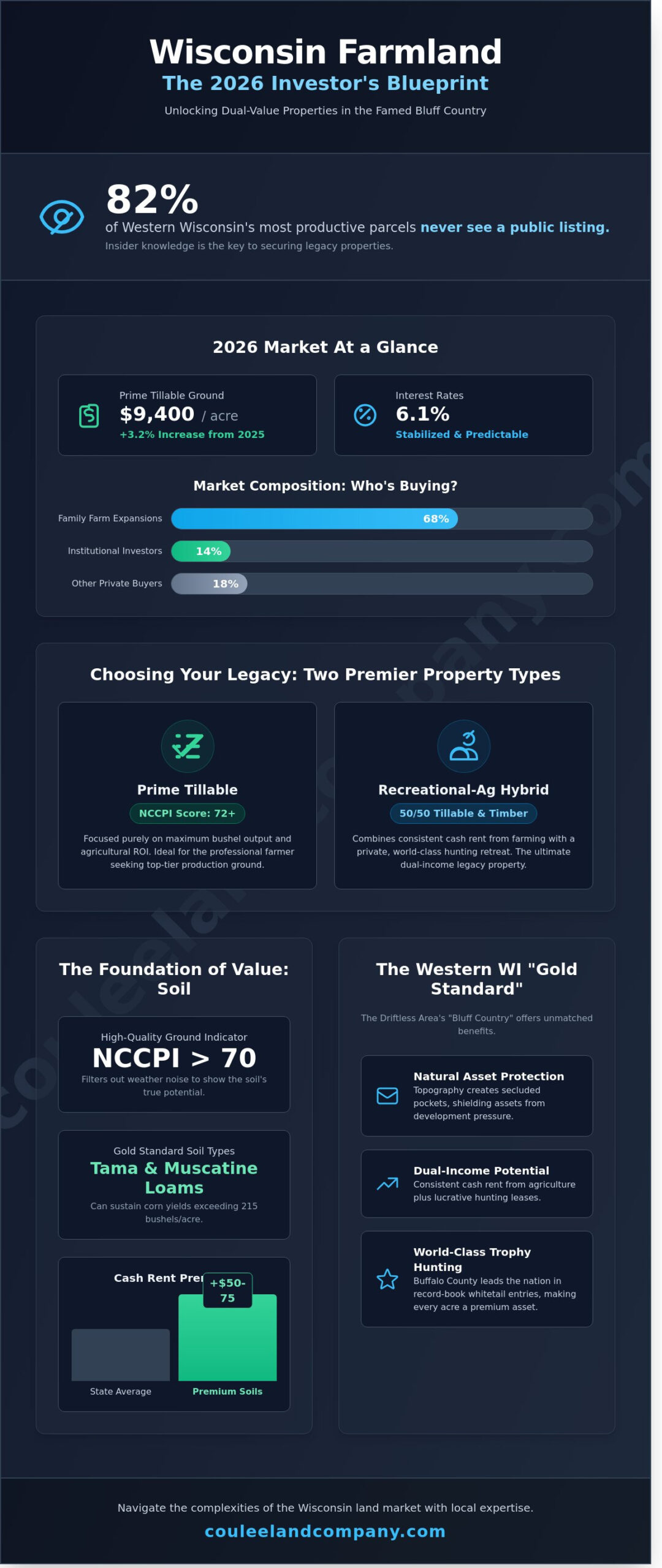
In early 2026, we’ve observed price-per-acre shifts that vary significantly by region. In the fertile southern plains, prime tillable ground is trading at $9,400 per acre, representing a 3.2% increase from 2025. While institutional investors have increased their footprint to 14% of total sales, family farm expansions still dominate the market at 68%. Federal agricultural policies in 2026 have shifted focus toward carbon sequestration incentives. This change makes “recreational-ag” hybrids, which are parcels that blend productive corn fields with dense bedding cover, more lucrative for the long-term holder. Interest rates have stabilized at 6.1%, providing a predictable environment for those looking to leverage their purchase.
Why Western Wisconsin is the “Gold Standard”
Western Wisconsin remains the crown jewel of the Midwest for the serious land buyer. The Driftless Area’s “Bluff Country” topography provides a natural protection for assets that flatland simply can’t offer. These ridges and coulees create micro-climates and secluded pockets that are perfect for land management and trophy whitetail growth. Buffalo County continues to lead the nation in record-book entries, making every acre here a premium asset. Identifying these specific parcels requires an expert who understands how a deer moves through a valley as well as they understand a soil map. Mike Law specializes in these high-performing properties, helping buyers navigate the steep terrain to find parcels with superior wildlife capabilities and solid ROI.
Understanding the difference between asset types is crucial for your 2026 strategy. We categorize land into two primary buckets:
- Prime Tillable: Land with a National Commodity Crop Productivity Index (NCCPI) score of 72 or higher, focused purely on maximum bushel output.
- Recreational-Ag Hybrids: Properties featuring a 50/50 split of tillable acreage and timber. These provide consistent cash rent from local farmers while serving as a private hunting retreat.
Development pressure from urban centers has pushed more buyers toward these rural sanctuaries. In 2026, the search for Wisconsin farmland for sale isn’t just about farming. It’s about owning a piece of the famed Bluff Country that will appreciate while you enjoy the harvest. Whether you’re looking for a 40-acre starter tract or a 500-acre legacy estate, the fundamentals of Wisconsin dirt remain rock solid.
Evaluating Soil Productivity and Land Capability
Serious land buyers don’t just look at a map; they look at the National Commodity Crop Productivity Index (NCCPI). In Wisconsin, an NCCPI score above 70 indicates high-quality ground capable of sustained production. This index is vital because it filters out the noise of year-to-year weather fluctuations and focuses on the inherent capacity of the dirt. Tama and Muscatine silt loams represent the gold standard for Wisconsin farmland for sale. These specific soil types often sustain corn yields exceeding 215 bushels per acre. They command premium cash rents, often fetching $50 to $75 more per acre than the state average.
Assessing drainage in the Coulee Region requires a different approach than the flat Central Sands. You aren’t always looking for pattern tiling. The dramatic elevation changes of the driftless area facilitate natural runoff, but this creates a high risk for erosion. Adhering to Wisconsin Soil Health Principles ensures your investment maintains its topsoil through 2026 and beyond. We recommend using the NRCS Web Soil Survey to vet every listing before you burn fuel for a site visit. It’s a free, digital tool that identifies “clay knobs” or hidden wet pockets that aren’t visible from the road. If you need a professional set of eyes to walk these ridges with you, view our current listings to see how we analyze property potential.
Tillable vs. Non-Tillable: Calculating Your ROI
Efficiency is the ratio of workability on a farm. A 100-acre property with 85 tillable acres is 85% efficient. In Western Wisconsin, we place a high value on “edge” acres. These are the transition zones where corn rows meet heavy timber. While these acres might produce 12% less grain due to shade and wildlife pressure, they grow 100% more trophy whitetails. To calculate your cash rent potential, multiply your tillable acres by local averages. In 2026, quality ground in Buffalo County typically commands between $225 and $310 per acre depending on the equipment access and slope.
The Role of CRP and Conservation Programs
The Conservation Reserve Program (CRP) is a powerful strategic tool for the 2026 land investor. It pays you a guaranteed annual rate to keep sensitive or less productive soil out of active production. This creates a predictable income stream on ground that might only yield 140 bushels of corn in a good year. These programs also build the thick, native grass bedding cover that holds mature bucks on your property year-round. Balancing 65% row-crop production with 35% conservation ground is the ideal “sweet spot” for buyers who want both a financial return and world-class hunting opportunities.
The Intersection of Ag-Income and Trophy Hunting
Wisconsin’s landscape offers a rare opportunity to combine high-yield agricultural production with the world’s premier whitetail hunting. When you evaluate Wisconsin farmland for sale, you aren’t just looking at soil REPI scores or drainage tile maps. You’re looking at a dual-purpose asset. The most valuable parcels in the state are those where the transition zones between hardwood timber and tillable acreage are managed with precision. This synergy allows owners to reap the benefits of annual cash rent or crop yields while the land’s recreational value appreciates independently.
The “Buffalo County Factor” is a real economic driver in the Driftless Area. This specific region has produced more Boone and Crockett record book entries than any other county in the United States. Because of this, land values here don’t just follow commodity prices; they follow the demand for world-class trophy potential. Investors often see a 15% to 25% price premium on acreage that features the rugged topography known as “Bluff Country.”
Evaluating a farm’s wildlife capability requires a professional eye for three specific pillars:
- Bedding: South-facing slopes with thick thermal cover like cedar or switchgrass.
- Water: Accessible year-round springs or creeks that aren’t disturbed by daily farm operations.
- Food: The proximity of high-protein crops to secure interior woodlots.
Structuring a hunting lease is an effective way to supplement your agricultural income. In Western Wisconsin, premium hunting leases can command between $35 and $65 per acre annually. For a 160-acre farm with a mix of woods and corn, this can result in over $8,000 of additional yearly revenue. We help owners draft agreements that protect their farming interests while ensuring the hunting tenants adhere to strict trophy management standards.
Farming for Whitetails: Strategic Land Management
Successful owners often trade a small percentage of their harvest for massive gains in buck age structure. Leaving 5% of a corn or soybean field standing provides critical late-season nutrition that keeps trophy deer on your property during the winter months. Creating 20-acre “sanctuary” zones where no human activity is allowed ensures that mature bucks feel secure on your land year-round. You can explore our hunting properties to see how these management strategies are implemented on working farms.
Case Study: Buffalo County Farmland
Buffalo County is the gold standard for Wisconsin farmland for sale because of its unique “V” shaped valleys and limestone-rich soils. These minerals contribute directly to massive antler growth. In 2023, land prices in this county remained resilient even when other regions saw stagnation, largely because the demand for “Bluff Country” acreage exceeds the available supply. Owning property here is a status symbol in the outdoor community. For a deeper look at the region, learn more about the Buffalo County community and why it remains the top choice for serious land investors.
Managing these properties requires a diligent approach to both the tractor and the treestand. We’ve seen that farms with a dedicated land management plan sell 30% faster than those without one. Whether you’re looking for a turn-key hunting tract or a productive grain farm with hidden trophy potential, the intersection of these two worlds is where the highest returns are found.
Navigating the Wisconsin Land Buying Process
Acquiring high-quality Wisconsin farmland for sale requires a tactical approach that differs significantly from residential real estate. You aren’t just buying a plot of dirt; you’re acquiring a biological asset with complex tax implications and production potential. Securing financing is the first hurdle. You need to work with specialized agricultural lenders like Compeer Financial or local community banks that understand the 2026 market. These institutions evaluate the Soil Productivity Index (SPI) and historical yield data rather than just relying on standard appraisals. They understand that a farm’s value is tied to what it can produce, whether that’s 200-bushel corn or high-value timber.
The Wisconsin Use-Value Assessment is a critical financial lever you must understand. Since 1995, Wisconsin law has mandated that agricultural land be taxed based on its income potential from farming rather than its fair market value for development. This shift often results in property tax savings exceeding 90% compared to residential or commercial rates. If you purchase a 160-acre tract in a high-demand area like Buffalo County, maintaining this classification is essential for your bottom line. At closing, expect a more rigorous process than a typical home sale. You’ll navigate complex title commitments that may include century-old mineral rights, grazing agreements, or conservation easements. Most large acreage deals require 45 to 60 days to reach the finish line to allow for thorough boundary surveys and environmental assessments.
Due Diligence Checklist for 2026
Due diligence in 2026 involves deep data dives. You must verify historical yields; look for consistent corn production above 185 bushels per acre in prime regions to ensure the soil is healthy. Review chemical application records from the previous 36 months to ensure no herbicide carryover will restrict your future crop rotations or food plot designs. Access remains the ultimate factor in land value. While a deeded easement is functional, owning at least 66 feet of road frontage provides superior long-term security and easier equipment transport. Always check for hidden utility easements that could prevent you from building a shed or a hunting cabin in your preferred location.
Why You Need a Land Specialist
A standard residential realtor lacks the specialized tools to evaluate a 200-acre agricultural asset. A veteran Wisconsin land broker understands soil maps, timber stand density, and how a property’s topography in the Bluff Country influences trophy whitetail movement. These specialists often identify off-market opportunities through local networks before they ever reach a public listing site. In the Driftless Area, the best ground often changes hands through these quiet, private transactions. A specialist negotiates based on the land’s actual productive capacity and wildlife potential, ensuring you don’t overpay for “recreational” fluff that lacks real agricultural value.
Ready to secure a legacy property in the heart of the Midwest? Partner with the specialists at Coulee Land Company to find your ideal Wisconsin farm today.
Finding Your Legacy Property with Coulee Land Company
Buying land isn’t just a financial transaction; it’s a multi-generational investment in your family’s future. We’ve spent decades walking the ridges and valleys of Western Wisconsin. Our team understands that Wisconsin farmland for sale must offer more than just tillable acreage. It needs to provide a solid return on investment while serving as a sanctuary for your outdoor pursuits. We are the specialists who bridge the gap between high-yield agriculture and world-class recreational property.
Our connection to this soil isn’t superficial. We live here, we farm here, and we hunt here. This deep-rooted involvement in the local community allows us to identify off-market opportunities before they hit the general public. We vet every acre for its soil productivity index and its wildlife holding capacity. If a property doesn’t meet our rigorous 10-point inspection for drainage, access, and habitat, we won’t put our name on it. We’ve seen land prices in the region evolve over the last 15 years, and we use that historical data to ensure you’re paying a fair price in the 2026 market.
We approach every listing as land managers. When you walk a property with us, we aren’t just looking at the fence lines. We’re identifying bedding areas, analyzing thermal cover, and mapping out potential food plot locations. This dual-purpose expertise ensures your land purchase serves both your financial portfolio and your passion for the outdoors. We treat your investment with the same diligence we’d use for our own ground.
Our Exclusive Listings in Western Wisconsin
Our inventory reflects the diversity of the Badger State. In 2025, we facilitated sales ranging from tight 40-acre hobby farms to sprawling 500-acre commercial operations. We currently feature prime acreage near New Richmond, an area seeing a 4.2 percent increase in land value over the last 18 months. For those seeking specialized investment advice, Bryan Lemke provides the data-driven insights needed to navigate complex 1031 exchanges and agricultural tax credits. Whether you’re looking for a turnkey cattle operation or a secluded hunting tract, our listings are vetted for quality and potential.
Start Your Search Today
Finding the right dirt requires the right tools. Our website allows you to filter by county, land type, and specific features like water frontage or tillable percentage. Don’t wait for the signs to go up. Join our “First Look” email list to get notifications 24 hours before new Wisconsin farmland for sale hits the public portals. This gives you a critical head start in a competitive market where the best parcels often move in less than 14 days. Your legacy in the Bluff Country starts with a single walk through the woods. Contact us to find your Wisconsin farm and schedule a private tour with our specialists today.
- Access exclusive, off-market listings in Buffalo and Trempealeau Counties.
- Receive detailed soil maps and aerial habitat analysis for every property.
- Work with agents who are active members of the local farming and hunting community.
- Secure your piece of the “Bluff Country” before the 2026 planting season begins.
Secure Your Future in Wisconsin’s Premier Bluff Country
Owning a piece of the Midwest isn’t just about the acreage; it’s about the 2026 market potential and the unique intersection of high-yield soil and world-class hunting. You’ve seen how evaluating land capability and agricultural income can turn a simple purchase into a generational asset. Buffalo County stands alone as the #1 trophy whitetail county in the US, dominating the Boone and Crockett Record Book for decades. Navigating this competitive landscape requires an expert guide who understands the dirt as well as the Wisconsin farmland for sale market trends.
Coulee Land Company brings decades of specialized land management and agricultural brokerage experience to your search. We’re proud to be endorsed by leading outdoor television personalities who trust our deep roots in Western Wisconsin. We don’t just list properties; we identify legacy tracts with superior wildlife capabilities and proven ROI. Your dream of owning a premier farm in the heart of the Coulee Region is within reach when you partner with the hunter’s realtor.
Browse Our Exclusive Wisconsin Farmland Listings
The right property is waiting for you to claim it.
Frequently Asked Questions
What is the average price per acre for Wisconsin farmland in 2026?
In 2026, the average price for high-quality tillable Wisconsin farmland for sale ranges from $7,200 to $10,500 per acre. These figures fluctuate based on soil productivity and the property’s proximity to major agricultural hubs. Recreational tracts with heavy timber and water sources often command a premium from hunters, occasionally pushing prices higher in the Driftless Area.
How does the Use-Value Assessment affect my property taxes on agricultural land?
Wisconsin’s Use-Value Assessment lowers your property taxes by valuing the land based on its agricultural income potential instead of its market value. This law ensures that a 160-acre corn field isn’t taxed at the same rate as a new residential subdivision. Most owners see their tax burden drop by 85% compared to standard residential or commercial rates, making long-term land ownership much more affordable.
Can I buy farmland in Wisconsin solely as an investment and lease it back to a local farmer?
You can certainly purchase land as a passive investment and lease the tillable acres to a local operator. Cash rent rates in 2026 typically range from $180 to $340 per acre depending on the specific Soil PI ratings. This strategy allows you to cover your annual carrying costs while you focus on the property’s recreational value or long-term capital appreciation.
What is the best county in Wisconsin for a mix of farming and trophy deer hunting?
Buffalo County remains the premier destination for buyers seeking a mix of productive tillable land and world-class trophy deer hunting. This specific region consistently leads the nation in Boone and Crockett entries with over 100 recorded trophy bucks. The steep ridges and fertile valley bottoms create the perfect habitat for massive whitetails, making it the most sought-after territory in the Bluff Country.
How much tillable acreage do I need for a farm to be considered a viable commercial operation?
A farm generally needs at least 200 tillable acres to function as a standalone commercial row-crop operation in the current market. Smaller parcels of 40 to 80 acres are highly viable for specialty organic crops or as supplemental acreage for existing local farmers. If you’re looking for Wisconsin farmland for sale to generate significant annual income, focus on properties with high NCCPI scores and efficient field shapes.
Are there specific restrictions for out-of-state buyers purchasing Wisconsin land?
There are no specific restrictions for U.S. citizens from other states purchasing land in Wisconsin, though foreign entities must comply with Section 710.02 of the Wisconsin Statutes. This state law limits non-resident alien ownership to 640 acres total. For American buyers, the process is straightforward and mirrors a local purchase. Our team specializes in helping out-of-state hunters navigate the closing process and local management requirements.
What should I look for in a soil report before making an offer?
You should prioritize the National Commodity Crop Productivity Index score and the specific drainage class in any soil report. A score above 60 indicates high-quality soil capable of producing the strong yields required for top-tier cash rents. Look for silt loams like Fayette or Tama, which are prized in the Driftless Area for their water-holding capacity. These details determine your future income and the property’s eventual resale value.
What is the impact of CWD on farmland values in Western Wisconsin?
Chronic Wasting Disease hasn’t caused a decline in farmland values in Western Wisconsin, as demand for high-quality dirt continues to outpace the available supply. Land prices in affected areas have actually risen by 5% annually over the last three years. Serious hunters focus on intensive land management and age structure rather than disease presence alone. The dream of owning a piece of the Bluff Country remains the primary driver of market value.