
According to the 2022 USDA Census of Agriculture, over 70% of family owned farms fail to survive the transition to the second generation, a statistic that hits home for anyone who has spent a lifetime managing the rugged ridges of Wisconsin’s Bluff Country. You know that your property is far more than a simple asset; it’s a heritage where you’ve tracked trophy whitetails and built a life. It’s common to feel a sense of dread when starting wisconsin farm succession planning, especially when weighing the “fair versus equal” debate among heirs or the tax implications of high value land. You want to ensure your land stays in the family without sparking a decade of resentment at the dinner table.
This guide offers a clear roadmap that protects your financial security while honoring your land’s agricultural or hunting legacy. You’ll learn how to distinguish a standard estate plan from a comprehensive succession strategy to keep your acreage intact. We’ll walk through the specific legal and financial steps required to transition your property to the next generation with the same precision you use to manage your timber and wildlife habitats.
Key Takeaways
- Understand why a standard will is insufficient for protecting your land and how to properly transition management and ownership to the next generation.
- Master a proven three-phase framework designed to move your property from its current assessment to a long-term vision that secures your acreage for decades.
- Learn to navigate the “fair vs. equal” dilemma to provide for all heirs without compromising your wisconsin farm succession planning or selling off the family’s soil.
- Discover how to integrate recreational income and the “Trophy Whitetail” factor into your strategy to maximize the value of your Bluff Country land.
- Get actionable tips for hosting the first family meeting and assembling a specialized team of experts to protect your hunting and agricultural legacy.
What is Wisconsin Farm Succession Planning? (And Why It Matters)
Wisconsin farm succession planning is the deliberate process of transferring management, labor, and ownership from one generation to the next. It represents a strategic roadmap that ensures the operation remains a viable business during the transition. Many landowners confuse this with simple estate planning, but a will alone isn’t enough to save the farm. While a will dictates who receives assets after death, a succession plan coordinates the living transfer of control. For families across Western Wisconsin, this distinction is the difference between a thriving legacy and a forced liquidation.
The “Failed to Plan” trap is a common reality for those who ignore these steps. Under Wisconsin Chapter 852, intestacy laws distribute assets to heirs in a rigid hierarchy that rarely accounts for the operational needs of a working farm. This often leads to the fragmentation of large tracts as non-farming heirs demand their liquid share, forcing the sale of productive acreage to satisfy legal requirements. With Western Wisconsin land values projected to reach new heights through 2026, the financial stakes of these legal defaults have never been higher for local families.
The High Cost of Waiting
Procrastination is the primary driver of forced land sales across the state. When families delay these conversations, they often find themselves at the mercy of aggressive developers or outside investors who lack a connection to the soil. In counties like Buffalo and St. Croix, where prime agricultural land and world-class hunting ground fetch premium prices, the tax implications of a sudden transfer can be devastating. The messy middle of a farm transition is the period where management responsibilities shift to the successor while the legal title remains with the senior generation.
Legacy Beyond the Plow
Protecting a legacy in the “Bluff Country” involves more than just keeping the tractors moving. Many properties in this region are prized for their hunting properties and recreational value. Buffalo County consistently dominates the record books for trophy whitetail bucks, making the timber and coulees as valuable as the tillable soil. A comprehensive wisconsin farm succession planning strategy accounts for these wildlife capabilities. This ensures that the heritage of the land remains intact for the next generation of hunters and stewards who value the hunt as much as the harvest.
The 3-Phase Framework for a Wisconsin Farm Transition
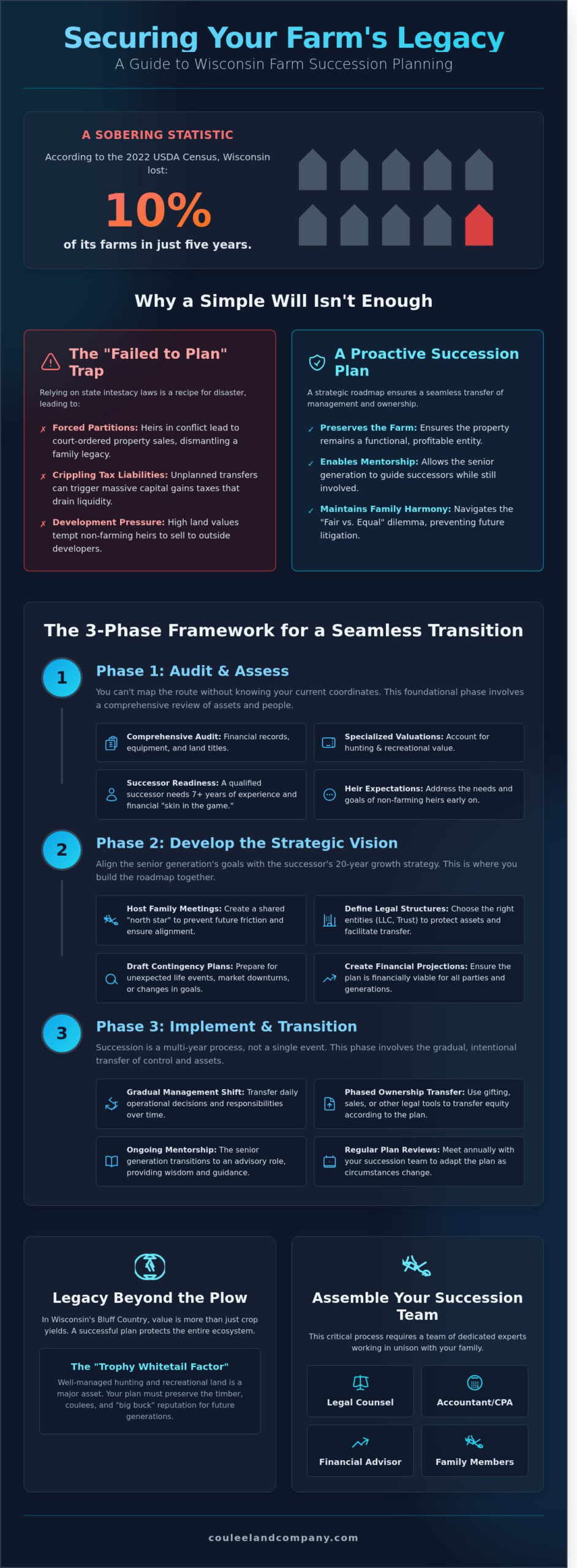
Wisconsin farm succession planning isn’t a single event. It’s a deliberate process that protects your legacy and the land’s productivity. Successful transitions follow a clear three-phase framework: Discovery, Visioning, and Implementation. Skipping steps often leads to family friction or unnecessary tax burdens. It’s vital that every generation involved sits at the table during the visioning phase. When the retiring generation and the successors don’t align on the 20-year outlook, the business model usually collapses within five years of the transfer. Open communication ensures everyone understands the path forward for the property.
Phase 1: Auditing Your Assets
You can’t plan for the future without a clear picture of the present. This phase requires a deep dive into financial records, land titles, and current hunting property valuations. In regions like Buffalo County, the recreational value of the land often rivals its agricultural value. You must assess the successor’s readiness beyond just their ability to drive a tractor. Do they have the management skills and financial skin in the game required for modern operations? This is also where you address the expectations of non-farming heirs. Identifying these expectations early prevents legal disputes that could force a land sale later.
Phase 2 & 3: From Vision to Reality
Once the audit is complete, the family must conduct a SWOT analysis for the farm’s future. This isn’t about next year’s crop; it’s about the 2044 outlook. We then set a concrete timeline for the gradual transfer of management duties. This transition typically happens over a 5 to 10-year window to allow the successor to gain confidence and authority. The final phase involves drafting the legal “teeth” of the plan. This includes:
- Drafting Buy-Sell agreements to control how shares are transferred.
- Creating detailed operating manuals for daily management.
- Finalizing estate documents that reflect the agreed-upon vision.
These documents ensure the land stays in the family and the business survives unforeseen life events. This structured approach is crucial for successful wisconsin farm succession planning. If you’re ready to start this process, speaking with our specialized land agents can help you understand the true market potential of your acreage.
Navigating Legal and Financial Hurdles in Wisconsin
The core challenge of wisconsin farm succession planning often boils down to the “Fair vs. Equal” dilemma. Most owners want to treat their children fairly, but giving an equal 25% share of a 200-acre Buffalo County farm to four siblings can lead to the “death by partition” of a legacy. If one child wants to farm and the others want to cash out, the land is often sold and subdivided, destroying its value as a contiguous hunting or agricultural tract. Savory planning involves using life insurance policies or non-farm assets to provide for off-farm heirs while keeping the acreage intact for the next generation of land stewards.
Timing is critical because of the looming 2026 tax law sunset. Under current rules, the federal estate tax exemption sits at $13.61 million per individual for 2024, but this figure is scheduled to drop by approximately 50% on January 1, 2026. Wisconsin landowners must also leverage the “step-up in basis.” This allows heirs to inherit the property at its fair market value on the date of the owner’s death, effectively wiping out decades of capital gains tax liability. A transition coordinator, often sourced through the Wisconsin Department of Agriculture, Trade and Consumer Protection (DATCP), can help facilitate these difficult conversations between generations.
The Power of the LLC
Establishing a Family Limited Partnership or an LLC is a pragmatic move for protecting “Bluff Country” holdings. This structure shields the land from individual liabilities, such as personal lawsuits or divorces, which could otherwise force a sale. Instead of transferring physical acres, owners transfer “membership units” or shares. This allows for a gradual transition of ownership, perhaps 2% or 5% annually, keeping the operation stable. It’s essential to work with specialized agents who recognize how these corporate structures affect the long-term marketability and management of rural land.
Managing the Tax Burden
Wisconsin’s Use Value Assessment remains a vital tool for keeping property taxes manageable. This system taxes agricultural land based on its income-producing capacity rather than its potential for residential development. However, owners focused on trophy whitetail management must be careful. If land is reclassified from agricultural to recreational, tax bills can spike by 100% or more. Conservation easements offer a strategic alternative. By voluntarily restricting development on sensitive bluff-side habitats, owners can secure significant tax relief while ensuring the land remains a haven for wildlife for decades to come.
Balancing Agriculture, Hunting, and Family Legacy
Successful wisconsin farm succession planning today looks far beyond the combine and the grain bin. It recognizes that a 200-acre parcel in the Coulee Region holds value that transcends traditional yield maps. In Western Wisconsin, specifically Buffalo County, the “Trophy Whitetail” factor is a primary driver of land worth. Buffalo County leads the nation with over 150 Boone and Crockett record book entries, making the recreational potential of your land a massive financial asset. You aren’t just passing down tillable acreage; you’re transitioning a premier recreational legacy.
Integrating a formal land management plan into your succession documents ensures the property remains a cohesive unit. This strategy helps bridge the gap between farming and non-farming heirs. While one child may want to run the dairy or row-crop operation, another might find their connection to the land through the deer stand. By designating specific areas for recreational use, you keep the entire family emotionally and financially invested in the property’s future.
- Leasing Income: Hunting leases can provide $30 to $55 per acre in prime Bluff Country, offering a safety net for the next generation.
- Conservation Easements: These can provide tax benefits while protecting the “wild” character of the land.
- Timber Management: Sustainable harvests provide periodic lump-sum payments that can fund estate buy-outs.
Maximizing Land Value During Transition
Professional land valuation is the only way to ensure a fair estate distribution among siblings. It’s the cornerstone of any wisconsin farm succession planning strategy. Families often overlook the potential for country homes with acreage on rugged terrain that isn’t suitable for heavy machinery. In Western Wisconsin, a property’s value often lies in its wildlife capabilities as much as its bushels-per-acre. This realization allows for creative partitioning where non-farming heirs maintain ownership of the “hunting woods,” keeping the family legacy intact without hindering the farm’s daily operations.
The Multi-Use Farm Model
Modern farms thrive on diversity. A 2023 analysis of land sales in the Driftless Area shows that properties with a mix of high-quality tillable ground and managed timber command the highest premiums. You should balance active row-cropping with timber stand improvement (TSI) and strategic food plots. This dual-purpose approach stabilizes the farm’s financial health. Diversified income streams, from corn yields to trophy hunting leases, make the transition more viable for the next generation by reducing reliance on volatile commodity markets.
View our current hunting properties to understand the market demand for premier Wisconsin acreage.
Taking the First Steps Toward Your Farm’s Future
Securing the future of your land requires moving from abstract ideas to concrete action. The USDA reports that approximately 70 percent of family farms fail to transition successfully to the second generation, often because the initial conversation never happens. Effective wisconsin farm succession planning begins with a clear timeline and a dedicated team of experts. You’ll need an attorney for legal structures, a CPA to mitigate the 15 to 20 percent capital gains tax hit, and a Land Specialist who understands the specific value of Wisconsin’s “Bluff Country.”
Setting a “Drop-Dead” date is the most effective way to prevent procrastination. Pick a date exactly 90 days from your first meeting to have a completed first draft in hand. Without this deadline, the process often stalls for years. You must also obtain an external valuation early. An objective report removes the emotional weight from the numbers. It prevents arguments between siblings regarding what the land is “worth” by providing a baseline rooted in current market data rather than sentiment.
The Family Meeting Agenda
Host the first meeting on neutral ground to keep tensions low. Focus on “Values” first and “Assets” second. Ask each member what they want the farm to look like in 20 years before discussing who gets which parcel. Establish ground rules: no interrupting and no historical grievances. Identify “Deal-Breakers” early, such as a firm refusal to sell the back 40 for development. This clarity reduces friction and keeps the focus on the legacy of the land.
Your Next Moves
Don’t leave your legacy to chance. Start the process today by gathering the right tools and professional insights. Follow these steps to begin your transition:
- Download a Wisconsin-specific farm succession workbook to organize your financial data.
- Contact Coulee Land Company for a confidential land valuation to establish your baseline market value.
- Schedule a consultation with a transition specialist to review your initial goals.
Proactive wisconsin farm succession planning ensures that the land you’ve worked remains a productive asset for your heirs. By assembling your team and setting firm deadlines, you protect both your family’s harmony and your property’s value.
Secure the Future of Your Bluff Country Legacy
Your land represents decades of sweat equity and a deep connection to Western Wisconsin’s rugged terrain. Effective wisconsin farm succession planning ensures your legacy doesn’t disappear through legal hurdles or family disputes. You’ve learned how the 3-phase framework provides a clear roadmap for transition while protecting your agricultural assets and trophy hunting potential. Buffalo County alone holds the #1 spot for Boone and Crockett whitetail entries in the United States; preserving that value requires specialized knowledge. We understand that a standard appraisal won’t capture the unique worth of your timber, tillable acres, and wildlife corridors. As specialists in the Bluff Country market, Coulee Land Company provides the expert insight endorsed by top outdoor industry professionals. We’ll help you navigate the financial complexities so your heirs inherit a thriving property rather than a complex legal burden. Get a Professional Land Valuation for Your Succession Plan to ensure your transition is handled with precision. Taking action today protects the soil and the hunt for the next 50 years.
Frequently Asked Questions
What is the difference between farm succession and estate planning?
Farm succession planning focuses on the transition of business operations and management; estate planning deals with the legal transfer of assets after death. Succession is the blueprint for who makes decisions and runs the daily operations in the field. Estate planning provides the legal documents like wills and trusts to move titles. Successful wisconsin farm succession planning requires both to ensure the legacy of your Bluff Country acreage remains intact for the next generation.
How do I divide the farm fairly if one child wants to farm and the others don’t?
You don’t have to split the land equally to be fair to your children. Many Wisconsin families use buy-sell agreements or life insurance policies to provide cash payouts to non-farming heirs while the land stays with the operator. This prevents a 200-acre home farm from being partitioned or sold to satisfy an inheritance. It ensures the farming child has a viable business while others receive their fair share of the family’s total wealth.
What are the tax implications of transferring a Wisconsin farm in 2026?
The federal estate tax exemption is scheduled to drop from $13.61 million in 2024 to approximately $7 million on January 1, 2026. This sunset of the Tax Cuts and Jobs Act means more Wisconsin farms will face a 40 percent federal tax rate on assets exceeding the new limit. You should act now to lock in current gifting limits. Shield your trophy whitetail properties from this looming 50 percent reduction in tax free transfers.
Does Wisconsin have a state inheritance tax on farmland?
Wisconsin does not have a state inheritance or estate tax on farmland as of January 1, 2008. The state legislature fully repealed the death tax to help family farms stay in the family. While you won’t owe the state a dime when inheriting property, you still have to navigate federal tax laws. This makes Wisconsin one of the most favorable states for long-term land ownership and legacy building in the Midwest.
How can I protect my land from being developed after I pass it on?
Conservation easements are the most effective way to ensure your land is never subdivided or developed into a housing tract. By working with organizations like the Mississippi Valley Conservancy, you can place permanent restrictions on the deed that limit future construction. These easements often provide a 100 percent deduction against your federal income tax. It’s a powerful tool for hunters who want to preserve the wildlife capabilities of their Buffalo County timber forever.
What is a ‘Step-up in Basis’ and why does it matter for my heirs?
A step-up in basis resets the cost basis of your farm to its current fair market value at the time of your death. If you bought land for $500 an acre in 1980 and it’s worth $8,000 today, your heirs can sell it immediately without paying capital gains tax on that $7,500 increase. This tax rule saves Wisconsin families thousands of dollars. It’s a critical component of any wisconsin farm succession planning strategy.
How much does a professional farm succession plan cost in Wisconsin?
A comprehensive farm succession plan in Wisconsin typically costs between $3,000 and $10,000 depending on the complexity of your holdings. This fee covers the work of attorneys, tax professionals, and land specialists who draft your trusts and operating agreements. While the upfront cost seems high, it’s a small price to pay to avoid a 40 percent federal estate tax bill or a family legal battle. Investing in professional guidance secures your 160-acre legacy properly.
Can I use an LLC to transfer my farm gradually over several years?
You can use a Limited Liability Company (LLC) to transfer ownership of your farm in small increments over 10 to 20 years. By gifting minority membership units to your heirs annually, you utilize the $18,000 per person gift tax exclusion. This method allows you to maintain control of operations while slowly moving equity out of your taxable estate. It’s a pragmatic way to transition the management of a hunting property without a massive tax hit.