
It’s a staggering fact: Buffalo County, Wisconsin, alone has produced more Boone and Crockett typical whitetails than 29 entire states. For any serious hunter, the dream of owning a piece of this legendary ground is powerful, yet the path to ownership is often crowded and confusing. You know the feeling; the competition for quality land is fierce, and it’s difficult to distinguish a property with genuine trophy potential from just another tract of woods, leaving you to fear overpaying for unproven ground.
This guide cuts through that noise. We’re not just talking about hunting spots; we are revealing the science and strategy behind the nation’s premier whitetail destination. You’ll discover the hard data that proves why this region leads the nation and get the essential framework for identifying and managing the land that consistently produces world-class Wisconsin Boone and Crockett Bucks. Consider this your blueprint for evaluating a property’s true wildlife capabilities and finding a specialist who speaks your language.
Key Takeaways
- Discover the specific soil and mineral compositions in Wisconsin’s “Driftless Area” that are non-negotiable for growing world-class antlers.
- Learn to read a topographic map like a seasoned outfitter to identify the key “bedding benches” and “cruising funnels” that consistently hold mature bucks.
- Understand the unique land management legacy of Buffalo County and why this single region produces more Wisconsin Boone and Crockett Bucks than most entire states.
- Get the 5-point inspection checklist every buyer must use to evaluate the true trophy potential of any hunting property before making an investment.
Why Wisconsin Consistently Leads the Boone and Crockett Record Books
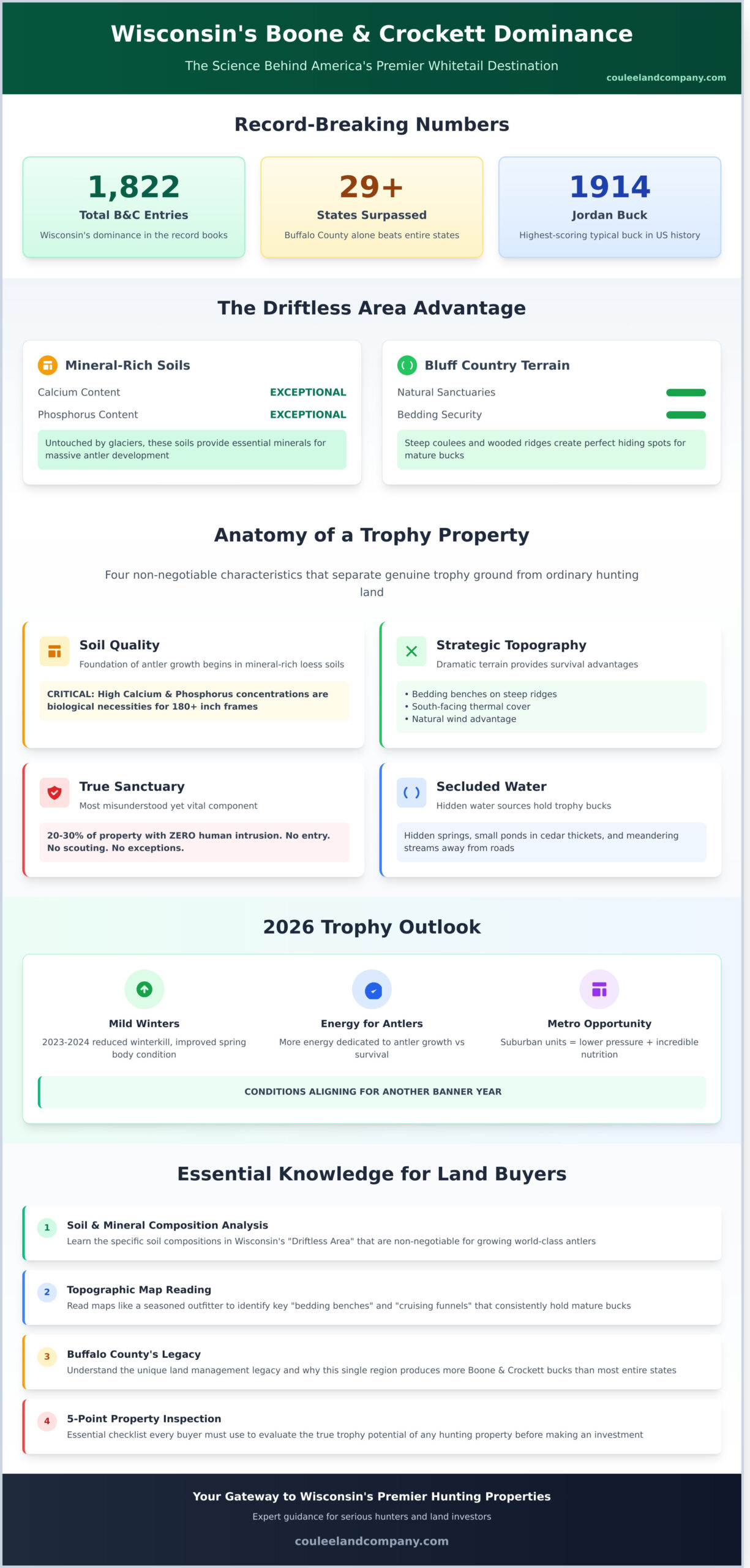
There’s no debate. When it comes to producing world-class whitetails, Wisconsin stands alone. The Boone and Crockett Club’s 14th edition of “Records of North American Whitetail Deer” confirms this dominance, crediting Wisconsin with an astounding 1,822 total entries. That isn’t a statistical anomaly; it’s the result of a perfect storm of geology, genetics, and strategic land management that has been brewing for decades. This legacy of producing giant whitetails dates back to 1914 with the harvest of the iconic Jordan Buck, a deer that still stands as the highest-scoring typical buck in the United States.
The foundation for Wisconsin’s trophy potential is literally its soil. The famed “Driftless Area” of western Wisconsin, a region untouched by the last glaciers, boasts incredibly fertile, mineral-rich soils. This geological gift translates directly into superior forage. Alfalfa, corn, and soybeans grown here are packed with the calcium and phosphorus essential for developing massive antlers. It’s a nutritional advantage that simply doesn’t exist in many other parts of the country.
This powerful nutrition is paired with a landscape built for sanctuary. The steep, rugged terrain of “Bluff Country” creates a natural fortress for mature bucks. The deep coulees and wooded ridge tops provide countless hiding spots where a buck can easily evade hunting pressure and live to reach the 5.5-year-plus age class. This unique topography, combined with a statewide management plan that divides the state into specific Deer Management Units (DMUs), helps maintain a healthy buck-to-doe ratio and a robust age structure, ensuring a consistent supply of mature animals.
The 2026 Outlook for Wisconsin Trophy Whitetails
Conditions are aligning for another banner year. The mild winters of 2023 and 2024 reduced winterkill and allowed bucks to enter spring with excellent body conditions, dedicating more energy to antler growth. Keep a close eye on the often-overlooked “Metro” gun seasons; these suburban units have lower hunting pressure and incredible nutrition, making them a secret weapon for hunters targeting the biggest Wisconsin Boone and Crockett Bucks.
Wisconsin vs. The Rest: A Comparative Analysis
While Illinois and Iowa produce incredible top-end bucks, Wisconsin’s sheer volume of record-book entries is unmatched. From a “Hunter’s Realtor” perspective, this makes Wisconsin land a more stable and accessible investment. The state’s natural advantages are widespread throughout the Coulee region, unlike the more concentrated trophy pockets in the flatlands of its Midwestern neighbors. This provides more opportunities for hunters and landowners to manage for and harvest a true giant.
Anatomy of a Trophy Property: What Makes a Buck Reach B&C Status?
Producing a Boone and Crockett buck isn’t an accident of nature; it’s the result of a precise formula where genetics, age, and nutrition converge. While genetics are widespread across the state’s herd, the key variables a landowner can control are age and nutrition. This is where the land itself becomes the most critical factor. A true trophy property isn’t just a piece of woods. It’s a complex ecosystem engineered to grow and hold mature deer. The finest properties in Western Wisconsin share four non-negotiable characteristics.
- Soil Quality: The foundation of antler growth begins in the dirt. The rich, dark loess soils of Wisconsin’s Driftless Area are packed with high concentrations of Calcium and Phosphorus, the essential minerals that build bone and antler. A buck can’t grow a 180-inch frame without ingesting these minerals through native browse and forage. This isn’t a preference; it’s a biological necessity.
- Topography: The dramatic terrain of Bluff Country provides mature bucks with an undeniable survival advantage. Steep ridges create natural “bedding benches” where a buck can lie with the wind at his back while visually scanning the coulee below. South-facing slopes offer critical “thermal cover,” allowing deer to absorb solar radiation and conserve vital energy during harsh Wisconsin winters, a key factor in year-over-year survival.
- Sanctuary: A true sanctuary is the most misunderstood and vital component. This is a designated core area, typically comprising 20-30% of a property’s total acreage, that remains completely free of human intrusion. No entry. No scouting. No shed hunting. This is where a 5 or 6-year-old buck feels secure enough to live out his life, and it’s the single most effective way to keep mature deer on your land.
- Water Access: While any water is good, secluded water is what holds trophy bucks. They are masters of avoiding exposure. Properties with hidden springs, small ponds tucked into cedar thickets, and meandering coulee creeks provide countless opportunities for a wary buck to drink during daylight hours without ever leaving secure cover.
The Role of Land Management in Antler Growth
Inherent quality is the starting point, but elite properties are actively managed for peak performance. High-protein food plots planted with soybeans, clover, and brassicas provide the nutritional engine required to grow 170+ inch typicals. Furthermore, strategic Timber Stand Improvement (TSI) like hinge-cutting creates the high-stem-density bedding cover that mature bucks crave. For today’s discerning buyer, superior whitetail land management isn’t an option; it’s a core investment value.
Neighboring Pressure and QDM Cooperatives
Your property doesn’t exist in a vacuum. Before making an offer, it’s critical to evaluate the “neighborhood.” Is the surrounding area managed with a similar mindset? The power of Quality Deer Management (QDM) cooperatives in Western Wisconsin cannot be overstated. This collaborative approach, which aligns with the management goals of the Wisconsin DNR, elevates the entire local herd. A 40-acre parcel located within a 1,500-acre QDM co-op will consistently outproduce an isolated 100-acre tract where hunting pressure is unmanaged. It’s proof that shared stewardship yields bigger bucks for everyone. Finding a property that contains this perfect recipe for growing Wisconsin Boone and Crockett Bucks is the ultimate goal, and it’s where our expertise as Wisconsin’s Land & Property Sales Specialists becomes invaluable.
Buffalo County: The Undisputed King of the Record Books
When you talk about giant whitetails, one name echoes louder than any other: Buffalo County. It’s not just a hotspot; it’s the epicenter of the whitetail world. With over 150 typical and non-typical entries, Buffalo County alone has more Boone and Crockett qualifiers than 28 entire states combined. This isn’t a fluke. It’s the result of a perfect storm of genetics, nutrition, and a culture built around growing mature deer. The legacy of producing world-class Wisconsin Boone and Crockett bucks is deeply woven into the fabric of the Buffalo County community.
A significant part of this success story is what we call the “Indrebo Effect.” Decades ago, land management pioneers like Ron Indrebo championed a radical idea for the time: selective harvest and letting young bucks walk. This philosophy of Quality Deer Management (QDM) took root here long before it became a national trend. It created a multi-generational legacy where landowners and hunters collaboratively manage the herd for an older age structure, the single most critical ingredient for producing record-book antlers.
This forward-thinking culture is amplified by the county’s unique topography. The Driftless Area’s landscape is a whitetail paradise, defined by:
- Steep Bluffs: Nearly vertical ridges create natural barriers and funnels.
- Deep Coulees: These hidden valleys provide sanctuary and secluded travel corridors.
- Hidden Benches: Flat shelves halfway up the bluffs serve as ideal bedding areas, keeping mature bucks safe from predators and pressure.
This rugged terrain is the ultimate “escape hatch.” It gives bucks the ability to evade hunters and reach full maturity at 5.5 years and older. While the official Wisconsin Deer Metrics System gives a great overview of herd health, the true magic of Buffalo County lies in how this landscape protects its most valuable asset: its age class.
Why Buffalo County Land Values Remain Resilient
Investing in Buffalo County land is about more than just owning property; it’s about acquiring a legacy. This is why its price-per-acre values consistently outpace surrounding regions. There’s a “trophy premium” baked into every deed. Buyers understand they are purchasing access to a whitetail hunting experience that is unmatched anywhere on the planet. For serious hunters and land investors, this is the Holy Grail of whitetail real estate, making it a remarkably stable and sought-after asset.
Finding the “Next Buffalo County” in Western Wisconsin
While Buffalo County wears the crown, the same genetics and terrain bleed into neighboring areas. Emerging trophy hotspots like Trempealeau, Pierce, and St. Croix counties possess the same raw potential. The key is spotting undervalued properties with that signature Buffalo County-style terrain. Look for parcels with steep, wooded bluffs overlooking fertile agricultural valleys. The secret lies in identifying those hidden gems with the perfect mix of food, water, and sanctuary cover. Unlocking this potential requires boots-on-the-ground knowledge, the kind that only dedicated recreational land specialists possess.
Evaluating the “B&C Potential” of Wisconsin Hunting Land for Sale
Securing a deed in Buffalo or Vernon County is a monumental first step, but the county name alone doesn’t guarantee a record-book buck. The true trophy potential is written in the dirt, the timber, and the topography of a specific parcel. An elite property actively grows, holds, and protects mature whitetails. To find one, you must go beyond the listing photos and perform a rigorous 5-point inspection that separates good ground from legendary ground.
This isn’t just about acreage; it’s about the right acreage. Here’s what our specialists look for:
- Topography & Travel Corridors: A topographic map is a playbook for deer movement. We look for “buck traps”-natural funnels like saddles between ridges, steep bluffs that force deer along a bench, or narrow pinch points between a swamp and a high bank. These are the high-odds ambush sites. Mature bucks use these “cruising funnels” to travel between bedding and feeding areas with maximum efficiency and security, especially during the November rut.
- Habitat Diversity: A property consisting of only 80 acres of mature hardwoods is a deer desert for much of the year. True B&C potential lies in diversity. You need a mosaic of thick bedding cover (like south-facing cedar thickets or hinge-cut sanctuaries), varied food sources (acorn-producing oaks, ag fields, and established food plots), and a reliable, year-round water source.
- Neighborhood & Access: The “neighborhood effect” is real. A property’s potential is directly impacted by the management practices on adjacent lands. Is the property an island surrounded by intense hunting pressure, or is it part of a larger block of like-minded QDM practitioners? Equally critical is your access. Can you get to your best stand locations with a favorable wind without alerting every deer on the property?
- Soil & Forage Quality: Genetics get the glory, but nutrition builds the bone. We analyze NRCS soil maps to identify parcels with productive soil types, like silt loams, that can support high-protein food plots. Poor soil means you’re fighting an uphill battle to provide the nutrition necessary to produce world-class antlers.
- Historical Data: Past performance is the single best indicator of future results. Ask the seller for the last 3 to 5 years of trail camera data. Don’t just look for one big buck; look for a consistent history of multiple bucks reaching 4.5 years of age or older. This data reveals the property’s ability to consistently produce the class of Wisconsin Boone and Crockett Bucks you’re after.
Red Flags That Kill Trophy Potential
Some properties look great on paper but have underlying issues. Be wary of land showing signs of over-browsing, where a visible browse line 4-5 feet high indicates too many deer and poor nutrition. A border with high-traffic public land that lacks a significant buffer or visual screen can also create constant pressure. Finally, trail camera history showing only does and 1.5-year-old bucks signals a deeply unbalanced herd with no mature age class.
The Value of Exclusive Listings and Off-Market Deals
The absolute best hunting properties-the ones with a proven history of producing giants-often never hit widely advertised listing platforms or the open market. They trade hands quietly between landowners or are sold through a specialist’s private network. This is where working with a true expert gives you an undeniable edge. A broker who is also a hunter, like Land Specialist like Mike Law, has deep connections in the community and often knows about premier properties long before they are publicly available. They can “read the dirt” as well as the contract, identifying subtle clues about a property’s potential that others miss.
An expert guide is invaluable in this process. Explore our dedicated buyer services for hunting land to see how our team can help you find and vet a property with genuine B&C potential.
Securing Your Legacy: How to Buy or Sell High-Value Hunting Properties
Owning a premier hunting property in Wisconsin’s Bluff Country is an investment in both your portfolio and your soul. The financial return on investment is undeniable; premium recreational tracts in counties like Buffalo, Trempealeau, and Vernon have shown consistent, powerful appreciation. But the emotional ROI is where the true value lies. It’s the quiet satisfaction of managing a piece of hallowed ground, the thrill of watching a buck grow over several seasons, and the creation of a legacy that your family will cherish for generations.
Selling a property with a proven history requires a strategy far beyond a standard real estate listing. You are marketing a legend, not just land. This is where the “Hunter’s Realtor” promise becomes critical. A generic agent sees acres and soil types; we see pinch points, thermal hubs, and the precise habitat needed to produce mature, heavy-horned whitetails. Our team’s deep, boots-on-the-ground expertise allows us to translate a property’s unique wildlife capabilities into maximum market value. For those looking to capitalize on their years of stewardship, our specialized seller services for land owners are designed to honor your investment and achieve a record-breaking return.
Preparing Your Land for a Record-Breaking Sale
A documented history is your single most powerful sales tool. We call it “social proof,” and it’s the definitive evidence of a property’s potential. A meticulously organized binder filled with years of trail camera photos, detailed harvest logs with scores and dates, and maps of food plot rotations isn’t just memorabilia; it’s a prospectus for the next owner. Properties with a clear, professional land management plan in place, from established clover plots and brassica fields to hinge-cut bedding sanctuaries, consistently command a premium of 15-20% over unmanaged parcels. To amplify this value, Coulee Land Company leverages its exclusive network of outdoor industry professionals. A video walkthrough with a respected hunting personality provides unparalleled credibility, instantly validating the property’s quality to a national audience of serious buyers.
Final Steps: Closing the Deal on Your Dream Property
Acquiring your dream property involves more than just an accepted offer. Navigating Wisconsin’s property tax laws is a crucial step toward long-term financial health. We guide our clients through programs like the Managed Forest Law (MFL), which offers 25- and 50-year enrollment options that can reduce property tax liability by over 80% in exchange for a sustainable forestry plan. This makes holding and improving a large property significantly more affordable. Once the papers are signed, your first 100 days are about transitioning from buyer to land steward. This is the time to:
- Walk every property line and confirm access points.
- Take soil samples for your future food plots.
- Consult with a forester to align timber goals with wildlife habitat.
- Deploy trail cameras to begin a comprehensive inventory of the herd.
The quest for Wisconsin Boone and Crockett Bucks is a marathon, not a sprint. It begins with securing the right piece of land and cultivating its potential. The journey from initial search to a successful harvest is one we’ve guided countless clients through, backed by a team that speaks your language and shares your passion. This is your chance to own a piece of the legend. Contact us today to start your trophy land search.
Your Trophy Legacy Starts Here
The data doesn’t lie. Wisconsin, with Buffalo County consistently leading all U.S. counties in record-book entries, offers an unparalleled opportunity for the serious whitetail hunter. But securing a place in the books isn’t a game of chance. It’s a calculated investment in a property with the right genetics and habitat, guided by proven Quality Deer Management principles-a science we’ve mastered over decades in the heart of Bluff Country.
The pursuit of legendary Wisconsin Boone and Crockett bucks demands more than just a real estate agent; it requires a team of dedicated land specialists. It’s why top outdoor TV personalities trust our expertise to find and manage world-class hunting properties. We don’t just sell land; we help build hunting legacies.
Your journey begins with the right piece of ground. View Our Exclusive Wisconsin Hunting Land Listings and let our team of hunter-realtors guide you to the property you’ve always dreamed of. Your legacy buck is waiting.
Frequently Asked Questions About Wisconsin’s Trophy Bucks
Which Wisconsin county has the most Boone and Crockett entries?
Buffalo County has the most Boone and Crockett entries, making it the undisputed trophy whitetail capital of not just Wisconsin, but the world. As of 2023 records, Buffalo County has produced over 150 entries in the B&C record book. This incredible success is a direct result of the county’s superior genetics, rugged terrain that allows bucks to mature, and a deep-rooted culture of quality deer management. It’s the gold standard for hunters seeking land capable of producing legendary Wisconsin Boone and Crockett bucks.
What is the minimum score for a whitetail to make the Boone and Crockett book?
The minimum score for a typical whitetail to qualify for the Boone and Crockett “Awards” book is 160 inches, while the prestigious “All-Time” record book requires 170 inches. For non-typical bucks, the minimums are higher at 185 inches for the Awards book and 195 inches for the All-Time book. These scores represent the top tier of antler development and are the ultimate benchmark for trophy whitetail hunters across North America.
Does CWD affect the value of hunting land in Wisconsin?
Chronic Wasting Disease (CWD) can influence hunting land values, though the specific impact varies. A 2018 study by the University of Wisconsin-Whitewater suggested a potential 10-20% decrease in land value in some CWD-positive areas. However, premium hunting properties in sought-after regions like the Driftless Area often maintain strong demand. Discerning buyers and seasoned hunters focus on a property’s long-term wildlife capabilities and management potential, which are key drivers of value.
How much does an acre of hunting land cost in Buffalo County, WI?
An acre of quality hunting land in Buffalo County typically costs between $6,000 and $12,000 as of 2024. The final price depends on critical factors like road access, timber value, the percentage of tillable acreage for food plots, and a proven history of trophy buck activity. Parcels with established trail systems, water sources, and documented harvests will command prices at the higher end of this range, representing a premier investment for serious hunters.
Can a small 20-acre property produce a Boone and Crockett buck?
Yes, a small 20-acre property can absolutely produce a Boone and Crockett buck if it’s in the right neighborhood and managed correctly. The key is to own the best habitat on the block. If your parcel provides the most secure bedding cover, the only water source, or the most desirable food source in the immediate area, it will attract and hold mature bucks from surrounding properties. Strategic habitat improvements can turn a small tract into a big buck magnet.
What is the difference between “Typical” and “Non-Typical” B&C scores?
The primary difference is how antler symmetry is measured. A “Typical” score is based on a symmetrical frame and receives deductions for differences between the left and right antlers. The goal is perfect balance. A “Non-Typical” score starts with the typical frame’s score and then adds the total length of all abnormal points, such as droptines or kickers. This system rewards racks for their unique character and sheer volume of antler growth.
Do I need a special license to hunt trophy bucks in Wisconsin?
No, you don’t need a special or separate license to hunt trophy bucks in Wisconsin. Your standard Wisconsin deer hunting license, purchased through the DNR, gives you the legal authority to harvest any buck, regardless of its antler score. The true challenge isn’t acquiring a tag but gaining access to or owning private land that is managed to allow bucks to reach their maximum genetic potential, which often means reaching 5.5 years of age or older.
Why is the “Driftless Area” so good for deer hunting?
The “Driftless Area” is an exceptional zone for deer hunting because its unique topography was never flattened by glaciers. This created a rugged landscape of steep ridges, deep coulees, and fertile valleys that provide the perfect mix of sanctuary and nutrition. The combination of hardwood timber on the ridges for bedding and security, along with rich agricultural crops in the valleys for food, gives whitetails everything they need to thrive and reach trophy status.