
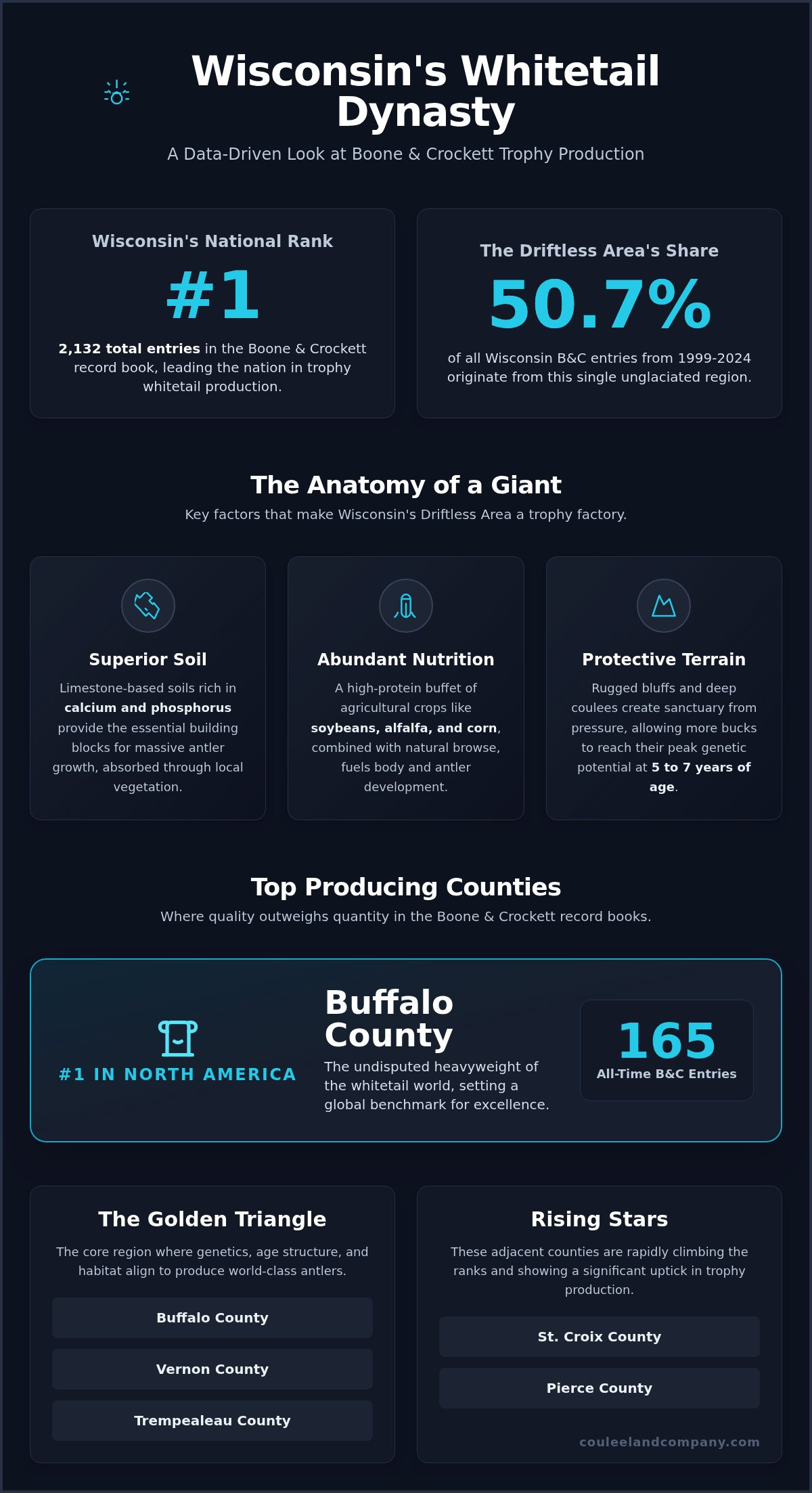
Did you know that a single geographic slice of Wisconsin produces over half of the state’s record-book whitetails? Between 1999 and 2024, the rugged Driftless Area accounted for 50.7% of all entries, proving that trophy potential isn’t just about luck; it’s about the dirt. You’ve likely spent hours scrolling through generic sites, trying to analyze wisconsin boone and crockett bucks by county to separate high-density regions from the true “giant” factories. It’s frustrating to see high harvest numbers that don’t translate to the heavy antler growth you’re after.
This guide cuts through the noise to rank the top-producing regions for the 2026 season. We’ll explore why the unique “Bluff Country” geography creates world-class whitetails and provide the expert data you need to invest in a legacy property that produces mature bucks year after year. From the legendary ridges of Buffalo County to the fertile valleys of Vernon and Richland, you’re about to discover where the next state record is likely hiding and why this region remains the undisputed king of North American whitetail hunting.
Key Takeaways
- Understand why the Driftless Area’s unglaciated terrain and fertile soils consistently produce the nation’s heaviest antler growth.
- Identify the top producers using our 2026 data on wisconsin boone and crockett bucks by county, featuring the legendary Buffalo, Vernon, and Richland counties.
- Explore the specific biological factors and habitat requirements that have maintained Buffalo County’s status as the #1 record-book destination in North America.
- Learn how to transition from studying record books to securing your own property through strategic land acquisition and neighborhood management.
- Discover how professional land specialists bridge the gap between B&C statistics and securing a high-value legacy property in the heart of Bluff Country.
The Geography of Giants: Why Wisconsin Leads the Nation in Boone and Crockett Entries
The Boone and Crockett (B&C) scoring system remains the undisputed gold standard for measuring mature whitetail trophies. It’s a rigorous, data-driven process that evaluates antler mass, tine length, and symmetry to determine if a buck qualifies for the all-time records. Wisconsin currently leads the nation with 2,132 entries; a statistic that proves the state’s habitat is uniquely designed for trophy production. When you examine the data for wisconsin boone and crockett bucks by county, it becomes clear that this dominance isn’t a matter of chance. It’s the result of the Driftless Area, a region of unglaciated “Bluff Country” where steep ridges and deep coulees provide the sanctuary needed for bucks to reach their full potential.
To better understand the history of legendary deer in this region and how they are measured, watch this helpful video:
The Biological Edge: Soil, Nutrition, and Age
The mineral content of Western Wisconsin soil is the primary driver behind these massive racks. High levels of calcium and phosphorus in the limestone-based soil are absorbed by local vegetation, providing the building blocks for antler density. Foundational White-tailed Deer Facts show that nutrition is a key pillar of growth, and the mineral-rich dirt here is superior to almost anywhere else in the country. When you study wisconsin boone and crockett bucks by county, the highest concentrations consistently align with these specific soil profiles.
Nutrition extends beyond the soil to the diverse agricultural forage available. The Driftless Area offers a high-protein buffet of soybeans, alfalfa, and corn, balanced by a wide variety of natural browse found in the timbered bluffs. This caloric surplus allows bucks to survive harsh winters and still have the energy required for antler development. Wisconsin’s management history also plays a role. The state’s traditions and regulations have fostered a healthy age structure, allowing more bucks to reach the five to seven year old range where they express their maximum genetic potential.
Terrain also provides a tactical advantage for survival. The rugged bluffs create micro-climates and deep thermal cover that protect deer from extreme weather and hunting pressure. These hidden pockets are where the giants live. For serious hunters, securing the right hunting properties in these corridors is the most effective way to ensure consistent encounters with record-book class animals.
Wisconsin Boone and Crockett Bucks by County: A Breakdown of the Top Producers
Analyzing wisconsin boone and crockett bucks by county reveals a sharp divide between deer density and trophy potential. While northern counties often boast higher harvest numbers, the western edge of the state dominates the record books. This is where quality outweighs quantity. Serious hunters understand that a high deer count doesn’t always lead to a wall-hanger. Instead, they focus on the “Golden Triangle” of Buffalo, Vernon, and Trempealeau counties, where the genetics and age structure align to produce world-class antlers.
The Dominance of Buffalo County
Buffalo County is the undisputed heavyweight of the whitetail world. With 165 all-time entries, it’s the top-ranked county in North America for Boone and Crockett whitetails. This isn’t just a local statistic; it’s a global benchmark for excellence. The combination of steep terrain and managed acreage allows bucks to reach maturity, making it the ultimate prize for those looking to invest in a legacy. You can learn more about the local landscape and culture in our Buffalo County community guide. The success here has set the standard for the surrounding regions, creating a culture of stewardship that benefits the entire Driftless Area.
Western Wisconsin’s Rising Stars: St. Croix and Pierce Counties
While the Golden Triangle gets the headlines, St. Croix and Pierce counties are rapidly climbing the ranks. These areas are seeing an uptick in record-book entries because of a shift toward sophisticated private land management. According to the Boone and Crockett Club’s Wisconsin records, these counties are no longer sleepers; they’re proven producers. The correlation is clear: when landowners prioritize habitat and limit pressure, the B&C potential skyrockets. This trend makes these counties excellent targets for buyers who want to get ahead of rising land values.
Contrast this with the high-density northern counties where winter kill and lower-quality forage can limit antler growth. In the west, the focus remains on the individual buck’s potential. If you’re ready to move from the record books to the field, browsing our current hunting properties is the first step toward securing your own piece of this legendary territory.
From Record Books to Reality: How to Secure Your Own Trophy Whitetail Property
Owning your own ground is the only consistent way to harvest a world-class buck. While public land offers adventure, it doesn’t provide the control over age structure and habitat required for B&C success. When you analyze wisconsin boone and crockett bucks by county, you’re looking at the results of long-term management. Real success happens when you manage the land year-round, ensuring that high-protein forage and low-pressure sanctuaries exist on your specific acreage. This control allows you to pass on four-year-olds with the confidence they’ll survive to reach their peak potential.
Neighborhood management is just as vital as your own property lines. The Driftless Area dominates the top 12 counties for trophy bucks because of a shared culture among landowners. When your neighbors are committed to letting young bucks walk, your 40 or 80 acres suddenly feels like part of a much larger, managed ecosystem. This synergy is what turns a good hunting spot into a consistent producer of record-book whitetails.
Scouting for Property with Record Book Potential
Finding a property with true trophy potential requires an eye for specific topographical features. You aren’t just looking for woods; you’re looking for natural funnels, secluded bedding on south-facing slopes, and reliable water sources that aren’t easily disturbed. Thermal cover is another non-negotiable for winter survival in the Bluff Country. To refine your search, review the 5 Key Features of Trophy Whitetail Properties to understand how landscape architecture dictates deer movement. Identifying these nuances before you buy is the difference between a high-value investment and a frustrating purchase.
Partnering with a Wisconsin Land Specialist
A standard residential realtor lacks the specialized vocabulary of genetics, soil biology, and habitat stewardship. They see a price per acre; we see wisconsin boone and crockett bucks by county data translated into real-world opportunity. You need a partner who understands how a specific coulee or ridge system influences a buck’s ability to reach age six. Our team at Coulee Land Company lives and breathes this lifestyle. We recommend meeting with specialists like Mike Law or Bryan Lemke, who possess the regional expertise to identify “sleeper” tracts that others miss. Let us help you find the legacy property that puts your name in the record books.
Claim Your Stake in the Land of Giants
Securing a record-book whitetail is a journey that begins with a deep understanding of the land. We’ve explored how the unglaciated soils of the Driftless Area provide the essential biological foundation for world-class antlers and why the data on wisconsin boone and crockett bucks by county consistently points to the western ridges. Whether you’re targeting the legendary Buffalo County or rising stars like Pierce and St. Croix, the difference between a close encounter and a harvested trophy often comes down to owning the right dirt.
At Coulee Land Company, we bridge the gap between B&C statistics and property ownership. Our team brings an authentic hunter-broker perspective to every transaction, specializing in the very counties that lead the nation in entries. Endorsed by industry leaders and rooted in regional expertise, we don’t just sell land; we help you build a hunting legacy. It’s time to stop dreaming about the record books and start managing your own piece of Bluff Country.
Browse Our Exclusive Wisconsin Hunting Land Listings and take the first step toward your 2026 trophy season. The giants are out there, and with the right strategy, your name could be next in the books.
Frequently Asked Questions
Which Wisconsin county has the most Boone and Crockett entries?
Buffalo County is the undisputed leader, boasting 165 Boone and Crockett entries, which makes it the top-producing county in North America. Its unique position in the heart of the Driftless Area provides the perfect storm of genetics, nutrition, and age. This specialized environment is why serious trophy hunters consistently focus their land searches within this specific territory to maximize their chances of an encounter with a giant.
What is the minimum score for a Boone and Crockett whitetail buck?
The minimum entry score depends on the category and whether you’re aiming for the Awards or All-time books. Typical whitetails require a net score of 160 for Awards and 170 for All-time status. Non-typical bucks have higher thresholds, requiring 185 for Awards and 195 for the All-time records. These standards ensure the Boone and Crockett name remains the definitive benchmark for the most elite mature whitetails in the world.
Why is Western Wisconsin so much better for trophy hunting than the Northwoods?
Western Wisconsin outperforms the Northwoods because of its superior soil fertility and diverse nutritional landscape. The limestone-based soils of the Driftless Area deliver essential minerals like calcium directly into the forage, which is critical for antler density. Unlike the vast, often nutrient-poor forests of the north, the western “Bluff Country” combines high-protein agriculture with rugged sanctuary that allows bucks to survive long enough to grow massive racks.
Can I find Boone and Crockett bucks on public land in Wisconsin?
You can find giants on public land, but the data on wisconsin boone and crockett bucks by county shows that private land management is the most consistent path to success. Public tracts often face higher pressure, which prevents most bucks from reaching the five-year-old threshold. Owning property allows you to implement year-round habitat improvements and strict harvest criteria, which are the primary drivers behind the state’s record-book frequency.