
Buffalo County, Wisconsin, dominates the Boone and Crockett record book, boasting more typical and non-typical whitetail entries than any other single county in North America. It’s not a fluke; it’s a formula of genetics, terrain, and soil that creates a trophy factory unlike any other place on earth.
You’ve dreamed of owning a piece of this legacy, a place where trail camera pictures of 160-inch bucks are the rule, not the exception. Yet, the intense competition for quality land and the confusion over which parcels truly deliver can make that dream feel out of reach. It’s frustrating to pour your heart into a small property only to watch mature bucks live on the neighbor’s land.
This is your strategic plan for 2026. We’re pulling back the curtain on the specific management strategies and geographic secrets that produce legendary Wisconsin big deer. You’ll discover how to identify properties with superior wildlife capabilities and learn the exact steps to transform your own piece of the Bluff Country into a whitetail sanctuary, ensuring your investment becomes a legacy for generations to come.
Key Takeaways
- Pinpoint the exact geographic features within the Bluff Country that provide the mineral-rich soil and security cover necessary to grow giant whitetails.
- Learn to identify “fringe” counties that offer the same elite genetics as Buffalo County but at a more accessible price point for your investment.
- Go beyond basic food plots by implementing the “nutritional high-grading” strategy required to consistently produce a 170-inch Wisconsin big deer.
- Understand why a specialized “Hunter’s Realtor” is essential for evaluating a property’s true hunting potential and long-term ROI in today’s market.
The Legend of the Wisconsin Giant: Why the Badger State Dominates the Record Books
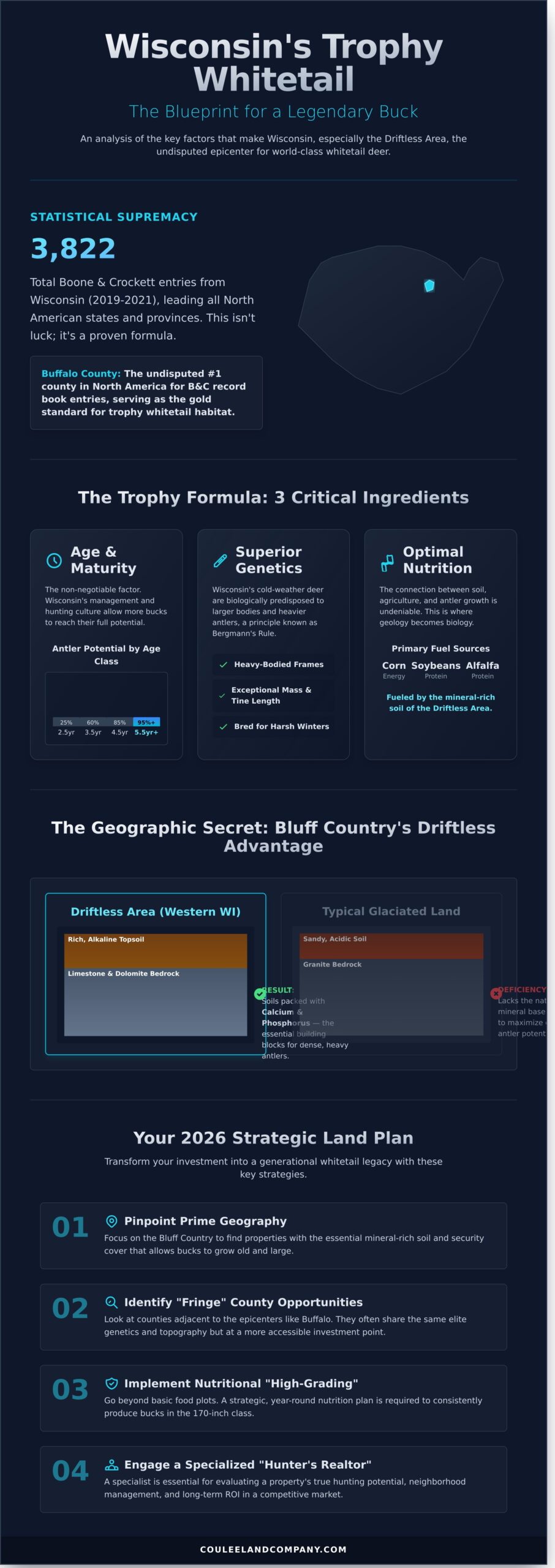
It’s not folklore or a tall tale shared around a campfire. It’s a statistical fact. When you analyze the data, Wisconsin stands alone at the pinnacle of trophy whitetail production. The state’s dominance in the Boone & Crockett record books isn’t an accident; it’s the result of a perfect storm of genetics, nutrition, and sound management. The classic Wisconsin big deer phenotype is unmistakable: a heavy-bodied frame built for harsh winters, crowned with antlers defined by exceptional mass and tine length. For serious hunters, this isn’t just another state on the map; it’s the hallowed ground where legends are made.
Understanding the strategy behind consistently harvesting mature bucks is the first step toward success. This video offers superior insights into the year-round work required:
The Boone & Crockett Factor
The numbers speak for themselves. According to the Boone and Crockett Club’s 31st Big Game Awards data from 2019-2021, Wisconsin led all North American states and provinces with an incredible 3,822 total entries. This historical dominance isn’t slowing down. The state’s deer management plan, which extends through 2026, continues to empower County Deer Advisory Councils (CDACs). This localized approach fosters regulations that protect younger bucks and promote a healthier age structure. Nowhere is this more evident than in Buffalo County, which has produced more B&C record book entries than any other county in the nation. Dane County follows as another consistent producer, making these regions the undisputed epicenters for any hunter seeking a world-class whitetail.
Biology of a Trophy Whitetail
A trophy buck is the product of three key ingredients: age, genetics, and nutrition. Wisconsin delivers on all fronts. The state’s rich agricultural landscape provides a high-protein buffet of corn, soybeans, and alfalfa that fuels explosive antler growth. This superior nutrition is paired with cold-weather genetics. This biological blueprint is the foundation of The Legend of the Wisconsin Giant, but it’s the state’s unique environment that unlocks it. These deer exhibit the principles of Bergmann’s Rule, a scientific observation that populations in colder climates tend to have larger body masses to conserve heat, resulting in the heavy-bodied giants hunters dream of.
Age is the final, critical component. A buck doesn’t reach over 95% of its genetic antler potential until it hits the 5.5-year age class. The deep-rooted hunting culture in the famed “Bluff Country,” combined with a growing commitment to Quality Deer Management (QDM), means more bucks are reaching this peak maturity. It’s this powerful combination of factors that creates the emotional connection to the hunt here. It’s more than just a pursuit; it’s an opportunity to become part of a legacy built on the rich soil and rolling hills of Wisconsin.
Geography of a Trophy: The Bluff Country and Driftless Advantage
Not all Wisconsin land is created equal. The secret to consistently producing trophy-class whitetails isn’t just about genetics; it’s baked into the very ground they walk on. The famed “Bluff Country” of Western Wisconsin, a region untouched by the last glaciers, offers a powerful combination of mineral-rich soil and rugged topography. This unique landscape, known as the Driftless Area, is the engine that drives the Boone and Crockett record books, and it’s the reason why hunters seeking a truly Wisconsin big deer focus their efforts here.
This isn’t a matter of opinion. It’s a matter of geology. The landscape provides everything a mature buck needs to survive, thrive, and express its maximum genetic potential through massive antler growth.
The Role of Soil and Minerals
The glaciers that flattened much of the Midwest bypassed this region, leaving behind a foundation of limestone and dolomite bedrock. Over millennia, this rock has weathered into deep, alkaline soils packed with calcium and phosphorus. These are the essential building blocks for strong skeletal frames and, most importantly, dense, heavy antlers. This geological advantage means the deer herd has access to superior nutrition right from the source, a benefit simply not available in the sandy, acidic soils of other regions. This direct link between land quality and herd health is why the most productive hunting properties for sale are found within this mineral-rich zone.
Topography as a Security Blanket
Mature bucks are masters of survival, and the Driftless Area is their fortress. The vertical terrain, with its steep ridges and deep valleys, creates natural sanctuaries that are difficult for predators, including humans, to access. A wise old buck will almost always bed on a “military crest” a point just below the ridge top that gives him a commanding view of the valley below while keeping his silhouette hidden from the skyline. This steep terrain is nature’s gatekeeper, limiting hunting pressure and allowing bucks to reach the 5.5- to 6.5-year-old age class. This natural age structure is the foundation of trophy management, a core principle detailed in the 2026 Strategies for 170-Inch Bucks and other long-term state goals.
The landscape itself dictates deer behavior. A coulee is a steep-sided, V-shaped valley that acts as a natural funnel for deer movement, channeling them between bedding and feeding areas.
Furthermore, this topography provides critical thermal cover. The deep coulees and shaded, north-facing slopes offer deer a refuge from blistering summer heat and a shield against brutal winter winds, reducing stress and conserving vital energy reserves. This intersection of timbered security cover and adjacent agriculture creates the perfect “edge effect.” Bucks can live securely in the hardwoods while having easy access to high-protein food sources like alfalfa, soybeans, and corn in the valley floors. It’s the ideal habitat for growing a monster whitetail. It’s this powerful combination of geology and geography that makes the Driftless Area the undisputed king of whitetail country. Understanding how to find a property where all these elements converge is the key, and it’s a skill our team of land specialists has honed over decades in these very hills.
Buffalo County vs. The Rest: Evaluating Wisconsin’s Premier Regions
For decades, one name has dominated the conversation about trophy whitetails: Buffalo County. The record books don’t lie. It’s the undisputed heavyweight champion, producing more Boone and Crockett entries than any other county in the nation. But for the serious hunter looking to invest in their own piece of hallowed ground, the question becomes more complex. Is the premium price for a Buffalo County address the only path to a legendary buck, or are there smarter plays on the board?
The truth is, the magic of this region isn’t confined by county lines. The same world-class genetics and nutrient-rich habitat extend across Western Wisconsin. Understanding the nuances between the epicenter and its potent neighbors is the key to making a wise investment and realizing your dream of harvesting a true Wisconsin big deer.
Why Buffalo County Still Wears the Crown
The dominance of Buffalo County isn’t an accident; it’s the result of a perfect storm of geography, culture, and decades of intensive land management. A deep-rooted, multi-generational culture of Quality Deer Management (QDM) means hunters religiously pass on 3.5 and 4.5-year-old bucks, allowing them to reach their maximum genetic potential. This isn’t just a suggestion here; it’s the local code. This ethos, combined with superior food plots and timber management, has created a unique environment where mature bucks are the rule, not the exception. For professional hunters and those demanding the absolute highest probability of a record-book encounter, the proven history and disciplined culture of Buffalo County justify its premium market value, which can often exceed $10,000 per acre for prime hunting tracts.
Emerging Trophy Hotspots in 2026
The secret that savvy land specialists know is that the incredible deer habitat doesn’t stop at the Buffalo County border. The steep ridges, deep valleys, and fertile agricultural land are characteristic of the entire region. The unique, unglaciated terrain creates natural funnels and sanctuaries that are ideal for growing and holding mature whitetails. This is where The Bluff Country and Driftless Advantage truly comes into play, creating opportunities in neighboring counties. Counties like Trempealeau, Jackson, Vernon, and La Crosse share this incredible topography and genetic base but often at a more accessible price point.
Consider the investment potential. A hunter might find a premier 80-acre parcel in Trempealeau County for $450,000, while a comparable property in Buffalo County could command over $700,000. This price difference allows an investor to acquire what we call “fixer-upper” hunting land-properties with incredible potential that may need strategic timber stand improvement, food plot installation, or access trails. By investing sweat equity and a fraction of the cost savings, a landowner can cultivate a property with B&C potential that rivals any in the state. The Mississippi River corridor, in particular, offers both public and private opportunities, acting as a massive travel route for bucks during the rut. While it can present challenges with hunting pressure and access, its potential for producing a giant is undeniable.
Looking toward the 2026 market, the demand for high-quality recreational land shows no signs of slowing. As prices in the epicenter continue to climb, the value proposition of these “fringe” counties will only become stronger. For the astute buyer, they represent the next frontier for securing a legacy property and the ultimate goal: a world-class Wisconsin big deer.
Managing for Maturity: 2026 Strategies for 170-Inch Bucks
Harvesting a 170-inch whitetail in Wisconsin isn’t an accident; it’s the calculated result of a multi-year commitment to superior land management. The bucks that reach this class don’t just happen upon good properties. They are cultivated there. Achieving this goal by 2026 requires a disciplined, year-round approach that transforms your land into a sanctuary where mature deer choose to live. It’s about giving them everything they need, exactly when they need it.
The foundation of this strategy is a strict annual calendar. Forget random weekend projects. Success demands a plan:
- January-March: This is your construction season. Execute your Timber Stand Improvement (TSI) plan, focusing on hinge-cutting to create immediate bedding cover. It’s also the time for frost-seeding clover into existing plots.
- April-June: Get your soil tests done by April 15. Based on the results, apply lime and fertilizer. Plant your perennial food plots like clover and alfalfa to provide critical protein for antler growth.
- July-August: Focus on high-energy fall plots. Plant your brassicas, turnips, and radishes by August 1. This is also the time to ensure every water source is clean and full before the early archery season.
- September-December: Hunt smart. Use observation stands to gather intelligence before moving in for the kill. Your pressure management during these months is the single most important factor in holding mature bucks.
The Modern Food Plot Strategy
We’ve moved beyond simply planting a green field. The new strategy is “nutritional high-grading,” which means providing the absolute best forage at key times. A combination of perennial clovers for spring and summer protein, followed by late-season brassicas for winter energy, creates a year-round buffet. Use small, 1/4-acre “hidey-hole” plots tucked into the timber to coax mature bucks into daylight during legal shooting hours, a proven tactic for getting a shot before the October lull.
Creating Bedding and Security
Food is an attractant, but security is what holds a truly massive Wisconsin big deer on your property. The most effective tool for this is hinge-cutting. By using a chainsaw to fell smaller-diameter trees (3-8 inches) at waist height without severing them completely, you create instant horizontal cover. This thick, tangled habitat is precisely what mature bucks seek for daytime security. This work, done in the winter of 2024, creates the secure bedding that will hold a 5.5-year-old buck in 2026.
This habitat work is useless without establishing a non-negotiable sanctuary. A full 25% of your property must be designated as off-limits to all human traffic, year-round. This core area becomes a buck’s safe space, ensuring he never feels pressured to leave. When you do monitor the property, use trail cameras intelligently. Place them on travel corridors leading to food, not directly in bedding areas, and check them no more than once every three weeks to avoid burning out your prime locations.
Putting these elite strategies into practice starts with the right piece of ground. A property with the inherent structure for sanctuaries and food plots is paramount. Implementing these advanced management techniques requires the perfect canvas. Explore our inventory of properties engineered for trophy whitetail potential.
Securing Your Legacy: Navigating the Wisconsin Land Market
The pursuit of a trophy whitetail is a journey. For many, the final, most rewarding step is owning the ground where that journey unfolds. Public land offers opportunities, and leases can provide access, but ownership is different. It’s about control, stewardship, and building a legacy. In the hyper-competitive land market of the mid-2020s, securing a premier hunting property requires more than just a search; it demands a specialist who understands the unique variables that create a haven for Wisconsin big deer.
This isn’t about buying a weekend getaway. It’s about investing in a property with a high “hunting ROI,” a place where your management efforts in food plots, timber stand improvement, and pressure control directly translate to more and bigger bucks on camera and on the ground. The path from dreaming about your own slice of Bluff Country to that first crisp morning in your own stand is clear, but it requires an expert guide.
Why a Land Specialist Matters
A general real estate agent sells houses; a land specialist understands habitat. When Mike Law and our team walk a property, we’re not just measuring acreage. We are reading a story written in buck rubs, historical scrapes, and subtle terrain features that dictate deer movement. We see the difference between “dirt value,” the raw price per acre, and “hunting value,” the property’s proven or potential ability to produce and hold mature whitetails. A 40-acre parcel with a hidden ridge-top food plot and secure bedding cover can have a far greater hunting value than a flat, featureless 80-acre tract. This deep understanding is also critical when we properly value land for sellers, ensuring decades of stewardship are reflected in the asking price.
The Path to Ownership
For serious buyers, navigating this market requires a strategic approach. The best properties, especially in famed counties like Buffalo and Trempealeau, often trade hands before ever hitting the open market. Our local connections and deep network provide access to these off-market listings, giving our clients a critical head start. The process follows a proven roadmap:
- Strategic Planning: We begin by defining your specific goals. Are you seeking a turnkey property with established food plots or a blank slate to craft your own whitetail paradise?
- Financing First: Securing pre-approval is a crucial step. Financing recreational land is a specialized field, and we connect our clients with lenders who understand the nuances of land loans, often offering more favorable terms than traditional banks.
- Boots on the Ground: We identify and vet properties that match your criteria, leveraging our network to uncover hidden gems. We walk every potential property with you, pointing out the features that matter.
- Closing the Deal: From offer to closing, we manage the complexities of due diligence, including access verification, mineral rights, and survey reviews, ensuring a smooth transaction.
Ultimately, owning the land is the only way to truly control your hunting destiny. It empowers you to manage the habitat, control the pressure, and cultivate the deer herd you’ve always dreamed of. It’s the final chapter in the hunter’s guide, where you stop searching for big deer and start growing them. Your legacy starts here.
Secure Your Wisconsin Hunting Legacy in 2026
The path to a 170-inch whitetail isn’t a secret; it’s a science built on proven ground. The data is clear: Wisconsin’s Driftless Region, led by the legendary Buffalo County, consistently produces more Boone and Crockett entries than any other area. Yet, elite geography is only the foundation. Your success in 2026 depends on implementing a disciplined land management strategy today, creating the specific habitat and pressure conditions that allow bucks to reach full maturity. It all starts with owning the right piece of dirt.
That’s where our expertise becomes your advantage. As Wisconsin’s #1 Land Specialists for Buffalo County, our team has leveraged over $500M in rural property sales experience to guide hunters to their perfect properties. We don’t just sell land; we connect serious hunters with the legacy-defining parcels capable of producing the next generation of Wisconsin big deer. It’s why the most respected hosts in outdoor television trust us to find their ground.
Your dream property is waiting. View our exclusive Wisconsin hunting land listings and let our team help you turn a vision into a reality. The buck of a lifetime is out there.
Frequently Asked Questions About Wisconsin Big Deer Hunting
What is the best county in Wisconsin for big deer in 2026?
Buffalo County consistently remains the top county for hunters seeking Wisconsin big deer, a reputation backed by decades of record-book entries. It has produced over 100 Boone & Crockett bucks, far surpassing any other county in the nation. This trend is expected to continue into 2026 due to superior genetics and excellent habitat in the Driftless Area. The unique topography provides ideal cover and nutrition for growing mature whitetails.
How much does an acre of hunting land cost in Buffalo County, WI?
The average cost for an acre of quality hunting land in Buffalo County ranges from $7,000 to $12,000 as of late 2024. Prices vary based on specific features like tillable acreage, timber value, water sources, and established food plots. A property with proven trophy potential and turnkey improvements can command a premium, sometimes exceeding $15,000 per acre. It’s crucial to work with a specialist who understands the true value of these premier parcels.
Can a non-resident buy hunting land in Wisconsin?
Yes, a non-resident can absolutely buy hunting land in Wisconsin without any special restrictions. The process is identical for both residents and non-residents, and you have the same property rights. This includes the ability to manage the land for wildlife, build a cabin, and hunt according to Wisconsin DNR regulations. Many of our clients are from out-of-state, drawn to the world-class hunting opportunities our state offers.
What is the record buck size for Wisconsin whitetails?
The current Wisconsin state record typical whitetail is the James Jordan Buck, scoring an incredible 206 1/8 inches Boone and Crockett. This legendary buck was taken in Burnett County in 1914 and remains one of the largest typicals ever recorded. For non-typical bucks, the Elmer Gotz buck, harvested in Buffalo County in 1973, holds the top spot with a net score of 253 inches. These records solidify Wisconsin’s reputation as a premier destination.
How many acres do I need to effectively manage for trophy bucks?
You can effectively manage for trophy bucks on as little as 40 acres, provided the property has the right habitat and is located in a good neighborhood. While larger parcels of 80 acres or more offer greater control, strategic management on a smaller property can yield amazing results. Success hinges on providing the best food, cover, and water in the immediate area. Working with neighbors who share QDM goals can amplify your efforts exponentially.
Does Chronic Wasting Disease (CWD) affect land values in Wisconsin?
No, CWD has not shown a measurable negative impact on recreational land values in Wisconsin’s top hunting counties. Demand for premier hunting properties, especially in the Driftless Area, remains exceptionally strong. While CWD is a serious wildlife management issue, it hasn’t deterred serious investors. The core value drivers-genetics, habitat, and location-continue to dictate market prices. Buyers are still aggressively pursuing their dream hunting properties.
What are the Wisconsin deer hunting season dates for 2026?
The official 2026 Wisconsin deer hunting season dates will be set by the DNR in early 2026, but they follow a consistent pattern. You can anticipate the archery and crossbow season opening in mid-September. The popular nine-day gun deer season will likely start the Saturday before Thanksgiving, running from November 21st to November 29th, 2026. Always confirm the final dates in the official Wisconsin DNR hunting regulations pamphlet once it’s published.
How do I find off-market hunting land for sale in the Driftless Area?
Finding off-market hunting land requires working with a well-connected land specialist who has deep roots in the local community. Many of the best properties in the Driftless Area trade hands privately before ever hitting the MLS. As Wisconsin’s Land & Property Sales Specialists, we’ve spent over 20 years building relationships with landowners. This network gives our clients exclusive access to these unlisted opportunities. It’s how you find the truly legendary parcels.