
Searching for wisconsin agricultural land for sale often feels like navigating a maze. You see the acreage and the asking price, but how do you truly measure a property’s worth beyond its potential crop yield? For the serious investor and passionate outdoorsman, the real value is a complex equation of soil quality, income potential, and the often-overlooked recreational opportunities. How do you assign a dollar value to a secluded hollow perfect for a food plot, or understand how the hunting potential in the famed Bluff Country impacts a tract’s long-term worth? It’s easy to get lost in impersonal listings that fail to capture the soul of the land.
This is not another listing page-it’s your complete buyer’s guide. As Wisconsin’s Land & Property Sales Specialists, we live and breathe this land, and we’ve created this resource to give you an insider’s advantage. Here, you will discover the key factors for making a smart investment, from evaluating soil productivity and income streams to uncovering the hidden recreational value that separates a good property from a legacy property. We’ll equip you with the knowledge to confidently assess any parcel, understand Wisconsin’s unique agricultural regions, and make an investment that pays dividends in both the field and on the balance sheet.
Key Takeaways
- Learn a professional framework to evaluate a farm’s true potential, assessing critical factors like soil quality, water access, and income generation that go beyond the listing photos.
- Discover how the best Wisconsin agricultural land for sale offers a dual return on investment by combining farm income with premier habitat for trophy whitetail deer.
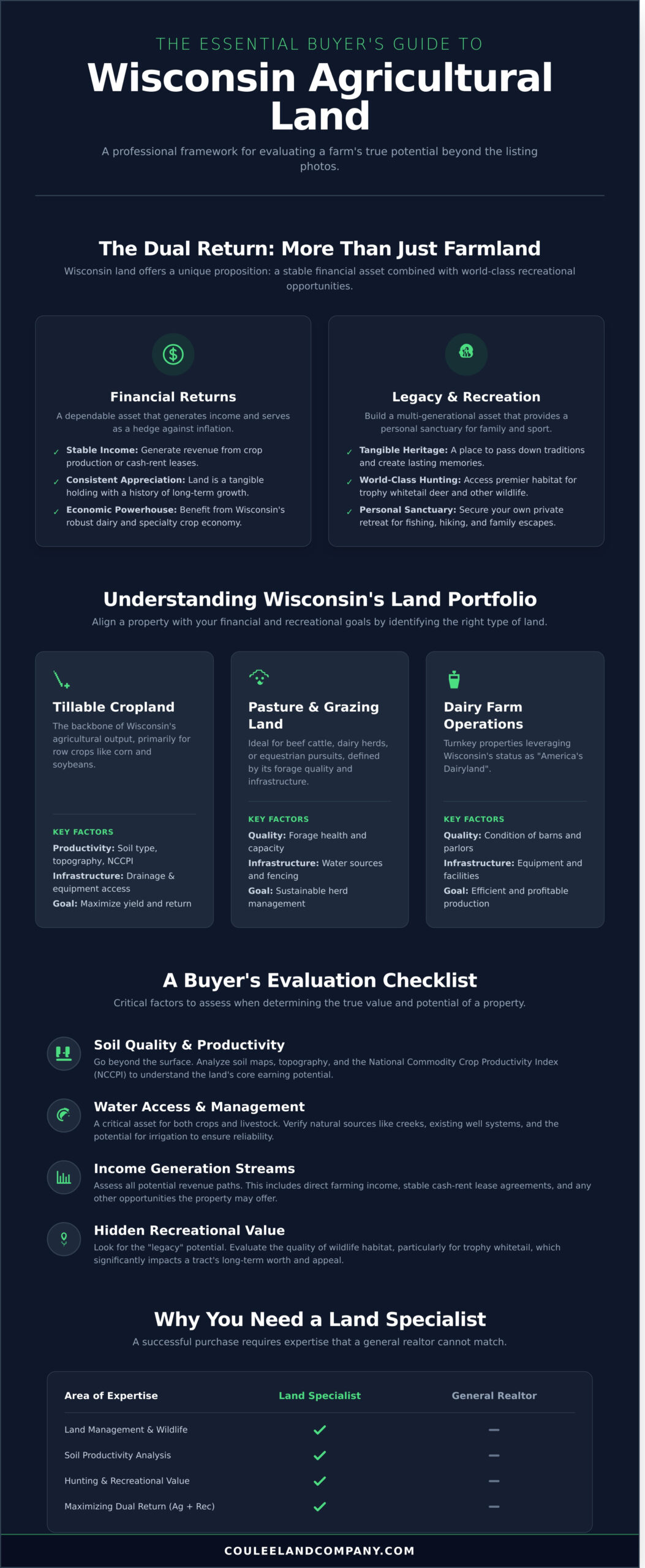
- Understand the distinct types of agricultural land available, from tillable crop acres to pasture, to align a property perfectly with your financial and recreational goals.
- Recognize why a dedicated land specialist is essential for a successful purchase, providing expertise in land management and wildlife that a general realtor cannot match.
Why Invest in Wisconsin Agricultural Land? More Than Just Farmland
When you search for wisconsin agricultural land for sale, you’re looking for more than just soil and crop yields. You are pursuing a tangible piece of a rich American heritage. Wisconsin’s identity is forged in its fields and forests, from its world-renowned status as the Dairy State to its leadership in cranberry production. This land offers a unique, dual-purpose investment proposition: a stable financial asset that generates agricultural income while also providing world-class recreational opportunities for hunting, fishing, and family retreats.
This video showcases a prime example of the breathtaking properties that combine productive land with exceptional living and recreational value:
The Economics of Wisconsin Farmland
The financial returns from Wisconsin farmland are as diverse as its landscape. The state’s fertile ground consistently produces high yields of primary crops like corn, soybeans, and alfalfa hay. Beyond row crops, its dominance in dairy and specialty cheese production underpins a robust agricultural economy. For a landowner, this translates into direct income opportunities, whether through a hands-on farming operation or a stable cash-rent lease to a local producer. The deep history of Agriculture in Wisconsin provides a strong foundation for these economic models, ensuring a reliable return on your investment.
A Legacy Investment: Stability and Growth
Farmland is one of the most dependable long-term assets you can add to your portfolio. Unlike volatile paper assets, land is a tangible holding that has historically served as a powerful hedge against inflation and demonstrated consistent appreciation. For many of our clients, owning land is about more than financial security; it’s about building a multi-generational legacy-a place to pass down traditions, manage for trophy wildlife, and create lasting family memories.
Whether you’re drawn to the vast, irrigated fields of the Central Sands or the rolling hills and hidden valleys of the Driftless Area-famed for its record-book whitetails-investing in Wisconsin agricultural land secures both a productive asset and a personal sanctuary. It’s a strategic move that pays dividends in the field and for the soul.
Types of Agricultural Land for Sale in Wisconsin
Wisconsin’s landscape offers a diverse portfolio of agricultural properties, each with unique potential for production, investment, and recreation. Understanding these categories is the critical first step in finding a tract that aligns with your vision. Whether you seek a high-yield investment or a private legacy property, identifying the right type of wisconsin agricultural land for sale ensures your objectives are met from day one. As Wisconsin’s Land & Property Sales Specialists, we guide clients through this process, matching their goals to the distinct capabilities of the land.
Tillable Cropland
These properties are the backbone of Wisconsin’s agricultural output, primarily suited for row crops like corn and soybeans. The value of tillable ground is directly tied to its productivity. We assess key metrics like soil type, topography, and the National Commodity Crop Productivity Index (NCCPI) to determine a farm’s true potential. Superior drainage and efficient field access for modern equipment are non-negotiable factors for maximizing yield and return on investment.
Pasture and Grazing Land
Ideal for beef cattle, dairy herds, or equestrian pursuits, pastureland is defined by its forage quality and infrastructure. A premier grazing property features reliable water sources-from natural creeks to well-fed systems-and secure, well-maintained fencing. We evaluate these tracts for their capacity to support rotational grazing and other sustainable land management practices that enhance both the herd and the health of the land itself.
Dairy Farm Operations
As America’s Dairyland-a fact backed by the official Wisconsin Agricultural Statistics-these properties represent a unique turnkey opportunity. A successful dairy operation hinges on its infrastructure. We conduct a thorough analysis of existing facilities, including the condition of freestall barns, the efficiency of the milking parlor, and the capacity of silos and manure storage, ensuring the farm is ready for immediate and profitable operation.
Specialty Farms and Recreational Tracts
This category offers a powerful blend of income and personal enjoyment. From apple orchards and vineyards to the state’s iconic cranberry bogs, these specialty farms provide niche income streams. Often, these properties feature significant recreational value, where tillable acres or pastureland complement superior wildlife habitat. For many of our clients, these tracts are the ultimate prize: a working farm that doubles as a world-class hunting retreat.
How to Evaluate a Farm Property: A Buyer’s Checklist
A successful land purchase moves beyond attractive listing photos to a professional, boots-on-the-ground evaluation. When you’re searching for wisconsin agricultural land for sale, the true value is found in the details that determine long-term productivity and potential. With the state’s agricultural landscape constantly evolving, as documented by the USDA’s Wisconsin Agricultural Statistics, a buyer must be armed with the right questions. This checklist provides the expert framework needed to assess a property’s core assets.
Soil Quality and Productivity
The foundation of any productive farm is its soil. We go beyond surface-level assumptions by using the USDA’s Web Soil Survey to analyze a property’s composition. Understanding the National Commodity Crop Productivity Index (NCCPI) rating for each soil type is critical; it provides an objective measure of the land’s potential yield. This data reveals which areas are best suited for row crops like corn and soybeans versus those better designated for pasture or premier wildlife food plots.
Water Resources, Rights, and Drainage
Water is the lifeblood of a farm, and a thorough assessment is non-negotiable. We investigate all water sources, including the capacity of existing wells, the health of ponds and streams, and any associated water rights for irrigation. Equally important is drainage. The presence of drain tile is a significant asset, preventing waterlogged fields and maximizing tillable acreage. These water features are essential for both agricultural operations and creating superior habitat for waterfowl and trophy whitetails.
Location, Access, and Infrastructure
A property’s logistics can make or break its efficiency. Evaluate access from public roads for moving large equipment and assess the internal trail system for reaching all corners of the land. Proximity to key services like grain elevators, livestock markets, and suppliers directly impacts your bottom line. Existing infrastructure-barns, sheds, and grain bins-must be inspected for structural integrity, functionality, and potential for future use. A well-maintained barn is an asset; a dilapidated one is a liability.
Zoning and Government Programs
Understanding the legal framework governing a property is a critical step in due diligence. We verify local zoning ordinances to confirm permitted uses, from agricultural activities to building a residence or hunting cabin. It’s also vital to identify any existing easements or right-of-ways that could impact your use of the land. Finally, determine if the property is enrolled in government programs like the Conservation Reserve Program (CRP) or Managed Forest Law (MFL), as these agreements come with both income and specific land-use obligations.
The Hidden Value: Combining Agriculture with World-Class Hunting
In Wisconsin, the line between productive farmland and elite hunting ground is often blurred. The most astute buyers understand that a property’s true value lies not just in its crop yield, but in its wildlife capabilities. When you invest in wisconsin agricultural land for sale, you are often acquiring a turnkey habitat for producing mature, trophy whitetail bucks. This dual potential-for both agricultural income and world-class recreation-represents a powerful return on investment that few other assets can match.
How Farmland Creates Premier Deer Habitat
The perfect environment for a thriving deer herd is a diverse landscape, and Wisconsin’s agricultural properties provide exactly that. Expansive fields of corn and soybeans offer a high-protein buffet that fuels body and antler growth throughout the year. These food sources are perfectly complemented by the natural structure of a farm: wooded draws, creek bottoms, and overgrown fence lines serve as critical bedding areas and secure travel corridors. This ideal blend of food, water, and cover is precisely what transforms a working farm into one of the nation’s prime hunting properties.
Generating Income Through Hunting Leases
Beyond personal enjoyment, the recreational value of your land can become a significant secondary revenue stream. The demand for exclusive hunting rights on well-managed private land is incredibly strong. By leasing your property to a select group of hunters, you can generate consistent income that supplements your agricultural profits and helps offset property taxes. A land specialist with deep market knowledge can accurately assess your property’s hunting potential and help you establish a fair lease value, ensuring you maximize this powerful income source.
Balancing Farming with Wildlife Management
Unlocking a property’s full potential requires a deliberate strategy that benefits both the farmer and the hunter. This is where expert land management becomes essential. Simple but effective practices can yield amazing results:
- Strategic Food Plots: Placing small, targeted food plots near bedding areas can hold deer on your property and create predictable patterns.
- Conservation Cover: Planting native grasses or creating early successional habitat provides crucial fawning and bedding cover.
- Timber Stand Improvement (TSI): Selectively managing your woodlots enhances tree health and creates a more desirable habitat for wildlife.
Developing a comprehensive plan that integrates these elements with your farming operation is critical, especially in world-renowned areas like Buffalo County. The specialists at Coulee Land Company can help you analyze any piece of wisconsin agricultural land for sale to create a management plan that achieves all your goals.
Why You Need a Land Specialist, Not Just a Realtor
Purchasing a significant tract of land is fundamentally different from buying a home. The complexities of purchasing wisconsin agricultural land for sale go far beyond a simple inspection and appraisal. A residential realtor is an expert in houses, neighborhoods, and school districts. A land specialist is an expert in soil productivity, timber value, water rights, and wildlife capabilities. Making a wise investment in rural Wisconsin requires a guide who understands the very ground beneath your feet, and that is a distinction that can define the success of your purchase.
Deep Market Knowledge and Accurate Valuation
A true land specialist lives and breathes the rural real estate market. They don’t just see acreage; they see a complex portfolio of assets. They understand the premium value of Class I tillable soil versus pasture, the long-term investment of a mature hardwood forest, and the conservation potential of wetlands. This granular expertise is absolutely critical for establishing an accurate valuation, ensuring you make a competitive offer that reflects the property’s true potential and avoids costly overpayment.
Navigating the Complexities of a Land Purchase
The path to closing on a land deal is paved with unique challenges that a typical realtor may not anticipate. A land specialist has deep expertise in the critical details that secure your investment, including:
- Properly interpreting land surveys and identifying boundary issues.
- Navigating complex title work, including mineral, water, and access rights.
- Managing the transfer of government programs like CRP, CREP, or Managed Forest Law (MFL).
- Understanding local zoning ordinances and land use restrictions.
An expert will guide you through the buying process from the initial search to the final signature, protecting your interests at every turn.
The Coulee Land Company Advantage
At Coulee Land Company, we are not just agents; we are passionate outdoorsmen, hunters, and land management experts. Our team possesses an intimate, firsthand knowledge of Western Wisconsin’s famed Bluff Country because we live, hunt, and work here. We don’t just see a property on a map-we see the travel corridors for trophy whitetail bucks, the potential for food plots, and the legacy you want to build.
Don’t leave the most important purchase of your life to a generalist. Partner with the specialists. Let our team’s unparalleled expertise at Coulee Land Company work for you.
Secure Your Piece of Wisconsin’s Bluff Country
Investing in Wisconsin’s heartland is an opportunity to build a true legacy. As this guide has detailed, the real value lies in understanding the powerful combination of agricultural productivity and world-class hunting potential. When you’re ready to explore the premier wisconsin agricultural land for sale, navigating the market requires more than a standard checklist-it demands a partner with a deep, on-the-ground understanding of the land’s full capabilities.
This is where the expertise of a true land specialist becomes indispensable. At Coulee Land Company, we are not just realtors; we are Wisconsin’s Land & Property Sales Specialists. Our team of passionate hunters and land experts possesses unmatched expertise in Western Wisconsin’s famed Bluff Country, ensuring you see the hidden value and wildlife potential that others miss.
Your journey to owning the perfect farm or hunting retreat starts here. View our current Wisconsin agricultural and hunting properties. The legacy you’ve dreamed of is waiting-let’s go find it.
Frequently Asked Questions About Wisconsin Agricultural Land
What is the average price per acre for agricultural land in Wisconsin?
While the statewide average for tillable land hovers around $5,600 per acre, this figure can be misleading. In the famed “Bluff Country” of Western Wisconsin, prices are driven by far more than soil quality. Premier recreational and hunting characteristics can elevate a property’s value significantly. Parcels with established food plots, timber, and a history of producing trophy whitetail bucks in counties like Buffalo or Trempealeau will command a much higher price than simple cropland.
How do property taxes work for farmland in Wisconsin?
Wisconsin offers a significant advantage to landowners through its “use-value assessment” system for agricultural land. This means your property is taxed based on its potential to generate agricultural income, not its higher market or recreational value. This keeps carrying costs manageable and is a crucial benefit for owners who want to farm, lease the tillable ground, or simply manage their property for wildlife without facing exorbitant tax bills based on development potential.
Can I get a loan to finance a Wisconsin farm or agricultural land purchase?
Absolutely. Financing is readily available for qualified buyers. While traditional banks offer loans, we often guide our clients toward specialized agricultural lenders like Compeer Financial or other members of the Farm Credit System. These institutions possess a deep understanding of land valuation, farm income, and the unique aspects of rural properties. Their expertise ensures a smoother process, from appraisal to closing, for your specific land-buying goals.
What is the Conservation Reserve Program (CRP) and how does it affect land value?
The Conservation Reserve Program (CRP) is a federal initiative that pays landowners an annual rental payment to convert highly erodible cropland to resource-conserving covers, such as native grasses. For a land buyer, this has two powerful benefits. First, it provides a stable, guaranteed income stream. Second, and often more importantly for our clients, it creates superior wildlife habitat, providing critical nesting cover for pheasants and turkeys and excellent bedding areas for deer.
Are there restrictions on building a home on land zoned for agriculture?
Yes, building eligibility is a critical factor to verify. When considering different parcels of Wisconsin agricultural land for sale, it is essential to consult the specific county and township zoning ordinances. Many areas have minimum acreage requirements, designated building envelopes, or other restrictions to preserve farmland. As your expert guides, we help you perform this vital due diligence early in the process to ensure the property you choose aligns perfectly with your vision for a home or cabin.
How much income can I expect from leasing my land for farming or hunting?
Lease income varies based on location and quality. Tillable land can generate anywhere from $150 to over $300 per acre annually, depending on soil productivity. Hunting lease income is driven by the property’s reputation and wildlife capabilities. In the highly sought-after trophy whitetail areas of Western Wisconsin, a quality hunting lease can command $20 to more than $50 per acre per year, providing a significant revenue stream that reflects the land’s recreational value.