
Your property’s true potential isn’t measured by the clover in June, but by the tracks in the snow in January. It’s a frustrating reality for many Bluff Country landowners when mature bucks vanish the moment the mercury drops, leaving you with empty ridges and low acorn production from aging oaks. You’ve likely watched your local herd migrate to the neighbor’s thicker cover or better food sources just as the winter stress begins. Implementing strategic winter habitat projects for deer is the only way to ensure your acreage remains a destination rather than a pass-through.
We believe that stewardship is about more than just a season; it’s about building long-term land value and a legacy of healthy wildlife. This guide will show you how to transform your woods into a winter whitetail sanctuary using proven timber management and high-energy forage strategies. We’ll explore how Timber Stand Improvement (TSI) can create the thermal security deer crave in the coulees and how to maximize ridge-top browse. By the time the 2026 archery season opens on September 12, your property will be primed for more daylight activity and a significantly higher carrying capacity.
Key Takeaways
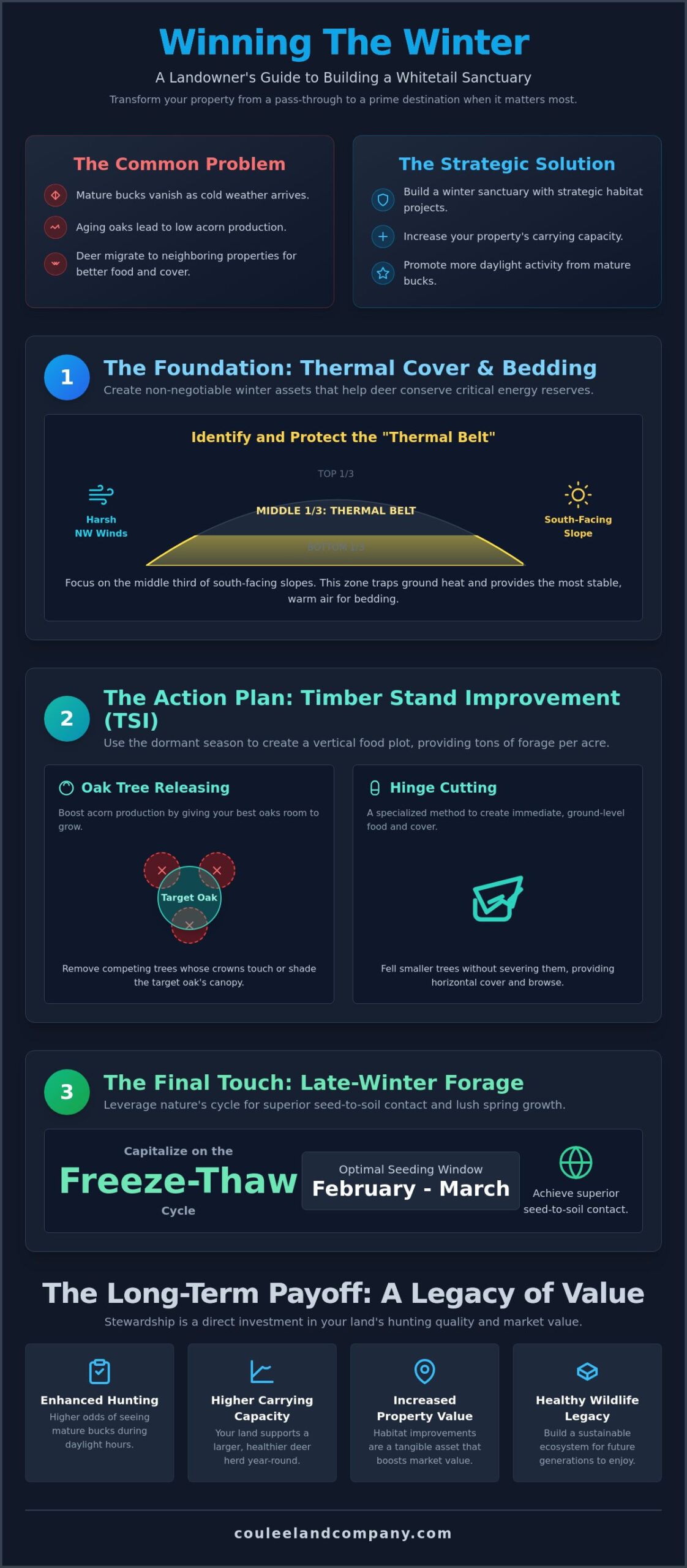
- Identify and protect the “thermal belt” on south-facing slopes to provide essential bedding that traps ground heat and blocks harsh winter winds.
- Execute Timber Stand Improvement (TSI) during the dormant season to maximize visibility and stimulate the growth of high-energy browse and mast-producing oaks.
- Implementing strategic winter habitat projects for deer ensures your property remains a preferred sanctuary during the most critical survival months of the year.
- Capitalize on the late-winter freeze-thaw cycle in February and March to achieve superior seed-to-soil contact for perennial legumes and spring forage.
- Professional habitat stewardship serves as a long-term investment that significantly enhances both the hunting quality and the market value of your Bluff Country acreage.
Designing Thermal Cover and Bedding in Wisconsin’s Coulees
Thermal cover is a non-negotiable asset for whitetails facing a brutal Wisconsin winter. In our rugged Bluff Country, this translates to dense vegetation that effectively traps ground heat while blocking the biting northwest winds. When you plan your winter habitat projects for deer, you must look beyond mere food. Without adequate thermal protection, deer burn through their fat reserves just trying to stay warm, which can lead to significant mortality during the 2026 winter season. Understanding core deer management principles requires a focus on topography; specifically, the “thermal belt.” This is the middle third of a south-facing slope where the air remains most stable and warm during the day.
To better understand how these improvements look on the ground, watch this helpful video:
Mature bucks in Buffalo County often favor side-hilling bedding areas. These specific locations allow them to catch the rising thermals from the valley below while keeping the wind at their backs from the ridge top. To enhance these coveted spots, prioritize the protection or planting of conifers like Norway Spruce or White Pine in the valley floors and coulee bottoms. These species provide a dense canopy that remains green throughout the winter, offering a physical barrier against snow and wind that deciduous trees cannot match. If you are looking to invest in hunting properties with high-end potential, focus on acreage that offers these diverse topographic features.
The Role of Soft Edge Transitions
Creating a feathered edge between mature timber and open fields provides immediate security for deer entering or exiting food sources. Use a chainsaw to drop low-value trees perpendicular to the field edge. This technique breaks up the hard line of the forest, creating a visual screen that encourages daylight activity. It is a pragmatic way to increase the holding power of your land while executing your winter habitat projects for deer.
Identifying Natural Thermal Hubs
Natural thermal hubs often exist as cedar thickets or dense brush in the bottom of coulees. These areas are the most critical winter sanctuaries on any property. You should avoid disturbing these core areas during the late-season months. Keeping human pressure to a minimum in these low-lying thickets ensures deer feel safe enough to stay on your land rather than seeking refuge on a neighboring property.
Timber Stand Improvement (TSI): Releasing Mast and Creating Browse
Winter is the ultimate season for the chainsaw. When the sap is down and the leaves have fallen, you gain a clear view of your timber’s architecture. Timber Stand Improvement, or TSI, is the strategic removal of low-value “junk” trees to allow sunlight to reach the forest floor. This sunlight is the fuel for preferred species like oaks and the growth of high-quality woody browse. These are the tender buds and twigs whitetails rely on when heavy snow covers traditional food sources. It’s effective work. By opening the canopy, you’re essentially creating a vertical food plot that produces tons of forage per acre.
Before you start cutting, spend time evaluating deer habitat conditions to identify which areas of your woods are stagnant. This is one of the most impactful winter habitat projects for deer because it provides immediate results that deer can use the same day you cut. If you’re looking for land with high potential for these types of improvements, browsing our current hunting properties can give you a head start on finding the right topography.
How to Release a Crop Tree (Oak Releasing)
Successful oak management requires identifying dominant White or Red Oaks with large, healthy crowns. Think of the tree’s canopy as a circle divided into four quadrants. To “release” the tree, you must remove any competing timber whose crowns touch or shade the target oak in those quadrants. This reduction in competition allows the oak to expand its crown. It leads to significantly higher acorn yields and better long-term land value.
Hinge Cutting for Bedding and Browse
Hinge cutting is a specialized method used to provide horizontal bedding cover and immediate ground-level food. Select flexible species such as elm, hackberry, or maple. Cut approximately 60-70% through the trunk at waist height, carefully allowing the tree to fall while the cambium layer remains intact. This keeps the tree alive on the ground. It creates a dense tangle of cover that deer love for bedding while putting nutrient-rich buds within easy reach.
Late-Winter Forage Management and Soil Preparation
Late winter represents the critical bridge between survival and growth. In Buffalo County hunting land, this window is often the most difficult for whitetails as standing grains are exhausted and woody browse is depleted. This “late-winter stress period” is the ideal time to pivot your focus toward soil health and perennial legumes. Executing these specific winter habitat projects for deer ensures your acreage is the first to provide high-protein green-up when the spring thaw finally arrives.
The Benefits of Frost Seeding Clover
You can use the natural freeze-thaw cycle of February and March to your advantage. Broadcasting clover seed over thin food plots or frost-cracked soil utilizes the “honeycomb” effect. As the ground freezes at night and thaws during the day, the soil expands and contracts, effectively pulling the small seeds into the earth for perfect seed-to-soil contact without the need for heavy equipment. For the 2026 growing season, we recommend focusing on these three varieties for Wisconsin winters:
- Ladino White Clover: Exceptional for its high protein content and multi-year longevity.
- Frosty Berseem Clover: Known for its rapid spring growth and ability to handle cold soil temperatures.
- Medium Red Clover: A hardy choice that excels at fixing nitrogen and improving soil structure.
Collecting Soil Samples for Spring Success
Success in the fall begins with chemistry in the spring. You should pull soil samples as soon as the top two inches of the earth thaw. This allows you to test for pH and nutrient levels early, giving you ample time to plan your 2026 fertilizer and lime budget before the spring rush. Professional land management is a hallmark of high-value acreage. These improvements do more than just grow bigger deer; they significantly impact your Hunting Land Valuation by demonstrating a history of diligent stewardship and high-yielding forage potential. Taking the time to execute these winter habitat projects for deer positions your property as a premier destination for both wildlife and future buyers.
Securing Your Legacy in Bluff Country
Transforming your property into a premier whitetail sanctuary requires a commitment to year-round stewardship. By prioritizing thermal cover in the coulees and executing strategic Timber Stand Improvement on the ridges, you provide the security and forage necessary for herd health during the most stressful months. These winter habitat projects for deer are more than just seasonal chores; they’re foundational investments that elevate your land’s hunting potential and long-term market value. You’re not just managing a forest; you’re building a legacy of healthy wildlife and superior hunting opportunities.
Coulee Land Company stands as the undisputed authority in Western Wisconsin Bluff Country. Our team consists of dedicated land specialists who are also hunters and stewards, and we’ve successfully brokered over $100M in rural land sales. Endorsed by regional land management experts, we possess the regional expertise to help you find and develop a world-class property. If you’re ready to take the next step in your land ownership journey, View Exclusive Buffalo County Hunting Listings and discover the potential of this prized territory. Your vision for a premier hunting tract starts with the work you do today.
Frequently Asked Questions
When is the best time to start winter habitat projects for deer?
The optimal time to initiate winter habitat projects for deer is between late December and the end of March. During this dormant season, the sap has stopped flowing, which prevents unnecessary stress on your high-value timber while allowing for maximum visibility through the canopy. This timing also provides immediate woody browse to the local herd exactly when natural food sources are most scarce in the coulees.
Will hinge cutting trees hurt my property value or timber sale?
Hinge cutting will not diminish your property value if you target non-commercial species like elm, ironwood, or box elder. In fact, creating high-quality bedding and security cover often increases the market value of hunting land by demonstrating superior habitat stewardship. You should always avoid hinge cutting dominant mast-producers or veneer-quality timber. Strategic TSI projects show prospective buyers that the land is already optimized for trophy whitetail retention.
How much land do I need to make a difference in winter deer survival?
You don’t need hundreds of acres to improve winter deer survival; even a focused 10-acre project can provide a critical sanctuary. By creating dense thermal pockets on a small south-facing slope, you offer a refuge that can hold deer that would otherwise migrate miles away. The key is concentration. A small, high-quality bedding area with immediate access to frost-seeded clover or hinge-cut browse is far more effective than a large, open forest with no ground-level forage.
Can I do TSI projects if I don’t own a tractor or heavy equipment?
Most impactful winter habitat projects for deer require nothing more than a reliable chainsaw and a basic hand spreader. You don’t need a tractor or heavy machinery to release oaks, hinge cut bedding areas, or frost seed perennial legumes. These manual improvements allow for greater precision in steep Bluff Country topography where heavy equipment often struggles to navigate. Diligent hand work often results in a more natural and effective habitat layout than large-scale mechanical clearing.