
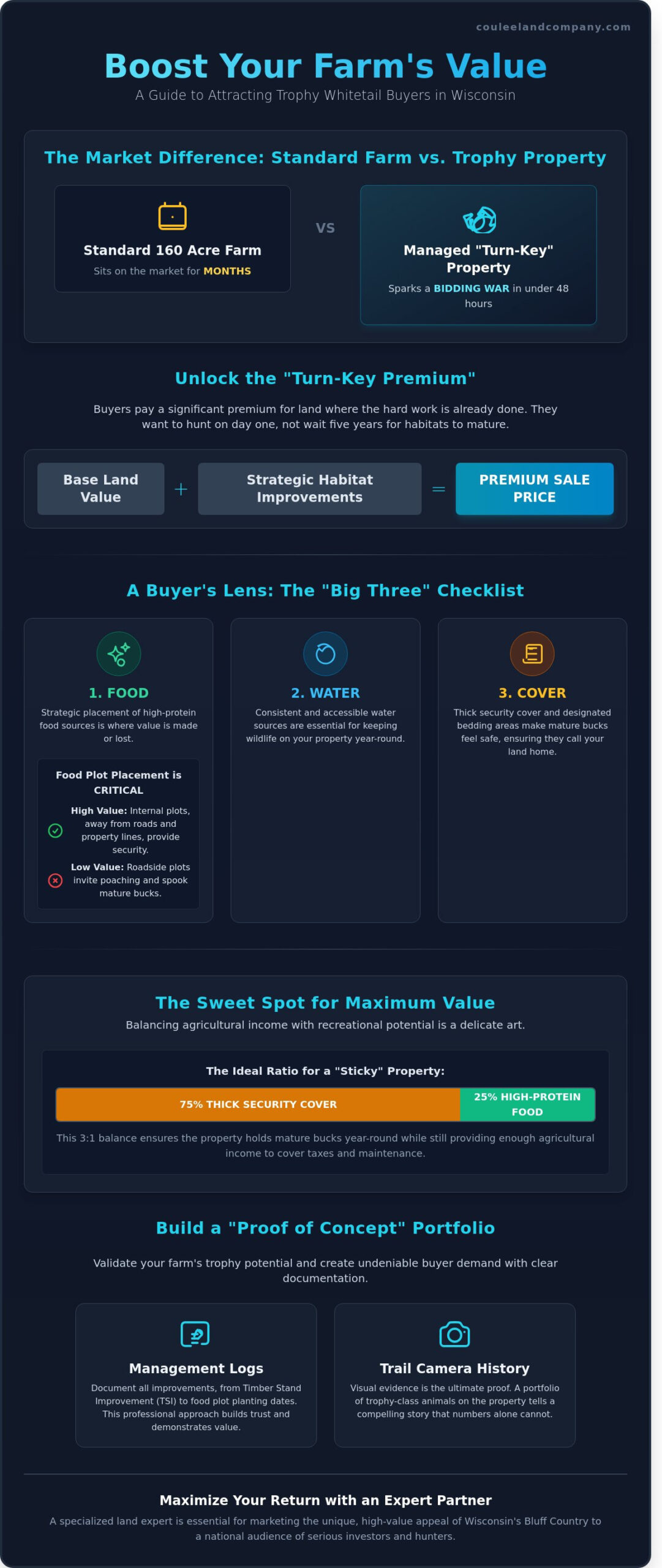
A standard 160 acre Wisconsin farm might sit on the market for months, but a property with a proven track record of 150 inch whitetails can spark a bidding war in under 48 hours. You likely understand that land is more than just soil and timber; it is a legacy and a sanctuary. Many sellers worry that investing in food plots or timber stand improvement won’t actually move the needle on their final sale price. You don’t want to over-improve your land only to see it languish next to a neighboring farm that is priced lower.
Our expert guide on Wildlife Habitat Management on WI Farms: Tips to Attract Buyers and Boost Value shows you how to turn those concerns into a strategic advantage. You will discover how strategic habitat improvements can transform your Wisconsin farm into a high-value, turn-key trophy property that commands a premium price from the most serious buyers in the Midwest. We are diving into the specific habitat enhancements that drive up your price per acre and ensure your land stands out as a premier destination in the famed Bluff Country.
Key Takeaways
- Learn how to capture the “Turn-Key Premium” by transforming your land into a property where buyers can pursue trophy whitetails from the day of closing.
- Discover how implementing Wildlife Habitat Management on WI Farms: Tips to Attract Buyers and Boost Value through strategic food plot placement can significantly increase your property’s market demand.
- Understand the role of Timber Stand Improvement (TSI) in increasing both your property’s ecological health and its overall “huntability” for mature bucks.
- Find out how to build a professional “Proof of Concept” portfolio that uses management logs and trail camera history to validate your farm’s trophy potential.
- See why partnering with a specialized land expert is essential for effectively marketing the unique appeal of Wisconsin’s Bluff Country to a national audience.
The Financial Impact of Habitat Management on Wisconsin Farm Values
In the 2026 Wisconsin land market, savvy investors treat land as a high-performance asset class rather than just a place to park capital. Strategic Wildlife Habitat Management on WI Farms: Tips to Attract Buyers and Boost Value isn’t just about personal hunting success; it’s about building equity. Generic agricultural land often trades at a baseline price determined by soil productivity, but properties with established trophy potential command a significant premium. This “Turn-Key Premium” exists because high-net-worth buyers are willing to pay more for land where the hard work of timber stand improvement and food plot establishment is already done. They want to hunt on day one, not wait five years for a bedding thicket to mature.
Effective wildlife management techniques transform a standard corn field into a high-performance hunting asset. While raw acreage has its own appeal, a managed property creates an emotional and psychological pull that’s hard to ignore. For many buyers, owning a piece of the famed “Bluff Country” is a lifelong dream. They aren’t just looking for dirt; they’re looking for a legacy where they can consistently encounter world-class whitetails. This aspirational demand ensures that managed farms remain liquid and highly sought after, even when the broader real estate market fluctuates.
To better understand these habitat principles, watch this helpful video regarding common mistakes to avoid:
Why Managed Land Sells Faster in Western Wisconsin
Demand for properties with established wildlife capabilities has reached an all-time high in Western Wisconsin. Buffalo County continues to dominate the Boone and Crockett Record Book, which creates a massive baseline value that habitat work only amplifies. When you combine the natural topography of the Coulee Region with professional-grade land management, you create a product that stands out in a crowded market. If you’re looking for professional guidance on preparing your property for the market, checking out our resources for sellers can provide the competitive edge you need to maximize your profit.
Recreational Value vs. Agricultural Income
Balancing tillable acreage for annual income with habitat for trophy potential is a delicate art. While cash rent from corn or beans provides immediate cash flow, the true value of a farm often lies in its ability to hold mature bucks year-round. The sweet spot for maximizing property value lies in maintaining a 3:1 ratio of thick security cover to high-protein food sources. This balance ensures the property remains “sticky” for wildlife while still providing enough agricultural income to cover taxes and maintenance. Additionally, the strategic use of conservation easements can provide long-term tax benefits and protect the property’s wild character, though it’s vital to ensure these agreements don’t restrict future Wildlife Habitat Management on WI Farms: Tips to Attract Buyers and Boost Value.
Creating the ‘Big Three’: Food, Water, and Cover through a Buyer’s Lens
Effective Wildlife Habitat Management on WI Farms: Tips to Attract Buyers and Boost Value starts with understanding the biological hierarchy of needs for a trophy whitetail. To a serious investor, a farm isn’t just a collection of acreage. It’s a machine designed to produce and hold mature bucks. When a buyer looks at a property, they’re mentally checking off the “Big Three”: food, water, and cover. If these aren’t present and strategically placed, the land’s price per acre will inevitably suffer.
Strategic food plot placement is the first area where value is either made or lost. Internal food plots, tucked away from property lines and roads, are worth significantly more than roadside plots. Roadside clover might look green, but it invites poaching and allows passing traffic to spook deer. An internal plot provides the security a mature buck needs to move during daylight hours. Buyers searching for hunting properties will pay a premium for a layout that allows them to hunt without alerting the entire neighborhood. When designing these features, consulting UW Extension wildlife resources provides the scientific backing needed to ensure your efforts yield results.
Water remains the most overlooked value-add on Wisconsin ridges. In the driftless area, deer often have to drop hundreds of feet into a valley to find a drink. By installing a small pond or a solar-powered watering tank on a ridge top, you’ve effectively changed the movement patterns of every deer in the section. This turns your property into a hub, increasing its marketability to hunters who understand that water is a magnet during the October heat.
High-Value Food Plot Strategies
A diverse food strategy signals a well-managed farm. Perennial clover plots offer high-protein forage for roughly 9 months of the year, while annuals like brassicas and cereal grains provide the “draw” during the late season. Adding soft mast like crabapples or persimmons creates immediate visual appeal during property showings. For specific planting schedules, refer to our wisconsin land management for wildlife guide to maximize your soil’s potential. These improvements show buyers that the work is already done.
Securing the Sanctuary: Bedding and Thermal Cover
Bedding security is what keeps deer on your side of the fence. To a buyer, “thick” is beautiful. Using native switchgrass or warm-season grasses creates a visual screen from neighbors, making a 40-acre farm feel like 80. Edge feathering, the process of dropping low-value trees along a field edge, creates a thick transition zone that deer love. When a buyer can see these defined “sanctuaries” on a topo map, they see a property that can grow 160-inch bucks. Wildlife Habitat Management on WI Farms: Tips to Attract Buyers and Boost Value is about creating these visible layers of security that promise a successful harvest season after season.
Improving ‘Huntability’: TSI and Natural Funnels
Huntability is the metric that separates a standard recreational property from a premier hunting estate. It describes the ease with which a hunter can pattern and harvest a mature buck. You can have a high deer density, but if you can’t get close to them without being detected, the land loses its appeal to serious buyers. Effective Wildlife Habitat Management on WI Farms: Tips to Attract Buyers and Boost Value focuses on manipulating the environment to put the odds in the hunter’s favor. This means creating a layout where deer move predictably and hunters can move invisibly.
Timber Stand Improvement (TSI) for Browse and Value
Many landowners fear that cutting trees will decrease their property’s worth, but the opposite is true. Timber Stand Improvement involves selective thinning to remove “wolf trees,” which are large, low-value trees with broad canopies that shade out the forest floor. By removing these, you make room for high-value red and white oaks. This process increases sunlight to the forest floor, which triggers the growth of woody browse and thick bedding cover. TSI improves both wildlife habitat and future timber value by focusing growth on the most marketable species. For those looking for technical guidance on these practices, the UW Extension Wildlife Management Resources provide excellent frameworks for balancing forest health with hunting goals. Well-executed TSI tells a buyer that the woods are healthy, productive, and designed for big bucks.
Designing the ‘Perfect Hunt’ with Topography
In the rugged terrain of Western Wisconsin, topography is your best tool for directing deer movement. You can create natural funnels by clearing specific ridge-top travel corridors that connect bedding areas to food sources. This makes the deer movement predictable for the future owner. A buyer’s biggest concern is often access; they want to know they can enter and exit a stand without spooking the entire valley. Strategic Wildlife Habitat Management on WI Farms: Tips to Attract Buyers and Boost Value includes designing these routes along downwind edges or behind topographical breaks. You can see these principles in action by exploring the Buffalo County community page, where the steep bluffs and deep coulees create some of the most legendary “pinch points” in the country. This isn’t just about aesthetics; it’s about engineering a property that produces 170-inch bucks year after year. When a buyer sees a property with established funnels and clean access, they see a property where they can actually succeed.
Preparing Your Managed Property for the Market: Documentation and Scouting
Habitat management takes years of sweat equity. Don’t let that value go unnoticed when it’s time to sell. Providing a “Proof of Concept” means showing a buyer exactly how your Wildlife Habitat Management on WI Farms: Tips to Attract Buyers and Boost Value strategy has transformed the local herd. A buyer wants to see that your 40-acre sanctuary actually holds the 160-inch whitetails Western Wisconsin is famous for. Documentation bridges the gap between your asking price and the buyer’s confidence.
The Trail Camera Portfolio
Organize your photos by individual deer. A folder showing a specific buck over three seasons proves your property provides the security and nutrition needed for age-class progression. While a “hero shot” of a harvested buck is impressive, a library of 500 inventory photos is more valuable. It demonstrates a healthy, resident population. Use these images to show deer utilizing your water holes during the 2023 drought or hitting your brassica plots during the first November frost. This data proves your management plan works.
Mapping and Infrastructure
High-quality land requires accessibility. We recommend using digital mapping tools to highlight every improvement. Mark your 2.5-acre clover plots, your secluded water holes, and your permanent blind locations. If you’ve invested in a 1.5-mile internal trail system, map it clearly. This allows a prospective buyer to visualize how they’ll hunt the wind. It also makes property tours much smoother. For those ready to move, visit the Coulee Land Company seller’s page to access specialized valuation tools that account for these specific land improvements.
Timing your listing is critical. A property looks its best in August or September when food plots are peaking and the timber is lush. This visual impact, combined with your documentation, justifies a premium price. You’re selling a turnkey hunting legacy, not just a parcel of land. When you apply Wildlife Habitat Management on WI Farms: Tips to Attract Buyers and Boost Value principles, you create a product that stands out in a crowded market. Show the work, prove the results, and the value will follow.
Why a Land Specialist is Essential for Selling Managed Acreage
Selling a farm with intensive habitat improvements requires a different approach than selling a suburban home. You need a “hunter’s realtor” who understands the difference between a standard woodlot and a high-performance whitetail sanctuary. Residential agents often miss the value of a strategic 5-acre clover plot or a secluded bedding area. Specialists like Mike Law or Bryan Lemke live and breathe this lifestyle. They recognize that Wildlife Habitat Management on WI Farms: Tips to Attract Buyers and Boost Value isn’t just a concept; it’s a proven strategy to increase property worth. These experts speak the language of land management, allowing them to explain the ROI of your hard work to prospective buyers.
The reality is that Western Wisconsin, particularly Buffalo County, has recorded more Boone and Crockett whitetail entries than any other county in the United States. This prestige creates a national demand that only a specialist can tap into. We leverage this reputation by using social proof and endorsements from recognized names in the outdoor industry to build prestige for every listing. When a buyer see that a property has been managed correctly, they aren’t just buying dirt. They’re buying a legacy.
The Power of Niche Marketing
We don’t just list properties; we market the dream of the Driftless Area to a national audience of serious outdoorsmen. By using professional drone videography and high-definition ground footage, we showcase the specific terrain features that hold mature bucks. Our team maintains an active “buyers-in-waiting” list, connecting sellers directly with individuals specifically looking for managed acreage in Western Wisconsin. This database often results in properties moving quickly because the right buyers are already watching for these opportunities.
Closing the Deal on a Managed Farm
Closing a sale on a premium farm requires justifying a higher price point with hard evidence. We use habitat data, trail camera history, and soil maps to prove the land’s capability. Buyers who understand land management are willing to pay a premium for a turnkey hunting property because it saves them years of labor and expense. When you demonstrate that Wildlife Habitat Management on WI Farms: Tips to Attract Buyers and Boost Value has been implemented correctly, the negotiation shifts from price per acre to the value of the experience. If you’re ready to move your property, contact Coulee Land Company to list your managed property today.
Secure Your Return on Wisconsin’s Premier Hunting Land
Transforming a standard farm into a high-performance hunting property requires a strategic focus on the “Big Three” of food, water, and cover. These improvements do more than just attract deer; they create a tangible financial asset. By implementing Wildlife Habitat Management on WI Farms: Tips to Attract Buyers and Boost Value, you’re positioning your acreage to stand out in a competitive market. Properties in Buffalo County, which currently leads the Boone and Crockett record books for typical and non-typical whitetail entries, demand a premium when they offer proven huntability through Timber Stand Improvement (TSI) and established natural funnels.
You’ve put in the sweat equity to improve your land, and now it’s time to realize the return on that investment. Selling managed land isn’t like selling a residential home. It requires an expert who understands the nuances of bedding areas and soil quality. Our team brings decades of experience as Buffalo County specialists and is endorsed by leading outdoor television personalities who trust us with their own property searches. We’ve built a proven track record of record-breaking whitetail property sales across Western Wisconsin by speaking the language of the land. Ready to see what your managed land is worth? Get a free valuation today. Your hard work has created a world-class habitat, and we’re here to make sure the market recognizes its true worth.
Frequently Asked Questions
Does wildlife habitat management really increase my property’s appraisal value?
Wildlife habitat management on WI farms: tips to attract buyers and boost value often results in a 10% to 15% premium over unmanaged acreage in the Driftless Area. While standard appraisals focus on soil quality and timber value, recreational buyers prioritize the property’s proven ability to produce trophy whitetails. We’ve seen managed tracts in Buffalo County command higher prices because the infrastructure for elite hunting is already established, saving the new owner years of sweat equity.
What is the single most important habitat improvement for attracting whitetail buyers?
Creating high-quality security cover, such as 5 to 10 acres of hinge-cut timber or native warm season grasses, is the most critical improvement. While food plots are popular, buyers know that deer won’t stay on a property they don’t feel safe in. Establishing thick bedding areas adjacent to food sources ensures mature bucks remain on your land during daylight hours. This structural change transforms a simple farm into a premier hunting destination.
How many years of management are needed before I should list my land for sale?
You should aim for at least 3 years of consistent management before listing your property for sale. This timeframe allows native plantings to establish and provides a multi-year trail camera history of specific bucks. A 36-month record of habitat work proves to a buyer that the land’s productivity isn’t a fluke. It demonstrates a commitment to the hunter’s realtor standards that Coulee Land Company clients expect in the Wisconsin market.
Can I get tax breaks for wildlife habitat management on my Wisconsin farm?
Wisconsin’s Managed Forest Law (MFL) provides significant tax relief, often reducing property taxes by 80% for landowners who follow an approved forest management plan. Enrolling 20 or more contiguous acres into this program incentivizes long-term habitat health while keeping annual carrying costs low. It’s a powerful selling point because it guarantees the land remains a productive wildlife corridor for the next 25 or 50 years, depending on the contract length chosen.
Should I install permanent hunting blinds before selling my property?
You shouldn’t install permanent box blinds because every hunter has a unique strategy and preferred wind direction for specific stands. Instead, clear 3 or 4 strategic access trails and prepare flat sites for portable setups. Providing a map of these ready-to-hunt locations is more valuable than a fixed tower that might be in the wrong spot for a buyer’s style. Flexibility allows the new owner to envision their own hunt on the property.
What is ‘huntability’ and why do buyers care so much about it?
Huntability refers to the ability to access stand locations without alerting wildlife, and it’s the top priority for 90% of serious land buyers. A property can have the best food in the county, but it’s worthless if you spook every deer on the way to your blind. We look for properties with perimeter access and internal terrain features that mask movement. High huntability scores ensure the land remains a sanctuary rather than a dead zone.
How do I show my habitat work to a buyer during a winter showing?
Use a digital portfolio featuring 1080p trail camera videos and summer drone footage to showcase your wildlife habitat management on WI farms: tips to attract buyers and boost value during winter. While the snow covers food plots, your archives prove what the land produces during the growing season. Mark every improvement on a high-resolution topo map. This allows the buyer to see the 160-inch buck from November while they’re walking the frozen ridges in January.