
Most real estate agents will tell you a property line is just a digital coordinate on a map, but in the vertical timber of Buffalo County, that single assumption can cost a buyer a 170-inch whitetail and a seller thousands in lost equity. You understand that a true legacy property isn’t defined by a manicured lawn; it’s defined by the ridge tops and thermal hubs that have made Western Wisconsin a permanent fixture in the Boone and Crockett Record Book. Finding a partner who actually walks the draws and understands soil productivity is the difference between a high-yield investment and a stagnant asset. To help you prepare for the upcoming shifts in the landscape, we have compiled this report on WI: Insights from a Top-Rated Realtor.
You recognize that the 2026 market requires more than just a standard listing. It demands a deep connection to the outdoor industry and a pragmatic approach to land management. We’ll show you how to navigate the rising demand for country homes and specialized hunting acreage with the confidence of a seasoned land specialist. We’ll explore the exact data points driving valuations in the Bluff Country and provide a clear roadmap for maximizing your ROI on every acre you own.
Key Takeaways
- Understand the critical distinction between a residential agent and a land specialist when navigating the unique topography of Wisconsin’s Bluff Country.
- Discover why the “Buffalo County Effect” continues to drive investment value and how 2026 inventory trends are impacting Western Wisconsin property availability.
- Gain **WI: Insights from a Top-Rated Realtor.** on evaluating property potential by looking beyond price-per-acre to assess wildlife capabilities and natural funnels.
- Learn strategic methods for positioning land to attract premium hunter-buyers and navigating the specific complexities of rural financing and appraisals.
- See how the “Hunter’s Realtor” approach leverages deep local roots and land management expertise to maximize the value of every hunting and country home listing.
What Defines a Top-Rated Realtor in the Wisconsin Land Market?
Success in the suburban residential market relies on school districts and square footage. In the rugged terrain of Western Wisconsin, these metrics fail. A top-rated agent understands that a 160-acre tract in Buffalo County requires a different lens than a four-bedroom home in Madison. High-volume residential agents might close 40 suburban deals a year; however, they often lack the technical knowledge to evaluate a ridge-top bedding area or a hidden valley food plot. This section provides WI: Insights from a Top-Rated Realtor. It’s designed to help you distinguish between a generalist and a specialist.
The “Hunter’s Realtor” persona is a necessity in the Driftless Area. Your agent must understand whitetail behavior to accurately value hunting properties. They need to know how a 20-degree slope affects thermal currents and why certain oak species provide better mast for wildlife. Reaching out-of-state legacy buyers requires specialized marketing that bypasses traditional channels. It’s about finding buyers who view land as a generational asset, which is a key part of WI: Insights from a Top-Rated Realtor.
The Value of Dirt-Deep Expertise
You can’t evaluate a property from a truck window. An expert must walk every acre to assess soil types like Fayette or Tama silt loams, which dictate both agricultural yield and wildlife capacity. They calculate timber value based on the density of Red Oak or Black Walnut stands while considering the topography’s impact on logging access. A Wisconsin Land Specialist is a broker who balances market data with ecological potential.
Specialized Networks and Endorsements
Visibility in the Buffalo County region often comes down to who you know in the outdoor industry. Top agents leverage endorsements from professional hunters and television hosts to build immediate trust with buyers. This reputation within the local land-owning community ensures access to off-market deals. When a celebrity in the hunting world vouches for an agent’s expertise, it creates a layer of buyer confidence that a standard real estate sign cannot replicate. This trust is built over decades of being present in the woods and at the local town halls, not just behind a desk.
2026 Wisconsin Land Trends: Insights from the Field
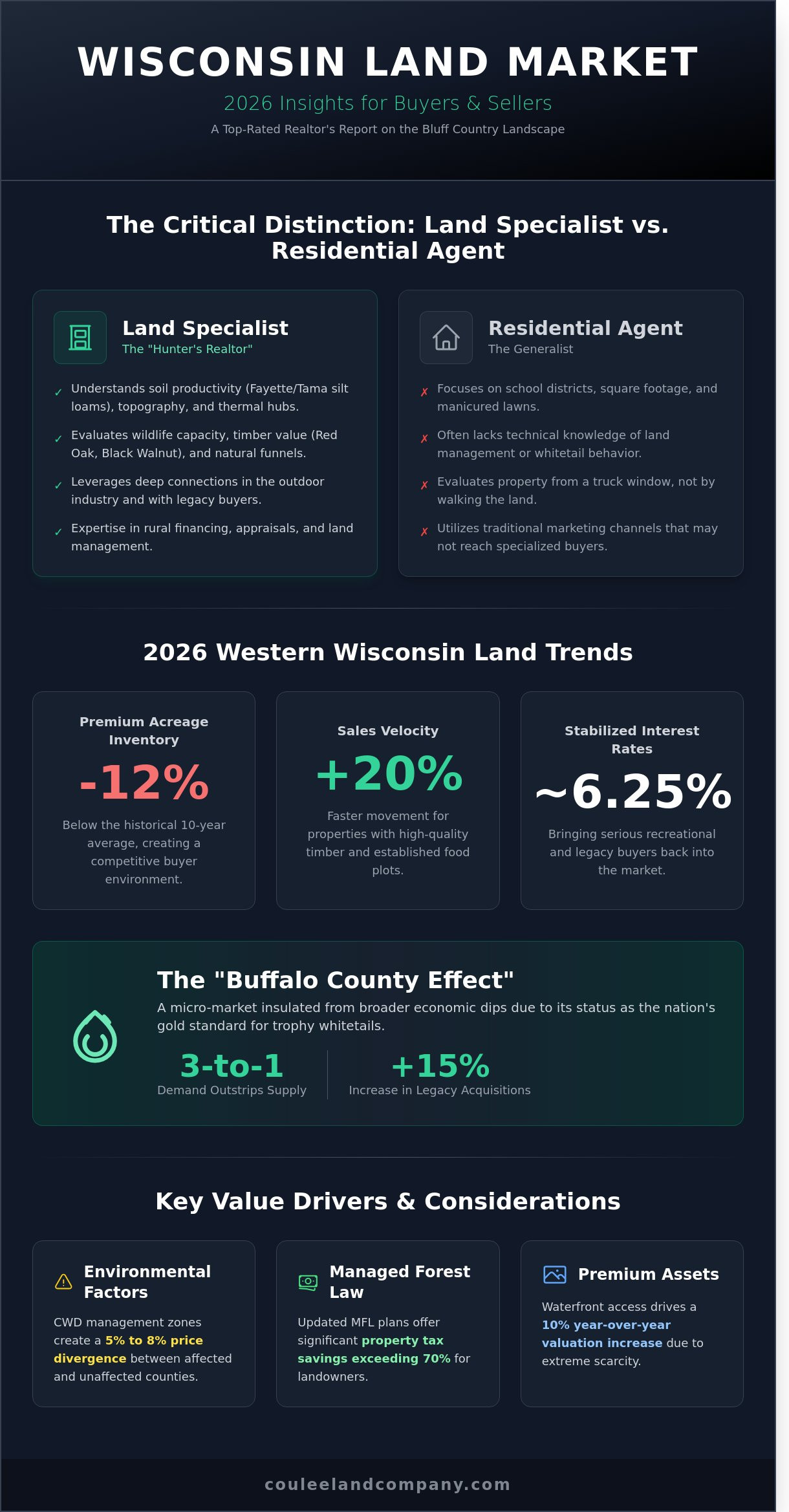
Entering 2026, the Western Wisconsin landscape presents a unique challenge for buyers. Inventory levels for premium acreage sit 12% below the historical 10-year average. This scarcity creates a competitive environment where speed is essential. Our team shares these WI: Insights from a Top-Rated Realtor. to help you understand that properties with high-quality timber and established food plots are moving 20% faster than raw land. Interest rates have stabilized at approximately 6.25% in early 2026, which has brought a wave of serious recreational buyers back into the fold. These investors aren’t just looking for dirt; they’re seeking turnkey habitat. They want land that’s ready for the season on day one. Buyers now prioritize self-sufficiency, often requiring properties with existing wells or solar potential.
The Rise of Bluff Country Demand
The Mississippi River corridor remains the most sought-after geography in the state. We’re seeing a 15% increase in legacy property acquisitions, where families purchase land intended to stay in the family for three generations or more. Analyzing Buffalo County reveals a micro-market with its own rules. Because it holds the highest concentration of record-book whitetails in the nation, prices here remain insulated from broader economic dips. It’s the gold standard for trophy whitetail bucks, and demand consistently outstrips supply by a 3-to-1 margin. This specific data is part of the WI: Insights from a Top-Rated Realtor. that we provide to our clients every day to ensure they make informed investment decisions.
Regulatory and Environmental Factors in 2026
Environmental management is a primary driver of value this year. Chronic Wasting Disease (CWD) management zones have caused a 5% to 8% price divergence between affected and unaffected counties. Smart buyers are also looking closely at the Managed Forest Law (MFL) updates. Recent 2025 legislative tweaks mean property tax savings can exceed 70% for those with approved forest management plans. Waterfront access remains a premium asset, with waterfront properties seeing a 10% year-over-year valuation increase due to limited supply. If you’re looking to secure a legacy tract before the fall season, exploring our current hunting properties is a logical first step.
Evaluating Property Potential: The Specialist’s Framework
Serious land buyers often get trapped by the price-per-acre metric. It’s a shallow way to look at high-value dirt. To gain WI: Insights from a Top-Rated Realtor., you have to look at the land’s utility rather than just its boundary lines. A 40-acre parcel with 12 acres of established bottomland food plots and thick thermal bedding is often worth more than 100 acres of solid, unmanaged timber. We look for natural funnels where topography and bench systems force deer movement into predictable patterns. These features create consistent harvest opportunities that simple acreage counts can’t match.
The smartest investors identify “sleeper” properties with high management upside. These are often neglected tracts with poor access or overgrown fields that haven’t seen a chainsaw or a tractor in a decade. By implementing a strategic three-year management plan, owners frequently see a 15% to 22% increase in appraised value. When gathering WI: Insights from a Top-Rated Realtor., the emphasis always shifts from basic ownership to strategic stewardship.
The Anatomy of a Trophy Property
Professional agents evaluate hunting properties based on low-impact access. If you can’t reach your stand without blowing deer off the property, the land loses its trophy status. We analyze neighboring land use within a 1.5-mile radius. If your neighbors practice strict QDMA standards, your property’s ceiling rises significantly. In Buffalo County, where a large percentage of landowners prioritize age structure, even a small tract can produce world-class bucks because the local culture supports deer reaching 5.5 years of age.
Valuing Rural Residential Assets
The market for country homes with significant acreage changed during the 2025 market cycle. Buyers now pay a premium for “turnkey” infrastructure. A 3,500-square-foot signature home adds more than just construction costs; it anchors the property’s long-term ROI. We see outbuildings, like a 60×80 heated shop or professional equestrian facilities, recoup roughly 80% of their value upon resale in the current market. Pricing a lifestyle property requires balancing the residential square footage with the agricultural or recreational income potential. It’s about the dream of the Bluff Country lifestyle backed by hard, tangible assets.
Strategic Guidance for Buyers and Sellers in 2026
Success in the 2026 land market requires more than a sign in the dirt. It demands a strategic approach that speaks the language of the dedicated outdoorsman. These WI: Insights from a Top-Rated Realtor. highlight how specialized expertise bridges the gap between a standard listing and a record-breaking sale in the Driftless Area.
High-quality media is the baseline for any serious land transaction. You can’t sell the dream of a trophy whitetail buck with grainy cell phone photos. Professional drone footage is mandatory because it reveals the hidden topography, thermal hubs, and pinch points that hunters crave. This visual data justifies a premium price point by proving the property’s wildlife capabilities before a buyer even steps foot on the soil.
Negotiation for large-acreage tracts has shifted away from simple price-per-acre metrics. In 2026, value is dictated by “huntable” acreage and habitat diversity. Applying these WI: Insights from a Top-Rated Realtor. ensures you don’t overpay for a property with limited wildlife potential or allow a buyer to overlook the strategic value of your timber stands and bedding areas.
Maximizing Return on a Land Sale
Successful sellers recognize that habitat is their greatest financial asset. By 2026, buyers expect properties to be “turnkey” for the upcoming season. Investing in food plots or clearing UTV trails 12 months before listing can increase the final sale price by 15% or more. Timing is equally critical; while spring is popular for residential sales, listing hunting land in late August or early September captures the peak emotional interest of buyers ready for the Wisconsin archery opener.
The Buyer’s Roadmap to Bluff Country
Smart buyers look past the surface to find undervalued tracts. You should target properties with “poor” road frontage that offer superior interior seclusion. These often trade for 10% less than prime-access parcels but offer significantly better hunting. Always verify zoning and easements during the 30-day due diligence period to avoid future headaches. Working with a specialist like Mike Law provides access to off-market opportunities that never hit the public portals, giving you a distinct advantage in the competitive Buffalo County market.
Why Coulee Land Company Leads the Wisconsin Market
Coulee Land Company isn’t a traditional real estate firm. We operate as “Hunter’s Realtors,” a title we’ve earned through decades of boots-on-the-ground experience in Western Wisconsin. Our team understands that a property’s value isn’t found in its acreage alone, but in its bedding areas, travel corridors, and soil quality. We provide WI: Insights from a Top-Rated Realtor that help buyers and sellers navigate the nuances of the 2026 market with absolute certainty.
We leverage a sophisticated digital marketing suite to ensure our listings reach the right eyes. Our reach extends far beyond local borders, connecting sellers with a national database of serious land investors. We don’t just list a property; we tell its story through high-definition media and specialized land management data. This commitment to stewardship ensures that every transaction supports the long-term health of Wisconsin’s wild places and the success of our clients.
Expertise You Can Trust
Our team’s foundation rests on professional expertise in land management and forestry. We don’t guess about timber value or wildlife carrying capacity. Instead, we use data-driven analysis to prove it. This level of detail has earned us endorsements from some of the most respected names in the outdoor television industry. We’ve become the undisputed authority in “Bluff Country” because we live the lifestyle we sell. Our deep roots in the local community mean we often know about high-quality tracts before they ever hit the open market.
Start Your Wisconsin Land Journey
Your path to ownership starts with a clear understanding of the land’s worth. We provide free, expert valuations based on real-time sales data from across the region. You can browse our exclusive listings in Buffalo and neighboring counties to see the caliber of properties we represent. Buffalo County continues to dominate the Boone and Crockett record books, and our team knows exactly how to find the parcels with the highest trophy potential.
Don’t settle for a generalist when you can have WI: Insights from a Top-Rated Realtor guiding your investment. Our results-oriented approach has helped hundreds of hunters secure their dream properties. Connect with our agents to find your piece of Wisconsin and start your land legacy today.
Secure Your Legacy in Wisconsin’s Bluff Country
Navigating the 2026 market requires more than just a standard real estate license; it demands a deep understanding of land management and trophy whitetail potential. We’ve explored how identifying high-yield properties in Buffalo County and leveraging strategic market timing can transform a simple purchase into a generational asset. Gaining WI: Insights from a Top-Rated Realtor. means you’re prepared for the specific shifts coming to the Western Wisconsin landscape. Coulee Land Company remains the undisputed authority in this region. We’ve secured over $200 million in successful land sales and earned exclusive endorsements from the most respected personalities in outdoor television. Our team specializes in the rugged terrain of Buffalo County, a territory that consistently leads the Boone and Crockett Record Book for trophy entries. Don’t leave your investment to chance when you can work with the “hunter’s realtor” who understands the dirt as well as the deal. The right acreage is waiting for you to claim it.
View Our Exclusive Wisconsin Land Listings
Frequently Asked Questions
What makes a realtor ‘top-rated’ for hunting land specifically?
A top-rated realtor for hunting land possesses specialized knowledge of wildlife capabilities and land management strategies that standard agents lack. When seeking WI: Insights from a Top-Rated Realtor, look for a professional who has personally scouted thousands of acres and understands how topography influences deer movement. Our team at Coulee Land Company brings 15 years of boots-on-the-ground experience to every transaction, ensuring you buy a property that actually produces mature bucks.
How much is hunting land per acre in Wisconsin in 2026?
In 2026, premium hunting land in Western Wisconsin typically ranges from $4,500 to $8,500 per acre depending on the specific location and timber quality. High-demand areas like Buffalo County often command prices at the top of that range due to their reputation for producing trophy whitetails. You can expect to pay a 15% premium for parcels with established food plots and existing trail systems that are ready for the upcoming season.
Do I need a special loan to buy land in Wisconsin?
You generally need a specific land loan or a recreational property loan because traditional residential mortgages don’t apply to vacant acreage. Most agricultural lenders in Wisconsin require a down payment of 20% to 30% for raw land purchases. These loans often feature 15-year or 20-year terms; working with a lender who understands the value of timber and tillable soil is essential for a smooth closing process.
What should I look for when buying land in Buffalo County?
Look for properties with diverse topography and strong neighborhood QDM practices when scouting Buffalo County. This region leads the nation with over 100 Boone and Crockett record book entries, making it the premier destination for serious hunters. You want to prioritize south-facing slopes for bedding and secure access points that allow you to enter stands without blowing your scent across the entire property.
Is it better to sell my land in the spring or the fall?
Selling in the spring is generally superior because it allows buyers to see the true “bones” of the land before the summer canopy fills in. Data shows that listings hitting the market in March and April see a 40% increase in inquiries compared to those listed in late December. Buyers want to secure their property early enough to plant food plots and set up trail cameras well before the fall archery opener.
How do I know if a property has trophy whitetail potential?
You can identify trophy whitetail potential by analyzing the ratio of thick bedding cover to high-quality food sources. A property with a 3:1 ratio of secure cover to open ground typically holds more mature bucks throughout the year. We look for specific pinch points and natural funnels on topographic maps that have historically funneled deer into predictable shooting lanes during the November rut.
Can a regular residential agent sell my farm or hunting land?
While a residential agent can legally list your property, they often lack the specialized vocabulary and land management expertise required to maximize your sale price. Statistics suggest that 90% of residential agents don’t know how to calculate timber value or evaluate soil productivity indexes. WI: Insights from a Top-Rated Realtor show that specialized land agents secure higher offers by marketing directly to a global network of dedicated hunters.
What are the tax benefits of owning managed forest land in WI?
Enrolling your property in the Managed Forest Law (MFL) program can reduce your property taxes by as much as 80% annually. This program requires a written forest management plan designed to promote timber growth and wildlife habitat. For a 40-acre parcel, this can mean the difference between paying $2,000 in annual taxes and paying less than $400, provided you follow the sustainable harvesting guidelines set by the state.