
By the time a trophy-class buck appears on a public real estate portal in Buffalo County, you’ve likely already lost the race. You know the frustration of watching a prime piece of Western Wisconsin dirt slip into pending status just 48 hours after it went live. It’s a common story for hunters who rely on standard searches; while you’re clearing your schedule for a weekend walkthrough, a prepared buyer is already signing the closing papers. To secure your legacy in the Bluff Country in 2026, you need a strategy that puts you ahead of the digital curve. This guide shows you exactly how to WI: Beat the Competition by leveraging off-market pocket listings and specialized land financing that 85% of recreational buyers overlook. We’ll outline the tactical maneuvers required to identify high-value habitat and move with the speed of an expert land specialist. You’ll gain the confidence to evaluate trophy potential instantly and the local connections needed to see the best dirt before it ever hits a national database.
Key Takeaways
- Understand why Western Wisconsin’s Bluff Country remains the premier destination for trophy whitetails and how to navigate the 2026 inventory squeeze.
- Learn the critical strategic maneuvers needed to WI: Beat the Competition by securing specialized financing and local expertise before you start your search.
- Discover the “Land Specialist Advantage” and why topographic expertise is far more valuable than standard residential real estate knowledge.
- Identify hidden property potential by evaluating steep terrain as a defensive hunting advantage and analyzing the surrounding 1,000-acre neighborhood.
- Leverage deep industry connections and professional hunting experience to secure a legacy property in the heart of big buck country.
Understanding the Competitive Landscape of Wisconsin Land in 2026
The Western Wisconsin land market in 2026 is defined by a persistent inventory shortage that favors the prepared buyer. Current data shows that for every high-quality hunting tract that hits the market, there are approximately four qualified buyers ready to make an offer. This scarcity makes it difficult to secure a property in the Driftless Area without a proactive strategy. To succeed, you have to understand that “Bluff Country” isn’t just a location; it’s a competitive arena where hunters from across the country vie for the same ridges and valleys.
When we examine Wisconsin’s five distinct regions, the Western Upland stands out for its vertical relief and deep oak draws. This terrain creates the perfect habitat for world-class deer, but it also creates a bottleneck for buyers. If you want to WI: Beat the Competition, you need to define success through three specific pillars: access to off-market intel, the speed to act within 24 hours of a listing, and clean, non-contingent terms that appeal to motivated sellers.
To see exactly why these Western Wisconsin giants are worth the effort, watch this breakdown of a successful hunt:
The 2026 Market Dynamics
Interest rates have stabilized near 6.8% in early 2026, which has brought a wave of sidelined buyers back into the woods. We’re seeing a massive shift toward “turnkey” properties. Modern buyers don’t want to wait three seasons to build soil health; they want established food plots and stand sites ready for the upcoming opener. Properties with 10 or more acres of established clover or brassicas are currently commanding a 15% premium compared to raw timber tracts. Acting with this kind of data is the only way to WI: Beat the Competition when the next prime parcel hits the market.
Why Buffalo County is the Ultimate Prize
The “Buffalo County Factor” remains the most powerful force in Wisconsin real estate. This region is the undisputed heavyweight champion of the whitetail world, having recorded more than 1,000 Boone and Crockett entries. This statistic puts it at the top of the list for serious trophy hunters nationwide, ensuring that land values here remain insulated from broader economic shifts. Owning land here is both a financial asset and a legacy move for your family. Because demand consistently outstrips supply, properties often move in private, quiet sales. You can research local insights on our Buffalo County community page to see why this area is the gold standard for land ownership and why it continues to dominate the record books.
5 Strategic Steps to Beat the Competition for Prime Acreage
Securing a trophy property in the Driftless Area requires more than a high bid. You need a tactical approach that starts months before the first trail camera is hung. In the 2026 market, WI: Beat the Competition by treating your land search like a precision hunt. Preparation is the only way to outmaneuver buyers who are still waiting for Zillow notifications to hit their phones.
- Step 1: Secure specialized financing. Land loans aren’t residential mortgages. Work with a lender who understands agricultural value and timber potential.
- Step 2: Partner with a land specialist. General realtors don’t know a bedding thicket from a pinch point. You need an expert who lives and breathes the Coulee Region.
- Step 3: Define your non-negotiables. Know exactly what you need in terms of access, topography, and neighbors to make a decision in under 24 hours.
- Step 4: Leverage data. Use tools like OnX and NCCPI soil maps to vet a property’s food plot potential before you even put boots on the ground.
- Step 5: Present a clean offer. Minimize contingencies. Sellers in Buffalo County prefer a certain closing over a slightly higher price with strings attached.
Financial Readiness as a Tactical Advantage
A standard pre-approval letter won’t cut it when you’re bidding on 80 acres of prime timber. Land lenders typically require 20% to 35% down, and they’ll want to see a clear plan for the property. Having a land loan commitment shows the seller you’ve already cleared the hurdles of appraisals and environmental checks. Understanding DNR land acquisition priorities can also help you identify why certain parcels hold higher long-term value for conservation and habitat. If you aren’t a cash buyer, get your proof of funds organized into a single, shareable PDF. This transparency builds immediate trust with sellers who want a “cash-like” experience without the wait.
The Speed of Information
If a property is on a national portal, it’s likely already under contract or has significant issues. WI: Beat the Competition by tapping into the “pocket listing” network. These are properties sold privately through established relationships before they ever reach the public eye. In counties like Buffalo and Trempealeau, the best ground often changes hands through a handshake and a phone call. Setting up custom alerts with a local specialist ensures you’re viewing the land while others are still refreshing their browsers. If you’re ready to see what’s currently moving in the Driftless Area, browse our latest hunting properties to gauge the current market speed. Waiting for the weekend to tour a new listing is a recipe for second place. You must be ready to walk the ridges the moment a lead goes live.
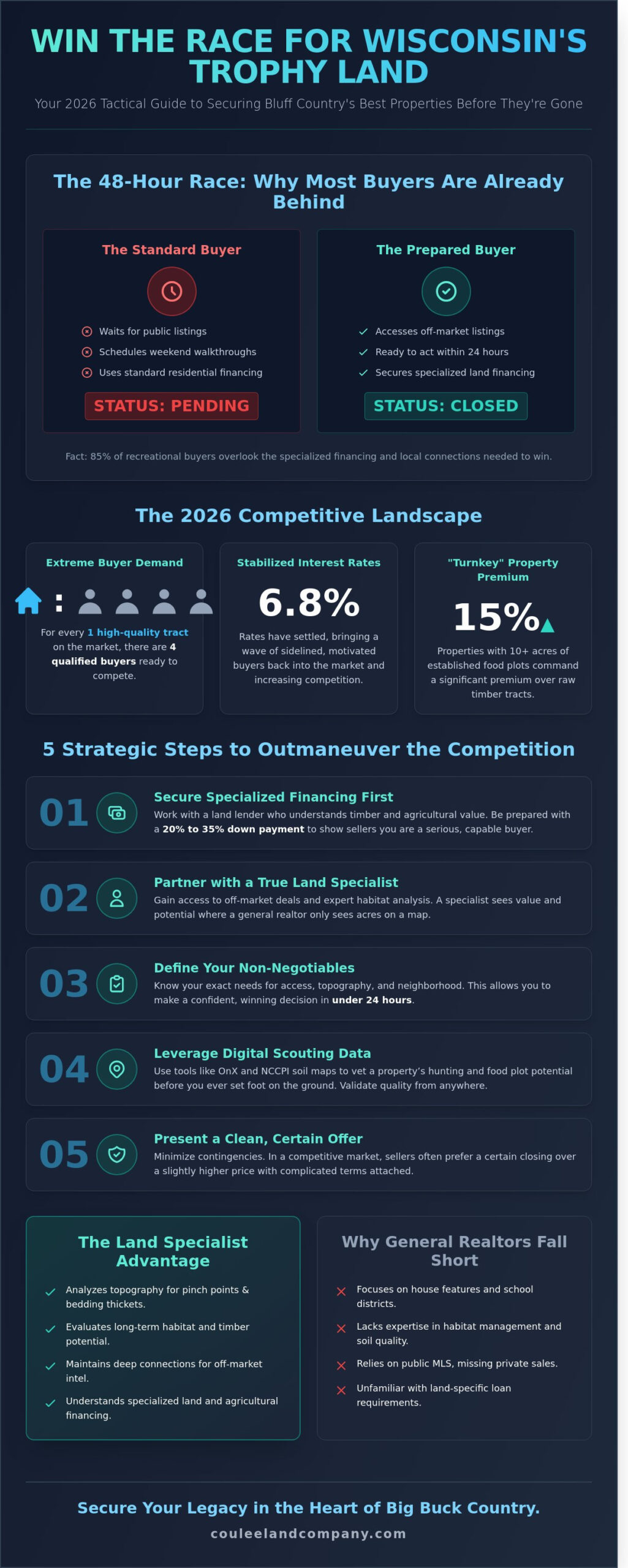
The Land Specialist Advantage: Why General Realtors Lose the Race
Buying a residential home requires a different lens than purchasing 80 acres of rugged terrain in Buffalo County. A general realtor focuses on kitchen remodels and school districts, but to WI: Beat the Competition in 2026, you need a partner who understands the dirt and the deer. Coulee Land Company agents don’t just walk the fence line; they analyze soil quality, timber stand value, and habitat density. A stand of mature white oak or a specific pocket of thermal cover represents thousands of dollars in “hidden” value that a residential agent will overlook every time. We identify these assets during the first walkthrough, giving you a clear picture of the land’s true wildlife capability.
Boots-on-the-Ground Expertise
Walking a property with a land specialist is a masterclass in deer biology. We identify primary bedding areas, pinch points, and travel corridors that dictate how a trophy buck moves through the landscape. We prioritize low-impact access points to ensure you don’t blow out the property on your first hunt. Our team knows that managing your property for wildlife starts the moment you step out of the truck. If you want a team that speaks your language and understands the nuances of the rut, visit our Coulee Land Company Buyers page to see how we vet every acre for its hunting potential.
Navigating Complex Land Regulations
The Wisconsin land market involves intricate legal layers like the Managed Forest Law (MFL). The MFL program is a critical tax-saving tool that allows WI landowners to reduce their property taxes by up to 80 percent in exchange for following a sustainable forestry plan. General realtors often miss these details or fail to explain the long-term impact of existing easements and zoning restrictions. Our agents are hunters first and realtors second. This perspective allows us to spot potential issues with government programs or neighbor access that others ignore. We leverage local networks to find off-market opportunities before they hit the MLS. In 2024, our deep roots in Western Wisconsin helped clients secure parcels that never saw a public listing. We provide the pragmatic, results-oriented guidance required to WI: Beat the Competition and secure your piece of the legendary Bluff Country.
Evaluating Bluff Country Potential: Seeing What Others Miss
To WI: Beat the Competition, you must look past the immediate aesthetics of a property. While many buyers search for park-like settings and clear views, seasoned land managers focus on the strategic advantages of rugged terrain. A 30 degree slope might seem like a liability to a casual observer, but for a trophy hunter, it is a primary defense. Steep topography limits human access; it creates natural sanctuaries where mature bucks can reach five or six years of age without seeing a single hunter. When you evaluate a parcel, you are not just buying the acreage within the fence line. You are assessing the surrounding 1,000 acres. If the neighboring properties provide 60% thick bedding cover and limited hunting pressure, your property value as a harvest site increases exponentially.
Topography also dictates movement through natural funnels and pinch points. By studying topographical maps before you ever set foot on the dirt, you can identify where ridges drop into narrow saddles or where rock outcroppings force deer into a 20 yard wide corridor. These are the locations where you can consistently harvest 170 inch class whitetails. Identifying these features early allows you to move faster than other buyers who rely solely on walking the perimeter.
Analyzing Wildlife Capabilities
Success starts with the dirt. Looking beyond the current deer sign is essential because tracks and rubs can change with the season. You need to analyze the long term potential of the habitat. High-calcium soil in regions like Western Wisconsin supports the skeletal growth necessary for massive frames. If a property currently lacks a water source, it is an opportunity rather than a flaw. Installing a 500 gallon solar powered watering system on a dry ridge can instantly centralize deer movement. For more technical scouting insights, review our Buffalo County Wisconsin Deer Hunting guide to understand what makes this region a world-class destination.
Strategic Property Layout
Every acre should serve a purpose. We often identify “dead” acreage, which can account for 25% of a property’s total size. This includes land that is impossible to hunt without blowing out the wind or areas that offer no bedding or food value. To WI: Beat the Competition, you need a layout that allows for low impact entry and exit. An internal road system that follows the leeward side of a ridge is worth a premium. It ensures you can reach your stand without alerting every animal in the valley. You can find examples of superior land design in our Hunting Properties listings, where we prioritize functional layouts over simple acreage counts.
Buying “ugly” land is the most effective way to see a high return on investment. Properties with 40% canopy closure or thick, unmanaged brush often sit on the market longer. For a visionary buyer, this is a blank canvas. By implementing timber stand improvement (TSI) and clearing three-acre food plots, you can transform a neglected $4,500 per acre parcel into a premier trophy producer. This proactive management builds equity that far outpaces general market appreciation.
Ready to find a property with hidden potential? Contact our land specialists today to start your search.
Secure Your Legacy with Coulee Land Company
Real estate in Western Wisconsin isn’t just about acreage; it’s about deer density, thermal cover, and the specific topography that creates world-class hunting. To WI: Beat the Competition in 2026, you need a team that understands why a north-facing slope matters as much as the price per acre. Coulee Land Company operates with a singular focus on the Bluff Country lifestyle. We don’t just list properties. We curate opportunities for hunters who want to own a piece of Buffalo County, an area that consistently accounts for more Boone and Crockett entries than any other county in the nation. Our team uses over 25 years of combined local experience to ensure you aren’t just buying land, you’re investing in a heritage.
Meet the Specialists
Mike Law leads our team with a track record built over two decades of boots-on-the-ground experience in the Driftless Area. Our agents don’t spend their weekends at open houses for suburban condos; they’re in tree stands or scouting bedding areas across the region’s rugged ridges. This deep immersion allows us to identify “sleeper” properties before they ever hit the public market. As Mike often says, “We aren’t just selling dirt; we’re the hunter’s realtor, matching your passion for the chase with the perfect piece of timber.” Our celebrity endorsements from industry leaders in outdoor television aren’t just for show. They’re a testament to our status as the premier authority in Western Wisconsin land sales.
Your Strategic Partner in the Hunt
Finding the land is only the beginning of the journey. We guide you through every phase, from analyzing wildlife capabilities to navigating the closing process and offering expert land management advice. Our past clients have secured 160-inch bucks within their first season because we helped them buy the right habitat, not just the right zip code. Our reputation is backed by a consistent track record of success among buyers who sought out the unique terrain of Western Wisconsin. We understand the nuances of the 2026 market and the urgency required to secure prime ground.
- Access to off-market listings and deep industry connections.
- Expert analysis of food plot potential and bedding area security.
- Proven negotiation strategies to help you win in a low-inventory environment.
- Long-term land management consulting to maximize your trophy potential.
If you want to WI: Beat the Competition before the 2026 season begins, you need to move now. The most coveted tracts in Buffalo County don’t stay available for long. Contact us today to start your property search and ensure your legacy is secured in the heart of big buck country.
Secure Your Place in the Bluff Country Legacy
Success in the 2026 market requires a shift from passive searching to aggressive, expert-led acquisition. To truly WI: Beat the Competition, you must leverage specialized knowledge of Western Wisconsin’s unique topography and local land values. This isn’t just a real estate transaction; it’s a strategic move to secure your place in the nation’s most elite whitetail habitat. General realtors often miss the subtle wildlife capabilities that make a property a true trophy producer, but our team identifies those hidden gems before they hit the open market.
Coulee Land Company serves as Wisconsin’s premier Land & Property Sales Specialists, focusing on Buffalo County, the #1 trophy whitetail destination in the world. Our deep roots in the region and endorsements from top professionals in the outdoor television industry provide you with a distinct advantage. We don’t just sell land; we help you build a legacy on the same ridges that dominate the Boone and Crockett Record Book. Take the first step toward owning the premier hunting ground you’ve always dreamed of.
View our exclusive Western Wisconsin hunting land listings
Your future trophy buck is out there, and we’re ready to help you find the ground he calls home.
Frequently Asked Questions
Is Buffalo County still the most competitive market for hunting land in WI?
Buffalo County remains the most competitive market in 2026 because it consistently produces the highest number of Boone and Crockett whitetails in the nation. This single county recorded over 100 entries in the last 20 years, creating a permanent demand spike. Prices here often command a 15% premium over neighboring counties like Trempealeau or Jackson. You’ll need to move within 48 hours of a listing to secure a prime 40 acre parcel.
How can I find off-market hunting land listings in Wisconsin?
Accessing off-market listings requires a direct relationship with a specialized land broker who maintains a private database of pocket listings. To successfully execute the strategy of WI: Beat the Competition, you must tap into these unadvertised opportunities before they hit the Zillow or MLS platforms. Roughly 25% of our high-value sales in the Coulee Region occur through these private networks, ensuring buyers avoid bidding wars entirely.
What is the first step I should take to beat other buyers to a new listing?
Your first step is securing a pre-approval letter from a lender that specializes in agricultural or recreational land, such as Compeer Financial. Standard residential lenders often struggle with raw land valuations, which can kill a deal during the appraisal process. Having a land-specific pre-approval shows sellers you’re a serious buyer who won’t face financing hurdles. This preparation allows you to submit an offer the same day a property goes live.
Do I need a specialized loan for buying recreational or hunting land?
You definitely need a specialized loan because traditional 30 year fixed mortgages are rarely available for unimproved hunting land. Lenders typically require a 20% to 30% down payment for recreational tracts, with terms ranging from 15 to 20 years. These specialized products account for the unique appraisal needs of timber value and wildlife habitat. Working with a land-fluent lender ensures your closing stays on track without 11th hour surprises.
Why are land prices in Western Wisconsin continuing to rise in 2026?
Land prices in Western Wisconsin are rising in 2026 due to a 12% decrease in available inventory compared to five years ago. High demand for world-class whitetail habitat in the Driftless Area drives this appreciation. Investors now view these ridges as a safe haven asset class, similar to gold. This shift has pushed average prices for top-tier hunting ground above $6,000 per acre in several key townships.
Can a residential realtor effectively help me find trophy whitetail land?
A residential realtor rarely has the expertise to evaluate the wildlife capabilities or timber value of a trophy whitetail property. They often miss critical details like bedding cover density, thermal corridors, or historical buck movement patterns. You need a hunter’s realtor who understands how a 160 inch buck uses the topography. Our team walks every ridge and valley to ensure the land actually holds the quality of deer you’re chasing.
What makes a “clean offer” in a competitive land deal?
A clean offer is one that removes as many hurdles as possible, specifically by limiting contingencies to just the essentials like title insurance. You should include a recent proof of funds letter and a closing date within 30 days of acceptance. In a market where multiple offers are the norm, a cash offer with a 5% earnest money deposit often beats a higher bid that includes a long list of inspections or land-use permits.
How does Managed Forest Law (MFL) affect the competition for a property?
The Managed Forest Law (MFL) program increases competition by making high-acreage properties more affordable through an 80% reduction in property taxes. Buyers look for these enrollments to lower their annual carrying costs, but you must review the specific plan dates. An MFL-Closed status is highly coveted because it keeps the public off your land while maintaining those massive tax breaks. Understanding these 25 year or 50 year contracts is vital for your long-term investment.