
Buying a piece of Wisconsin dirt without a hunt-first perspective is the fastest way to overpay for a property that looks good on paper but fails in the field. In 2026, with Western Wisconsin land values under increased pressure, you can’t afford to realize your new acreage lacks proper bedding cover or is choked by restrictive easements after the closing. This risk is precisely why use a specialized land agent who understands that a property’s value is found in its wildlife capabilities, not just its road frontage.
You already know that owning a piece of the famed Bluff Country is a life-long goal, yet the fear of handling complex 1031 exchanges or confusing zoning laws can stall even the most seasoned hunter. We promise to show you how a dedicated expert helps you bypass these hurdles to identify high-potential trophy whitetail properties in regions like Buffalo County before they even hit the open market. This guide breaks down the essential advantages of specialized representation, from securing maximum market exposure for sellers to ensuring buyers don’t waste time on properties that will never produce a Boone and Crockett buck.
Key Takeaways
- Learn why treating acreage like a “house without a roof” is a major financial error and how technical expertise protects your investment.
- Discover why use a specialized land agent to assess “X-ray” property features like timber ROI and trophy whitetail habitat capabilities.
- Identify the critical questions to ask regarding MFL tax implications and county-specific sales volume before hiring any broker.
- Understand the “boots on the ground” marketing approach required to successfully navigate Wisconsin’s competitive recreational land market.
- See how partnering with a “Hunter’s Realtor” in Buffalo County ensures your property is managed for maximum value and long-term outdoor success.
Understanding the Critical Difference Between Land and Residential Real Estate
Selling or purchasing raw acreage in Western Wisconsin isn’t the same as trading a suburban ranch home. A standard Real estate agent focuses on bedroom counts and school districts, but a specialized land agent operates as a technical consultant for non-residential variables. You’re dealing with soil types, timber values, and topographical features that determine the property’s ultimate utility. Treating a parcel of ground like a “house without a roof” often results in massive financial errors, such as overpaying for land that lacks buildable sites or failing to account for restrictive easements.
The emotional drivers are different here. Buyers aren’t just looking for shelter; they’re pursuing a legacy in the famed “Bluff Country.” This is why understanding why use a specialized land agent is vital for your success. These experts know how to market hunting properties to high-net-worth individuals who value Boone and Crockett record book entries as much as modern kitchen finishes. We speak the language of the land, connecting the right buyers with the specific wildlife capabilities of a property.
To better understand the unique role these professionals play, watch this helpful video:
The “Dirt vs. Dwelling” Mentality
Residential realtors live by the price-per-square-foot metric. Specialized land agents focus on acreage quality and the “Highest and Best Use” of the soil. A 40-acre tract in Buffalo County might be worth double a similar tract elsewhere if it features the right mix of bedding cover and tillable food plots. We don’t just snap photos of a field; we utilize advanced GIS mapping and aerial data to analyze pinch points and thermal cover. This data-driven approach ensures the market value reflects the land’s actual production or trophy whitetail potential. It’s about seeing what the land can become, not just what it is today.
Regulatory Complexity in Rural Wisconsin
Wisconsin’s rural landscape is governed by complex tax and conservation programs that can make or break a deal. The Managed Forest Law (MFL) can reduce property taxes by nearly 80 percent, but it comes with strict harvesting schedules and specific public access rules. A specialized agent understands how these encumbrances affect your bottom line. Whether it’s navigating Conservation Reserve Program (CRP) contracts or implementing Wisconsin land management for wildlife, this knowledge is a transactional necessity. We ensure you aren’t surprised by thousands of dollars in back taxes or land-use penalties after the closing date. In the 2026 market, having an expert who understands these state-specific programs is the only way to protect your investment.
The “X-Ray Vision” of a Land Specialist: Seeing Beyond the Property Lines
A general real estate agent sees a map with boundaries and a price tag. A land specialist sees a living, breathing ecosystem. This fundamental difference is why use a specialized land agent when you’re investing in Wisconsin’s diverse terrain. We evaluate “wildlife capability” by dissecting how bedding areas, water sources, and mast-producing trees interact. It isn’t just about having trees; it’s about having the right diversity to hold mature bucks year-round. We also analyze timber value, treating your woods as a standing bank account. In 2024, high-quality white oak prices remained strong, and we help you project that ROI over a 15-year harvest cycle.
Strategic hunting requires more than just a platform in a tree. We assess access points based on prevailing westerly winds and neighbor pressure. If a neighbor’s primary ATV trail runs along your north fence, that changes your entire hunting strategy. We don’t just walk the flat ground. We conduct 4WD site visits to reach the ridges and valleys where the real value hides, ensuring every acre is accounted for before you sign a contract.
Evaluating Biological Potential
In regions like Buffalo County, which leads the nation with over 150 Boone and Crockett whitetail entries, the “neighborhood effect” is everything. We look at soil quality and topography to determine if a property can sustain trophy-class animals. Often, we find massive potential in “ugly” land. Thick, swampy brush or steep, brier-filled hillsides that scare off generalists are exactly where 170-inch bucks feel safe. We identify these hidden gems that others overlook because they don’t understand the biological needs of the herd.
Technical Infrastructure and Access
Building country homes or recreational cabins requires a deep dive into local regulations and physical limitations. We handle the gritty details of legal access and easements to ensure you aren’t buying a landlocked headache. Before you fall in love with a view, we check for utility proximity and coordinate perk tests to confirm a buildable site exists. Knowing the right questions to ask before hiring an agent will lead you to a partner who understands these technical hurdles. If you want a property that performs as both a sanctuary and a financial investment, you need a guide who knows the dirt. Explore our current hunting properties to see this expert evaluation in action.
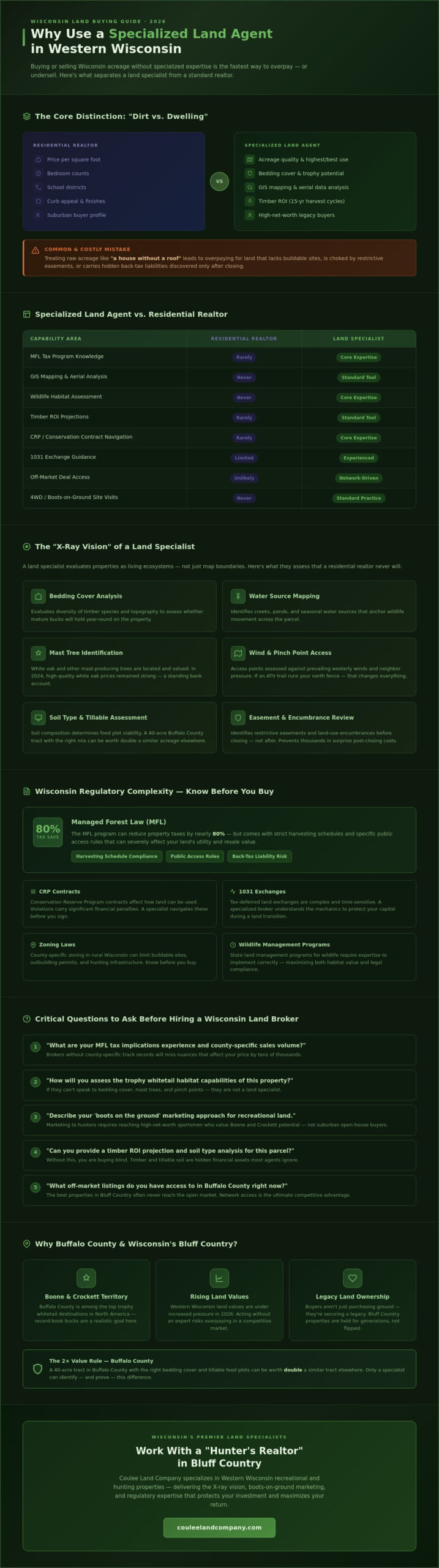
Specialized Land Agent vs. Residential Realtor: A Side-by-Side Comparison
A residential realtor is trained to sell square footage and school districts. They’re experts at staging kitchens. However, selling a 120 acre tract in Buffalo County requires a different set of skills. While a home might sell in 42 days on average in a hot Wisconsin market, a specialized land tract often stays on the market for 180 to 270 days. This timeline reflects the time needed to find a buyer who understands the specific wildlife capabilities of the property. You don’t just put a sign in the yard. You hunt for the right buyer. This is exactly why use a specialized land agent instead of a generalist.
The disparity in contract knowledge is another critical factor. Every agent must meet the Wisconsin real estate license requirements, but those standards are a baseline. A land specialist understands the complexities of timber value, mineral rights, and Managed Forest Law (MFL) status. They know how a pipeline easement or a water right dispute can slash property value by 25 percent or more overnight. A residential agent might miss these details because they don’t deal with them in a suburban cul-de-sac. Our “boots on the ground” approach ensures every acre is walked, not just viewed from a gravel road.
The Tools of the Trade
A land specialist doesn’t just carry a lockbox key. They arrive with a soil probe and an ATV. You can’t assess a property’s potential from the window of a truck. We use custom mapping software like OnX and Basemap to overlay topography, soil types, and thermal cover. When selling hunting land in Wisconsin, these tech stacks allow us to prove why a specific ridge is a natural funnel for trophy bucks. It’s about data-driven presentation, not just “pretty pictures.” We provide buyers with high-definition aerial surveys and property boundary data that a standard MLS listing simply can’t match.
The Buyer Psychology Gap
Residential buyers ask about granite countertops. Our buyers ask about buck-to-doe ratios and the proximity of neighboring sanctuaries. Understanding why use a specialized land agent becomes clear when you see how we vet leads. We don’t waste time with “looky-loos” who can’t secure a specialized land loan through institutions like Compeer Financial. The “Hunter’s Realtor” persona allows us to speak the language of the buyer, building immediate trust. We aren’t just selling dirt; we’re selling the dream of the next record-book whitetail in the heart of Bluff Country. Our network consists of serious outdoorsmen, not just casual browsers on general real estate portals.
Key Questions to Ask Before Hiring a Wisconsin Land Broker
Choosing the right representation determines whether you secure a legacy property or inherit a topographic nightmare. You shouldn’t settle for a residential agent who occasionally wanders into the woods. Understanding why use a specialized land agent becomes clear when you realize that specialized knowledge translates directly to your bottom line. Ask these four critical questions during your first interview to separate the hobbyists from the professionals.
- “How many acres of recreational land have you sold in this specific county in the last 24 months?” Generalists track sales by units; land specialists track by the acre. If an agent hasn’t moved at least 300 to 500 acres in the local area recently, they lack the current market pulse.
- “Can you explain the current MFL status of this property and its tax implications?” Wisconsin’s Managed Forest Law (MFL) can reduce property taxes by 80% or more. However, it comes with strict 25 or 50-year commitments. An expert must explain the difference between “open” and “closed” designations and the potential penalties for withdrawal.
- “How would you identify the primary bedding areas and travel corridors on this tract?” A land specialist views a map as a biological blueprint. They should point out north-facing slopes for thermal cover and pinch points where trophy whitetails move during the rut.
- “Do you have a network of land contractors to recommend?” You’ll need more than a title company. Ask for specific names of excavators for trail systems, foresters for timber management, and biologists for food plot design.
Vetting for Local Expertise
In the bluffs of Western Wisconsin, local expertise isn’t about a zip code on a business card. It’s about knowing how a 15-mph northwest wind affects a specific valley. Your agent should live the lifestyle they sell. When an agent manages their own timber and hunts the same ridges, they offer authentic insight that a city-based realtor cannot match. Look for agents endorsed by respected figures in the outdoor community to ensure they have the “hunter’s realtor” pedigree. This level of specialization is why use a specialized land agent when looking at high-value tracts in Buffalo County.
Evaluating the Marketing Plan
Selling land requires a different toolkit than selling a three-bedroom ranch. Demand to see professional 4K drone videography that highlights terrain changes and custom interactive maps. Your property must appear on specialized platforms like LandWatch and Land and Farm. These sites capture the 90% of buyers looking specifically for acreage. A high-tier broker also manages “pocket listings,” connecting buyers to off-market opportunities before they ever hit the public eye.
Why Coulee Land Company is the Premier Choice for Wisconsin’s Bluff Country
Coulee Land Company isn’t your average real estate brokerage. We focus exclusively on the rugged, high-value terrain of Buffalo County and the surrounding Western Wisconsin region. This hyper-local focus means we understand the specific nuances of the ridge-and-valley topography that defines the Driftless Area. We don’t just sell property; we live the lifestyle that makes this region world-famous. Our team has built a reputation as the undisputed authority in Wisconsin’s most prized hunting grounds by combining professional real estate expertise with a deep-seated passion for conservation and land management.
You might wonder why use a specialized land agent when any realtor can list a property on a standard website. The answer lies in our identity as the “Hunter’s Realtor.” Our team consists of dedicated land managers and hunters who see potential where others see simple brush. We leverage a massive regional network and high-profile celebrity endorsements from the outdoor television space to put your property in front of a targeted, qualified audience. We speak the language of the land, which allows us to bridge the gap between a simple real estate transaction and a legacy investment.
Our Hands-On Approach to Land Sales
Specialists like Mike Law and Bryan Lemke don’t just look at topographical maps from an office. They walk every acre to assess timber quality, bedding areas, and natural travel corridors. This hands-on method allows us to offer visionary land sales. We help buyers visualize what a property can become through strategic food plots and habitat improvement. Our track record is unmatched in Buffalo County, a region that has famously produced more Boone and Crockett whitetail entries than any other county in the United States. When you work with us, you’re hiring experts who know how to identify and market that trophy-producing potential.
Ready to Find or Sell Your Piece of the Bluffs?
Sellers in the 2026 market need more than a generic listing. You need a specialized property valuation that accounts for wildlife capabilities, soil productivity, and trophy history. These factors are often overlooked by generalists but are vital for maximizing your return. If you’re on the hunt for a new property, join our exclusive list for upcoming Wisconsin hunting land for sale. Many of our premier parcels move quickly within our private network before they ever reach a public portal. Don’t leave your land investment to chance. Contact Coulee Land Company today to partner with the true experts in Wisconsin’s Bluff Country.
Secure Your Legacy in Wisconsin’s Premier Whitetail Country
Buying acreage in 2026 requires more than a standard real estate license. It demands a deep understanding of soil quality and the wildlife capabilities that define a high-performing property. When you consider why use a specialized land agent, the answer lies in the technical precision they bring to complex 1031 exchanges and Managed Forest Law (MFL) programs. A residential realtor might see a view, but a specialist identifies the bedding areas and travel corridors that make a property a true hunting sanctuary.
Coulee Land Company stands as the authority in Wisconsin’s Bluff Country. We focus on Buffalo County, the nation’s #1 destination for trophy whitetails with more Boone and Crockett entries than any other county in the United States. Our team is endorsed by leading outdoor television personalities because we don’t just sell land; we manage it. We provide the strategic insight needed to navigate Western Wisconsin topography while protecting your investment through expert land management. It’s time to work with a partner who knows the dirt as well as you do.
Partner with Wisconsin’s Land Specialists at Coulee Land Company
Your dream of owning a piece of the nation’s most storied hunting ground is closer than you think.
Frequently Asked Questions
Is it more expensive to hire a specialized land agent than a regular realtor?
Hiring a specialized land agent typically costs the same in commission as a residential realtor, but the return on investment is significantly higher. You aren’t paying a premium for the title; you’re investing in a professional who understands soil maps and timber value. According to 2024 industry standards, commissions remain competitive, yet specialized agents often prevent costly mistakes in land use assessments that save thousands in the long run.
Can a residential realtor sell my hunting land?
A residential realtor can legally list your property, but they often lack the technical knowledge required to market trophy whitetail tracts effectively. Selling hunting land requires an understanding of wildlife travel corridors and bedding areas. Without these insights, a property might sit on the market 30% longer than those listed by specialists who speak the language of the outdoor community and reach the right buyer pool.
What is the “Highest and Best Use” of land and why does it matter?
Highest and Best Use is a valuation principle that identifies the most profitable use of a property that’s physically possible and legally permissible. This matters because a 40 acre parcel might be worth more as a secluded building site than as strictly agricultural acreage. Determining this correctly ensures you don’t leave money on the table, which is a key reason why use a specialized land agent who understands local zoning.
How do land agents determine the value of timber on a property?
Land agents evaluate timber value by conducting a basic inventory of species, age, and board footage. While we aren’t licensed foresters, we utilize current market reports from the Wisconsin DNR to estimate the standing value of hardwoods like Red Oak or Walnut. In 2025, timber prices for high quality veneer logs reached record highs, making it vital to have an agent who recognizes marketable timber during the initial walkthrough.
What are the benefits of using a land specialist when buying in Buffalo County?
Buying in Buffalo County requires an agent who understands why this region leads the world with over 1,000 Boone and Crockett entries. A specialist knows the specific ridges and coulees that produce trophy bucks and can identify properties with superior wildlife capabilities. We provide boots on the ground knowledge of local neighbors and historical harvest data that a generalist simply cannot access from a suburban office.
Do land agents help with financing and land loans?
Land specialists connect buyers with agricultural lenders like Compeer Financial who understand the nuances of land loans. Traditional banks often require 20% to 30% down payments and may struggle with non-residential appraisals. We streamline the process by providing the production records or lease income data these specialized lenders need to approve your financing quickly. Our team ensures the appraisal process accounts for the land’s true recreational value.
What is the difference between a land agent and a land broker?
The primary difference lies in the level of licensing and legal responsibility held under Wisconsin state law. A land agent is a licensed professional who must work under a firm, while a land broker has completed additional education and can operate their own independent agency. Both roles understand why use a specialized land agent for complex transactions, but a broker carries the ultimate liability for the firm’s contracts.
How does a specialized agent handle Wisconsin’s Managed Forest Law (MFL) during a sale?
A specialist manages MFL requirements by reviewing the specific management plan and ensuring all transfer paperwork is filed with the DNR within 30 days of closing. We explain the tax benefits of the program, which can reduce property taxes by up to 80% for eligible landowners. Failing to disclose MFL status or withdrawal penalties can lead to legal disputes, making expert oversight essential for Western Wisconsin timberland sales.