
For serious whitetail hunters, the name ‘Buffalo County’ is spoken with a certain reverence, a name synonymous with Boone and Crockett entries and legendary trail cam pictures. But beyond the hype, many hunters are left wondering about the real secret. The question of why buffalo county has big bucks isn’t about luck; it’s about a powerful confluence of specific, identifiable advantages that make this region the undisputed king of trophy whitetails.
It’s a question we, as Wisconsin’s Land & Property Sales Specialists, have dedicated our careers to understanding. This isn’t folklore. It’s a repeatable formula rooted in science and geography. In this definitive guide, we will uncover the unique combination of nutrient-rich soil, a dramatic bluff-country topography that allows bucks to reach maturity, and a deeply ingrained culture of land management. Prepare to understand exactly what makes this hallowed ground the ultimate destination for those pursuing the buck of a lifetime.
Key Takeaways
- Learn how Buffalo County’s unique, unglaciated topography provides the foundational advantage for growing world-class whitetails.
- Discover the powerful combination of superior nutrition and rugged sanctuaries that allows bucks to reach full maturity and genetic potential.
- Understand precisely why Buffalo County has big bucks by exploring the decades-old culture of quality deer management that transforms potential into reality.
- Gain the critical insight needed to evaluate and invest in a piece of this legendary region, where the land’s value is backed by unmatched hunting potential.
The Foundation: A Perfect Storm of Geography and Geology
The Boone and Crockett record books don’t lie. For decades, Buffalo County has been the undisputed king of trophy whitetail production, and the reason begins with the land itself. Long before the first food plot was ever planted, a unique combination of geological history and rugged geography created the perfect environment for whitetail deer to not just survive, but to achieve their maximum genetic potential. Understanding this foundation is the first step in understanding why buffalo county has big bucks.
This isn’t just prime deer habitat; it’s a landscape forged by a fortunate quirk of natural history, giving hunters and land managers an incredible head start.
The ‘Driftless Area’ Advantage
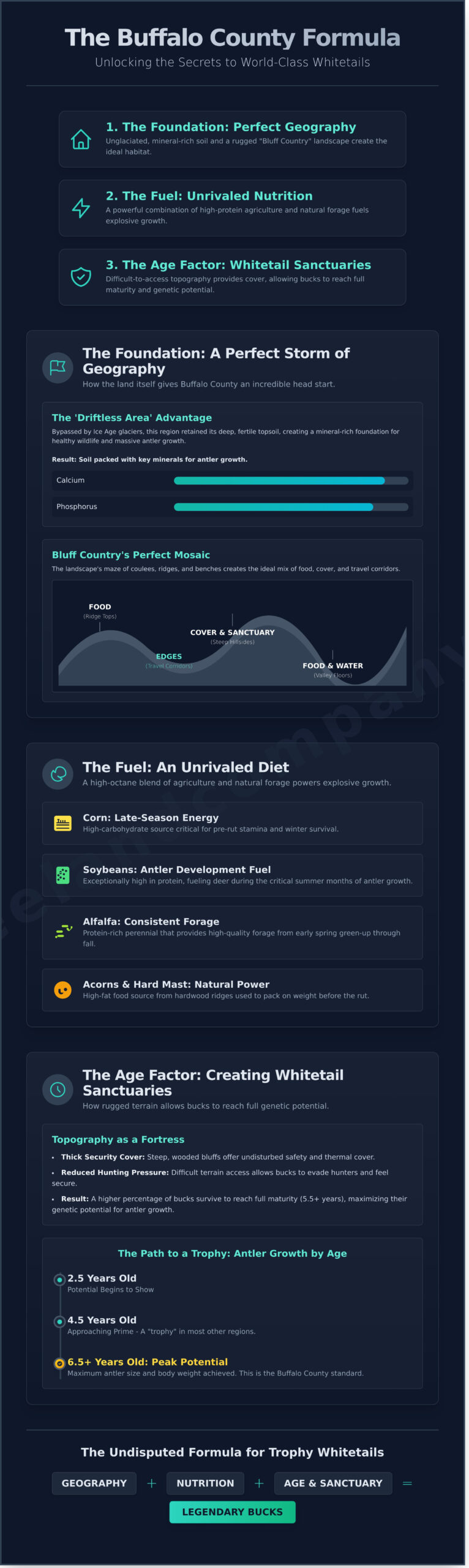
While the glaciers of the last ice age flattened much of the Midwest, they bypassed a section of Wisconsin, Minnesota, Iowa, and Illinois. This unglaciated region, known as the “Driftless Area,” is the secret to the area’s superior wildlife capabilities. Instead of having its rich topsoil scraped away, the ancient, rolling landscape of Buffalo County, Wisconsin was preserved. This resulted in deep, fertile soils packed with the essential minerals-like calcium and phosphorus-that are the building blocks of massive antlers and heavy bodies. Healthy soil grows nutrient-dense vegetation, from native browse to agricultural crops, providing the high-octane fuel required to grow giant whitetails.
Bluff Country Topography: Coulees, Ridges, and Benches
The defining characteristic of the Driftless Area is its dramatic “Bluff Country” topography. The landscape is a breathtaking maze of steep, wooded bluffs that drop into deep, winding valleys locally known as ‘coulees.’ This terrain creates a perfect storm of elements that mature bucks require to thrive:
- Food: Fertile, flat ridge tops and valley floors are ideal for agriculture, providing abundant, high-protein food sources like corn, soybeans, and alfalfa.
- Cover: The steep, rugged hillsides offer thick, undisturbed security and thermal cover, allowing bucks to feel safe and reach old age.
- Edges: The constant transition from ag-field to hardwood timber to thick bedding cover creates thousands of miles of “edge” habitat, which deer use as travel corridors between feeding and bedding areas.
This intricate mosaic of food, cover, and security is the core reason why buffalo county has big bucks, creating a sanctuary where they can thrive year-round. Learn more about the unique character of this region on our Buffalo County community page.
Unrivaled Nutrition: The Fuel for Record-Breaking Antler Growth
Genetics and age are the essential framework for a trophy whitetail, but without superior, year-round nutrition, that potential is never realized. It is the high-octane fuel that powers body condition and explosive antler growth. The primary reason why Buffalo County has big bucks is its unparalleled landscape, which provides a perfect storm of agricultural abundance and rich, natural forage. This powerful combination allows a mature buck to dedicate maximum resources to growing truly exceptional antlers, rather than just surviving.
An Agricultural Buffet
The rolling fields nestled within Buffalo County’s coulees and ridge tops create a veritable buffet for whitetails. These are not just any crops; they are high-impact food sources packed with the protein and energy needed to build massive frames and headgear. The key players in this agricultural powerhouse include:
- Corn: A high-carbohydrate source critical for late-season energy and winter survival.
- Soybeans: Exceptionally high in protein, fueling deer during the critical summer months of antler development.
- Alfalfa: A protein-rich perennial that provides consistent, high-quality forage from early spring green-up through fall.
Even after the harvest, abundant waste grain provides a crucial lifeline, helping the entire herd enter the harsh Wisconsin winter with vital fat reserves and emerge in spring ready to thrive.
Natural Forage and Hardwood Mast
What truly separates this region is how its world-class agriculture is seamlessly integrated with premier natural habitat. The hardwood ridges are dominated by white and red oaks, which in a good year can blanket the forest floor with acorns-a high-fat food source that bucks use to pack on weight before the rut. This powerful fusion of food sources is a recurring theme in expert analyses; in fact, Boone and Crockett Club records frequently cite this agricultural abundance as a key reason for the region’s dominance. During tough winters, the sun-drenched, south-facing slopes provide critical thermal cover and access to woody browse. This natural diversity acts as a built-in insurance policy, ensuring that even in a drought or a poor crop year, the deer herd has the resources needed to flourish.
The Age Factor: How Topography Creates Whitetail Sanctuaries
While genetics and nutrition are critical pieces of the puzzle, the single most important ingredient for growing Boone and Crockett class whitetails is age. A buck simply cannot express its full genetic potential at two or three years old. The secret to Buffalo County’s dominance lies in its unique ability to provide an environment where bucks can consistently survive hunting seasons and reach full maturity at 5, 6, or even 7 years of age.
The answer to why Buffalo County has big bucks is written directly into the land itself. The region’s famously rugged “Bluff Country” topography, characterized by steep, winding ridges and deep, inaccessible coulees, creates natural fortresses for whitetails. This challenging landscape is more than just scenic; it is a functional sanctuary that gives mature bucks a distinct home-field advantage, allowing them to evade pressure and grow old.
Escape Cover and Secure Bedding Areas
A mature whitetail buck prioritizes security above all else, and Buffalo County’s terrain delivers it in spades. The steep, timbered hillsides and thick benches provide ideal bedding locations where a buck can use its senses to maximum effect. Bedded high on a point, a buck can see danger approaching from below, use the swirling thermal currents to smell threats, and hear anything out of place in the valleys. This constant strategic advantage allows them to live with minimal human pressure, conserving energy for growth rather than flight.
Limited Access and Hunting Pressure
The same terrain that provides sanctuary for deer presents a formidable challenge for hunters. Unlike the flatlands of other Midwestern states, access here is naturally restricted. The landscape funnels human movement into predictable paths, making it incredibly difficult to hunt effectively without deep knowledge of a specific property. This is compounded by a tradition of large, privately owned parcels, which limits the overall number of hunters in the woods. This combination, as noted in a detailed Boone and Crockett Club analysis, results in a lower harvest rate for younger bucks, preserving the age structure necessary to produce world-class trophies year after year.
A Culture of Quality: The Human Element in Deer Management
The incredible genetics, nutrient-rich agriculture, and unique topography of the Coulee Region provide the raw potential for world-class whitetails. But potential alone doesn’t put bucks in the Boone and Crockett record book. The landscape sets the stage, but it’s the people-the landowners and hunters of Buffalo County-who turn that potential into a consistent reality. This shared stewardship is a critical, and often overlooked, piece of the puzzle explaining why buffalo county has big bucks.
The Rise of Quality Deer Management (QDM)
For decades, long before it became a mainstream concept, a powerful philosophy took root here: ‘let them go so they can grow.’ This isn’t a government mandate; it’s a deeply ingrained cultural standard. Hunters and landowners throughout the county voluntarily pass on 2.5 and 3.5-year-old bucks, understanding that giving these deer another year or two is the only way to see them reach their true genetic potential. This disciplined practice ensures a healthy age structure across the herd, making the chance to encounter a truly mature whitetail a real possibility, not a rare fluke.
A Community of Like-Minded Landowners
This commitment to QDM isn’t practiced on isolated islands of property. Instead, it’s a community-wide effort where neighbors work in concert toward a common goal. The local hunting culture prioritizes overall herd health and the pursuit of mature, trophy-class animals over simply filling a tag. This collective buy-in creates a multiplier effect, where the management practices on one farm benefit the next, amplifying the results across entire townships. It’s this spirit of cooperation that truly defines the region. Our founder, Mike Law, has worked with these dedicated landowners for decades, witnessing firsthand how this shared vision has shaped the landscape and its legendary deer herd.
Ultimately, the human element is the catalyst that transforms good deer country into the nation’s premier trophy whitetail destination. This disciplined, long-term approach to herd management is the final, essential reason why Buffalo County has big bucks year after year. Understanding this unique culture is key to finding your own piece of this legendary landscape, a process our team of specialists at Coulee Land Company knows better than anyone.
Owning a Piece of the Legend: Investing in a Whitetail Paradise
Throughout this guide, we’ve explored the perfect storm of genetics, nutrition, topography, and hunter culture that answers the question of why Buffalo County has big bucks. Understanding these interconnected factors is the first step in appreciating the profound value of the land here. Owning a property in this famed region is more than a simple purchase; it is a strategic investment in a world-class whitetail destination and an opportunity to become part of a rich, deeply-rooted hunting heritage.
This is where dreams of Boone and Crockett entries are realized, but securing the right piece of this paradise requires a specialist’s eye. The difference between a good property and a legendary one lies in the details-details that only a true land expert can identify.
What to Look For in a Trophy Property
A premier hunting property is a carefully balanced ecosystem designed to hold and grow mature whitetails. The most successful parcels share several critical features that create a year-round sanctuary for deer. Our team of seasoned professionals helps prospective buyers identify these key attributes, including:
- Strategic Access: Well-planned entry and exit routes that minimize pressure on wildlife are non-negotiable for consistent success.
- Habitat Diversity: The ideal property features a mosaic of hardwood timber for mast crops, thick bedding cover, and tillable acreage for high-protein food plots.
- Water Sources: Consistent water from creeks, ponds, or springs is essential for holding deer on your property, especially during the rut.
- Topography Advantage: South-facing slopes are critical, providing thermal cover and early green-up that attract deer during the harsh Wisconsin winters.
Partnering with a True Land Specialist
Navigating the Bluff Country real estate market requires more than a general agent; it demands a specialist who lives and breathes this unique landscape. A local expert understands the subtle nuances of the terrain, the history of specific parcels, and the local market dynamics. We don’t just see property lines; we see the untapped potential for food plots, stand locations, and habitat improvements that can transform a great property into a whitetail legacy.
The factors explaining why Buffalo County has big bucks are the same ones that drive the value and potential of its land. Don’t just buy a piece of ground; invest in a legacy of giant whitetails. When you are ready to find your dream property and become part of the legend, our team is here to guide you.
Explore premier Buffalo County hunting properties for sale.
Your Legacy in the Land of Giants
The legend of Buffalo County is no myth; it’s a calculated reality. The answer to why Buffalo County has big bucks lies in a powerful convergence of factors: nutrient-rich soils that fuel incredible antler growth, rugged bluff country topography that allows bucks to reach full maturity, and a deep-seated culture of quality deer management. This perfect storm has cemented its status as a whitetail paradise unlike any other on Earth.
Understanding this unique ecosystem is one thing; owning a piece of it is the ultimate dream for a serious hunter. As Wisconsin’s Land & Property Sales Specialists, Coulee Land Company offers unmatched expertise in the famed ‘Golden Triangle.’ Our decades of boots-on-the-ground experience means we don’t just sell land-we connect hunters with legacy properties. Your opportunity to be part of the legend is here. Explore premier Buffalo County hunting properties for sale.
Start your own chapter in this legendary whitetail story.
Frequently Asked Questions
Is Buffalo County still the number one place for Boone and Crockett whitetails?
Without question. Buffalo County continues to dominate the Boone and Crockett record books for trophy whitetail bucks, holding more entries than any other county in the world. This unrivaled legacy is built on a foundation of superior genetics, ideal habitat, and decades of quality deer management. For hunters seeking a legitimate opportunity at a world-class animal, Buffalo County remains the undisputed pinnacle of whitetail hunting destinations in North America, a status it has proudly maintained for decades.
What is a ‘Boone and Crockett’ buck and what does it take to qualify?
The Boone and Crockett Club maintains the official scoring system and records for North American big game, representing the gold standard for trophy animals. To qualify for the prestigious all-time record book, a typical whitetail buck must have a minimum net score of 170 inches after the mandatory 60-day drying period. A non-typical whitetail requires a much higher minimum net score of 195 inches. Achieving these scores is the ultimate goal for every serious whitetail hunter.
Can you hunt public land in Buffalo County and what are the opportunities like?
Yes, public hunting land is available in Buffalo County, with the Tiffany Wildlife Area being the most significant tract. However, these opportunities are limited and the areas experience intense hunting pressure. The very factors that explain why buffalo county has big bucks-its legendary reputation-also draw immense crowds to its public grounds. While accessible, securing a quality hunting experience often means competing with many other hunters, making private land ownership a superior alternative for serious sportsmen.
How much does hunting land typically cost per acre in Buffalo County?
The investment for prime hunting real estate in Buffalo County reflects its world-class status. Prices typically range from $5,000 to over $10,000 per acre, depending on several key factors. Variables influencing the final cost include the ratio of timber to tillable land, water access, established food plots, trail systems, and proven trophy history. A property with income-producing cropland and managed hardwood ridges will command a premium price in this highly sought-after market.
What other counties in Wisconsin’s Driftless Area are known for big bucks?
While Buffalo County holds the crown, the entire Driftless Area of Wisconsin is a powerhouse for producing trophy whitetails. Neighboring counties like Trempealeau, Vernon, Crawford, and La Crosse share the same rugged bluff country topography and rich agricultural food sources. These counties consistently produce record-book bucks, benefiting from the same genetic pool and habitat. They represent amazing opportunities for owning your own piece of whitetail paradise in the heart of Bluff Country.
Besides deer, what other hunting opportunities exist in Buffalo County?
While famed for its whitetails, Buffalo County offers diverse and exceptional hunting for other species. The area boasts a thriving wild turkey population, providing incredible spring and fall hunting in the steep hardwood ridges. The county’s border along the Mississippi River creates a major flyway for waterfowl, offering fantastic duck and goose hunting opportunities. Pursuits for small game like squirrels and rabbits are also readily available, making it a true year-round destination for the dedicated outdoorsman.