
Did you know that since 2000, a single Wisconsin county, Buffalo County, has entered more typical and non-typical whitetails into the Boone and Crockett record books than any other county in North America? It’s a staggering fact that proves what dedicated hunters already know: world-class bucks aren’t a happy accident. You’ve likely felt the frustration of overcrowded public lands and the rising costs of annual leases that build zero equity. You want control over your hunt, your habitat, and the quality of deer you manage.
This guide is your definitive blueprint for making that dream a reality. We’re delivering the essential intelligence for successful Whitetail hunting Wisconsin in 2026 and providing a clear path to owning the dirt that grows giants. Prepare to dive into updated regulations, identify the state’s premier trophy-producing regions, and calculate the powerful return on investment that separates landowners from leaseholders for good.
Key Takeaways
- Learn the specific geological and soil advantages of the Driftless Area that consistently produce record-book trophy bucks.
- Compare the true costs and security of public access versus leasing to determine the best path for your trophy hunting ambitions.
- Get a step-by-step framework for your 2026 Whitetail hunting Wisconsin season, from navigating DNR deadlines to advanced scouting techniques.
- Discover how to successfully transition from a visiting hunter to a landowner by leveraging the expertise of a land specialist.
The Legendary Status of Whitetail Hunting in Wisconsin (2026)
For serious hunters, Wisconsin isn’t just another state on the map; it’s the undisputed epicenter of trophy whitetail deer. This isn’t folklore or a well-kept local secret. It’s a statistical fact proven year after year in the record books. The pursuit of giant whitetails here is woven into the very fabric of the land, from the rugged coulees of the west to the dense northern forests. It’s a tradition, a science, and for many, a lifelong obsession. The experience of whitetail hunting Wisconsin transcends a simple harvest; it’s about participating in a legacy.
To truly grasp the passion and strategy behind this pursuit, see how dedicated hunters approach a season in the heart of whitetail country:
The year 2026 stands as a pivotal moment for hunters. It marks the maturation of deer management strategies implemented over the last decade, creating an environment where both herd health and trophy potential are peaking. This convergence of conservation science and hunting heritage makes understanding the Wisconsin whitetail landscape more critical than ever. It’s the distinction between simply going hunting and strategically pursuing a world-class animal on managed ground.
The Boone and Crockett Dominance
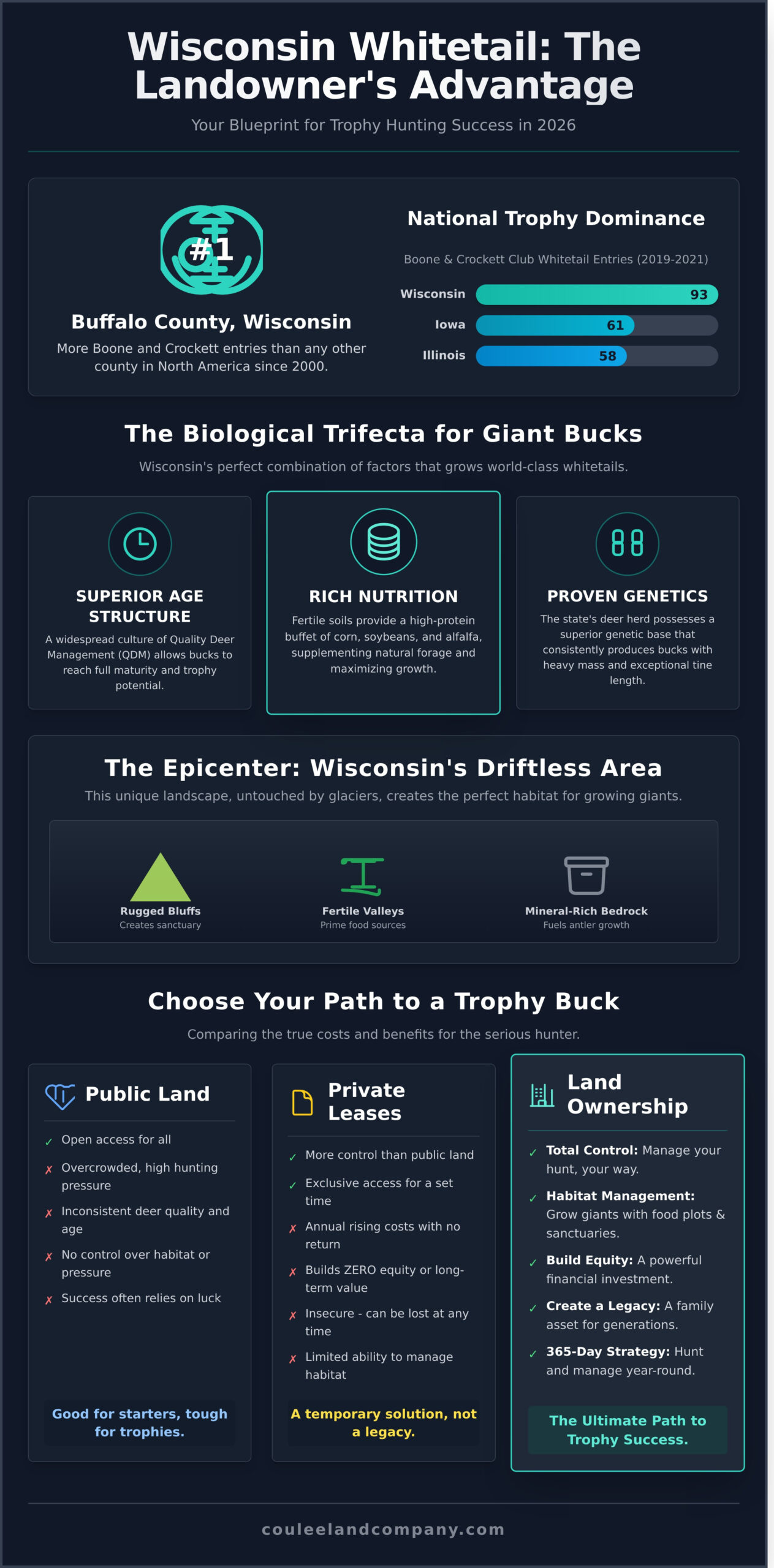
The numbers don’t lie. Wisconsin consistently leads the nation in Boone and Crockett whitetail entries. Data from the Boone and Crockett Club’s 31st Awards Period (2019-2021) showed Wisconsin logging 93 total entries, a figure that dwarfed competitors like Iowa (61) and Illinois (58). This dominance is no accident; it’s the result of a perfect trifecta of biological factors:
- Age: Widespread Quality Deer Management (QDM) practices and a culture of letting young bucks walk have dramatically improved the age structure of the state’s herd.
- Nutrition: The fertile soils of southern and western Wisconsin provide a rich agricultural buffet of corn, soybeans, and alfalfa, supplementing the natural mast crop.
- Genetics: The state possesses a superior genetic base that consistently produces bucks with heavy mass and exceptional tine length.
Understanding these biological pillars is key to appreciating The Legendary Status of Whitetail Hunting and why certain regions produce giants. The famed “Bluff Country” of Western Wisconsin, particularly Buffalo, Trempealeau, and Vernon counties, is the specific epicenter where this trifecta produces record-book results with unmatched frequency.
The Cultural Heritage of the Hunt
The classic image of a rustic, nine-day gun season deer camp is a cherished part of Wisconsin’s heritage. Yet, the culture has evolved. Today’s most successful hunters are sophisticated land managers who think about their property 365 days a year. The conversation has shifted from luck to strategy, from camp stories to habitat improvement plans. This is where the role of a true Hunter’s Realtor becomes invaluable, connecting passionate outdoorsmen with properties that hold the potential to create a personal legacy. The 2026 season perfectly reflects this modern approach, rewarding landowners who have invested in food plots, timber stand improvement, and sanctuary creation. It’s about building a superior hunting property, not just finding one.
Understanding the Driftless Area: Why Buffalo County Leads the Record Books
To truly grasp what makes whitetail hunting in Wisconsin legendary, you must first understand the land itself. Not all acres are created equal. The secret lies in a unique geological anomaly known as the Driftless Area, a region in Western Wisconsin that the last Ice Age failed to flatten. While glaciers scoured the surrounding Midwest, this rugged territory was left untouched, creating a perfect storm of elements for growing giant whitetail bucks.
This isn’t theory; it’s science. The lack of glacial scraping preserved the ancient, highly dissected terrain of steep bluffs and deep valleys, or “coulees.” This topography directly impacts everything from soil quality to deer behavior, creating a habitat that is simply unmatched anywhere else in the country.
Geology Meets Biology in the Bluffs
The foundation for trophy-class antlers begins in the ground. The limestone and dolomite bedrock of the bluffs are rich in calcium and phosphorus, essential minerals for bone and antler development. Erosion deposits these minerals into the valley floors and ridgetop agricultural fields, where they are absorbed by crops like corn, soybeans, and alfalfa. This creates a nutrient-dense food supply that fuels incredible body and antler growth year after year. The steep, timbered hillsides provide natural sanctuaries where bucks can reach maturity with minimal human pressure. For the hunter, this terrain creates predictable travel corridors and consistent wind patterns, making it possible to strategically hunt mature bucks that feel secure in their environment. Mastering these wind currents and funnels is crucial, but it’s only one part of a successful strategy; you also need a firm grasp of the latest rules from the Wisconsin DNR, which you can review in their guide for Planning Your 2026 Season: Regulations.
The Buffalo County Phenomenon
At the absolute epicenter of the Driftless Area is Buffalo County, a name that resonates with serious whitetail hunters everywhere. The statistics are undeniable: Buffalo County holds more Boone & Crockett and Pope & Young record book entries than any other county in the United States. It is the undisputed “Holy Grail” of whitetail hunting land. You can explore the communities and unique character of this famed region on our Buffalo County community page. This dominance isn’t just an accident of geology; it’s also the result of a multi-generational commitment by local landowners to Quality Deer Management (QDM) principles. This culture of letting young bucks walk and managing the herd for age structure has created a gene pool and a population of mature deer that is simply astounding. Consequently, properties in Buffalo County hold their value better than almost any other recreational land in the nation, making them both a hunting paradise and a premier real estate investment. This combination of world-class hunting and sound investment potential is why discerning buyers partner with specialists who truly understand the land.
Public Land vs. Private Leases vs. Land Ownership: Choosing Your Path
Every serious hunter in Wisconsin eventually confronts the same critical decision: where will I hunt? The answer dictates not just your strategy for the season, but the quality of your entire experience. Your choice between public ground, a temporary lease, or the permanent control of ownership will fundamentally shape your success and satisfaction. While each path has its place, only one offers complete authority over your hunting destiny.
Wisconsin is blessed with millions of acres of public land, a fantastic resource that provides access for all. Yet, this accessibility comes at a cost. The challenge of successful whitetail hunting Wisconsin on public ground is often a battle against human pressure, not just the instincts of a mature buck.
The Reality of Public Land Pressure
Hunter density, particularly in the state’s most popular Wildlife Management Areas, can make a quiet, strategic hunt nearly impossible. When you find a promising rub line or a secluded bedding area, chances are several other hunters have found it too. This constant pressure makes patterning a mature buck a frustrating exercise in futility; the deer’s behavior is dictated by the movements of other hunters, not natural patterns you can predict. Safety and ethics also become paramount concerns when tracts are crowded.
Why Owning is the Ultimate Management Tool
A private lease offers more seclusion, but it’s a temporary solution fraught with uncertainty. You pay for access, but you don’t build equity, and the landowner can change the terms or sell the property at any time, leaving you back at square one. True control, the kind that produces world-class whitetails year after year, only comes with ownership. When you own the deed, you become the ultimate wildlife manager. You decide:
- Habitat Improvement: Where to plant high-protein food plots, when to conduct a timber stand improvement, and which thickets to designate as untouchable sanctuaries.
- Herd Management: You have the power to let 3- and 4-year-old bucks walk, creating the age structure necessary to produce truly magnificent 5- and 6-year-old trophies.
- Legacy Building: You’re not just hunting; you’re investing in a tangible asset that appreciates in value while creating a family legacy for generations to enjoy.
This level of control is especially potent in the famed “Bluff Country” of Western Wisconsin. The unique, unglaciated topography creates natural funnels and sanctuaries that are a land manager’s dream. For a deeper dive into what makes this region so special, it’s worth Understanding the Driftless Area and its direct impact on whitetail habitat. Investing in these prime hunting properties isn’t just buying dirt; it’s securing a piece of Boone and Crockett history.
Consider the long-term return on investment. A premium guided hunt in the Midwest can cost $5,000 to $8,000 for a single week. Over a decade, that’s $50,000 or more with nothing to show for it but memories. A land payment, conversely, builds equity in an asset you can use 365 days a year. The investment you make in your own property works for you, growing in both financial and recreational value. It is, without question, the most powerful tool for any hunter dedicated to the pursuit of trophy whitetails.
Planning Your 2026 Season: Regulations, Scouting, and Habitat Management
A record-book buck doesn’t happen by accident. It’s the direct result of a year-long strategy that begins long before the frost settles on the cattails. For the serious hunter, preparation is a constant process of refinement, observation, and hard work. Success in the fall is earned in the spring and summer through diligent planning, a deep understanding of the landscape, and a commitment to improving wildlife habitat. This is how you transform a good property into a legendary one and ensure your 2026 season is your most successful yet.
Navigating 2026 Wisconsin Regulations
The foundation of any successful season of Whitetail hunting Wisconsin is a firm grasp of the Wisconsin Department of Natural Resources (DNR) regulations. These rules are not static; they evolve based on herd health, CWD prevalence, and public input. Staying ahead of deadlines and understanding key changes is non-negotiable. While final dates are confirmed by the DNR, the 2026 seasons will likely follow this established framework:
- Archery & Crossbow: September 12, 2026 – January 3, 2027
- Youth Gun Deer Hunt: October 10 – 11, 2026
- Gun Deer Hunt: November 21 – 29, 2026
- Muzzleloader: November 30 – December 9, 2026
Pay close attention to Chronic Wasting Disease (CWD) management zones, which dictate carcass transport rules. As of 2024, 59 counties are CWD-affected, meaning you cannot move a whole deer carcass out of the county of harvest. You must process it first. All licensing and harvest registration is streamlined through the state’s GoWild system, an efficient online portal every hunter must use.
Land Management for Mature Bucks
As Wisconsin’s Land & Property Sales Specialists, we don’t just sell land; we help our clients unlock its maximum potential. The most impactful tool in your habitat management arsenal is often the most overlooked: Timber Stand Improvement (TSI). TSI involves strategically removing less desirable trees to allow sunlight to hit the forest floor. This simple act sparks an explosion of new growth, creating the thick, dense understory that provides both high-protein browse and critical bedding cover for mature bucks.
This isn’t just forestry. It’s deer architecture. Through techniques like hinge-cutting, you can create natural funnels and pinch points that dictate deer movement with surgical precision. A well-placed series of hinge cuts can steer a buck from his bedding area directly into your shooting lane. It’s the ultimate home-field advantage.
Your work should follow a strict timeline. Begin with soil tests for food plots in March, followed by planting perennial clovers in April or May. Establish mineral sites by June 1 to support antler growth through the summer. By early August, it’s time to plant your kill plots with brassicas like turnips and radishes, creating an irresistible late-season food source that will hold deer on your property through the gun season and beyond. This is how you build a superior hunting parcel. Let our team of hunter realtors show you how to find or improve a property with world-class wildlife capabilities.
Finding Your Piece of the Bluff Country with Coulee Land Company
The ultimate dream for any serious hunter is to own a piece of ground where memories are made and legacies are built. Securing a premier property for whitetail hunting Wisconsin, especially in the legendary Bluff Country, requires more than a standard real estate search. It demands a specialist who walks the same woods you do, understands the subtle language of the land, and possesses the network to connect you with the perfect parcel. This is where Coulee Land Company becomes your essential partner.
We aren’t just real estate agents; we are Wisconsin’s Land & Property Sales Specialists. Our passion is rooted in the same rich soil and steep ridges that produce the nation’s most sought-after whitetails. We provide exclusive access to premier listings and off-market opportunities across Western Wisconsin’s famed hunting grounds, from Buffalo County, which has produced more Boone and Crockett entries than any other county in the U.S. since 2010, to the rolling hills of Trempealeau and Vernon counties.
Why a Land Specialist Matters
A conventional realtor sees a 40-acre parcel. A Coulee Land Company specialist sees south-facing slopes for bedding, fertile bottomland for food plots, and natural funnels that will bring a mature buck into range. This is the “Hunter’s Realtor” advantage. Our expertise is trusted by the most respected names in the industry, including Don & Kandi Kisky of “Whitetail Freaks,” because we evaluate a property’s “trophy potential” long before you make an offer. We analyze critical factors that define a superior hunting property:
- Strategic Access: Evaluating entry and exit routes that minimize pressure on wildlife.
- Habitat Quality: Assessing soil types, water sources, and existing cover to gauge wildlife capabilities.
- Neighborhood Genetics: Understanding the local deer herd and history of trophy production in the immediate area.
- Land Management Potential: Identifying opportunities for habitat improvements that will hold and grow mature bucks.
Navigating the complexities of a rural land purchase can be daunting. From Managed Forest Law (MFL) contracts and conservation easements to zoning restrictions and mineral rights, the details matter. We expertly guide our buyers through every step, ensuring a smooth and successful transaction that protects your investment for generations to come.
Taking the Next Step Toward Your Legacy
Owning your own hunting ground is about more than a single season; it’s about establishing a family heritage. It’s a place where traditions are passed down and the stories of the hunt echo through the years. Your journey begins by exploring the possibilities, whether you’re searching for raw hunting acreage or magnificent country homes that put world-class adventure right outside your door. Our hands-on, visionary team doesn’t just sell you a property. We help you envision its full potential, transforming a piece of land into the hunting paradise you’ve always dreamed of.
Your legacy property is waiting. We invite you to view our current listings and meet the dedicated team of specialists ready to help you find your perfect piece of Wisconsin’s Bluff Country. Let’s walk the land together.
Your Wisconsin Hunting Legacy Starts Now
The path to a record-book buck in 2026 is clearer than ever. You’ve seen why Buffalo County’s Driftless Area dominates the Boone and Crockett entries and how owning your own land provides the ultimate advantage for habitat management and hunting pressure. This isn’t just a dream; it’s the tangible reality of Whitetail hunting Wisconsin for those who plan strategically.
Making that dream a reality is our specialty. As Wisconsin’s Land & Property Sales Specialists, we’ve brokered over $500M in rural land transactions and have specialized in the famed Bluff Country since our inception. It’s why top outdoor television hosts trust us to find their premier hunting properties. Your own piece of this legendary landscape is waiting.
View Our Exclusive Wisconsin Hunting Land Listings and let’s find the ground where your story will unfold.
Frequently Asked Questions About Whitetail Hunting in Wisconsin
What is the best county for whitetail hunting in Wisconsin?
Buffalo County is undeniably the top county for trophy whitetail hunting in Wisconsin. Its reputation is cemented by the record books; it has produced more Boone and Crockett whitetail entries than any other single county in North America. The rugged bluffs and fertile valleys of this “Bluff Country” create the perfect habitat for growing mature, world-class bucks. This unique topography provides sanctuary and nutrition that is simply unmatched elsewhere.
When are the 2026 Wisconsin deer hunting season dates?
The 2026 Wisconsin nine-day gun deer season is projected to run from November 21 to November 29. The archery and crossbow seasons typically open around September 12, 2026, and run until January 3, 2027, with a brief closure during the gun season. These dates are based on the Wisconsin DNR’s traditional scheduling, but it’s essential to consult the official 2026 DNR regulations for confirmed dates before planning your hunt.
How much does hunting land cost per acre in Buffalo County?
As of late 2023, premium hunting land in Buffalo County typically costs between $7,000 and $12,000 per acre. The final price depends heavily on specific features like road access, the quality of timber, the percentage of tillable acreage for income, and the existence of established food plots or water sources. Properties with a documented history of producing trophy-class whitetails often command prices at the higher end of this range due to their proven genetic potential.
Can non-residents buy hunting land in Wisconsin?
Yes, non-residents can absolutely purchase hunting land in Wisconsin with no additional restrictions compared to residents. The buying process is identical for everyone, ensuring you can secure your own piece of whitetail paradise. Once you own the property, you’ll simply need to purchase non-resident hunting licenses. For reference, the 2023 non-resident gun deer license was approximately $160, a small investment for hunting your own private ground.
What are the rules for baiting deer in Wisconsin for 2026?
Deer baiting and feeding are prohibited in 58 of Wisconsin’s 72 counties due to CWD concerns, a regulation that is expected to remain in place for 2026. In the few counties where it is permitted, you can only place up to 2 gallons of bait per site, and it must be within 50 yards of your stand. Because these regulations can change annually by county, you must check the official Wisconsin DNR CWD map for the year you plan to hunt.
How do I find a land specialist in Western Wisconsin?
To find a genuine land specialist, you need a realtor who lives and breathes the outdoors. Look for an agent with a proven track record of selling premier hunting properties, not just rural homes. The best specialists are avid hunters themselves who understand topography, habitat management, and trophy potential. They will have extensive client testimonials from the hunting community and can guide you to a property that truly meets your goals for whitetail hunting Wisconsin.
What is the “Driftless Area” and why is it good for deer?
The Driftless Area is a unique geographical region in Western Wisconsin that glaciers bypassed, leaving behind a landscape of steep, rugged bluffs and deep coulees. This topography is a whitetail hunter’s dream. The ridges and valleys create natural funnels and pinch points that dictate deer movement, making them highly patternable. This combination of hardwood timber for cover and rich agricultural land in the valleys provides the ideal habitat for bucks to reach full maturity.
Is CWD affecting land values in Wisconsin?
No, Chronic Wasting Disease (CWD) has not demonstrated a measurable negative effect on recreational land values in Wisconsin. The demand for premier hunting properties, particularly in the famed counties of the Driftless Area like Buffalo and Trempealeau, remains incredibly strong. Buyers continue to prioritize superior habitat, location, and trophy potential above all else, ensuring that high-quality land continues to be a solid and appreciating investment for serious outdoorsmen.