
The dream of owning your own slice of hunting paradise-a legacy property where trophy whitetails roam and family memories are forged-is one of the most powerful aspirations for any outdoorsman. Yet, this dream is shadowed by the risk of a monumental financial mistake. The fear of choosing the wrong parcel, one that looks good on paper but lacks true wildlife potential, can turn the entire process into a source of overwhelming anxiety. A standard realtor might see acres and boundaries, but they won’t understand the critical nuances of pinch points, bedding areas, or the land management required to grow and hold mature bucks.
That’s why understanding exactly what to look for when buying hunting property is not just important-it’s everything. It is the definitive line between a sound, soul-satisfying investment and a costly lesson in what could have been. As Wisconsin’s Land & Property Sales Specialists, we’ve guided countless hunters through this exact journey. This expert checklist is the culmination of that experience, designed to break down every crucial factor, from habitat analysis to legal due diligence, giving you the confidence to find and purchase your perfect piece of Bluff Country.
Key Takeaways
- A successful land purchase begins with a solid financial and strategic plan, ensuring your search is targeted and efficient from day one.
- Master digital scouting with aerial and topographic maps to quickly identify a property’s core wildlife potential and eliminate poor candidates without leaving home.
- The on-site walkthrough is your most critical step in determining what to look for when buying hunting property, allowing you to verify habitat, water sources, and game sign firsthand.
- Protect your dream investment by conducting rigorous due diligence to confirm legal access, survey boundaries, and uncover any hidden restrictions before closing.
Phase 1: Foundational Prep Before You Search
The dream of owning your own slice of hunting paradise begins long before you ever step foot on a property. A solid plan is the foundation of a successful search, transforming a wish into a tangible asset. Too many aspiring landowners jump into listings unprepared, only to face financing hurdles or discover a property doesn’t truly meet their long-term goals. By preparing your finances and defining your objectives first, you avoid common pitfalls and ensure your search is both efficient and rewarding. This initial diligence is the first critical step in understanding what to look for when buying hunting property.
For a great overview of how to start your search, watch this helpful video from the experts at HuntStand:
Securing Your Finances and Setting a Realistic Budget
Your all-in budget is more than just the sticker price; it must account for closing costs, annual property taxes, and insurance. Financing raw land is a different game than a standard home mortgage, often requiring a larger down payment and involving specialized lenders. Securing pre-approval is a power move that makes your offer far more competitive. Finally, think beyond the purchase. Factor in future investments like establishing food plots, timber stand improvement, or trail maintenance to develop the property to its full potential.
Defining Your Property ‘Must-Haves’ vs. ‘Nice-to-Haves’
Clarity is your greatest asset. Before you look at a single listing, you must distinguish your absolute ‘must-haves’ from your ‘nice-to-haves.’ This simple exercise will focus your search and save countless hours. Consider these critical questions:
- Target Species: Are you pursuing record-book whitetails, flocks of turkey, or a mix of game?
- Accommodations: Do you need a turnkey cabin, or is a potential building site for a future home a priority?
- Accessibility: What is the maximum comfortable travel time from your primary residence?
Document your top five priorities. This list becomes your compass, guiding every decision you make.
Why a Land Specialist Outperforms a General Realtor
Partnering with the right expert from the start is non-negotiable. A general real estate agent sees acres and property lines; a true Land Specialist sees habitat, topography, and wildlife corridors. They understand the subtle nuances that determine a property’s true hunting potential, from soil types for food plots to thermal cover for wintering deer. A specialist’s expertise is grounded in the core principles of wildlife management, and they possess a network of trusted contacts for everything from forestry to excavation. Our team doesn’t just sell land; we live and breathe this world. See how we help buyers turn their vision into a legacy property.
Phase 2: The Map Scout – Analyzing Properties from Your Desk
Before you ever put boots on the ground, the most critical work begins at your desk. This digital scouting phase is a non-negotiable step in understanding what to look for when buying hunting property. By leveraging modern aerial and topographic maps, you can efficiently analyze dozens of listings, disqualify poor candidates, and pinpoint parcels with superior potential. This process saves an immense amount of time and fuel, ensuring that the properties you ultimately walk have already passed a rigorous initial test.
Reading Topography for Deer Movement
Topographic maps are the ultimate cheat sheet for predicting how whitetails use the landscape. The contour lines reveal natural funnels that concentrate deer movement, such as saddles between ridge tops, benches along hillsides, and pinch points created by steep terrain and water. Look for steep ridges and bluffs that dictate travel corridors, forcing deer to use specific paths. In the winter months, south-facing slopes receive more direct sunlight, making them preferred bedding areas that hold deer. This is especially crucial in Wisconsin’s famed Bluff Country, where sheer bluffs and deep coulees create some of the most predictable and exciting deer funnels in the nation.
Evaluating the Neighborhood and Surrounding Pressure
No property exists in a vacuum. What your neighbors are doing can dramatically impact the quality of your hunting. Use satellite imagery to assess the surrounding landscape. Are you bordered by vast agricultural fields that provide a destination food source? Is your parcel connected to a massive block of timber that acts as a sanctuary? Low-pressure neighbors who practice quality deer management are a significant asset. As you analyze access from public roads, you also begin your initial research; creating a preliminary due diligence checklist to note questions about easements or property lines is a wise step. Conversely, be aware of nearby public hunting land, which can increase pressure on your borders.
Assessing Property Shape and Layout for ‘Huntability’
The overall ‘huntability’ of a parcel is determined by its shape, layout, and diversity. A square 40-acre piece may look simple, but an irregularly shaped property often provides more edge, hidden corners, and secluded pockets that deer love. Evaluate how the layout accommodates different wind directions-a superior property allows you to hunt various stand locations on different winds without spooking game from core areas. Look for a mosaic of habitats within the boundaries, such as a mix of hardwoods, thick cover, and open areas for food plots. This diversity provides everything wildlife needs to thrive year-round, making your land the local hub of activity.
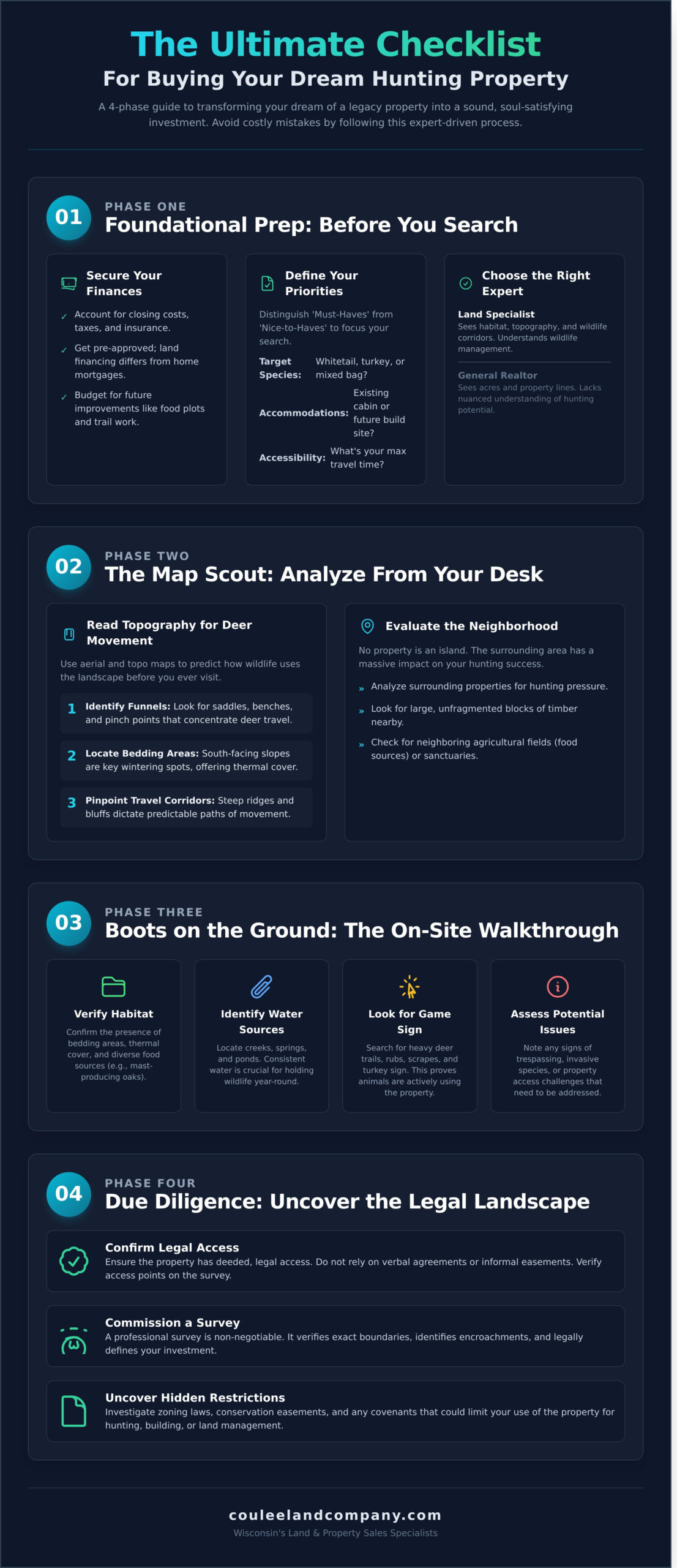
Phase 3: Boots on the Ground – The Critical On-Site Walkthrough
Digital scouting is an essential first step, but it’s only half the battle. Nothing replaces putting boots on the ground to confirm your research and truly understand a property’s potential. This on-site walkthrough is where you transition from theory to reality, focusing on the four pillars of premier hunting habitat: cover, water, food, and access. Come prepared with a GPS or mapping app, a compass, and a notebook-this is where your investment truly begins.
Cover: Finding and Assessing Bedding Areas
Mature bucks do not survive by accident; they live in the thickest, most secluded cover available. Look for areas an average person would hate to walk through: dense clear-cuts, impenetrable swamps, or stands of native warm-season grasses. On the famed hills of Wisconsin’s Bluff Country, identify benches on hillsides and concealed points that offer bucks security and a commanding view. Finding actual deer beds and rubs confirms consistent use, but the ultimate goal is identifying an area that can be left completely untouched-a true sanctuary. This is the single most important factor for holding trophy whitetails year after year.
Water: More Than Just a Creek
Every living creature needs water, making it a non-negotiable feature. Your on-site inspection must confirm the presence of year-round water sources like creeks, ponds, or hidden springs. A secluded water source located near a primary bedding area is an absolute goldmine for hunting opportunities. As you walk, also scout for low-lying areas with clay-based soil that could be ideal sites for creating a new pond or waterhole, a simple improvement that can dramatically increase a property’s wildlife-holding capabilities.
Food: Natural Browse and Food Plot Potential
A superior hunting property offers a diverse menu. First, assess the quality of natural browse-look for an abundance of briars, raspberry canes, and new woody growth that deer prefer. Next, identify critical mast-producing trees, especially white and red oaks. Evaluating the existing vegetation is a fundamental step; in fact, this Texas Parks and Wildlife guide to buying land offers an excellent framework for assessing a property’s natural resources. Finally, pinpoint flat, accessible areas with good soil for future food plots. The proximity of these food sources to secure cover is a critical component of a successful land management strategy.
Access: Your Key to Undetected Entry and Exit
This is one of the most critical and often overlooked aspects of what to look for when buying hunting property. You can have the best habitat in the county, but if you spook every deer on your way to the stand, it’s worthless. Can you use creeks, ditches, or the backside of a ridge to hide your approach? Evaluate potential stand locations and determine if you have a viable, low-impact access route for various wind directions. Poor access can ruin an otherwise perfect parcel, making this a deal-breaker for the serious hunter. Evaluating these elements on the ground requires experience, which is where a dedicated land specialist from Coulee Land Company can provide an invaluable advantage.
Phase 4: The Due Diligence – Uncovering the Legal Landscape
You’ve found the tract of land that quickens your pulse-the terrain is perfect, the sign is abundant, and you can already picture your stand in that oak-filled draw. But the final, and most critical, phase of the hunt is just beginning. A superior hunting property must also be a legally sound investment, and this due diligence phase protects you from costly surprises long after the sale is complete. This is a non-negotiable part of what to look for when buying hunting property. Working with your land specialist, you must investigate every detail with precision. Never skip these steps, no matter how good the property looks on the surface.
Confirming Legal and Physical Access
Guaranteed access is paramount. Is the property reached via a public road, or does it depend on a deeded easement across a neighbor’s land? A handshake agreement is not enough. We ensure any easement is permanent, legally recorded, and transfers with the title. Beware of ‘landlocked’ parcels with no guaranteed access, as they can become worthless overnight. Furthermore, we verify that the legal access is physically usable-a deeded easement through an impassable swamp won’t do you any good when you need to get your truck or tractor to the back forty.
Investigating Easements, Covenants, and Restrictions
What you see on the land isn’t always the full story. The property’s title history may reveal existing claims or restrictions that can significantly impact your ownership rights and land management strategy. It’s essential to uncover any and all encumbrances, which can include:
- Utility or access easements granting rights to power companies or neighbors.
- Existing timber contracts or mineral rights leases held by third parties.
- Conservation easements that may restrict development or certain agricultural practices.
- Enrollment in government programs like Managed Forest Law (MFL) or the Conservation Reserve Program (CRP), which come with specific obligations.
Verifying Utilities and Building Site Potential
If your dream includes a cabin, lodge, or permanent residence, this step is vital. We help you confirm the logistics of bringing your vision to life. This involves checking for practical access to electricity and the potential for a well. For properties without municipal sewer, a percolation (perc) test is required to determine the soil’s suitability for a septic system. Finally, we investigate local zoning ordinances and building restrictions to ensure your plans are feasible. This detailed homework is especially critical for buyers interested in one of our premier country homes with acreage, where the home site is as important as the hunt itself.
From Checklist to Closing: Your Hunting Legacy Starts Here
The journey to owning your own hunting paradise is a significant undertaking, but with the right approach, it’s an achievable dream. This guide has walked you through the critical phases, from the foundational map scout to the essential boots-on-the-ground walkthrough and final due diligence. Ultimately, knowing what to look for when buying hunting property is about more than just acreage and topography; it’s about understanding the land’s true potential to produce mature whitetails and lasting memories.
Navigating this process requires more than a realtor-it demands a partner who lives and breathes this world. As Wisconsin’s #1 Land & Property Sales Specialists, our team of passionate hunters possesses unmatched expertise, especially within the legendary trophy whitetail region of Buffalo County. When you’re ready to turn your dream into a deed, let our team guide you.
View Our Premier Hunting Properties in Wisconsin
The perfect tract of land is out there. Let’s find it together.
Frequently Asked Questions About Buying Hunting Land
How many acres do I really need for good deer hunting?
The ideal acreage depends more on the quality of the habitat than the number itself. A well-managed 40-acre parcel in Wisconsin’s Bluff Country with strategic food plots, thick bedding cover, and a water source can produce exceptional hunting. For rifle season, larger parcels provide a greater safety buffer and more effectively hold mature bucks on your property. The key is maximizing the wildlife capabilities of the land you can afford, not just chasing a number.
Is a property with agricultural fields better than one that is all timber?
A mix of agriculture and timber is often considered the gold standard, as it provides both food and cover. However, an all-timber parcel presents a superior opportunity for the dedicated land manager. It’s a blank canvas where you can strategically clear areas for food plots, create sanctuary bedding areas through hinge-cutting, and design a property that dictates deer movement. This control allows you to craft a true trophy whitetail haven from the ground up.
What are the biggest ‘red flags’ I should watch out for during a property walk?
During a property walk, be vigilant for signs of excessive pressure, such as a web of ATV trails or numerous old tree stands. A lack of quality deer sign-like rubs, scrapes, and well-worn trails-is a significant concern. Also, look for evidence of trespassing, boundary line disputes, or unclear access points. These red flags are crucial elements of what to look for when buying hunting property and can reveal potential management headaches down the road.
How important is the quality of hunting on the neighboring properties?
The quality of neighboring properties is profoundly important. A neighborhood where surrounding landowners practice Quality Deer Management (QDM) creates a collective environment that allows bucks to reach maturity. Conversely, if adjacent lands are subject to intense, indiscriminate hunting pressure, your efforts to grow mature deer can be consistently undermined. Understanding the local hunting culture is as critical as analyzing the habitat on the parcel itself. It can make or break your long-term success.
Can I get a traditional mortgage for a raw piece of hunting land?
Obtaining a traditional home mortgage for a raw piece of hunting land is generally not possible. Instead, you will need to secure a specialized land loan. These are offered by financial institutions that understand recreational and agricultural real estate. Be prepared for different terms, as land loans typically require a more substantial down payment, often in the 20-30% range, and may have a shorter amortization period than a conventional 30-year mortgage.
Should I worry about things like CWD (Chronic Wasting Disease) in the area?
Yes, you should absolutely be aware of the CWD status in any area you consider. Consult your state’s Department of Natural Resources (DNR) for maps of CWD management zones and prevalence data. While its presence isn’t an automatic disqualifier for many hunters, it is a critical factor that can impact long-term herd health, local regulations regarding baiting and feeding, and rules for transporting your harvested animal. Diligent research on this topic is non-negotiable.