
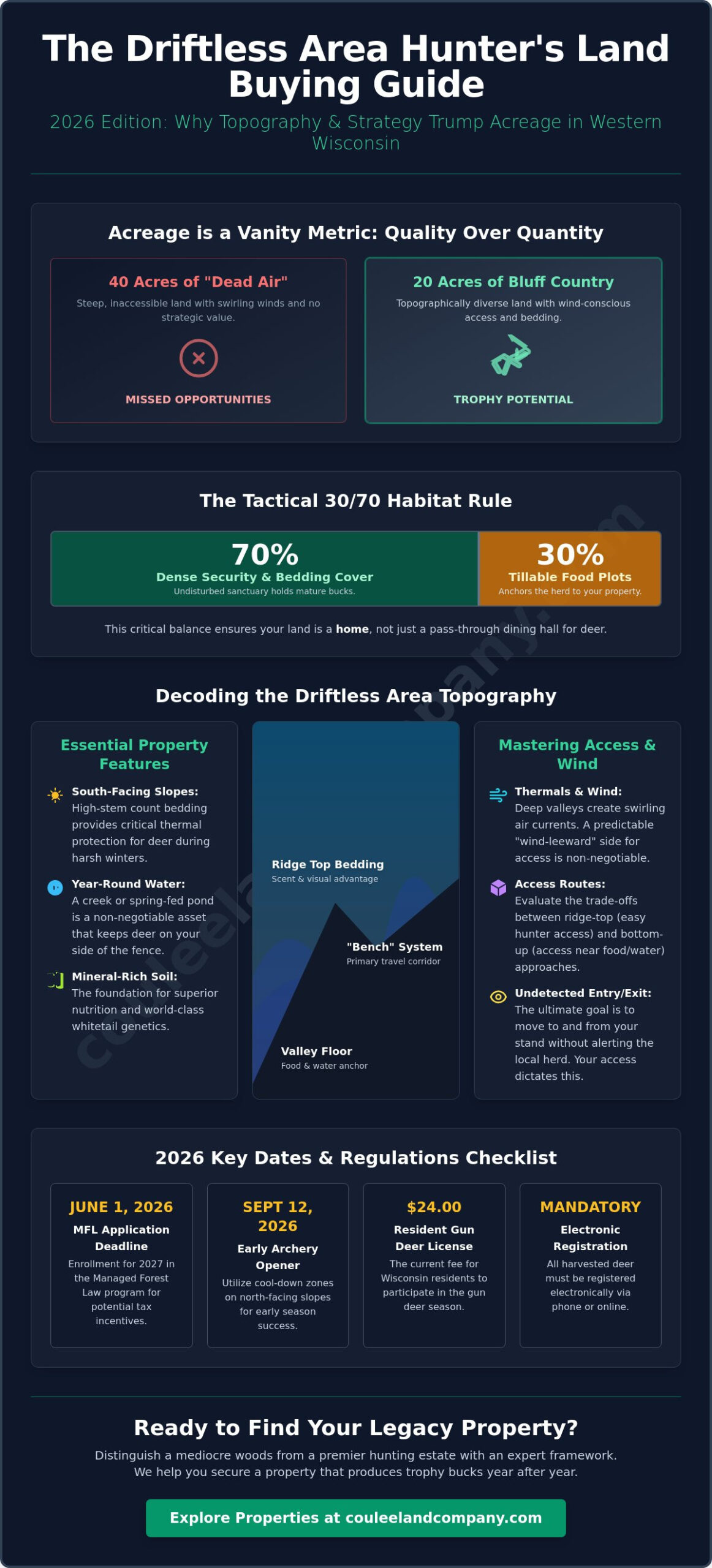
In the rugged coulees of the Driftless Area, forty acres of “dead air” can cost you more in missed opportunities than twenty acres of perfectly patterned bluff country. When you are determining what to look for in hunting land in western wisconsin, you must realize that total acreage is often a vanity metric. True trophy potential is dictated by topographic diversity and wind-conscious access. You likely already understand that this region is a world-class destination for whitetail enthusiasts, but the fear of buying a steep, inaccessible parcel that deer simply bypass is a valid concern for any serious investor.
We promise to help you navigate these ridge-and-valley systems so you can secure a legacy property that produces Boone and Crockett bucks year after year. This 2026 buyer’s guide explores how to master thermals, avoid hidden land improvement costs, and leverage programs like the Managed Forest Law before the June 1 application deadline. We’ll also cover current 2026 regulations, such as the $24 resident gun deer license and mandatory electronic registration, to ensure your investment is as practical as it is aspirational. You’ll gain the expert framework needed to distinguish a mediocre woods from a premier hunting estate.
Key Takeaways
- Master the geological advantages of the Driftless Area to identify the specific ridge-and-valley systems that produce superior mineral-rich soil and record-book genetics.
- Apply the tactical 30/70 rule to maintain a precise balance of tillable food plots and thick security cover, ensuring your land holds mature bucks rather than serving as a pass-through.
- Understand what to look for in hunting land in western wisconsin by prioritizing wind-conscious access routes that allow you to enter and exit stands without alerting the local herd.
- Identify high-stem count bedding on south-facing slopes to provide the critical thermal protection deer require to stay on your property during the harsh winter months.
- Evaluate the strategic trade-offs between ridge-top and bottom-up access to determine which topographic layout aligns with your long-term hunting strategy and property management goals.
Topographic Diversity: Why the Driftless Area Dictates Trophy Potential
The geological identity of Western Wisconsin is defined by a landscape that time and glaciers forgot. Unlike the rest of the state, this region escaped the flattening effects of the last glacial period, resulting in the steep, unglaciated ridge-and-valley systems known as the Driftless Area. These deep coulees and limestone bluffs harbor mineral-rich soils that provide the foundational nutrition required for world-class whitetail genetics. When you are evaluating what to look for in hunting land in western wisconsin, you must prioritize this verticality, as it creates the natural sanctuaries where bucks can reach maturity away from human pressure.
To better understand how to evaluate these properties from the ground up, watch this helpful guide:
The “Bluff Country” advantage is rooted in the security that elevation provides. Mature bucks utilize the steepest, most inaccessible points of a ridge as bedding, allowing them to scent anything approaching from below while visually monitoring the valley. Micro-climates also play a vital role; south-facing slopes act as solar collectors that hold deer during the late season, while shaded north-facing slopes provide essential cool-down zones during the early archery opener on September 12, 2026. Western Wisconsin remains the undisputed holy grail of whitetail hunting because its unique 2026 habitat standards and rugged terrain offer a level of age-class protection that flatland simply cannot match.
Mastering Thermal Hubs and Wind Direction
Swirling winds in deep valleys are the primary reason many hunters fail to consistently harvest trophy bucks in the Driftless. Thermal hubs occur where multiple ridges and valleys converge, creating complex air currents that can carry your scent in every direction if not analyzed with expert precision. You can see how these ridge systems dictate movement by studying the terrain in high-demand areas like Buffalo County. If a property lacks a predictable “wind-leeward” side for stand placement, its huntability is significantly compromised regardless of the deer density.
Ridge-Top vs. Valley Floor: Where the Big Bucks Live
Serious buyers should focus on “bench” systems, which are flat shelves located halfway up a bluff that serve as primary travel corridors for cruising bucks. While ridge tops offer convenient access for hunters, the valley floors often contain the water sources and rich agricultural land that anchor a herd to the area. Evaluating these parcels requires a pragmatic look at how deer transition between these elevations. Remember that any wooded acreage you acquire may be eligible for the Managed Forest Law tax incentives, provided you meet the June 1, 2026, application deadline for 2027 enrollment.
Tactical Habitat Evaluation: Bedding, Buffers, and Food Ratios
Successful land stewardship in the Driftless region requires a disciplined approach to habitat architecture. When you research what to look for in hunting land in western wisconsin, the most critical metric is often the 30/70 rule. This ratio dictates that a premier property should ideally consist of 30% high-quality tillable food plots and 70% dense, undisturbed bedding cover. Without this balance, your land becomes a dining hall where bucks visit only under the cover of darkness. You want to identify south-facing slopes with high-stem count growth, which provide the essential security cover and thermal protection deer need to stay on your acreage during the harsh winter months.
Water is the often-overlooked anchor of a legacy tract. While the region is known for its towering ridges, a year-round creek or a spring-fed pond is a non-negotiable asset that keeps deer on your side of the fence during dry spells. If you are browsing hunting properties currently on the market, look specifically for those that offer multiple water sources distributed across the terrain. These features act as a magnet for wildlife and provide the consistent hydration necessary for a healthy, thriving herd.
Evaluating Neighboring Properties and Pressure
The value of your deed is inextricably linked to the management styles of those around you. Adjacency matters because even the best habitat can be undermined by high-pressure neighbors who harvest young bucks. Use 2026 satellite imagery to pinpoint sanctuary zones on bordering land and check the proximity of Wisconsin Public Access Lands. High-value tracts often border neighbors who practice Quality Deer Management (QDM), which effectively extends your own sanctuary’s borders and increases the age class of local deer.
Timber Value and Habitat Improvement
A pragmatic buyer looks at a woodlot as both a habitat and a long-term financial asset. Assessing the stand of white oak, walnut, and maple is vital for mast production, which provides the high-protein acorns mature bucks crave. These species also offer a significant timber ROI if managed correctly. Selecting a parcel with diverse timber age classes ensures consistent cover and future revenue potential. You’ll find that properties with a healthy mix of hard mast and thick bedding are the ones that consistently produce top-tier results year after year.
Logistics and Access: The Difference Between a Deed and a Huntable Property
Owning a deed to eighty acres in the Driftless Area doesn’t guarantee you eighty acres of huntable ground. When you are evaluating what to look for in hunting land in western wisconsin, the most critical logistical factor is wind-conscious access. A property is only as valuable as your ability to enter and exit stand sites without being detected. If your only path to a food plot takes you through a primary bedding thicket, you’ll likely educate the local herd before the season even peaks. You need a layout that allows for multiple approach routes based on the prevailing Northwest and Southwest winds common to the region.
The choice between ridge-top and bottom-up access often dictates your entire hunting strategy. Ridge-top access is convenient for vehicle entry and building sites, but it carries the risk of blowing your scent directly into the thermal benches where mature bucks spend their daylight hours. Conversely, bottom-up access requires more physical effort but allows you to utilize rising morning thermals to stay undetected. To avoid the “Dead Air” trap, where prevailing winds render half of your acreage unhuntable, it’s essential to consult with a specialist like Mike Law to walk the ridges and map out a tactical entry plan before you commit to a purchase.
Legal Ease and Easement Integrity
Never rely on a handshake agreement for property access. You must verify that deeded access is recorded and legally binding to avoid future litigation or landlocked scenarios. Check for utility easements that might allow power company crews to disrupt your sanctuary during the rut. It’s also vital to identify shared boundaries with public land, as these can invite unwanted foot traffic. Utilizing resources like the Deer Management Assistance Program (DMAP) can help you establish a formal management plan that accounts for these legal and logistical boundaries while improving your herd’s health.
Investment Potential in Buffalo County
Western Wisconsin land values remain remarkably resilient because trophy-producing acreage is a finite resource. The historical ROI on high-quality parcels in this region consistently outperforms many traditional investments, particularly in world-renowned areas. If you want to understand why this specific territory holds the title for the most record-book entries, explore our guide on Buffalo County Wisconsin Deer Hunting. Securing a property here isn’t just about the hunt; it’s about owning a piece of the most coveted whitetail landscape in North America.
Secure Your Legacy in the Driftless Area
Owning a premier tract in the ridge-and-valley systems of Western Wisconsin is more than a real estate transaction; it’s a commitment to land stewardship and the pursuit of world-class whitetails. By prioritizing topographic diversity and mastering the tactical 30/70 habitat ratio, you ensure your property remains a sanctuary for mature bucks. Understanding what to look for in hunting land in western wisconsin requires a deep knowledge of thermal movement and wind-conscious access. Without these elements, even the most beautiful acreage can become a liability rather than a huntable asset.
Our specialized “Hunter’s Realtor” methodology is designed to identify these high-value nuances before you sign the deed. Endorsed by high-profile outdoor industry figures and backed by 52+ 5-star client reviews, we bring unparalleled regional expertise to every search. Don’t settle for a generic property when you can own a piece of the most legendary hunting ground in the country. View Our Exclusive Western Wisconsin Hunting Land Listings and take the first step toward securing your hunting future. Your dream of owning a trophy-producing estate is within reach.
Frequently Asked Questions
How many acres do I need to hunt whitetails effectively in Western Wisconsin?
You can hunt effectively on as little as 20 to 40 acres if the topography includes internal ridges and secluded bedding. In the Driftless Area, the verticality of the land creates more usable surface area and separate “rooms” for deer compared to flat terrain. When determining what to look for in hunting land in western wisconsin, focus on how the acreage is configured rather than the total number. A small, well-shaped parcel with thick security cover often outperforms a larger, open tract.
What makes Buffalo County the best county for trophy deer in 2026?
Buffalo County remains the gold standard due to a unique combination of mineral-rich limestone soils and a long-standing culture of trophy management. This region consistently leads the nation in Boone and Crockett entries because the steep terrain allows bucks to reach the necessary age classes for maximum antler growth. Local landowners typically adhere to strict harvest minimums. This creates a high-density population of mature, world-class whitetails that is difficult to find anywhere else in North America.
Is it better to have ridge-top or valley access for a hunting property?
The ideal access depends on your specific hunting style and seasonal goals. Ridge-top access is excellent for afternoon sits when thermals are rising, as it allows you to slip into stands without your scent dropping into the bedding areas below. Valley access is superior for morning hunts. It lets you climb toward the ridges while the cool morning air pulls your scent downward into the bottomlands, safely away from deer that are moving toward their daytime beds.
What are the common hidden costs when buying bluff country land?
The most frequent hidden costs involve trail maintenance and erosion control on steep grades. Building a sustainable access road or a secluded food plot in the bluffs requires specialized equipment and is more expensive than on flat ground. You should also budget for boundary surveys and potential fence repairs, as the rugged terrain makes these tasks labor-intensive. Factoring in the cost of professional habitat consulting is essential to maximize the property’s potential when evaluating what to look for in hunting land in western wisconsin.