
A 200-foot elevation change means nothing if you don’t understand how a mature buck uses the wind to navigate it. Most buyers focus on total acreage, but in the rugged terrain of Western Wisconsin and the Driftless region, a 40-acre parcel with the right topographical benches can out-produce a flat 120-acre farm every single season. You’ve likely felt that frustration of scouting a beautiful property only to realize it’s a pass-through tract where deer only show up during the peak of the rut. It’s a common fear, especially when you’re looking at land priced between $7,500 and $11,000 per acre in high-demand areas like Buffalo County.
Understanding what to look for in bluff country hunting land is the difference between owning a trophy sanctuary and a glorified hiking trail. We’ll show you how to identify the critical terrain features, habitat markers, and strategic access points that define a world-class property. This guide provides a professional checklist of features to look for during your next tour, from identifying thermal hubs to patterning deer in vertical landscapes so you can hold mature bucks year-round.
Key Takeaways
- Understand why mid-slope benches are the most productive terrain features for patterning mature bucks in vertical landscapes.
- Learn to evaluate timber composition, specifically focusing on mast-producing White and Red Oaks that serve as primary food sources.
- Discover what to look for in bluff country hunting land by identifying high-value “edge” transitions between deep coulees and ridge-top fields.
- Verify the property’s management potential by assessing existing trail infrastructure for tractor access and food plot development.
- Gain the expertise to distinguish between a seasonal rut-stop and a property that holds world-class whitetails throughout the entire year.
The Anatomy of a High-Performance Bluff Property
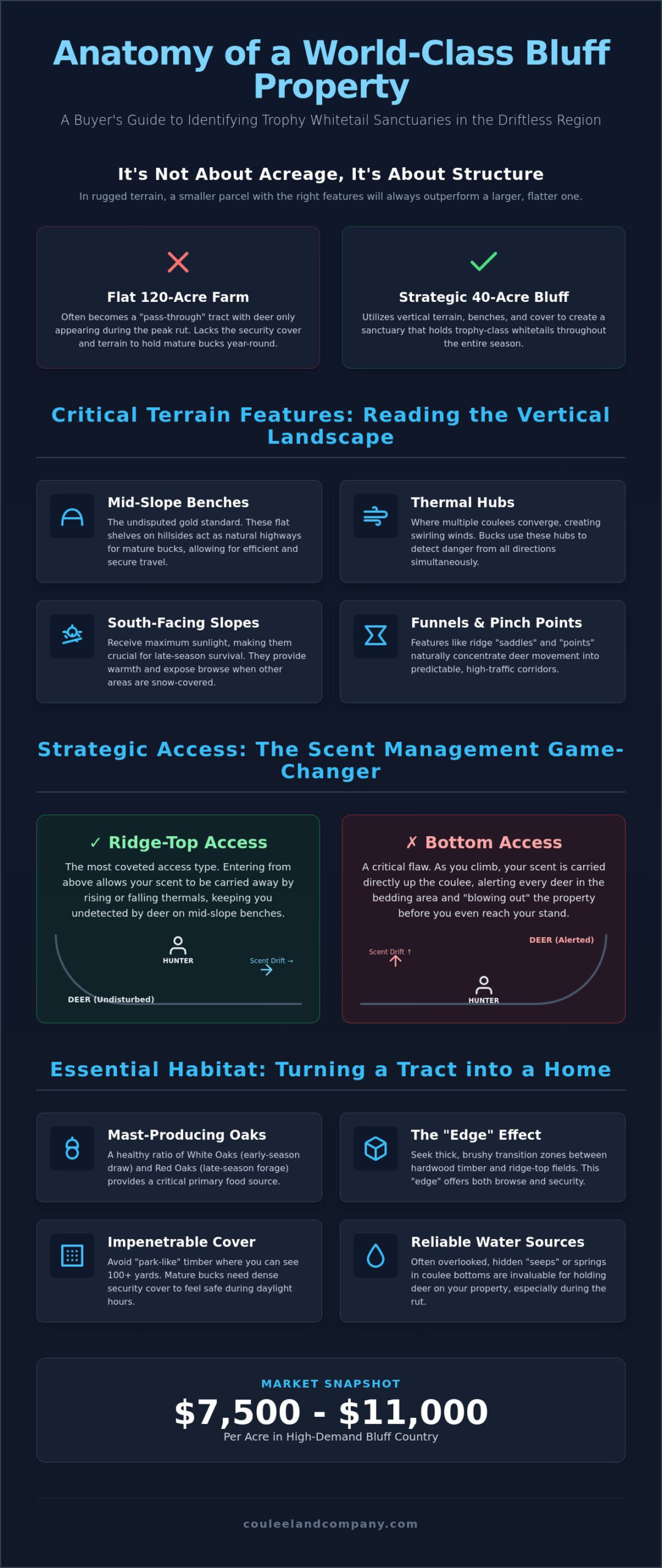
The Driftless Area, also known as Bluff Country, is a geological masterpiece defined by ancient limestone outcroppings, steep coulees, and soaring ridge tops. When you’re determining what to look for in bluff country hunting land, you must view the property through a vertical lens. This landscape isn’t just about total acreage; it’s about how the elevation creates specific micro-habitats that mature whitetails use to survive. The most elite properties feature a balance of high-plateau tillable ground for food and deep, secluded valleys for security.
Benches are the undisputed gold standard for movement in this region. These flat shelves, carved into the hillsides midway between the valley floor and the ridge top, serve as natural highways for mature bucks. They allow a deer to travel across the terrain with minimal effort while maintaining a tactical advantage. To see these features in action and understand their value, watch this helpful video:
Beyond simple travel, the “thermal hub” is a critical feature that separates average land from world-class tracts. These hubs occur where multiple coulees or valleys converge, creating a vortex of colliding air currents. Mature bucks gravitate toward these spots because the swirling winds allow them to detect danger from multiple directions simultaneously. If you can identify a property with a well-defined thermal hub near thick bedding, you’ve found a sanctuary that will hold bucks year-round. Slope orientation also plays a massive role in property performance. South-facing slopes receive the most sunlight during the winter, making them essential for late-season survival and daytime sightings when the mercury drops.
Identifying Natural Funnels and Pinch Points
Topographic maps are your best friend when hunting for “saddles,” which are low dips in a ridge line that connect two drainages. Deer naturally take the path of least resistance, and these saddles act as high-traffic corridors. Additionally, the “point” of a ridge is a premier bedding site. A buck bedding on a point can watch the valley below while using the wind coming over the ridge to monitor his back. Look for areas where the terrain contours tighten significantly, as these “pinches” force deer movement into narrow, predictable windows.
The Importance of Ridge-Top Access
Strategic access is the foundation of scent management. Properties with ridge-top access are highly coveted because they allow you to enter stand locations from above. In Buffalo County and the surrounding bluffs, scent typically rises in the morning and falls in the evening. Entering from the top keeps your scent away from the deer bedding on mid-slope benches. Conversely, bottom-access properties often “blow out” the entire coulee as your scent carries directly into the bedding cover during your climb.
Essential Habitat Features: Bedding, Browse, and Water
While topography dictates movement, habitat dictates residency. When considering what to look for in bluff country hunting land, you must look past the scenic vistas and examine the forest floor. A world-class property requires a strategic mix of mast-producing hardwoods and impenetrable security cover. Timber composition is your first indicator of quality. You want a healthy ratio of White and Red Oaks; White Oaks serve as the preferred early-season draw, while Red Oaks provide essential forage during the leaner winter months.
However, open, park-like timber is often a trap for buyers. If you can see 100 yards through the woods, a mature buck likely won’t feel safe there during daylight hours. You need a property that maximizes the “edge” effect. This is the thick, brushy transition zone between the hardwood timber and ridge-top fields. These areas offer the browse and security that keep deer on your side of the fence. Citing a professional framework for evaluating habitat conditions can help you quantify the carrying capacity of a potential investment before you sign a contract.
Water is another critical, yet frequently overlooked, component in vertical landscapes. High-performance tracts often feature hidden “seeps” or natural springs tucked into the coulee bottoms. These reliable water sources are invaluable. They keep deer from leaving your property to find water on the valley floor during dry summer months or the peak of the rut. If you’re ready to evaluate these features on the ground, our team can help you identify high-value hunting properties that meet these rigorous standards.
Evaluating Bedding Potential
Bucks in the Driftless region prioritize the “leeward” side of ridges for bedding. They prefer spots where the wind blows over the ridge top, allowing them to scent anything behind them while visually monitoring the valley below. Look for thickets of cedar or tangled briars on these slopes. These areas provide the thermal cover necessary for surviving brutal winters while offering the lateral security mature whitetails demand.
Native Browse and Natural Food Sources
Quality land offers more than just acorns. You should identify key native browse species like dogwood, raspberry, or viburnum. These indicators signal a healthy ecosystem that supports deer throughout the entire year. A diverse oak population is also vital, as it ensures a mast crop even when one species has an “off” year. You can learn more about improving deer habitat to maximize the natural potential of your acreage.
Logistics and Strategic Management Potential
Owning vertical terrain is a long-term commitment that requires more than just a passion for the hunt; it demands a property with the infrastructure to support active management. When evaluating what to look for in bluff country hunting land, you must assess the existing road and trail network. Can you safely get a tractor or UTV to the ridge tops for food plot maintenance? Without established access, your ability to implement Timber Stand Improvement (TSI) or maintain “kill plots” on mid-slope benches is severely limited. A property that lacks access is often a property where the habitat remains stagnant.
Strategic management also involves understanding the soil and vegetation before you buy. These guidelines for purchasing small acreages provide a solid framework for assessing the raw potential of rural tracts, regardless of the state. Beyond the dirt, you must consider the neighborhood dynamics. In world-class regions like the Driftless, the management practices of your neighbors can dictate the age structure of the local herd. A 40-acre parcel surrounded by like-minded conservationists is often more valuable than 100 acres in an area with high hunter pressure and poor age-class protection.
Access Strategy for Wind Management
A property’s layout must allow you to hunt on multiple wind directions without compromising core bedding areas. We call this the “Invisible Fence” concept. By using steep coulees and limestone outcroppings as natural barriers, you can keep your scent away from where the deer live. If you can’t enter and exit a stand site undetected, you aren’t hunting; you’re just educating the local bucks. You can browse our current hunting properties for sale to find tracts specifically vetted for these strategic access advantages.
Why a Land Specialist is Non-Negotiable
A residential realtor might see a pretty view, but specialized land brokers see the hidden benches and thermal funnels that define a trophy property. This level of local expertise is vital in high-stakes markets like Buffalo County, where a single topographical oversight can cost you years of hunting success. Don’t leave your investment to chance. If you’re ready to find your trophy property, contact Coulee Land Company today to work with a team that lives and breathes the land.
Securing Your Legacy in the Driftless
Securing your piece of the Driftless Area is about more than just a real estate transaction; it’s about investing in a landscape that rewards strategic stewardship. Success in this vertical world hinges on identifying those mid-slope benches and thermal hubs that dictate mature buck movement. You need a property with the right mix of mast-producing hardwoods and thick security cover to ensure your acreage acts as a sanctuary rather than a pass-through tract. These elements, combined with ridge-top access, create the foundation for a world-class hunting legacy.
Understanding exactly what to look for in bluff country hunting land allows you to filter through the noise and find properties with superior management potential. As Western Wisconsin land specialists and Buffalo County trophy whitetail experts, we provide an authentic outdoor experience rooted in a deep respect for the land and its wildlife. We help you navigate the complexities of vertical terrain to ensure your investment pays dividends every November. Your dream of owning a premier hunting property is within reach when you have the right guide by your side.
View Exclusive Bluff Country Hunting Listings and partner with a team that understands the hunt for the ultimate prize.
Frequently Asked Questions
What is a “bench” in bluff country hunting?
A bench is a flat, shelf-like topographical feature located between the valley floor and the ridge top. These shelves act as natural highways for deer, allowing them to traverse steep terrain with minimal effort. Mature bucks prefer benches because they provide a tactical vantage point to scent danger from above and see threats from below.
How much acreage do I need in the bluffs to effectively manage for trophy bucks?
While 40 to 80 acres is often the minimum for effective management, the quality of the terrain matters more than the total number of acres. A smaller parcel containing a thermal hub and multiple benches can hold more mature bucks than a larger, flatter tract. When determining what to look for in bluff country hunting land, focus on the diversity of the habitat and the management practices of your immediate neighbors.
Why is Buffalo County, WI considered the best for trophy whitetails?
Buffalo County holds the top spot for trophy whitetails due to its unique combination of nutrient-rich soils, high-protein agricultural crops, and rugged terrain that allows bucks to reach maturity. It historically leads the nation in record book entries. The steep bluffs provide natural sanctuaries where deer can hide from pressure, ensuring a consistent supply of world-class bucks.
Can I put food plots on steep bluff land?
Yes, you can establish food plots in the bluffs by utilizing flat ridge tops or carving small “kill plots” into existing mid-slope benches. These locations are highly effective because they are tucked away from road visibility and close to primary bedding areas. Success depends on having a property with enough road infrastructure to move equipment like a small tractor to these elevated sites.
What is the best wind direction for hunting river bluffs?
The best wind direction depends entirely on your specific stand location, but a cross-wind that blows parallel to the ridge is often the most predictable. This allows you to set up on a bench or point where your scent is carried out over the valley rather than into the bedding cover. Hunting river bluffs requires a deep understanding of how the wind interacts with the water and the vertical walls of the coulee.
How does thermal air movement affect deer hunting in the hills?
Thermals are rising or falling air currents caused by temperature changes, and they dictate how deer use the terrain. In the morning, as the sun warms the bluffs, air rises; in the evening, as the hills cool, air sinks toward the valley floor. Understanding these shifts is a key part of what to look for in bluff country hunting land, as it determines whether your scent will be carried to a buck’s nose or safely over his head.