
Why does one 80-acre tract produce 170-inch whitetails like clockwork while the neighboring property, despite thousands spent on premium brassica blends, struggles to see a three-year-old buck? It’s a hard truth that many hunters learn the expensive way: you cannot manage your way out of a property with poor natural “bones.” Understanding what makes a QDM property successful requires looking past the seed tags and focusing on the foundational attributes that define a premier hunting legacy. You already know that growing mature deer is about more than just a bag of clover and a weekend of work; it’s about the intersection of the right land and a disciplined strategy.
In this guide, you’ll discover the blueprint for transforming a standard piece of land into a trophy whitetail powerhouse. We’ll explore how habitat architecture, local genetics, and the often-overlooked neighborhood dynamics create the perfect environment for world-class deer. Whether you’re looking to buy your first parcel in the legendary Bluff Country or want to refine your current stewardship, this system provides the repeatable results you’ve been searching for. By the end, you’ll know exactly how to identify and build a property that holds mature bucks year after year.
Key Takeaways
- Identify the foundational “bones” of a property that allow it to produce mature bucks regardless of management intensity.
- Understand what makes a QDM property successful by balancing sex ratios and providing the essential trio of food, water, and secure bedding.
- Learn how to navigate the “small property trap” by leveraging neighborhood cooperatives to protect younger age classes across property lines.
- Discover why undetected access and exit routes are the most critical features for maintaining a low-pressure sanctuary and ensuring long-term ROI.
The Four Pillars of a Successful QDM Property
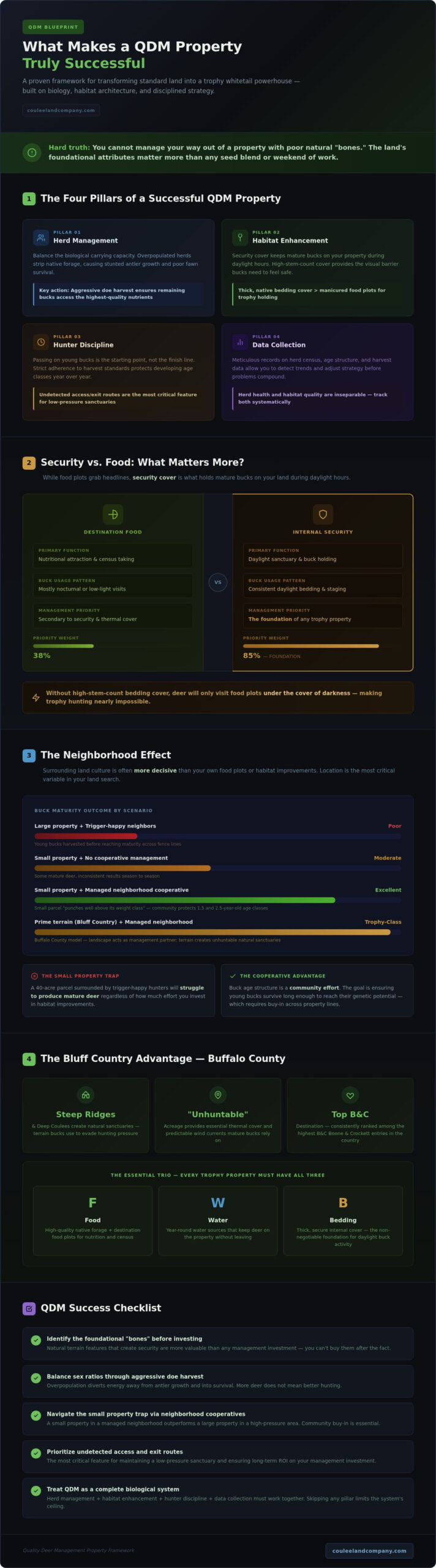
True Quality Deer Management is a holistic discipline that integrates biology with strategic land use. Many hunters mistakenly believe that passing on young bucks is the only requirement, but that’s just one piece of the puzzle. To understand what makes a QDM property successful, you must view the land as a biological system where herd health and habitat quality are inseparable. This approach requires a commitment to four specific pillars: herd management, habitat enhancement, strict hunter discipline, and meticulous data collection.
Effective Deer management involves more than just observation; it requires active intervention to ensure the population remains in balance with the available resources. In world-class regions like Buffalo County, which remains a top-ranked destination for B&C entries, professional agents see firsthand how these pillars transform average tracts into legendary ones.
To better understand how these elements come together, watch this breakdown of a premier hunting strategy:
Balancing the Biological Carrying Capacity
More deer doesn’t mean better hunting. Overpopulated herds strip the best native forage, leading to stunted antler development and poor fawn survival. Social stress occurs when high deer densities lead to increased competition and cortisol levels, which diverts energy away from antler growth and toward basic survival. Balancing the herd through aggressive doe harvest ensures that the remaining bucks have access to the highest-quality nutrients and reduces the pressure on your habitat.
The Security Factor: Why Bedding Trumps Food
While food plots grab the headlines, security cover is what keeps mature bucks on your dirt during daylight hours. High-stem-count cover, like native grasses or hinge-cut timber, provides the visual barrier a buck needs to feel safe. If your hunting properties lack this internal security, deer will only visit under the cover of darkness. Understanding what makes a QDM property successful means prioritizing thick, nasty cover over pretty, manicured fields.
| Attribute | Destination Food | Internal Security |
|---|---|---|
| Primary Function | Nutritional attraction and census taking | Daylight sanctuary and buck holding |
| Buck Usage | Mostly nocturnal or low-light visits | Consistent daylight bedding and staging |
| Management Priority | Secondary to security and thermal cover | The foundation of any trophy property |
The Neighborhood Effect: Why Location Dictates QDM Success
You can’t control what happens across the fence line, but you can choose who your neighbors are. When considering what makes a QDM property successful, the surrounding culture is often more decisive than your own food plots or habitat improvements. A 40-acre parcel surrounded by trigger-happy hunters will struggle to produce mature deer, regardless of your effort. Conversely, a small property in a managed neighborhood can punch well above its weight class because the community protects the 1.5 and 2.5-year-old age classes.
Academic research from the MSU Deer Lab on Quality Deer Management emphasizes that buck age structure is a community effort. While formal cooperatives are ideal, the primary goal is simply ensuring that young bucks have the chance to grow. This is why location is the most critical variable in your land search. If you’re looking for a property with these established management foundations, our team can help you identify hunting properties in high-value neighborhoods.
The Bluff Country Advantage
In regions like Buffalo County, the landscape itself acts as a management partner. The steep, rugged ridges and deep coulees of the Driftless Area create natural sanctuaries where bucks can reach maturity simply because the terrain is difficult to penetrate. This “unhuntable” acreage provides essential thermal cover and predictable wind currents that mature bucks use to evade pressure. You can dive deeper into these regional dynamics in our Buffalo County Wisconsin Deer Hunting: An Expert’s Guide.
Evaluating Neighborhood Culture Before You Buy
Before committing to a purchase, you need to vet the neighbors. Look for large tracts, low fence density, and signs of shared management goals, such as neighbors who pass on young bucks or share trail camera data. Mike Law and our team of experts prioritize this due diligence, often talking to local landowners to ensure the “neighborhood bones” support your long-term goals. We understand that what makes a QDM property successful is as much about the people around the property as it is about the soil on it.
Scouting for Success: Property Features That Guarantee ROI
Buying the right dirt is the most critical decision a hunter will ever make. While many believe sweat equity can fix any parcel, understanding what makes a QDM property successful starts with identifying natural “bones” that can’t be manufactured. At Coulee Land Company, we specialize in finding hunting properties that possess these foundational traits, ensuring your investment pays dividends in both trophy quality and land value. Success isn’t accidental; it’s the result of selecting land that works with you, not against you.
Undetected access and exit routes are the number one feature of a world-class tract. If you can’t reach your stand without blowing deer out of a food plot, your management efforts are wasted. Successful owners also look for edge habitat, those vital transition zones where field meets timber. In the high-ground regions of the Driftless Area, strategic water distribution is equally vital. Creating a reliable, year-round water source on a ridge top can transform a buck’s daily pattern. It’s helpful to understand the distinction between QDM vs. Trophy and Traditional Deer Management to ensure your property goals align with the land’s potential.
The QDM Buyer’s Checklist
- Step 1: Analyze aerial maps for “pinch points” and natural funnels that dictate buck movement during the rut.
- Step 2: Evaluate soil quality. High-protein food plots require a solid nutritional foundation to reach their maximum yield.
- Step 3: Inspect the timber. A successful property often needs a proactive Timber Stand Improvement plan to create the early successional cover mature bucks crave.
Maximizing Your Land Investment
In the 2026 market, a property with a proven track record of QDM success commands a significant premium. Buyers aren’t just looking for acreage; they’re looking for a turn-key legacy. Understanding what makes a QDM property successful requires a discerning eye for these details during the scouting phase. The emotional reward of watching a buck grow from a yearling to a five-year-old giant is matched only by the financial security of owning high-demand recreational land. If you’re ready to start your journey, browse our exclusive hunting land listings to find a property that truly has the potential for greatness.
Building Your Legacy in the Heart of Bluff Country
Transforming a standard parcel into a premier whitetail sanctuary is a journey that begins long before the first seed hits the soil. It requires a strategic alignment of natural topography, disciplined herd management, and a location that supports your long-term vision. By prioritizing undetected access and vetting the surrounding neighborhood culture, you move beyond the trial and error phase that plagues so many landowners. Understanding what makes a QDM property successful is the essential foundation for any serious hunter looking to build a multi-generational legacy.
At Coulee Land Company, we bring over 50 years of combined experience in Wisconsin land sales to help you navigate this complex process. As specialists in Buffalo County, the undisputed #1 trophy whitetail destination, our team is endorsed by industry leaders in land management. We don’t just sell land; we find the specific “bones” that allow a property to reach its full biological potential. This expertise ensures that your investment provides both world-class recreation and lasting financial value.
Find your perfect QDM property with our Bluff Country specialists and start building the hunting heritage you’ve always dreamed of owning. The right piece of ground is out there, and your future as a premier land steward starts today.
Frequently Asked Questions
How many acres do I need for a successful QDM program?
You can implement management principles on any size parcel, but 80 to 100 acres is generally considered the threshold where you can significantly influence deer movement and survival. On smaller tracts, your success depends heavily on the surrounding neighborhood and the quality of your “internal” sanctuary. In the rugged terrain of the Driftless Area, even a 40-acre property can punch above its weight if it contains the primary bedding thickets for the local herd.
Will QDM work if my neighbors shoot everything they see?
Yes, but your strategy must shift from herd-wide management to becoming the neighborhood sanctuary. When neighbors pressure young bucks, those deer naturally seek out the thickest, lowest-pressure cover available. By providing superior bedding and strictly controlling your own hunting pressure, you can “hold” mature bucks on your dirt during daylight hours. This dynamic is a core part of what makes a QDM property successful even in high-pressure regions.
What is the most important habitat improvement for mature bucks?
High-quality bedding cover is the single most important improvement you can make for mature whitetails. While food plots are excellent for nutrition and doe social structures, a five-year-old buck prioritizes security above all else. Creating thick, high-stem-count cover through hinge-cutting or native grass plantings ensures that bucks feel safe enough to move during legal shooting hours. Without secure bedding, your property will likely remain a nocturnal-only destination.
How long does it take to see results from Quality Deer Management?
You will typically see an improvement in herd health and doe-to-buck ratios within two to three years of consistent management. However, establishing a true trophy age structure where you have multiple bucks reaching five or six years of age usually requires a five-year commitment. This timeline allows the young bucks you pass today to reach their full antler potential. Understanding what makes a QDM property successful involves recognizing that land stewardship is a long-term investment rather than a quick fix.