
The most expensive mistake you can make in the Wisconsin woods isn’t overpaying for acreage; it’s buying a trophy property that won’t legally allow a single bathroom. While trail cam photos of 170-inch bucks are exciting, understanding what is a perc test for land in wisconsin is the only way to ensure your investment has actual utility. You likely agree that nothing is worse than the fear of being stuck with a beautiful but unbuildable piece of the Coulee Region because the soil failed to drain properly.
We promise to show you why a perc test is the “build-or-break” factor for your hunting land and how to handle the logistics like a seasoned pro. This 2026 buyer’s guide provides a clear look at current septic regulations and the specific soil evaluations required across Western Wisconsin. You’ll gain the knowledge needed to protect your capital with ironclad contingencies and learn about modern alternative septic options that can turn a “failed” lot into a viable cabin site.
Key Takeaways
- Understand exactly what is a perc test for land in wisconsin and why this soil evaluation is the ultimate “build-or-break” factor for your hunting property.
- Learn how to navigate the Wisconsin soil evaluation process, from hiring a Certified Soil Tester to analyzing the unique drainage of the Driftless region.
- Get the latest 2026 cost estimates and logistical insights for testing remote Bluff Country acreage in premier counties like Buffalo and Trempealeau.
- Discover how to use a “Perc Contingency” in your offer to purchase to protect your investment and ensure your land is suitable for a private septic system.
- Identify the specific geological challenges, such as shallow bedrock and steep slopes, that can impact development on Western Wisconsin’s famed trophy whitetail grounds.
Understanding the Perc Test: The Foundation of Wisconsin Land Development
When you’re scouting a property in the rugged hills of Buffalo County or the rolling terrain of the Driftless Area, your vision likely includes a cabin or a permanent home. Before you can break ground, you must answer one critical question: what is a perc test for land in wisconsin? A Percolation test, or perc test, measures how quickly the soil absorbs liquid. This data determines if the ground can support a Private Onsite Wastewater Treatment System (POWTS). Since Wisconsin law requires a functional septic system for any residence not connected to municipal sewer lines, this test is the ultimate build-or-break factor for your investment.
To better understand this concept, watch this helpful video:
In Western Wisconsin, land value hinges on these results. A failed test can turn a prime building site into strictly recreational acreage, often slashing the market price by 30 percent or more. While many hunters still ask what is a perc test for land in wisconsin, modern state standards have evolved. Today, the state emphasizes a comprehensive soil morphological evaluation to ensure long-term system performance and environmental safety.
How the Test Works in the Field
Professional testers don’t just dig a hole and pour water anymore. A Certified Soil Tester (CST) typically excavates test pits between 3 and 5 feet deep to observe the different soil horizons. They examine the soil structure, color, and texture to simulate how the ground will handle a septic load over several decades. A primary focus is identifying the seasonal high water table. If the soil shows signs of saturation too close to the surface, a traditional system won’t work, and you’ll need to look at alternative options like a mound system.
Wisconsin DSPS Regulations
The Wisconsin Department of Safety and Professional Services (DSPS) oversees all septic regulations under Chapter DSPS 383 of the state code. Wisconsin moved away from simple water-drop tests in 1994, favoring soil morphological evaluations because they provide a more accurate picture of how soil treats effluent. Only a licensed CST can perform these evaluations and submit the necessary paperwork to the county. When you’re buying hunting properties in the Coulee Region, ensuring a current soil report is on file is the most pragmatic step you can take to protect your capital.
The Wisconsin Soil Evaluation Process: Requirements and Timeline
Understanding what is a perc test for land in wisconsin requires more than just a shovel and a bucket of water. In the modern regulatory environment of 2026, the process is a scientific soil evaluation conducted by a licensed professional. It’s a mandatory step for any buyer looking to build a home or a hunting cabin in the Coulee Region. This evaluation determines how the land will handle wastewater, which directly dictates your building costs and property value.
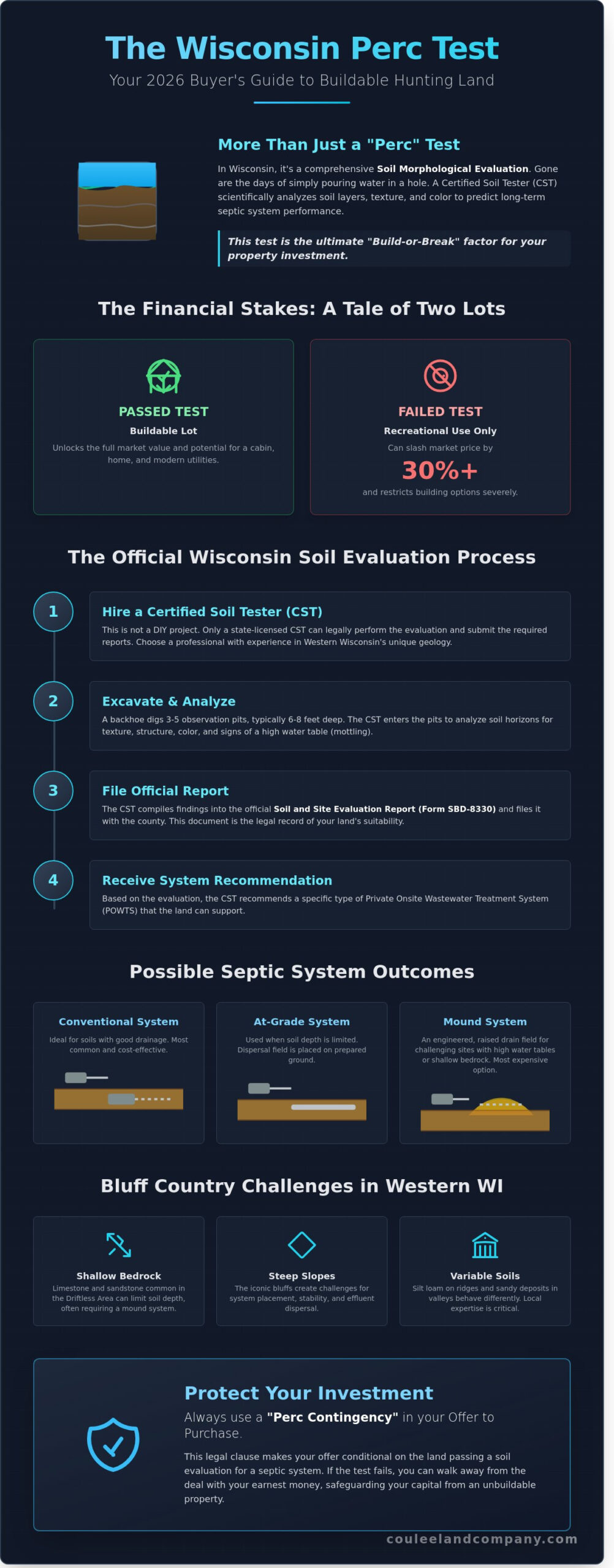
The process follows a strict sequence to ensure compliance with Wisconsin state law on soil testing. Here is the standard four-step procedure:
- Step 1: Hire a Certified Soil Tester (CST). You cannot perform this test yourself. You must contract a CST licensed by the State of Wisconsin to perform the site’s physical assessment.
- Step 2: Excavate the Observation Pits. A backhoe operator typically digs 3 to 5 pits across the proposed build site. These pits are usually 6 to 8 feet deep. The CST enters these pits to analyze soil texture, structure, and color, specifically looking for “mottling” which indicates high seasonal water tables.
- Step 3: File the SBD-8330 Form. After the field work, the CST completes the Soil and Site Evaluation Report, known as form SBD-8330. This document is the official record of your land’s capabilities.
- Step 4: Receive System Recommendation. Based on the soil’s restrictive layers, the CST will recommend a specific system type. This could be a conventional gravity system, an at-grade system, or a pressurized mound system.
Finding the Right Professional
Western Wisconsin’s topography is unique, and the steep ridges of Buffalo and Trempealeau Counties require a tester who understands Bluff Country geology. A local tester knows how the silt loam on a ridge top differs from the sandy deposits in the valley. Our team of land specialists frequently coordinates with local contractors to ensure the backhoe and the CST arrive on schedule. Before you hire a professional, ask how many tests they’ve conducted in your specific township and if they have experience with the county’s specific zoning department. This local knowledge can save you thousands in unnecessary excavation costs.
Timing and Seasonal Constraints
When buyers ask what is a perc test for land in wisconsin, they’re often surprised by the seasonal limitations. Spring and fall are the busiest seasons for soil testers. During these windows, the soil isn’t frozen, and the water table is most visible. If you attempt to test in the dead of winter, frozen ground can make backhoe access difficult and can mask the true color of the soil horizons. Once the field work is finished, the administrative side takes over. It typically takes 14 to 28 days to receive official results and approval from the county. If you’re currently scouting hunting properties, it’s wise to start this process during your 30-day due diligence period to avoid any surprises after closing.
Bluff Country Challenges: Why Soil Testing Matters for Hunting Properties
Western Wisconsin’s Driftless Area covers approximately 24,000 square miles of unglaciated terrain. This unique geology creates the steep ridges and deep coulees that produce world-class whitetails, but it also creates significant hurdles for traditional drainage. Understanding what is a perc test for land in wisconsin becomes critical when you’re looking at a 40-acre ridge top in Buffalo or Trempealeau County. The soil here isn’t uniform. You might find deep, well-draining silt on a bench, while fifty feet away, the limestone bedrock sits just 18 inches below the surface.
Steep slopes exceeding 20% grade often disqualify large portions of a property from standard septic installation. Buyers frequently fall in love with a “million-dollar view” on a narrow point, only to find the soil is too shallow for anything but an expensive holding tank. A buildable cabin site significantly increases the market value of hunting properties. Without a passing soil test, your “dream build” remains a primitive campsite, which can limit your pool of future buyers by as much as 50% based on recent regional sales data.
Buffalo County Nuances
Buffalo County is famous for its Boone and Crockett record entries, but its Fayette and Palo silt loam soils require expert evaluation. Ridge-top building sites often lack the soil depth found on valley floors, frequently necessitating mound systems or at-grade systems. We prioritize protecting wildlife habitat during this process. A skilled soil tester can evaluate a site with minimal disruption to bedding areas or travel corridors, ensuring your future cabin doesn’t ruin the very hunting that drew you to the land.
The “Cabin vs. Home” Septic Debate
Many hunters believe a small seasonal cabin can bypass strict regulations. However, Wisconsin Administrative Code SPS 383 requires a compliant private onsite wastewater treatment system (POWTS) for any structure with running water. Skipping a perc test on a property you intend to keep “primitive” is a risky financial move. Most buyers looking for buying a home with acreage want the option to build a permanent residence later.
- Resale Value: Properties with a pre-certified building site sell 20% faster on average in the Driftless region.
- System Requirements: Seasonal cabins must meet the same environmental safety standards as a four-bedroom home.
- Long-term Planning: Knowing what is a perc test for land in wisconsin helps you plan road access and power lines without wasting money on unbuildable ground.
Don’t assume a beautiful clearing is a functional building site. The rugged beauty of Bluff Country demands a pragmatic approach to soil science before you sign a closing statement.
Logistics: Costs, Results, and Navigating a “Failed” Test
Navigating the logistics of a perc test is a critical step for any buyer eyeing a trophy whitetail property in Western Wisconsin. For 2026, buyers should budget between $600 and $1,200 for a professional soil evaluation. This isn’t just a fee for a signature; it’s an investment in the buildability of your land. Understanding what is a perc test for land in wisconsin is essential because it dictates your long-term infrastructure costs before you ever break ground on a cabin or home.
Several variables can push these costs toward the higher end of the spectrum. If your dream site is deep in the timber with limited access, expect to pay more for equipment transport. Common cost drivers include:
- Backhoe Rental: Hiring an operator for deep hole observation typically adds $250 to $500 to the total bill.
- Remote Access: Sites located far from maintained roads require specialized machinery to reach the testing zone.
- Multiple Test Sites: Testing several potential build spots across a large acreage naturally increases the labor hours.
A “failed” test often creates unnecessary panic among first-time buyers. In the context of modern Wisconsin soil science, a failure usually means the soil cannot support a traditional, gravity-fed septic system. It doesn’t mean the land is unbuildable. It simply shifts the conversation toward alternative, engineered solutions that are common throughout the Driftless Area. When you analyze what is a perc test for land in wisconsin, you’re really looking for the soil’s “limiting factor,” such as high groundwater or shallow bedrock.
The Mound System: The Wisconsin Standard
Mound systems are the workhorse of Wisconsin’s Bluff Country. These systems overcome shallow bedrock or heavy clay by creating an artificial drainage area above the natural grade. While a conventional system might cost $8,000 to $12,000, a mound system generally ranges from $15,000 to $25,000. Despite the higher upfront cost, they’re the most reliable solution for the rugged terrain found in Buffalo and Trempealeau Counties. They ensure your camp remains functional without compromising the local watershed.
Holding Tanks: The Last Resort
Wisconsin state code permits holding tanks only when soil conditions are so restrictive that even a mound system cannot function. A holding tank is a sealed vessel requiring regular pumping by a licensed professional. Maintenance costs can exceed $2,000 annually depending on how often you use the property. From a financing perspective, many lenders view holding tanks as a risk, often requiring higher down payments for land purchases. It’s a solution typically reserved for small hunting cabins or very difficult riverside lots where no other options exist.
If you’re ready to find a property with build-ready potential, check out our current hunting properties for sale.
Real Estate Strategy: Using Perc Tests in Land Transactions
Understanding what is a perc test for land in wisconsin is only half the battle; knowing how to leverage those results at the closing table is where the real work begins. You must include a specific Perc Contingency in your offer to purchase. This clause allows you to walk away with your earnest money intact if the soil evaluation fails to meet the requirements for your intended septic system. In the competitive 2026 market, these contingencies are your primary defense against buying a trophy property that you can’t actually build on.
Negotiating the cost of the test is a standard part of the deal. While buyers typically pay for their own due diligence to ensure the results are unbiased, a savvy seller might pre-pay for the test to remove all doubt. If a test comes back as mound-only, it’s a powerful tool for renegotiation. A mound system can cost $5,000 to $10,000 more than a traditional gravity system. You should use this data to justify a lower sale price. Every country home for sale in Western Wisconsin should have recent soil data on file to prevent these last-minute price drops.
For the Land Seller
Having a pre-certified build site can increase your asking price by $10,000 or more in 2026. Buyers in the Bluff Country are often looking for a turn-key experience where they can start construction immediately. A perc-ready listing removes the 30-day waiting period for soil results and speeds up the closing process for premium properties. You can find more details on preparing your property at our guide for sellers looking to maximize their land value.
For the Land Buyer
Never rely on verbal assurances from a seller about soil quality. A seller might claim the land “percs great” because a neighbor built a house in 1995, but modern 2026 standards are much stricter. You should walk the property with your agent to identify potential build sites before the certified soil tester arrives. This ensures the test happens where you actually want your home, not just where the digging is easiest. Knowing what is a perc test for land in wisconsin helps you avoid the trap of buying “unbuildable” acreage.
- Verify the soil test report was filed with the county within the last 3 years.
- Confirm the test holes were dug in the exact footprint of your proposed home.
- Check for “limiting factors” like high groundwater or bedrock within 3 feet of the surface.
- Ensure the perc contingency date in your contract provides at least 21 days for testing.
- Review the results with a licensed septic installer to get an accurate installation quote.
Secure Your Future in Wisconsin’s Premier Hunting Grounds
Navigating the technical requirements of soil evaluation shouldn’t stand between you and your dream property. You’ve learned that a successful soil test is the foundation of any buildable site, especially when dealing with the steep terrain of Buffalo County. This region dominates the Boone and Crockett Record Book for trophy whitetail entries, making every acre a high-stakes investment. Understanding exactly what is a perc test for land in wisconsin ensures you don’t purchase a parcel that can’t support a modern septic system. Our team at Coulee Land Company brings a specialized blend of real estate expertise and land management knowledge to every transaction. We’re endorsed by top outdoor television hosts because we understand the land as deeply as the hunters who walk it. Whether you’re looking for a 40-acre ridge top or a valley bottom, verifying soil suitability early in the process protects your capital. It’s time to stop dreaming and start building your legacy in the Bluff Country.
Find your buildable dream property; view our exclusive Wisconsin listings
The right piece of land is waiting for you, and we’re ready to help you claim it.
Frequently Asked Questions
How much does a perc test cost in Wisconsin in 2026?
A professional soil evaluation in Wisconsin typically costs between $600 and $1,500 depending on the complexity of the terrain and the number of borings required. These fees cover the certified soil tester’s labor and the filing of official reports with the Wisconsin Department of Safety and Professional Services. While prices fluctuate based on fuel costs and demand, this range remains the standard for 2026 across Western Wisconsin counties like Buffalo and Trempealeau.
Can I do my own perc test for my Wisconsin property?
You cannot perform your own soil evaluation because Wisconsin state law requires a Certified Soil Tester to conduct the analysis. The Wisconsin Department of Safety and Professional Services regulates these professionals to ensure that septic system designs protect groundwater and public health. Attempting a DIY test won’t be recognized by the county for building permits; you need a licensed expert who understands the unique topography of the Coulee Region.
How long is a Wisconsin perc test valid for?
A Wisconsin soil evaluation remains valid indefinitely as long as the soil conditions on the site haven’t been altered by grading, filling, or compaction. While the physical data stays accurate, the state’s plumbing codes and administrative rules, such as SPS 383, can update over time. If you’re looking at a property with a report from 2010 or earlier, it’s wise to have a specialist verify that the original findings still meet current 2026 regulatory standards.
What happens if my land fails a perc test?
Failing a traditional soil evaluation means the ground cannot absorb wastewater through a standard gravity fed system. If the soil is too shallow or tight, you’ll likely need to install a mound system or a holding tank to meet state requirements. This is a common occurrence in the rugged terrain of Buffalo County, where steep slopes and rock layers often dictate more complex, engineered septic solutions for trophy hunting properties.
Is a perc test required to buy land in Wisconsin?
A soil test isn’t legally required to transfer a deed, but it’s an essential due diligence step for any buyer planning to build a cabin or home. Understanding what is a perc test for land in wisconsin helps you avoid purchasing an unbuildable lot that can’t support a septic system. We always recommend making a successful soil test a contingency in your purchase agreement to protect your investment in the Bluff Country.
What is the difference between a conventional and a mound septic system?
A conventional system uses gravity to move effluent into a subsurface drain field, while a mound system sits above the natural grade to treat waste in a raised bed of sand. Mound systems are necessary when the native soil is too thin or has a high water table, which is frequent in Western Wisconsin’s diverse geography. While mounds are more expensive to install, they provide a reliable solution for properties that lack deep, permeable soil.
Do I need a perc test if I am only building a hunting shed?
You don’t need a soil evaluation for a hunting shed if the structure lacks indoor plumbing and won’t generate wastewater. However, if your 2026 plans include adding a bathroom or a sink, the county will require a certified test before issuing a sanitary permit. Even for simple structures, it’s smart to know the soil’s capabilities early so you don’t limit the future resale value of your hunting ground in the Coulee Region.
How do I find a certified soil tester in Western Wisconsin?
You can find a licensed professional by searching the Wisconsin DSPS online credential database for Certified Soil Testers in your specific county. Local experts who specialize in the Coulee Region’s unique Bluff Country soil profiles are often the best choice for accurate results. Our team at Coulee Land Company maintains a list of 12 trusted contractors who have decades of experience navigating the specific geological challenges of this prized hunting territory.