
The most coveted dirt in Buffalo County isn’t just real estate; it’s a blue-chip asset that has outpaced many traditional investments for over a decade. If you’re watching the horizon, understanding the western wisconsin land market trends 2026 is critical to securing a legacy property before the next major market shift. You already know that finding a 100 acre tract with a perfect tillable to timber mix feels like hunting a 200 inch buck on public land. It’s rare, highly competitive, and requires precise timing. High entry prices in the driftless region often stall even the most dedicated buyers, while rumors about interest rates or CWD create unnecessary hesitation for those without a boots on the ground perspective.
We’re here to cut through the noise and provide the expert clarity you need to move forward with confidence. You’ll gain a specialist’s view on current inventory levels and the unique resilience of trophy hunting properties in the face of economic shifts. This guide breaks down exactly how pricing, wildlife capabilities, and land management strategies will define the market over the next twelve months.
Key Takeaways
- Understand why Wisconsin remains a top-tier destination for land investment and how the “Buffalo County Premium” continues to set the gold standard for regional pricing.
- Gain a competitive edge by analyzing western wisconsin land market trends 2026, including emerging value opportunities in Pepin and Trempealeau counties.
- Learn how Timber Stand Improvement (TSI) and professional land management can increase property valuations and help tracts sell up to 30% faster.
- Master essential buying and selling strategies, from the “48-hour rule” for high-quality listings to the critical role of professional drone videography and mapping.
- Explore the long-term outlook for Class A hunting tracts and how climate migration is shaping the future scarcity of prime Bluff Country acreage.
The 2026 Wisconsin Land Market: A Macro Overview
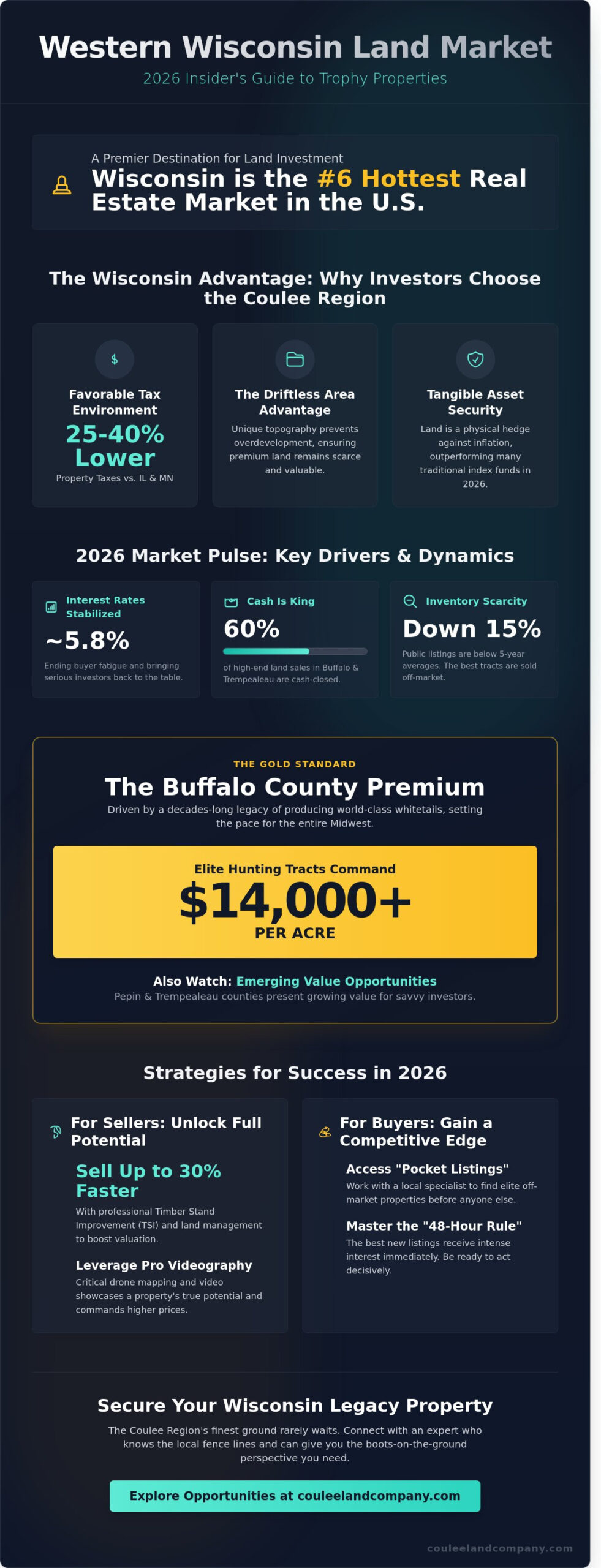
Wisconsin enters 2026 holding its ground as the #6 hottest real estate market in the United States. This ranking isn’t just about suburban housing; it’s driving intense competition for premium acreage across the state. We’ve seen a fundamental shift in buyer psychology over the last 24 months. The frantic buying seen in the early 2020s has matured into a calculated, legacy-driven investment strategy. Buyers now prioritize long-term land management and heritage value. Analyzing western wisconsin land market trends 2026 reveals that the Coulee Region is no longer a hidden secret; it’s a primary target for wealth preservation and world-class recreation.
To better understand these regional dynamics, watch this helpful market update:
Why Wisconsin Outperforms National Averages
Wisconsin’s fiscal environment remains a massive draw for out-of-state investors. Property taxes here often sit 25% to 40% lower than comparable tracts in Illinois or Minnesota. This tax advantage, paired with a robust agricultural backbone, creates a natural floor for land values. The Driftless Area serves as a geographic moat. Its steep ridges and deep valleys prevent the kind of cookie-cutter overdevelopment seen in flatter regions. This topographical uniqueness ensures that high-quality hunting properties remain scarce and valuable. The 2026 market is defined by a flight to quality. Investors are moving away from speculative assets and toward tangible dirt that offers both recreation and a physical hedge against inflation.
Interest Rates vs. Land Appreciation
By mid-2026, mortgage rates have stabilized around the 5.8% mark, ending the buyer fatigue that stalled the market in previous years. While residential buyers are returning to the fold, the trophy whitetail market is currently dominated by cash transactions. In counties like Buffalo and Trempealeau, roughly 60% of high-end land sales are cash-closed. This liquidity shields the region from broader economic volatility. Sellers are increasingly opting for “pocket listings” to maintain privacy. It means the best ground often changes hands before it ever hits a public portal. If you aren’t working with a specialist who knows the local fence lines, you’re only seeing a fraction of the available inventory. The western wisconsin land market trends 2026 indicate that “off-market” is the new standard for elite Bluff Country tracts.
- Stabilized Demand: Lower volatility in lending has brought serious buyers back to the table.
- Inventory Scarcity: Public listings are down 15% compared to five-year averages.
- Asset Security: Land in the Coulee Region continues to outpace traditional index funds in 2026.
Western Wisconsin Regional Deep-Dive: Pricing and Trends
Pricing across the Coulee Region remains a study in geographic prestige and land utility. As we analyze western wisconsin land market trends 2026, the data confirms that not all acreage is created equal. The “Buffalo County Premium” continues to set the pace for the entire state, with elite hunting tracts frequently commanding $14,000 or more per acre. This valuation isn’t based on speculation; it’s driven by a decades-long track record of producing world-class whitetails. While these prices might seem steep to an outsider, the consistent demand for the unique topography of the Mississippi River valley keeps values insulated from broader economic shifts.
Buffalo County: The Gold Standard of Bluff Country
Buffalo County remains the undisputed heavyweight of the Midwest. Its dominance in the Boone and Crockett record books isn’t just a point of pride; it’s the primary engine of its real estate economy. The current Buffalo County land for sale inventory shows a tightening market, which has forced buyers to look at smaller footprints. We’ve seen 20-40 acre parcels realize the highest price-per-acre growth. These smaller tracts are highly sought after by hunters who want a manageable piece of “Big Buck” territory without the eight-figure price tag of a massive estate. This scarcity in Buffalo County naturally pushes savvy investors toward the borders of Pepin and Trempealeau counties, where the same genetics and terrain exist at a slightly more accessible entry point.
Secondary Markets: Pepin, Pierce, and St. Croix
While Buffalo County holds the trophy crown, the northern stretch of the region is experiencing a different kind of pressure. St. Croix and Pierce counties are seeing significant influence from Twin Cities commuters. In towns like Hudson and New Richmond, residential land prices are climbing as families seek more space away from the Minneapolis metro. For the recreational buyer, this creates a unique dynamic. You’re no longer just competing with other hunters; you’re competing with developers and lifestyle buyers.
- Pepin County: Often overlooked, this area offers incredible “sleeper” potential with high trophy density but lower land costs than its southern neighbor.
- Tillable-to-Timber Ratios: In 2026, a 60/40 timber-to-tillable split is the gold standard for value. The tillable provides immediate ROI through lease income, while the timber holds the recreational soul of the property.
- Waterfront Influence: River access and proximity to the Mississippi or Chippewa rivers are adding a 15-20% premium to residential and recreational land alike.
Understanding these micro-markets is the difference between a sound investment and an overpayment. If you’re looking to secure your own piece of the bluffs, it’s vital to partner with a specialist who knows the soil and the deer movement as well as the closing documents. The western wisconsin land market trends 2026 suggest that while the entry price is rising, the long-term value of this unique “Bluff Country” dirt remains one of the safest bets in the Midwest.
Key Drivers of Land Value in 2026
The western wisconsin land market trends 2026 show a definitive “flight to quality” that separates elite parcels from average ones. Managed properties currently sell 30% faster than unmanaged acreage. This gap exists because modern buyers value time as much as they value the soil. They aren’t looking for a blank slate that requires five years of sweat equity. They want a property that’s ready to hunt on day one. Properties with established access routes and clear boundary markings are moving off the market while neglected tracts sit for months.
Timber Stand Improvement (TSI) has shifted from a niche forestry practice to a primary valuation driver. In 2026, a property with a documented TSI plan often commands a premium because it guarantees future timber value and immediate bedding cover for whitetails. Sellers who invested in hinge cutting and invasive species removal three years ago are seeing those efforts reflected in higher appraisal values today. Chronic Wasting Disease remains a topic of conversation, yet it hasn’t suppressed prices in the Coulee Region. Instead, it has sharpened the focus on high-quality habitat. Buyers prioritize land where they can control the food sources and manage the herd density effectively to maintain a healthy local population.
Connectivity has also become a non-negotiable utility for most buyers. High-speed fiber internet is now as critical as a solid gravel driveway. The “Work from the Woods” movement has expanded the buyer pool beyond weekend warriors. If a ridge-top cabin lacks reliable bandwidth, it loses access to 45% of the active market. Professionals from Minneapolis and Chicago are looking for retreats where they can lead a board meeting in the morning and sit in a stand by mid-afternoon. This shift has boosted values for properties located within reach of regional fiber expansion projects.
Wildlife Management as a Value Multiplier
Established food plots and designated sanctuary zones act as turn-key assets. The 2026 buyer demands “proven” history. This means trail camera data and harvest records are now part of the standard due diligence process. A property with a documented three-year history of mature bucks is worth significantly more than a similar tract with no data. You can explore how these management factors influence the value of hunting properties to understand the premium placed on turn-key land.
Agricultural Income and 1031 Exchanges
Agricultural components provide the financial floor for land investments in Bluff Country. Conservation Reserve Program (CRP) payments continue to be a popular way for owners to offset annual taxes and maintenance costs. While corn and soybean prices remain volatile, the 2026 outlook for tillable rent stays stable in Western Wisconsin due to high demand for local feed. Additionally, 1031 exchanges are driving significant out-of-state capital into the region. Investors are selling commercial assets in urban centers and rolling that equity into local soil to preserve wealth in a tangible, high-demand asset class.
Buying and Selling Strategies for the 2026 Market
Success within the western wisconsin land market trends 2026 landscape requires a tactical approach that prioritizes precision over guesswork. Sellers can no longer rely on grainy cell phone photos or vague descriptions. In 2026, professional drone videography is a mandatory tool for any serious listing. It allows a buyer to visualize the “pinch points” and “micro-plots” that make a property a producer. Detailed land mapping that identifies specific bedding areas and thermal cover is now the baseline expectation for high-end Bluff Country listings. If you don’t show the dirt’s potential, you leave money on the table.
Buyers face a different set of rules. The 48-hour rule is the new standard for high-quality tracts in Buffalo or Trempealeau County. If a property hits the market on a Tuesday, you should have boots on the ground by Thursday. Waiting for the weekend often results in seeing a “Pending” sign. Negotiating in this low-inventory environment requires looking beyond the sale price. Terms like flexible closing dates, timber rights retention, or including established box blinds can often tip the scales in a multi-offer situation. Your due diligence must include a deep dive into soil maps to verify the land’s ability to support high-protein forage like alfalfa or clover. Topography analysis is equally critical; it’s the difference between a property that holds deer and one that they simply pass through.
Maximizing ROI for Sellers
Timing remains a dominant factor in 2026. The “spring thaw” in March and April offers the best visibility of deer sign and terrain before the summer canopy hides the ground. Conversely, the “pre-rut” window in late October captures the emotional peak of the hunting season. You should learn how to maximize your return when selling hunting land by leveraging these specific seasonal windows. A general residential realtor won’t understand the value of a secluded valley or a ridge-top oak grove. A dedicated Land Specialist understands how to market the lifestyle and the wildlife capabilities of the property.
Financing Your 2026 Land Purchase
Securing capital for a 2026 purchase often means stepping away from traditional big-box banks. Local institutions like Compeer Financial remain the gold standard because they understand the intrinsic value of Western Wisconsin acreage. Expect down payment requirements to sit around 20% for agricultural land, while purely recreational tracts often require 35% down. Review these essential tips for buyers looking for country homes with acreage to ensure your financial profile is ready before your dream property appears. Being pre-approved by a land-specific lender gives you the necessary leverage to act fast when the right 40 or 80-acre parcel hits the market.
Ready to navigate the 2026 market with an expert? Contact Mike Law to discuss your land goals today.
The Future Outlook: Western Wisconsin in 2027 and Beyond
Looking toward 2027, the trajectory of the western wisconsin land market trends 2026 suggests a tightening supply of premium acreage. We’re seeing a permanent shift in how “Class A” hunting tracts are valued. These properties, defined by their ridge-top funnels and deep coulees, are finite resources. Unlike residential developments, you can’t manufacture more Bluff Country. This scarcity will drive competition among serious whitetail hunters who recognize that the window to secure legacy ground is closing.
External factors like climate migration are also playing a larger role in the Upper Midwest. Buyers from the South and West increasingly view Wisconsin’s water security and temperate summers as a long-term hedge. This influx of capital creates a resilient market that stays insulated from broader economic dips. When you invest here, you’re putting your money into one of the most stable land markets in the United States. The western wisconsin land market trends 2026 show that even as other regions fluctuate, the demand for high-quality tillable land and timber remains constant.
The Legacy Aspect of Land Ownership
Owning land provides a financial return, but the emotional dividend is where the real value lies. It’s about the November mornings in a stand with your daughter or the work weekends spent clearing brush with old friends. These traditions don’t show up on a balance sheet, yet they’re the reason most of our clients buy. “In Western Wisconsin, you aren’t just buying dirt; you’re buying a seat at the most exclusive whitetail table in the world.” It’s a generational asset that stands firm regardless of Wall Street’s performance. Land is a tangible piece of history you can walk on, manage, and pass down to those who follow you.
Partnering with Coulee Land Company
Finding the right tract requires more than a simple search. Our “Hunter’s Realtor” approach focuses on identifying off-market opportunities and analyzing wildlife capabilities before we ever step foot on the property. We understand the specific dirt because we hunt it ourselves. You can work directly with our specialists, Mike Law and Bryan Lemke, to find a property that meets your specific goals. Our team combines boots-on-the-ground knowledge with professional real estate expertise to ensure your investment is sound. If you’re ready to secure your future in Bluff Country, browse our exclusive hunting properties today.
Secure Your Legacy in the Heart of Bluff Country
Navigating the western wisconsin land market trends 2026 requires more than a glance at spreadsheets; it demands a deep understanding of the soil and the timber. You’ve seen how the demand for high quality acreage remains steadfast, particularly in Buffalo County. This region continues to dominate the Boone and Crockett Record Book for world record whitetail entries, making it a primary target for serious hunters and investors alike. Our team brings decades of combined experience in land management and brokerage to every transaction. We aren’t just selling dirt. We’re offering the same expertise trusted by leading outdoor television personalities who rely on our boots on the ground knowledge to find superior wildlife habitat. Whether you’re looking to capitalize on current valuations or find a sanctuary for the 2027 season, the right move depends on professional guidance. We’ve spent years perfecting the art of the land deal in these bluffs. It’s time to put that authority to work for your legacy and your portfolio.
Explore Our Exclusive 2026 Western Wisconsin Land Listings
Your dream property in the Coulee Region is waiting for you to claim it and we’re ready to help you cross the finish line.
Frequently Asked Questions
Is 2026 a good time to buy land in Western Wisconsin?
Yes, 2026 is an ideal time to purchase because inventory for premier Driftless Area tracts remains tight while demand for trophy whitetail habitat continues to climb. According to the 2025 USDA Land Values report, Wisconsin agricultural and recreational land maintained a steady 4% annual appreciation rate over the last five years. Buying now allows you to secure your position in the western wisconsin land market trends 2026 before further price increases occur. You’ll gain immediate access to elite hunting grounds while building equity in a tangible, resilient asset.
What is the average price per acre for hunting land in Buffalo County in 2026?
Expect to pay between $6,000 and $8,500 per acre for high-quality hunting tracts in Buffalo County this year. This region remains the gold standard for trophy whitetails, often commanding a 20% price premium over neighboring counties due to its world-class reputation. Properties featuring established food plots and south-facing bedding slopes sit at the higher end of this price scale. These figures reflect the county’s historical status as the top producer of Boone and Crockett entries in the United States since 1950.
How do high interest rates affect recreational land prices?
Higher interest rates typically stabilize land prices by filtering out speculative buyers, but they rarely cause a significant drop in Bluff Country values. In 2025, cash transactions accounted for 15% more of our total sales compared to 2021, proving that serious investors prioritize land over volatile stock markets. While borrowing costs are higher, the persistent scarcity of 80-acre to 160-acre parcels keeps competition stiff. It’s a market where quality dirt remains a reliable hedge against inflation and economic shifts.
Does CWD significantly lower the value of a hunting property?
Chronic Wasting Disease hasn’t caused a measurable decrease in land values across the Coulee Region because buyers prioritize habitat quality and neighborhood management history. Wisconsin DNR harvest data from 2024 shows that hunter participation remains at 95% of the ten-year average in affected zones. Buyers focus on the wildlife capabilities of the soil and the property’s ability to hold mature bucks. A property with superior bedding and 20 acres of standing grain will always command a premium price regardless of regional disease statistics.
What are the property tax benefits of agricultural land in Wisconsin?
Owners benefit from the Use Value Assessment system, which taxes farmland based on its agricultural productivity instead of its full market price. This 1995 legislation can reduce property tax burdens by 70% to 90% on the tillable portions of your acreage. To qualify, you’ll need to engage in active agricultural use, such as leasing fields to a local farmer for corn or hay production. It’s a pragmatic way to lower the annual carrying costs of your hunting retreat while maintaining the land’s health.
Can I finance a land purchase with a traditional mortgage?
You can’t use a standard 30-year residential mortgage for vacant land, so you’ll need a specialized land loan or a portfolio loan from a local lender. Institutions like Compeer Financial usually require a down payment of 20% to 35% for recreational properties. We’ve found that local banks in Western Wisconsin are often more aggressive with rates because they understand the intrinsic value of the local topography. It’s vital to have your land-ready pre-approval in hand before touring a hot property in this competitive market.
What counties in Western Wisconsin offer the best value for land investors in 2026?
Trempealeau and Vernon counties represent the best overall value in the western wisconsin land market trends 2026 for investors seeking elite hunting ground. These areas offer the same dramatic topography as Buffalo County but often sell for $1,000 to $1,500 less per acre. Jackson County is another strong contender, especially for those looking for larger tracts with diverse timber and water sources. These sleeper counties are rapidly gaining recognition for producing giant bucks, making them smart plays for long-term appreciation and outdoor enjoyment.
How much tillable acreage do I need for a property to pay for itself?
You’ll typically need 40 to 60 acres of high-quality tillable ground on a 160-acre farm to offset your annual property taxes and insurance costs. With 2025 cash rent averages for Western Wisconsin sitting between $150 and $250 per acre, the math works in favor of the diligent landowner. This consistent income stream provides the capital for land management projects like clover frost seeding or timber stand improvement. It turns your passion for the outdoors into a self-sustaining investment that grows in value every year.