
Your Wisconsin property tax bill isn’t just a government invoice; it’s a financial blueprint that dictates the actual ROI of your hunting land or timber investment. When that envelope arrives in December, it’s natural to feel a surge of frustration as you see the state’s average bill of $3,818 and wonder why your “Assessed Value” seems so detached from reality. Understanding wisconsin property tax bills is the first step in ensuring you aren’t overpaying for your slice of Bluff Country. You’ve worked hard to secure a property capable of producing trophy whitetail bucks, and you shouldn’t be penalized by a lack of clarity on your annual statement.
We agree that the gap between “Fair Market” and “Assessed” value is often confusing, especially since Wisconsin law currently places no cap on annual assessment increases. This guide will show you how to decode every line of your statement and identify specific credits, like the $10.00 per acre Farmland Preservation credit, that can significantly lower your tax burden. We’ll walk through the January 31 and July 31 payment deadlines, explain how the 1.25% effective tax rate impacts your bottom line, and help you determine if programs like Managed Forest Law or Ag-use classifications are right for your land management goals.
Key Takeaways
- Learn to identify the five specific taxing jurisdictions that compose your bill to see exactly where your land investment dollars are being distributed.
- Master understanding wisconsin property tax bills by verifying your eligibility for key credits that can shave hundreds off your annual bottom line.
- Discover how Use-Value Assessment provides a massive tax advantage for landowners who properly classify their agricultural and recreational acreage.
- Secure your financial flexibility by mastering the strict January 31 and July 31 installment schedule to avoid losing your right to split payments.
- Uncover the difference between your gross tax and net tax to ensure you aren’t leaving unclaimed credits on the table this year.
Decoding the Layout: What Every Line on Your Wisconsin Tax Bill Means
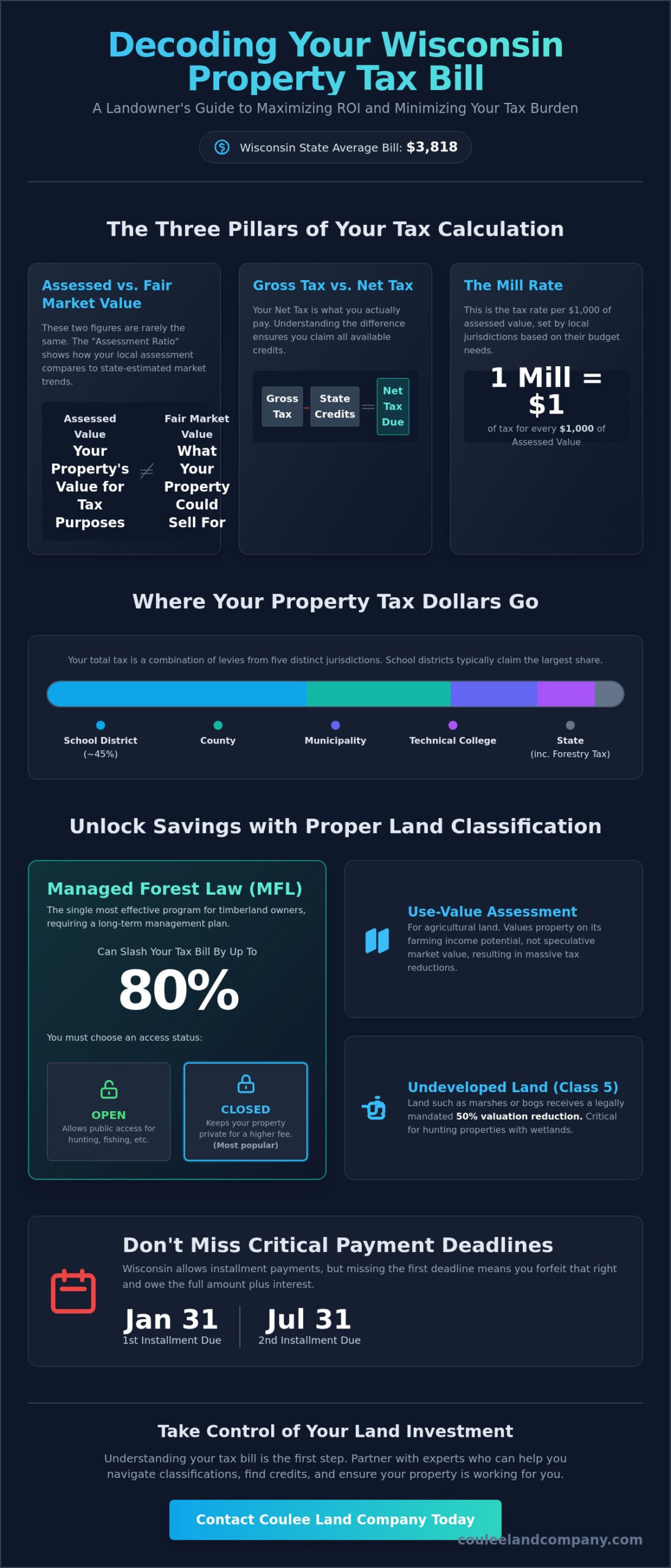
Your annual tax statement is more than a bill; it’s a breakdown of how your investment supports local infrastructure. Understanding wisconsin property tax bills requires a close look at the five core jurisdictions that set your rates: the County, Municipality, State, School District, and Technical College. Each entity determines its own levy based on its budget needs for the coming year. The Wisconsin Department of Revenue (DOR) provides the framework for these calculations, ensuring that local officials follow the 2026 Property Assessment Manual guidelines.
To read your bill accurately, you must distinguish between “Total Property Tax” and “Net Property Tax.” The total represents the raw amount owed to all jurisdictions combined. Your net tax is the final figure you pay after the state applies specific credits. Two critical numbers drive this calculation: the Mill Rate and the Assessed Value. The Mill Rate is the amount of tax payable per dollar of the assessed value of a property. Assessed Value is the dollar amount assigned to a property by the local assessor for tax purposes.
Assessed Value vs. Estimated Fair Market Value
These two figures rarely match on a Wisconsin statement, which often causes frustration for landowners. The ratio is key. This “Assessment Ratio” reflects how closely your municipality’s valuations track with actual market trends. If your assessment looks inflated compared to recent Bluff Country sales, it’s time to investigate. A ratio below 100% means the local assessment is lower than the state’s market estimate, while a ratio above 100% suggests you might be over-assessed.
The Role of Taxing Jurisdictions
Your local school district typically claims the lion’s share of your tax dollars, often accounting for 45% or more of the total levy. This is why school board elections and local referendums have such a direct impact on your land’s carrying costs. For those owning timber or recreational acreage, the “State Forestry” tax is a unique line item. It’s a small fee that funds wildfire suppression and forest management programs across the state. While the amount is usually minor, it’s a direct contribution to the health of the very woods where you hunt trophy bucks.
Navigating Land Classifications and Tax Credits for Rural Property
Saving money on your acreage starts with identifying the right codes on your statement. While every property with a structure usually qualifies for the First Dollar Credit, understanding wisconsin property tax bills requires digging into deeper classifications. The Lottery and Gaming Credit is another common line item, though it’s strictly reserved for your primary residence. For the serious land investor, the real value lies in the “Use-Value Assessment” for agricultural land. This system values land based on its income potential from farming rather than its speculative market value, which often results in a massive tax reduction compared to residential rates.
Classifying your terrain correctly is a powerful tool for cost management. Under Class 5, “Undeveloped Land” such as marshes or bogs receives a 50% valuation reduction by law. This is a critical distinction for those buying hunting properties with significant wetlands. Similarly, Productive Forest Land is taxed at its full value unless it’s enrolled in a specific program. Navigating Wisconsin’s Property Tax landscape involves verifying these codes every year to ensure your assessor hasn’t missed a classification that could save you thousands. Mastering the art of understanding wisconsin property tax bills is often what separates a profitable land investment from a financial drain.
The Managed Forest Law (MFL) Advantage
The MFL program is the single most effective way to lower your tax burden on timberland, often slashing bills by 80%. In exchange for a long-term timber management plan, you pay a significantly reduced acreage share tax. You’ll need to choose between “Open” and “Closed” status. Open land allows public access for hunting and fishing, while Closed status keeps your property private for an additional fee. Most of our clients prefer Closed status to protect their trophy buck sanctuary.
Agricultural and Managed Land Credits
The “Ag-Forest” classification offers a 50% assessment reduction for parcels that feature a mix of standing timber and active agriculture. This is perfect for the classic Bluff Country farm that has tillable valley floor and wooded ridges. Additionally, if your land is in a designated zone and meets revenue requirements, you may qualify for the Farmland Preservation Credit. This provides up to $12.50 per acre for landowners meeting conservation standards. If you’re unsure if your current land is optimized for these credits, our team can help you review your options when you’re ready to look at new land opportunities.
Proactive Tax Management: Planning for Your Land Investment
Managing your land investment requires more than just checking trail cameras; it demands strict attention to the calendar. Wisconsin property taxes are payable in two installments, with the first due by January 31 and the second by July 31. Missing that initial January deadline is a costly mistake. If you’re late, you immediately lose your installment privileges, making the entire balance due at once with interest and penalties added. Understanding wisconsin property tax bills means knowing these dates are non-negotiable if you want to maintain your cash flow throughout the year.
If you believe your assessment is unfairly high, you aren’t powerless. Landowners can appeal their valuation through the local “Board of Review” process. This typically requires providing evidence of comparable sales to prove your land is overvalued relative to the market. When the time comes for selling hunting land in Wisconsin, having a lean tax bill is a massive competitive advantage. A property already optimized with MFL or Ag-Forest status is far more attractive to buyers looking for a high-quality retreat with low carrying costs.
Evaluating Taxes Before You Buy
Researching tax history is a mandatory step in due diligence, especially in high-demand areas like Buffalo County. Don’t take the current bill at face value. A high tax amount might actually be a hidden opportunity if the land is currently misclassified as residential. We’ve seen many cases where reclassifying a property to Ag-Forest or Undeveloped Land (Class 5) significantly dropped the annual overhead, instantly improving the property’s long-term value.
Working with a Wisconsin Land Specialist
Expert guidance is essential when understanding wisconsin property tax bills during a purchase. Agents like Mike Law specialize in analyzing tax statements to ensure there are no surprises at the closing table. We verify that MFL contracts and agricultural leases are in good standing and will transfer correctly to the new owner. This level of diligence ensures your dream of owning a piece of the Bluff Country doesn’t come with an unexpected tax headache on day one.
Take Control of Your Land Investment Costs
Owning a piece of Western Wisconsin’s Bluff Country is a dream that requires diligent financial management to remain sustainable. By identifying the right land classifications and utilizing programs like the Managed Forest Law, you can reduce your tax burden by as much as 80%. Mastering the nuances of understanding wisconsin property tax bills ensures you never pay more than your fair share for the woods you call home. It’s vital to stay ahead of the January 31 and July 31 deadlines to protect your installment privileges and keep your annual cash flow predictable.
As Wisconsin’s Land and Property Sales Specialists, Coulee Land Company brings a wealth of expertise in MFL and Ag-Use land classifications to every transaction. Our team is proudly endorsed by leading outdoor television hosts and remains the undisputed authority in this famed hunting region. We don’t just sell real estate; we help you build a legacy on the land. Looking for land with favorable tax classifications? View our current Wisconsin listings.
Your property is a significant asset that deserves professional oversight. Start your journey toward smarter land ownership today and secure the future of your hunting grounds.
Frequently Asked Questions
When are Wisconsin property tax bills mailed out?
Local treasurers are required by state law to mail property tax statements by the third Monday in December each year. This timing ensures that landowners have at least several weeks to review their assessments before the first payment installment is due in January. If your bill hasn’t arrived by late December, you can typically find a digital copy on your specific county treasurer’s website by searching for your parcel number.
What is the difference between the Lottery Credit and the First Dollar Credit?
The Lottery and Gaming Credit is strictly reserved for your primary residence, while the First Dollar Credit applies to any taxable parcel that contains a real estate improvement, such as a cabin or a home. Both credits are designed to reduce the school levy portion of your bill. While the First Dollar Credit is applied automatically to eligible improved properties, you must certify that a property is your main home to receive the Lottery Credit on your statement.
Can I lower my taxes on hunting land if I don’t farm it?
You can significantly reduce your taxes on non-farmed ground by enrolling in the Managed Forest Law (MFL) program or ensuring your acreage is correctly classified as “Undeveloped Land.” MFL enrollment can slash your tax burden by up to 80% in exchange for a long-term timber management plan. Additionally, land classified under Class 5 as “Undeveloped” receives a 50% valuation reduction. Understanding wisconsin property tax bills allows you to verify these classifications and keep your holding costs low on trophy hunting ground.
What happens if I miss the January 31st tax payment deadline in Wisconsin?
Missing the January 31 deadline results in the immediate loss of your installment privileges, which makes the entire remaining tax balance due at once. Interest and penalties are applied retroactively to February 1, typically accruing at a rate of 1.5% per month until the total is paid. This penalty can quickly erode the profitability of a land investment, so it’s vital to ensure your payment is postmarked or delivered to the local treasurer by the end of January.