
Forget the bank. For savvy buyers eyeing their own piece of Wisconsin’s whitetail paradise, the most powerful tool in 2026 won’t be a mortgage pre-approval; it will be a well-structured land contract. This direct path to ownership cuts through the red tape and high interest rates that can stall a dream property acquisition.
We get it. You’ve seen the interest rate forecasts, and you’re wary of navigating the complexities of documents like Wisconsin’s ‘Form 11’ land contract. The fear of losing your hard-earned equity in a default scenario is a legitimate concern that holds many buyers back. This guide is your definitive roadmap to mastering seller financing. We’ll give you the expert knowledge to structure a fair deal, protect your investment, and confidently secure that legacy hunting property without traditional bank hurdles. From a clear definition of ‘equitable title’ to a step-by-step process for both buyers and sellers, you’ll gain a complete toolkit for understanding land contracts in Wisconsin.
Key Takeaways
- Discover how a land contract, or ‘Contract for Deed,’ empowers you to purchase prime Wisconsin acreage directly from the seller, cutting out traditional bank hurdles.
- Grasp the critical difference between equitable and legal title to know your rights and responsibilities as a buyer from day one of the agreement.
- For a successful transaction, understanding land contracts in wisconsin involves comparing their rapid closing times and unique cost structures against a standard mortgage.
- Structure a winning deal by learning to negotiate the essential terms, from the down payment to the interest rate, ensuring your land investment is secure.
What is a Land Contract in Wisconsin? The ‘Contract for Deed’ Explained
A land contract is a powerful, alternative real estate financing tool. In its simplest form, it’s a seller-financing agreement where the buyer makes payments directly to the property owner in installments, rather than securing a loan from a traditional bank. In Wisconsin, this arrangement is most commonly referred to as a ‘Contract for Deed.’ The buyer takes immediate possession of the property, but the seller retains the legal title until the final payment is made. For a foundational overview, you can explore the basics of What is a Land Contract?, but understanding its specific application in the Badger State is crucial for any serious land buyer.
Here in 2026, we’ve seen a significant resurgence in these agreements. With 30-year fixed mortgage rates from conventional lenders holding steady above 7% since early 2025, many aspiring landowners are seeking more creative and flexible paths to ownership. A land contract offers just that, providing a direct route to acquiring your dream property without navigating the rigid underwriting processes of a large financial institution.
For a clear visual breakdown of how this works, the following explanation is invaluable:
The fundamental shift in a land contract is that the seller effectively becomes the bank. While the seller holds the legal title as security, the buyer is granted what’s known as ‘equitable title.’ This gives the buyer the right to occupy, use, and enjoy the property, and they are responsible for taxes, insurance, and maintenance, just like a traditional homeowner. This distinction is a core component of understanding land contracts in wisconsin. Once the contract terms are fulfilled, the seller executes a deed transferring full legal ownership to the buyer.
The Role of the State Bar of Wisconsin Form 11
In Wisconsin, we don’t leave these critical agreements to a handshake. The State Bar of Wisconsin provides a standardized document, Form 11-Land Contract, which has become the gold standard for these transactions. Using this form ensures all essential terms are clearly defined, protecting both buyer and seller. As licensed brokers, we facilitate its use to structure deals with precision, outlining key components like:
- The total purchase price
- The amount of the down payment
- The agreed-upon interest rate
- The amortization period and final balloon payment date
Recreational Land vs. Residential Land Contracts
While land contracts can be used for any property type, they hold unique advantages for the recreational land market, especially for large acreage in famed areas like Buffalo County. A seller of a prime 160-acre trophy whitetail property might prefer a land contract over a cash sale. Why? It provides a steady, reliable income stream over 5 to 10 years, often at a favorable interest rate, while deferring a large capital gains tax event. From a ‘hunter’s realtor’ perspective, these deals create a partnership, often between landowners who share a deep respect for land management and the legacy of Wisconsin’s superior hunting grounds.
Understanding Equitable Title and Legal Rights in Wisconsin
A land contract operates on a unique and powerful legal principle: the separation of equitable title from legal title. This distinction is the absolute core of understanding land contracts in Wisconsin. While the seller’s name remains on the deed, the buyer gains what is known as equitable title the moment the contract is signed. This means you, the buyer, are treated as the true owner for most practical purposes. You have the right to possess, use, and enjoy the property. You’re also responsible for property taxes and carrying insurance, just like any other landowner.
The seller, in turn, retains legal title. Think of this as their security interest. They hold the deed as collateral, guaranteeing that you will fulfill your end of the bargain. Once the final payment is made, the seller is legally obligated to transfer the deed, and legal title becomes yours. To protect your investment and publicly declare your ownership interest, it’s critical to record the land contract with your County Register of Deeds. This simple step prevents a seller from attempting to sell the property to someone else and secures your rightful claim to the land.
The Buyer’s Rights: Management and Improvements
With equitable title, your dream of sculpting the perfect hunting paradise can begin immediately. You can plant food plots, establish mineral sites, and implement a trail camera strategy to pattern those legendary Bluff Country bucks. Want to build a cabin or a pole barn? You absolutely can, provided the land contract explicitly permits it. These details, along with other key land contract considerations, must be clearly defined in your agreement. Timber rights, the “standing gold” on many Wisconsin properties, typically transfer to the buyer. This allows you to conduct timber stand improvements to enhance wildlife habitat, but it’s another crucial point to clarify in writing before you sign.
The Seller’s Security: What Happens in a Default?
Wisconsin law provides sellers with a powerful and efficient remedy in the event of a buyer default: strict foreclosure. Unlike a lengthy mortgage foreclosure, this process is faster. If a buyer misses payments, the seller can file a strict foreclosure lawsuit. A court will then grant the buyer a “redemption period,” which is a final opportunity to pay the full remaining balance of the contract. The length of this period is at the court’s discretion, but it’s often shorter for buyers with less equity built up. If the buyer fails to pay within that window, they forfeit the property and all payments made. The seller reclaims the land without having to go through a public sale. This stark reality underscores the importance of financial readiness before entering a land contract. Properly structuring these complex terms is where the expertise of a specialized land agent becomes invaluable, ensuring your rights are protected from day one.
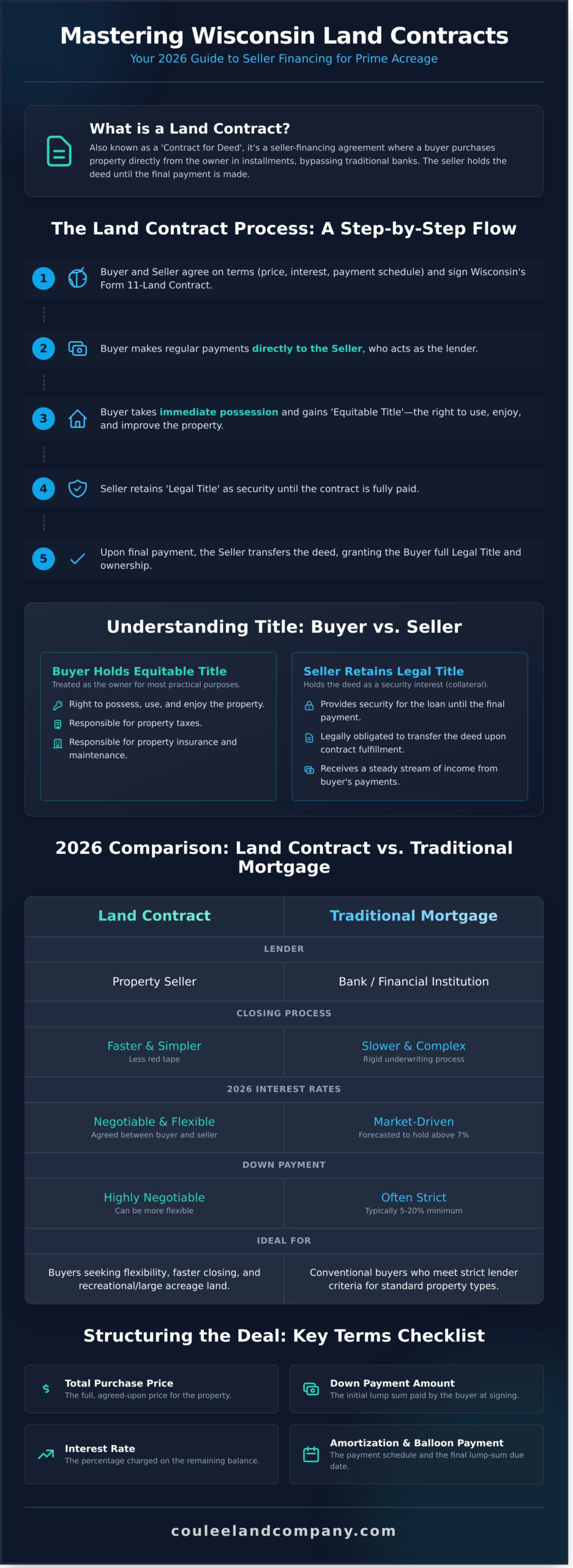
Land Contracts vs. Traditional Mortgages: A 2026 Comparison
For many aspiring landowners in Wisconsin’s famed Bluff Country, the path to ownership doesn’t run through a traditional bank. The rigid, one-size-fits-all nature of a 30-year mortgage often fails to account for the unique value of recreational land. As we look toward 2026, a growing number of savvy buyers are discovering that seller financing, specifically a land contract, offers a superior combination of speed, flexibility, and common-sense valuation that conventional lending simply cannot match.
The fundamental difference lies in who is acting as the lender. With a mortgage, you’re dealing with a financial institution. With a land contract, you’re dealing directly with the property owner. This direct relationship cuts through immense red tape, making the entire process more efficient. A key part of understanding land contracts in Wisconsin involves recognizing this shift from an institutional transaction to a personal one. The seller retains legal title as security for the loan, while the buyer gains equitable title and the full rights of ownership. This division of legal and equitable title in Wisconsin is the bedrock of the agreement, allowing for a streamlined and powerful alternative to bank financing.
Let’s break down the core advantages:
- Speed of Closing: A typical mortgage in 2026 can take 45 to 60 days to close, mired in underwriting, appraisals, and committee approvals. A land contract can be negotiated and closed in as few as 10 business days. When a prime piece of land hits the market, this speed is a decisive advantage.
- Cost Analysis: While interest rates on a land contract might be 1-2% higher than a bank’s best rate, the overall costs are often significantly lower. Buyers avoid thousands in loan origination fees, appraisal costs, and application fees. Crucially, there is no Private Mortgage Insurance (PMI), which can save hundreds of dollars each month.
- Unmatched Flexibility: A bank offers a fixed monthly payment. Period. A land contract can be tailored to the buyer’s reality. For instance, a farmer or hunting guide with seasonal income can structure larger payments in the fall after harvest and smaller payments in the spring. This level of customization is impossible with traditional lenders.
Financing Trophy Whitetail Properties
Conventional banks excel at valuing a three-bedroom, two-bath house in a subdivision. They struggle mightily when asked to value 120 acres of rugged Buffalo County terrain managed for trophy whitetails. Their appraisers rely on residential or tillable-acre comps, creating a significant “appraisal gap” where the bank’s valuation is tens of thousands of dollars below the property’s true market value to a hunter. A land contract bridges this divide, allowing the buyer and seller, who both recognize the land’s real worth, to agree on a fair price. See our current hunting properties to understand the unique value we represent.
Tax Implications for Both Parties
Properly structured land contracts offer compelling tax advantages. For the seller, it’s an installment sale, allowing them to spread capital gains tax liability over the term of the contract instead of taking a single, massive tax hit in the year of the sale. For the buyer, the interest paid on the land contract is tax-deductible, just like mortgage interest. The seller reports the interest income received, and the buyer reports the interest paid, typically documented on an IRS Form 1098, making it a clean and beneficial arrangement for everyone involved.
Structuring the Deal: A Checklist for Wisconsin Sellers and Buyers
The handshake agreement is just the beginning. The real work, and the real protection, lies in the specific terms of the land contract. This is where your dream of owning a piece of Wisconsin’s famed bluff country is either secured on solid ground or put at risk. A properly structured contract protects both parties and is a critical part of understanding land contracts in Wisconsin, setting the stage for a successful transfer of ownership.
The financial terms form the core of the agreement. Let’s break down what’s typical for recreational land:
- Down Payment: Expect to bring more to the table than with a traditional bank loan. Down payments for rural land typically range from 15% to 25%. This higher amount reflects the risk the seller is taking by acting as the lender.
- Interest Rate: Rates are negotiable but almost always higher than conventional mortgage rates. As of late 2023, it’s common to see rates set 2 to 4 percentage points above what a bank would offer, compensating the seller for the risk and the illiquidity of their investment.
- The Balloon Payment: This is the most common pitfall for unprepared buyers. Your contract may have payments calculated on a 20 or 30-year schedule, but the entire remaining balance becomes due in a much shorter term, often 5 to 7 years. You must have a clear strategy to either pay this off or secure traditional financing well before the due date hits.
Before a single term is discussed, professional sellers must secure an independent, professional valuation. Pricing a unique parcel with trophy whitetail potential or valuable timber based on tax assessments is a costly mistake. A certified appraisal establishes a fair, defensible market value that provides a firm foundation for negotiations and gives the buyer absolute confidence in their investment. It’s a non-negotiable first step for any serious seller.
Essential Clauses for Recreational Properties
For hunting land, a standard-issue contract is simply not enough. Your agreement must specifically address timber harvesting rights, protecting the long-term value of the forest and its habitat. It should also explicitly define hunting rights and access points, which is crucial if the seller owns an adjacent parcel. Clauses detailing who is responsible for maintaining food plots, trail systems, and existing habitat structures will prevent future disputes and preserve the property’s premier hunting character.
Due Diligence and Closing
Even in a private deal, you must insist on a few key protections. Never, ever skip title insurance. It is your only defense against prior liens or ownership claims on the property. The contract must also clearly assign responsibility for property taxes and casualty insurance; often, the buyer pays these into an escrow account to ensure they are never delinquent. Finally, your attorney should file a “Memorandum of Land Contract” with the county Register of Deeds. This public notice secures your equitable interest in the property and prevents the seller from trying to sell it to someone else while you’re making payments.
Structuring a land contract that truly protects your investment requires specialized, local expertise. Contact Wisconsin’s Land & Property Sales Specialists at Coulee Land Company to ensure your dream property is secured on the right terms.
Why Expert Guidance Matters in Bluff Country Land Contracts
A standard legal document can outline payment terms, but it can’t walk the property line with you. It can’t identify a hidden deer sanctuary or tell you the true value of a south-facing slope for food plots. This is the critical gap where so many buyers falter. A complete understanding of land contracts in Wisconsin goes far beyond the ink on Form 11; it requires a deep, boots-on-the-ground knowledge of the very dirt you’re buying, especially in the state’s most coveted hunting regions.
The market dynamics in a place like Buffalo County, which consistently dominates the Boone and Crockett record book for trophy whitetails, are unlike anywhere else. Here, a property’s value isn’t just measured in acres. It’s determined by a complex matrix of factors that only a local land specialist can accurately assess:
- Topography and Access: Are there established entry and exit routes for hunting that won’t pressure the deer?
- Timber vs. Tillable Ratio: What is the potential for income from crops or timber, and how much land is prime for food plot development?
- Water Sources: The location of year-round creeks and ponds is a non-negotiable for holding mature bucks.
- Neighborhood Genetics: What is the quality of the surrounding properties and their management practices?
Our team, led by seasoned experts like Mike Law, bridges the gap between legal paperwork and land reality. We translate the terms of a contract into what they mean for your hunting strategy and long-term land management goals. We don’t just sell land; we help you acquire a legacy.
The Coulee Land Company Advantage
We’re not just realtors; we are land management specialists who live and breathe this terrain. We leverage a trusted network of local attorneys and title companies who are intimately familiar with land contract transactions. For example, in the fall of 2023, we helped a buyer secure a 140-acre legacy property through a creatively structured land contract that deferred a portion of the down payment, allowing him to acquire a world-class parcel that would have otherwise been unattainable.
Ready to Secure Your Piece of Wisconsin?
The journey from a land contract to full ownership is a significant one. It marks the transition from buyer to steward of your own piece of Wisconsin’s famed Bluff Country. Having an expert guide ensures every step is taken with confidence, from the initial negotiation to the final recording of the deed. If you’re serious about owning a trophy property, don’t go it alone. Let our experience be your advantage.
Contact us for a confidential consultation on seller-financed opportunities and view our exclusive listings. Your dream property is waiting.
Secure Your Legacy in Wisconsin’s Bluff Country
A land contract can be a powerful tool, opening a direct path to owning the hunting parcel you’ve always wanted. It provides a flexible alternative to the rigid requirements of traditional bank financing, but it’s not a simple handshake deal. Protecting your investment means meticulously defining terms, from the payment schedule to the handling of equitable title. A complete grasp of these details is the foundation of understanding land contracts in Wisconsin and ensuring a successful transaction for everyone involved.
Navigating these agreements demands specialized land expertise. As Wisconsin’s Land & Property Sales Specialists, we live and breathe this world. Our team, led by experts Mike Law and Bryan Lemke, has structured countless successful land contracts, particularly for the trophy whitetail properties Buffalo County is famous for. We don’t just sell land; we secure legacies.
Your dream property is out there. Let us provide the expert guidance to make it yours. Start Your Journey to Land Ownership with Coulee Land Company today and take the first step toward hearing whitetails crunching leaves on your own piece of Wisconsin.
Frequently Asked Questions About Wisconsin Land Contracts
Is a land contract the same as rent-to-own in Wisconsin?
No, a land contract is not the same as a rent-to-own agreement. In a land contract, you gain equitable title and build ownership interest with every payment from day one. A rent-to-own is fundamentally a lease with a future option to buy; you don’t build equity until you formally purchase the property. This distinction is critical when you’re serious about securing your own piece of Wisconsin’s prime hunting ground for the long term.
What is a typical down payment for a Wisconsin land contract?
A typical down payment for a Wisconsin land contract ranges from 10% to 20% of the total purchase price. While there isn’t a state-mandated minimum, most sellers require a substantial down payment to ensure you’re a committed buyer. For a $150,000 parcel, that means having $15,000 to $30,000 ready. A larger down payment often gives you leverage to negotiate a more favorable interest rate from the seller.
Who pays the property taxes on a land contract in Wisconsin?
The buyer is almost always responsible for paying all property taxes and insurance on a land contract in Wisconsin. As the holder of equitable title, you take on the financial responsibilities of an owner. The contract should state this explicitly. Failing to pay property taxes is a serious breach and can lead to the seller initiating foreclosure proceedings, so it’s a critical budget item to plan for.
Can a seller back out of a land contract if they get a better offer?
No, a seller cannot legally back out of a signed and executed land contract for a better offer. Once the agreement is in place, it is a binding legal document. The seller is obligated to transfer the deed to you once you’ve fulfilled your side of the contract. The only way a seller can terminate the deal is if you, the buyer, default on the terms, such as by missing payments.
How do I refinance a land contract into a traditional mortgage later?
You refinance a land contract by applying for a conventional loan from a bank or credit union to pay off the seller. This process converts your seller-financed deal into a standard mortgage. To qualify, you’ll need to show a consistent payment history on the land contract, have a credit score of at least 620, and provide proof of income. The lender will appraise the property and, upon approval, will pay the seller the remaining balance.
What is a balloon payment, and why is it common in land contracts?
A balloon payment is a large, one-time payment due at the end of the land contract term. These arrangements are common because land contracts are short-term financing tools, often with terms of 3 to 5 years. Your monthly payments cover interest and some principal, but the full balance comes due at the end. Buyers must plan for this by saving or, more commonly, securing a traditional mortgage to make the final balloon payment.
Does a land contract need to be notarized and recorded in Wisconsin?
Yes, to fully protect your interest, a land contract must be signed, notarized, and recorded at the Register of Deeds office in the county where the property is located. Recording the contract provides public notice of your equitable ownership. This prevents the seller from selling the land to someone else or taking out new loans against it. A complete understanding land contracts in Wisconsin means never skipping this essential step.
Can I sell my interest in a land contract to someone else?
Yes, you can often sell your interest as a buyer in a land contract through a process called an “assignment.” The new buyer takes over your rights and obligations, including making payments to the original seller. However, most land contracts contain a “due-on-sale” clause that requires you to get the seller’s permission before assigning the contract. Always review your agreement and consult with the seller before proceeding.