
In a market where inventory remains at historic lows, the most dangerous mistake a 2026 investor can make is treating a prime piece of “Bluff Country” like a standard commercial warehouse. You understand that while the soil provides the annual yield, the timber and the trophy whitetail potential provide the long term wealth. It’s often frustrating to stare at a spreadsheet and realize that traditional metrics fail to capture why a parcel in Buffalo County, which consistently leads the nation in record book entries, commands such a specific premium. Many buyers struggle to define a realistic cap rate for wisconsin farmland when the recreational demand is this high.
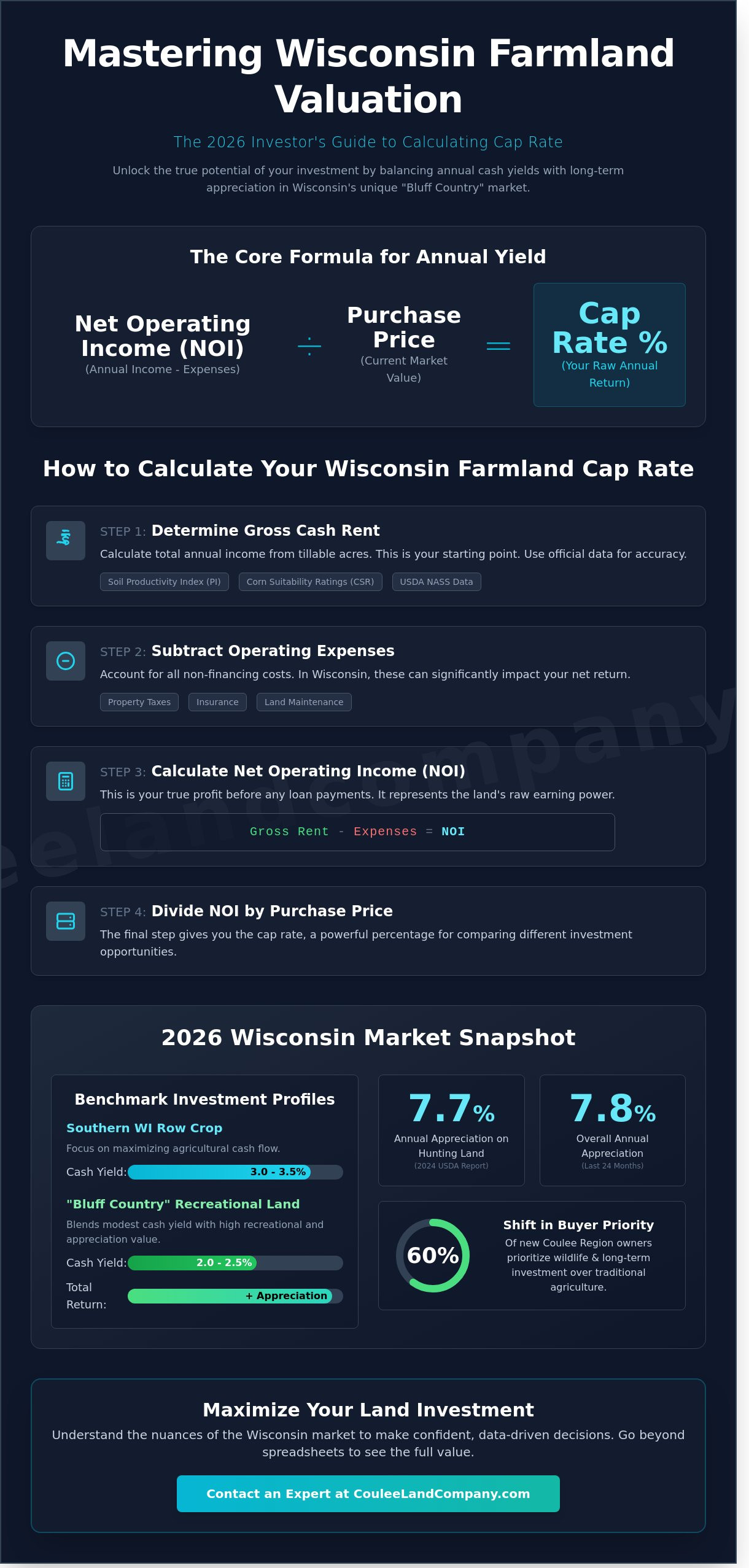
This guide will help you master the fundamentals of land valuation so you can make confident, data driven decisions. You’ll learn a pragmatic formula to calculate your own Net Operating Income and discover how hunting land appreciation, which showed a 7.7% increase in the 2024 USDA Land Values report, can effectively offset lower cash yields. We’ll provide the 2026 benchmarks you need to identify a fair deal and avoid the fear of overpaying for your piece of the Wisconsin dream.
Key Takeaways
- Define your annual yield before financing using the professional capitalization formula tailored for the Wisconsin agricultural market.
- Master the specific steps to calculate a realistic cap rate for wisconsin farmland by accurately balancing tillable cash rents against operating expenses.
- Compare benchmark yields between Southern Wisconsin row crops and the legendary “Bluff Country” to determine which investment profile fits your long-term goals.
- Understand how Western Wisconsin’s unique “Ridge vs. Valley” topography and proximity to urban centers create a stable floor for land values.
- Learn how to identify hidden income potential in recreational tracts to maximize your total return with expert land management strategies.
What is a Cap Rate for Wisconsin Farmland?
When you’re evaluating a premium parcel in Buffalo County or the rolling hills of the Driftless Area, you need a reliable metric to gauge its performance. The Capitalization rate, or cap rate, serves as that primary yardstick. It’s the ratio of a property’s Net Operating Income (NOI) to its current market value or purchase price. In the context of the 2026 market, calculating the cap rate for wisconsin farmland allows you to strip away the complexities of debt and financing to see the raw annual yield the soil produces.
To better understand this fundamental real estate concept, watch this helpful video:
As we move through 2026, we’re seeing cap rates trend lower across the state. This compression doesn’t mean the land is less productive. Instead, it reflects the extreme scarcity of high-quality rural assets and a surge in demand. You’ve got to distinguish between your gross rent, which is the total cash a farmer pays you per acre, and your net return. Your net return accounts for property taxes, insurance, and land maintenance costs. In Wisconsin, these expenses can eat into your margins, making the cap rate for wisconsin farmland a vital tool for honest accounting.
Why Investors Use Cap Rates for Land
Savvy investors use these figures to benchmark Wisconsin acreage against other asset classes like REITs or commercial retail spaces. In competitive regions like Western Wisconsin, a solid cap rate helps you justify a high-stakes bid. It proves that a property isn’t just a trophy; it’s a functioning financial asset. For many buyers, the cap rate is the deciding factor when choosing between a flat tillable tract and a diverse parcel with timber value.
The 2026 Wisconsin Land Market Context
Recent data from the UW-Madison Division of Extension shows that statewide average land prices have remained resilient. We’ve observed a 7.8% annual appreciation rate over the last 24 months, which fundamentally shifts investor psychology. Buyers are now balancing a 2% to 3.5% cash yield with aggressive equity growth. The market has shifted significantly. We’re seeing a transition where 60% of new owners in the Coulee Region prioritize wildlife capabilities and long-term investment potential over traditional production agriculture. This makes the “Bluff Country” one of the most sought-after territories for those seeking both utility and financial growth.
How to Calculate Cap Rate for Wisconsin Properties
Calculating the cap rate for wisconsin farmland requires a disciplined approach to data. This metric allows you to compare the profitability of a tillable tract in Buffalo County against a dairy farm in Dane County on an even playing field. The math is straightforward, but the variables require local expertise to ensure accuracy. You aren’t just looking at a sticker price; you’re evaluating the land’s ability to generate consistent annual returns. Follow these four steps to find your number:
- Step 1: Determine the Gross Cash Rent. Start by calculating the total annual income from tillable acres based on local Wisconsin averages.
- Step 2: Subtract Operating Expenses. You must account for every dollar that leaves your pocket, including property taxes, insurance, and necessary land maintenance.
- Step 3: Calculate the Net Operating Income (NOI). Net Operating Income for farmland is the remaining cash after all non-financing ownership costs are paid.
- Step 4: Divide the NOI by the Purchase Price. Take your final NOI and divide it by the current market value or the price you intend to pay to see the percentage return.
Determining Gross Cash Rent in WI
Gross rent isn’t a static number. In Wisconsin, savvy investors look at the Soil Productivity Index (PI) and Corn Suitability Ratings (CSR) to determine what a farmer can realistically pay. You can find reliable, county-level data through the USDA National Agricultural Statistics Service (NASS), which tracks average cash rents across the state. To push your cap rate for wisconsin farmland higher, consider adding a hunting lease. In the Bluff Country, a high-quality lease for trophy whitetails can add $25 to $45 per acre in additional annual revenue without interfering with the agricultural production.
Accounting for Land-Specific Expenses
Operating costs can vary significantly based on how the state classifies your acreage. You need to understand Wisconsin property tax laws regarding agricultural versus recreational use, as “Use Value Assessment” provides a substantial tax break for working farms. Beyond taxes, don’t overlook maintenance costs like clearing culverts, maintaining boundary fences, or performing Timber Stand Improvement (TSI) to protect your long-term timber value. These costs are essential for preserving the land’s integrity and future resale potential. If you’re looking to maximize your ROI through dual-income streams, our team specializes in finding hunting properties that offer both strong tillable income and elite recreational value.
Benchmarking “Normal” Cap Rates: Row Crop vs. Recreational Land
Wisconsin farmland isn’t a uniform asset class. Investors must distinguish between the flat, black-dirt tracts of the south and the rugged, timber-heavy ridges of the west. In Southern Wisconsin counties like Rock or Walworth, a healthy cap rate for wisconsin farmland currently ranges from 2% to 3.5%. These returns are driven strictly by agricultural production and soil productivity indexes. In contrast, Western Wisconsin’s “Bluff Country” often shows lower cash-rent cap rates, frequently landing between 1% and 2%. While the immediate cash flow is lower, the total ROI often tells a different story due to the intense recreational demand that fuels property value growth.
High-Productivity Tillable Land
In regions dominated by high-yield corn and soybean production, the land’s value is a direct reflection of its Corn Productivity Index (CPI) and drainage. These properties offer incredible income stability. You’re typically looking at long-term leases with established dairy or grain farmers who prioritize consistency. The risk profile is minimal; however, there’s almost no “play” factor for the owner. You’re essentially buying a factory that produces grain. It’s a pragmatic investment for those seeking a cap rate for wisconsin farmland that mirrors traditional real estate, but it often lacks the explosive appreciation potential found in land with diverse utility.
The Bluff Country Premium
Investors often wonder why Buffalo County WI land for sale commands such a high price despite having fewer tillable acres than a farm in the prairie. The answer lies in the dirt, but not just for the corn. This region dominates the whitetail entries in the Boone and Crockett Record Book. When you own a piece of this world-class hunting ground, you’re holding an asset with a massive “Appreciation Gap.”
- Recreational Utility: Many investors accept a 1.5% cap rate when the land is a proven “Boone and Crockett” producer. The demand for trophy hunting ground is inelastic and grows every year.
- Inflation Hedge: Recreational land often outpaces inflation better than prime tillable land. The buyer pool includes both professional investors and high-net-worth outdoor enthusiasts.
- Scarcity: They aren’t making more Bluff Country. The specific topographical features of Western Wisconsin ensure long-term value retention that flat ground cannot match.
Choosing between a 3.5% row-crop return and a 1.5% recreational return depends on your long-term goals. If you want a steady, predictable check, the southern tillable tracts are excellent. If you want a legacy asset that grows in value while providing world-class hunting experiences, the Coulee Region remains the undisputed choice for savvy land buyers.
Factors Influencing Farmland Returns in Western Wisconsin
The Driftless Area presents a unique set of variables that don’t exist in the flat plains of the I-states. When calculating the cap rate for wisconsin farmland, you have to look beyond the standard soil map. Geography here dictates both the annual rental income and the eventual resale value of the asset.
Topography and Tillable Ratios
In Western Wisconsin, the ratio of tillable acreage to timber is the primary driver of value. Ridge-top fields offer excellent drainage and are often easier for modern, wide-frame equipment to navigate. Conversely, bottomland fields in the valleys often boast richer alluvial soils but can be prone to seasonal flooding. A property with a high tillable percentage usually commands a higher cash rent, but savvy investors look for the hidden value in the woods. Managed timber stands of White Oak or Walnut provide a significant harvest every 15 to 20 years. This timber income acts as a powerful supplement to the standard agricultural return, boosting the long-term yield beyond simple crop production.
Local Market Dynamics in the Coulee Region
The influx of out-of-state capital from Chicago and the Twin Cities has transformed Western Wisconsin into a high-demand corridor. These buyers aren’t just looking for corn ground; they view hunting properties as legacy assets that protect wealth against inflation. The scarcity of “Bluff Country” terrain ensures long-term value retention because these specific topographical features cannot be replicated elsewhere. This limited supply creates a competitive environment that supports high land valuations even when commodity prices are soft.
External factors also play a critical role in stabilizing your investment. Urban sprawl from growing hubs like Eau Claire or La Crosse creates a price floor for acreage within a 30-mile radius. According to 2024 regional land surveys, proximity to these centers adds a layer of “development potential” that shields the land from significant depreciation. Additionally, government programs like the Conservation Reserve Program (CRP) provide a reliable, hands-off income stream. In 2025, CRP remains a favorite for investors who want to improve wildlife habitat while securing a fixed annual payment from the USDA. Wildlife health is equally vital to your cap rate for wisconsin farmland. We monitor local Chronic Wasting Disease (CWD) trends closely, as properties in areas with robust, healthy deer populations consistently see higher demand and faster appreciation than those in heavily affected zones.
Browse our current land listings.
Maximizing Your Land Investment with Coulee Land Company
Securing a strong cap rate for wisconsin farmland in 2026 demands more than just a passing interest in real estate. It requires an expert who understands that a property’s value is found in its soil quality, its timber stand, and its reputation for producing world-class whitetails. Coulee Land Company doesn’t just list properties. We analyze the wildlife capabilities and agricultural potential to ensure your investment works as hard as you do. Our team looks beyond the surface to find hidden income streams that traditional firms often overlook.
The Value of a Land Specialist
Traditional agents often miss the nuances of tillable rent and hunting lease value. They might calculate basic cash rent but ignore the premium value of a professionally managed hunting lease. Mike Law and our team of specialists bring boots-on-the-ground experience to every evaluation. We’ve spent decades in the ridges and valleys of the Driftless Area, allowing us to identify properties with underutilized income potential. Whether it’s enrolling acres in a higher-paying conservation program or optimizing a lease structure, we help you build a pragmatic plan. If you’re planning for the future, our resources for sellers provide the framework for maximizing profit when the time comes to harvest your investment.
Finding Your Piece of Wisconsin
The most lucrative opportunities rarely make it to a public portal. Our deep local connections in the Bluff Country mean we often know about high-performing tracts before they hit the market. We focus on areas like Buffalo County, where the trophy heritage is unmatched and the land values reflect a history of superior management. This geographic niche isn’t just a specialty; it’s our home. We help you find land that offers both recreational joy and a competitive cap rate for wisconsin farmland. You aren’t just buying acreage. You’re securing a piece of Wisconsin’s heritage. View our current Western Wisconsin land listings today to find a property that meets your financial and personal goals.
Maximizing ROI involves active management. We advise clients on habitat improvements that increase the property’s desirability for high-end hunting leases, which can significantly boost annual returns. By focusing on food plots, bedding cover, and water sources, you’re not just improving the hunt; you’re improving the bottom line. Our team provides the data and the local insight needed to turn a standard land purchase into a high-performing asset.
Secure Your Legacy in the Driftless Area
Investing in the 2026 market requires a sharp eye for both agricultural yield and long-term appreciation. You’ve learned that a competitive cap rate for wisconsin farmland depends on more than just soil quality; it’s about the synergy between row crop production and elite recreational potential. Buffalo County continues to lead the Boone and Crockett Record Book for whitetail entries, making this region a powerhouse for land value. Our team at Coulee Land Company specializes in the world-famous Bluff Country, where we bridge the gap between stable agricultural income and trophy whitetail habitat.
We’re endorsed by the most respected voices in the outdoor industry because we understand the land’s pulse. Whether you’re analyzing a return on tillable acres or the intangible value of a legacy hunting tract, you need a partner who knows the terrain. We’ll help you navigate the complexities of Western Wisconsin real estate with the diligence of a seasoned woodsman. Browse Exclusive Wisconsin Land & Farmland Listings and plant your flag in the coulees today.
Frequently Asked Questions
What is a good cap rate for farmland in Wisconsin in 2026?
A good cap rate for Wisconsin farmland in 2026 generally falls between 2.5% and 4.0% for high-quality tillable acreage. This range reflects the stability of land as an asset class and accounts for the 4.8% average increase in Wisconsin farm real estate values reported by the USDA in 2024. While these rates are lower than some commercial sectors, they represent a secure hedge against inflation in the heart of Bluff Country.
How does the cap rate for hunting land differ from row-crop farmland?
Hunting land typically yields a lower cap rate of 1.0% to 2.0% because its value is driven by recreational demand and trophy whitetail potential rather than commodity production. While row-crop land focuses on bushels per acre, hunting tracts in Buffalo County command a premium for their wildlife capabilities. Investors often accept a lower immediate yield for the superior long-term appreciation found in world-class hunting grounds.
Can I include hunting lease income in my cap rate calculation?
You can and should include hunting lease income in your cap rate for wisconsin farmland calculation to get an accurate picture of your net operating income. In Western Wisconsin, premium hunting leases can generate $25 to $50 per acre annually, providing a vital secondary revenue stream. This income often bridges the gap between pure agricultural returns and the total ROI of a diverse land investment.
How do property taxes in Wisconsin affect my net operating income?
Wisconsin’s use-value assessment significantly protects your net operating income by taxing agricultural land based on its farming potential rather than its market value. According to the Wisconsin Department of Revenue, this system keeps property taxes on tillable land much lower than residential rates. For a 160-acre parcel, this can mean the difference of thousands of dollars in annual carrying costs, directly boosting your bottom line.
Is farmland a better investment than residential real estate in Wisconsin?
Farmland offers lower volatility and fewer management headaches than residential rentals, making it a superior choice for many long-term investors. While residential properties might show higher gross yields, they come with 10% to 15% vacancy risks and constant maintenance costs. Farmland provides a stable 3% to 4% return with a tenant who maintains the asset, all while the land itself appreciates in value.
What is the average cash rent per acre in Buffalo County?
Average cash rent for non-irrigated cropland in Buffalo County reached $218 per acre in 2023 according to USDA NASS data. High-quality tracts with superior soil productivity ratings often command upwards of $275 per acre from local operators. These figures fluctuate based on corn and soybean futures, but Buffalo County remains a top-tier destination for both agricultural productivity and recreational value.
How does the Conservation Reserve Program (CRP) affect my land’s ROI?
The Conservation Reserve Program (CRP) provides a guaranteed income stream for 10 to 15 years, stabilizing your land’s ROI regardless of market fluctuations. These government payments often match or exceed local cash rents on marginal soils while simultaneously improving wildlife habitat. It’s a strategic move for hunters who want to build trophy whitetail bedding cover while receiving a steady check from the USDA.
Why are cap rates for Wisconsin land lower than in other states?
Cap rates for Wisconsin land are often lower because the high demand for world-class hunting creates a recreational premium that increases the purchase price. In states like Iowa or Illinois, land values are tied strictly to corn yields, but in the Coulee Region, buyers pay for the chance at a Boone and Crockett buck. This increased asset value naturally compresses the cap rate for wisconsin farmland even when agricultural rents remain competitive.