
Did you know that a single Wisconsin county, Buffalo County, has produced over 150 Boone and Crockett whitetail entries since 1895? That’s more than any other county on the entire planet. It’s no secret that owning a piece of this legendary Bluff Country is the ultimate dream for any serious deer hunter. But the path to securing a premier property is filled with pitfalls, from overpaying for acreage that lacks true huntability to navigating complex land use laws that can derail your entire management strategy.
This guide is your definitive roadmap to making that dream a reality. We will provide the expert framework to confidently evaluate and acquire the superior trophy whitetail property for sale Wisconsin has to offer, ensuring your investment appreciates in both long-term value and wildlife potential. You’ll discover the three non-negotiable habitat features every top-tier parcel must have, how to analyze a neighborhood’s Quality Deer Management philosophy from a map, and the key financial strategies to secure your own piece of whitetail heaven.
Key Takeaways
- Understand the critical distinction between average hunting land and a property engineered to produce record-book whitetails year after year.
- Discover how to leverage Bluff Country topography and ‘Thermal Hubs’ to dictate mature buck movement and gain a tactical advantage.
- Evaluate the true market value of any trophy whitetail property for sale Wisconsin, from Buffalo County to hidden gems, by analyzing the crucial ‘Neighborhood Effect.’
- Master a 10-point due diligence checklist to verify a property’s potential, focusing on key factors like soil quality for food plots and secluded water sources.
What Defines a True Trophy Whitetail Property in Wisconsin?
Any parcel of land with trees can be called ‘hunting land’. But in 2026, a genuine trophy property is something entirely different. It’s a meticulously crafted ecosystem engineered for a specific outcome. Simply put, a true trophy property is a self-sustaining habitat that allows bucks to reach 5.5+ years of age, unlocking their maximum genetic potential. It’s the difference between hoping a big buck wanders through and knowing you’re holding mature deer on your own dirt year after year. This distinction is what separates a weekend hunting spot from a world-class investment.
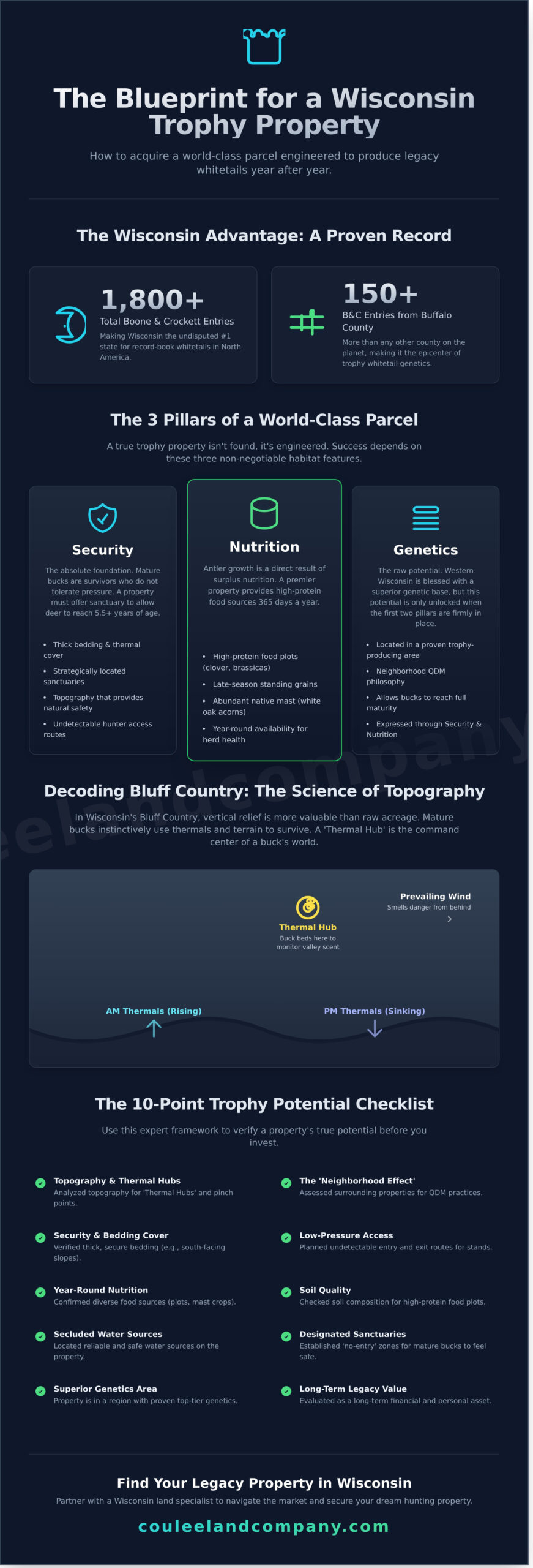
There’s a reason Wisconsin remains the undisputed king of whitetail hunting, leading the nation with over 1,800 total Boone and Crockett entries. It’s not by accident. It’s a combination of agricultural abundance and a deep-rooted culture of stewardship. But to find the perfect trophy whitetail property for sale wisconsin, you must look beyond the state’s reputation and analyze the three pillars that support a world-class parcel:
- Security: Mature bucks are survivors. They don’t tolerate pressure. A premier property must offer sanctuary, featuring thick bedding cover, thermal protection, and designated no-entry zones. This isn’t just about acreage; it’s about topography and habitat that make a buck feel safe.
- Nutrition: Antler growth is a direct result of surplus nutrition. A top-tier property provides high-protein food sources 365 days a year, from spring green-up in clover plots to late-season calories in standing grains and brassicas. It balances agricultural fields with native mast crops like the all-important white oak acorn.
- Genetics: This is the raw potential. Wisconsin, particularly the western counties, is blessed with a superior genetic base. However, genetics are only realized when the first two pillars are firmly in place. It requires a deep knowledge of the species, and a solid foundation in understanding the white-tailed deer, to create an environment where that potential can be expressed as bone on a buck’s head.
The 2026 Wisconsin Whitetail Landscape
The impact of Quality Deer Management (QDM) principles over the last two decades is undeniable. Across the state, we are seeing a significantly improved age-class structure in whitetail herds, which directly elevates the value of well-managed land. Nowhere is this more evident than in the famed “Bluff Country” of Buffalo, Trempealeau, and Vernon counties. This region’s unique topography of steep ridges and deep coulees provides the natural security that is the foundation for growing giant whitetails.
The ‘Legacy Property’ Mindset
Purchasing a premier hunting property is more than a transaction; it’s an investment in a legacy. You are acquiring an asset that appreciates both financially, as the habitat matures under your stewardship, and emotionally. The return on investment is measured in Boone and Crockett scores, but also in sunrises from a deer stand and memories made with family. It’s a tangible asset for generations. You can explore our exclusive hunting properties to see what this looks like on the ground.
Topography and Security: The Science of Bluff Country Hunting
In Wisconsin’s famed Bluff Country, the raw acreage of a property is a secondary metric. The true measure of a parcel’s potential to produce and hold mature bucks lies in its topography. Vertical relief, with its intricate network of ridges and coulees, is the engine that drives whitetail behavior. It dictates where a buck beds, how he travels, and how he uses the wind to survive. Understanding this science is the first step in separating an average piece of hunting ground from a world-class whitetail sanctuary.
The secret is using verticality to your advantage. Every morning, as the sun warms the earth, thermals—currents of air—begin to rise up the hillsides. In the evening, as the land cools, they reverse, sinking back down into the valleys. A mature buck knows this instinctively. He will often bed on a ridge point where the prevailing wind is at his back, allowing him to smell anything approaching from behind, while the falling evening thermals carry scent from the entire valley below directly to his nose. We call these locations ‘Thermal Hubs’, and they are the command centers of a buck’s world. Learning to read a topographic map is not just a skill; it’s a necessity. Those tightly packed contour lines reveal the steep ridges, saddles, and pinch points that funnel deer movement with predictable precision, turning a 200-acre property into a handful of can’t-miss ambush sites.
Bedding Security and Sanctuary Design
A buck’s entire life revolves around security, and that security is built upon impenetrable bedding cover. Look for properties with thick, south-facing slopes; these areas receive the most direct sunlight during the winter, melting snow faster and providing critical thermal cover that can be up to 15 degrees warmer than a shaded north slope. This is a sanctuary. To enhance it, we create ‘edge feathering’ by strategically cutting trees along field and timber lines. This practice promotes an explosion of thick, early successional growth that provides both exceptional security cover and high-quality browse. This is why a rugged 40-acre parcel of thickets and sanctuary beats 100 acres of open, park-like timber every time. When you find a trophy whitetail property for sale wisconsin that has these core elements, you’ve found a parcel with immense potential that can be further magnified through strategic habitat work, often guided by resources like Wisconsin’s Deer Management Assistance Program (DMAP).
Access Strategy: The Silent Killer of Trophy Land
You can own the best deer habitat in Buffalo County, but if you cannot get to your stand without alerting deer, you own nothing. Poor access is the silent killer of trophy properties. Evaluating a parcel for ‘Low Impact’ entry and exit routes is paramount. This means using deep ditches, creek bottoms, or the backside of a ridge to shield your approach from both sight and scent. The prevailing northwest wind in Wisconsin dictates everything. A stand overlooking a perfect food plot is rendered useless if every northwest wind carries your scent directly into the sanctuary it’s meant to protect. This leads to the Golden Rule of whitetail land: if you can’t get in, hunt, and get out without blowing deer out, it’s not a true trophy property. This level of detailed access analysis is precisely what our team of land specialists provides for every parcel we represent, ensuring your investment pays dividends for years to come.
Buffalo County vs. The Rest: Is the ‘Gold Standard’ Worth It?
For decades, the name “Buffalo County” has been synonymous with giant whitetails. It’s the undisputed king, the benchmark against which all other trophy regions are measured. But as we look at the 2026 market, the savvy investor and hunter must ask a critical question: is the significant price premium still justified? The reality is that the ‘Buffalo County tax’ is real, with land prices often commanding a 30-40% premium over parcels in adjacent counties that share the exact same world-class genetics and topography.
The true value of a property isn’t just within your property lines; it’s in the surrounding culture. This is the ‘Neighborhood Effect,’ and it’s your single greatest asset. Owning land surrounded by neighbors who also practice meticulous Quality Deer Management (QDM) creates a sanctuary where bucks can reach full maturity. In Buffalo County, this philosophy is deeply ingrained. However, this same ethos has spread throughout the Driftless Area, creating pockets of excellence where the hunting pressure is low and the age structure of the herd is superb. Your investment’s success hinges on finding a neighborhood of like-minded landowners, regardless of the county name on the deed.
Why Buffalo County Dominates the Record Books
With more Boone and Crockett entries per square mile than any other county in the world, Buffalo County’s legendary status is cemented in hard data, not just campfire stories. This dominance is a product of a perfect trifecta. First, the region’s unique loess soils are incredibly rich in calcium and phosphorus, the essential building blocks for massive antler growth. Second, and perhaps most importantly, there is a deep cultural commitment to letting young bucks grow. This isn’t just a trend; it’s a multi-generational practice. Learn more about the Buffalo County community and the mindset that produces these incredible animals year after year.
Diversifying Your Search: The Hidden Gems of Western Wisconsin
The secret to a successful 2026 investment is recognizing that the same key ingredients for trophy whitetails exist just across the county line. Counties like Trempealeau, Vernon, and Pierce offer the opportunity to find ‘Buffalo County quality’ at a much lower price point per acre. These areas are all part of the famed ‘Driftless Area,’ a landscape of steep, rugged bluffs and deep coulees that was untouched by glaciers. This topography provides whitetails with the ultimate security cover and natural travel corridors, allowing them to feel safe and grow old.
When you find a parcel with this elite topography, you’ve found the foundation. The next step is to maximize its potential. The presence of large-scale agriculture, particularly corn and soybeans, provides the high-octane fuel a deer herd needs to thrive. A property with a blend of timbered security cover and access to agricultural food sources is a gold mine. With the right vision and some expert habitat management advice, you can transform a property in these rising-star counties into a personal whitetail paradise. Ultimately, the smartest search for a trophy whitetail property for sale wisconsin extends beyond the most famous zip codes to focus on the core elements that truly grow giants: genetics, nutrition, and age.
Due Diligence Checklist: 10 Points to Verify Before You Buy
Securing a premier hunting property is more than just a transaction; it’s the fulfillment of a lifelong dream. The difference between a good piece of ground and a legendary one lies in the details that don’t always show up in the listing photos. Before you sign any papers for a trophy whitetail property for sale wisconsin, you must conduct a thorough investigation. This checklist is your blueprint for verifying the true potential of a parcel, ensuring your investment pays dividends for generations of hunters to come.
A true specialist looks beyond the acreage and focuses on the core assets that produce and hold mature bucks. Here’s what we verify on every property we represent:
- Soil Quality: The foundation of any wildlife paradise is the dirt. We use the USDA Web Soil Survey to identify parcels dominated by Class I and II soils, like the rich Fayette and Dubuque silt loams common in Wisconsin’s Bluff Country. These soils are essential for growing high-protein food plots like soybeans, alfalfa, and clover that translate directly into body weight and antler growth.
- Water Sources: Every property has water, but is it in the right place? We look for year-round, secluded water sources like natural springs, hidden ponds, or deep-coulee creeks. These features become crucial kill-zone magnets during the rut and hot early-season hunts, keeping deer on your land instead of your neighbor’s.
- Timber Value: Your land should be an asset that works for you. A stand of mature red oak, hard maple, or black walnut represents a significant financial return. A well-managed, selective timber harvest can fund property taxes for years, pay for a new tractor, or finance the construction of your dream cabin, all while improving the forest health for wildlife.
- Neighborhood Intel: You aren’t just buying 80 acres; you’re buying into a 1,000-acre neighborhood. We investigate the local hunting culture to see if neighbors practice Quality Deer Management (QDM). A neighborhood that protects young bucks and manages for a healthy age structure is one of the most valuable, unwritten assets a property can have.
- Existing Infrastructure: The right infrastructure saves you time and tens of thousands of dollars. We assess the quality of the internal trail system for silent access to stand locations. We verify the proximity and cost of running electricity for a future cabin or pole shed. These practical elements are fundamental to your enjoyment and the property’s long-term value.
The Land Management Audit
A raw piece of land is a blank canvas. We identify specific Timber Stand Improvement (TSI) opportunities, like hinge-cutting maple to create dense bedding cover right where you need it. We evaluate food plot locations for sunlight, soil type, and discreet entry and exit routes. Critically, we scout for invasive species like buckthorn or honeysuckle that degrade the habitat and create a plan for their removal, unlocking the land’s true wildlife potential.
Legal and Financial Verification
Understanding the fine print is non-negotiable. Many parcels are enrolled in Wisconsin’s Managed Forest Law (MFL) program, which offers a significant property tax reduction. However, you must understand the contract’s timber harvest requirements and any public access stipulations. We verify that every property has ironclad, deeded legal access. Before making a move, it’s also wise to understand your financial position by getting a clear picture of how to value your current land before upgrading.
This level of detailed analysis is what separates a frustrating purchase from a legacy investment. It requires a deep, authentic understanding of the land that goes far beyond a typical real estate transaction. This is the expert-level diligence our team performs every day. Let our land specialists guide your search and ensure the property you buy is the one you’ve always dreamed of.
Why Partner with a Wisconsin Land Specialist?
Securing a premier trophy whitetail property for sale in Wisconsin requires more than a standard real estate license; it demands a lifetime spent in these same woods. A residential agent can value a three-bedroom home, but they can’t see the inherent value in a south-facing slope for bedding, a natural travel corridor between ridges, or the soil quality needed for a high-tonnage food plot. That’s the Hunter’s Realtor difference. We don’t just sell land. We analyze its wildlife capabilities, understand its history, and envision its future potential for producing world-class whitetails.
Our roots are sunk deep into the soil of Western Wisconsin’s famed Bluff Country. For decades, we have lived, hunted, and worked in the very counties, like Buffalo County, that dominate the whitetail entries in the Boone and Crockett Record Book. This isn’t just a market for us; it’s our backyard. This intimate, local knowledge gives our clients an unparalleled advantage. We know which properties are quietly managed for mature bucks and which ones hold untapped potential. This insider access often leads to off-market opportunities, properties that never see a public listing because our “boots-on-the-ground” network of local landowners and farmers brings them to us first.
Our partnership extends far beyond the closing table. Your investment is our commitment, and we provide the guidance to transform a great property into a legendary one. From purchase to harvest, we help our clients with critical post-sale land management strategies, including:
- Food Plot Design: We advise on location, layout, and seed selection tailored to the property’s unique topography and soil.
- Sanctuary Development: We help identify and create secure, low-pressure bedding areas that hold mature bucks on your land year-round.
- Access Route Planning: We map out entry and exit strategies for stands that minimize pressure on your deer herd.
- Timber Stand Improvement (TSI): We connect you with trusted foresters to improve habitat and increase the long-term value of your timber.
The Expertise of Mike Law and Bryan Lemke
Our team is led by Mike Law and Bryan Lemke, who bring decades of combined experience in both land brokerage and personal whitetail hunting. Their expertise is so respected that their property assessments are sought after by icons of the outdoor television world, including the crews from The Crush with Lee & Tiffany and Driven with Pat & Nicole. This validation from industry leaders provides our clients with absolute confidence in a property’s potential.
Your Next Steps in the Wisconsin Woods
The next legendary buck of the Driftless Area is waiting. Your first step is to schedule a private tour of our signature Bluff Country listings, where we can walk the property lines and discuss its potential in person. We specialize in facilitating seamless, transparent transactions for out-of-state buyers, handling the details so you can focus on your dream. Don’t just buy land; secure a legacy. Contact Coulee Land Company to join the elite ranks of Wisconsin landowners today.
Secure Your Wisconsin Hunting Legacy in 2026
Investing in a premier hunting property is about more than acreage; it’s about securing a future filled with unforgettable hunts. You now understand that the steep ridges and secure valleys of Bluff Country are scientifically proven to hold mature deer. You also know that navigating the market, especially in a legendary area like Buffalo County which dominates the Boone and Crockett record books, requires an expert guide. This isn’t just a purchase; it’s a calculated investment in your passion. Finding the right trophy whitetail property for sale wisconsin demands a specialist who lives and breathes this land.
With over two decades of proven results and endorsements from the outdoor industry’s most respected professionals, Coulee Land Company is that specialist. We don’t just sell land; we match dedicated hunters with legacy properties. Your dream property is waiting, and the time to act is now.
View Our Exclusive Wisconsin Trophy Whitetail Listings and let’s begin your journey.
Frequently Asked Questions About Wisconsin Trophy Whitetail Properties
What is the average price per acre for trophy whitetail land in Wisconsin in 2026?
The average price for premium trophy whitetail land in Wisconsin is projected to range from $8,500 to $12,000 per acre in 2026. This price is for high-quality recreational tracts in proven big-buck counties. Factors like the percentage of tillable acreage for food plots and income, timber value, road access, and the presence of water sources like creeks or ponds can significantly influence the final per-acre cost. Properties with established food plots and trail systems command a premium.
Is Buffalo County still the best place to buy trophy hunting land?
Yes, Buffalo County and the surrounding “Bluff Country” of Western Wisconsin remain the undisputed epicenter for world-class whitetails. The region continues to produce more Boone and Crockett record book entries per county than anywhere else in North America. The combination of superior genetics, rich agricultural food sources, and rugged terrain that allows bucks to reach maturity makes it the premier destination for serious hunters seeking a top-tier investment in their passion.
How much acreage do I really need for a sustainable trophy whitetail property?
For a sustainable trophy whitetail property, a minimum of 80 to 120 acres is the ideal starting point for serious management. This size allows you to implement a complete habitat strategy, including dedicated sanctuaries, diverse food plots, and strategic access routes that minimize pressure. It provides the necessary foundation to hold and grow mature bucks on your own parcel, giving you a distinct advantage. Anything less than 40 acres makes you highly dependent on your neighbors’ management practices.
What is the Wisconsin Managed Forest Law (MFL) and how does it affect taxes?
The Wisconsin Managed Forest Law (MFL) is a landowner incentive program that dramatically reduces property taxes in exchange for following a sustainable forest management plan. Landowners can see tax reductions of up to 80% on enrolled acreage. The program has two options: “Open” requires allowing public access for hunting and recreation, while “Closed” keeps the land private for a slightly smaller tax break. It’s an exceptional tool for lowering the holding cost of a large property.
Can I hunt my own land if it’s enrolled in a government conservation program?
Yes, in nearly all cases, you can hunt your own land if it’s enrolled in government conservation programs like the Conservation Reserve Program (CRP) or Conservation Reserve Enhancement Program (CREP). These programs are designed to enhance wildlife habitat. However, your specific contract dictates all terms. It’s critical to review your agreement, as some may have restrictions on activities like mowing dates or food plot installation within the enrolled acres.
What should I look for in a neighborhood when buying hunting land?
When buying hunting land, look for large neighboring properties with a shared commitment to Quality Deer Management (QDM). A neighborhood where landowners are passing on 2.5 and 3.5-year-old bucks drastically increases your odds of harvesting a mature trophy. You should investigate the local hunting culture and avoid areas fragmented into small parcels under 40 acres, which often leads to excessive hunting pressure. A great property in a poor neighborhood is a bad investment.
How do I finance a large recreational land purchase in Wisconsin?
Financing a large recreational land purchase typically requires a specialized agricultural or rural lender, as traditional mortgage companies often avoid it. We recommend institutions within the Farm Credit System, like Compeer Financial. They understand land valuation and the unique aspects of recreational properties. Be prepared for a down payment requirement of 20-25%. A formal timber valuation or an existing agricultural lease can significantly strengthen your financing application.
What are the most important food plot crops for Wisconsin deer?
For Wisconsin’s climate, a blend of annuals and perennials is the most effective food plot strategy. For critical fall and winter attraction, plant brassica blends with turnips and radishes, alongside cereal grains like winter rye. For season-long protein and nutrition, establish perennial plots of white clover and alfalfa. For a high-energy late-season food source, soybeans and corn are king, but they generally require larger plots of at least 3 acres to withstand heavy browse pressure.