
Most Wisconsin landowners are unknowingly managing their neighbors’ trophy bucks rather than their own. It’s a frustrating reality that many dedicated stewards face; you put in the sweat equity, plant the food plots, and check the trail cameras, yet those mature 5.5 year old giants seem to vanish into thin air the moment the hunting pressure turns up. You deserve a property that doesn’t just attract deer, but holds them through every phase of the season, even when the neighbors start pushing the woods.
We understand that owning land in this legendary region is about more than just a title deed; it’s about the dream of cultivating a premier whitetail destination. This guide will show you how to master trophy deer management wisconsin by shifting your focus from simple supplemental feeding to comprehensive habitat architecture. We’ll explore the strategic principles of property layout, proven methods for year-round deer retention, and the documented management success that significantly increases your land’s market value. You’ll learn how to create a sanctuary where elite bucks feel secure enough to move during daylight hours, ensuring your acreage becomes the undisputed crown jewel of the local landscape.
Key Takeaways
- Shift your focus from simple genetics to the selective protection of young bucks and deliberate habitat enrichment.
- Prioritize dense security cover over food sources to encourage mature bucks to move during daylight hours.
- Implement the “Sanctuary Concept” by designating 25-50% of your property as a human-free zone to anchor resident deer.
- Master the principles of trophy deer management wisconsin to transform your acreage into a premier destination for elite whitetails.
- Build a documented history of mature harvests to significantly increase the market value and desirability of your hunting land.
The Fundamentals of Trophy Deer Management in Wisconsin
True Principles of Deer Management involve more than just planting a few acres of clover and hanging a stand. In our region, trophy deer management wisconsin is defined by the disciplined, selective protection of young bucks and the aggressive enrichment of native habitat. It’s a commitment to letting a 3.5 year old buck with massive potential walk so he can reach his peak at 5.5 or 6.5 years of age. Without this restraint, even the best genetics in the world can’t produce a world-class herd. You’re not just hunting; you’re cultivating a biological legacy.
Western Wisconsin has long been the gold standard for whitetail enthusiasts across the country. Our “Boone & Crockett” legacy isn’t an accident of nature; it’s the result of a unique intersection between mineral-rich soil, diverse timber, and a growing culture of private land stewardship. While genetics provide the blueprint, they’re only half the battle. You simply can’t shoot a 170 inch buck if he’s harvested as a 120 inch three year old. Age is the ultimate multiplier of antler growth and property prestige.
To better understand how these property improvements translate to better hunting, watch this helpful video:
Establishing a healthy age structure is the most critical hurdle for any serious landowner. This requires a firm understanding of the 2026 Wisconsin deer season regulations as your legal baseline. With the Archery and Crossbow seasons opening on September 12, 2026, and the traditional Gun Deer Hunt beginning November 21, 2026, your management plan must account for varying levels of hunter pressure. Success relies on creating an environment where mature bucks feel secure throughout these high-traffic windows. If they don’t find that security on your land, they’ll find it on the neighbor’s.
Why Bluff Country is the Epicenter of Trophy Management
The Driftless Area offers a biological advantage that flat land simply cannot replicate. Our unique topography, characterized by steep limestone bluffs and deep coulees, creates natural funnels that dictate deer movement with surgical precision. These elevation changes provide essential thermal cover, allowing bucks to conserve energy during brutal Wisconsin winters. When you combine this rugged terrain with the strategic placement of food and water, you create a fortress for mature whitetails. For those looking to invest in the heart of this region, our Buffalo County Wisconsin Deer Hunting: An Expert’s Guide provides a deeper dive into the specific attributes that make this territory the top producer of record-book bucks in the nation.
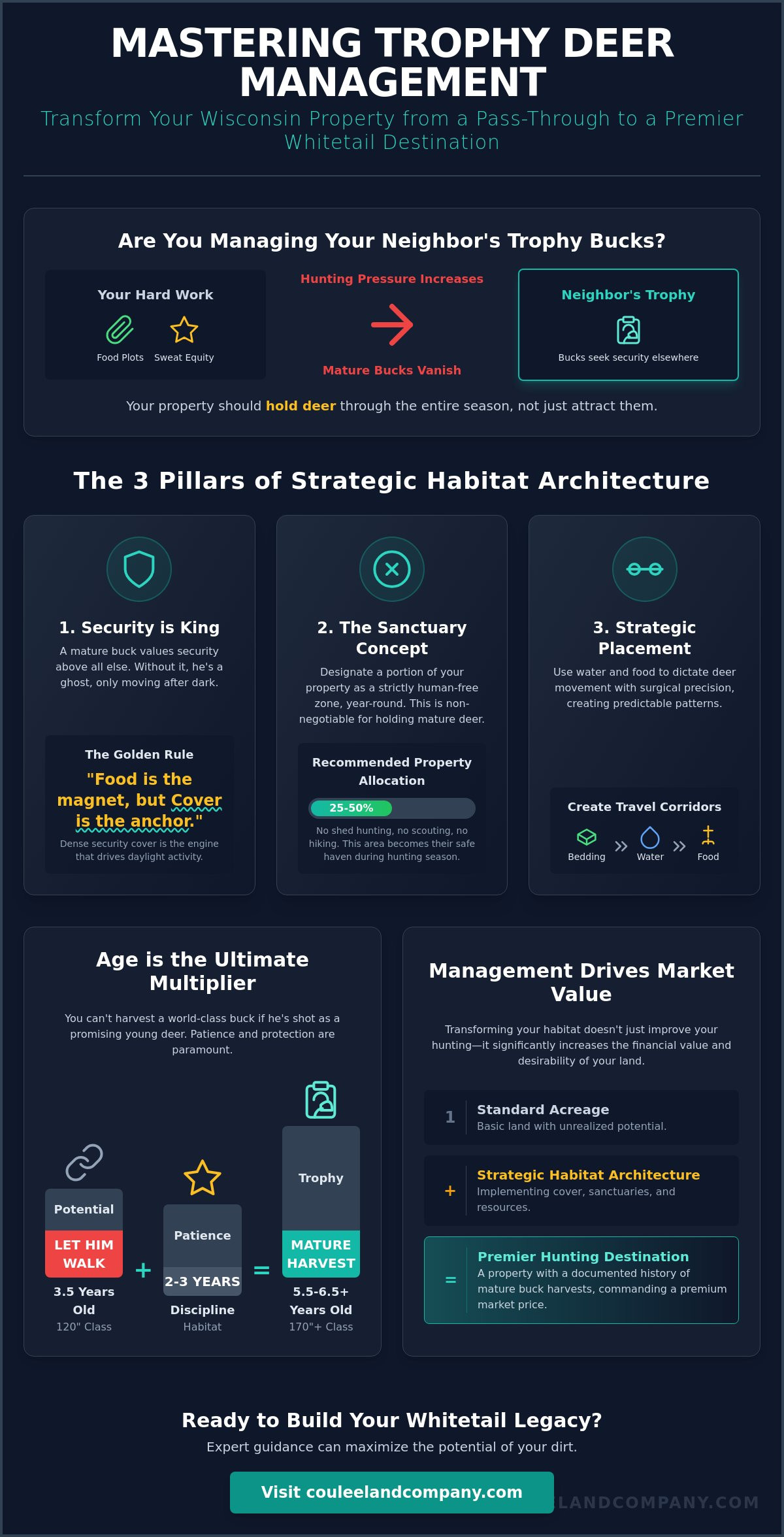
3 Pillars of Strategic Habitat Architecture
Many landowners over-invest in food while neglecting the one thing a mature buck values above all else: security. In the context of trophy deer management wisconsin, food is a magnet, but cover is the anchor. If a buck doesn’t feel safe, he simply won’t show himself until the sun goes down. High-quality bedding cover is the engine that drives daylight activity on your acreage. Without it, you’re merely feeding the neighbors’ deer.
The “Sanctuary Concept” is non-negotiable for anyone serious about trophy deer management wisconsin. You must designate 25% to 50% of your property as a strictly human-free zone year-round. This means no shed hunting, no summer hiking, and certainly no scouting inside these borders. When hunting pressure peaks during the November gun season, these sanctuaries become the only places mature bucks feel comfortable remaining on your land. Security is the ultimate currency of a trophy property.
Strategic water source placement acts as a precision patterning tool. By digging small micro-ponds or installing tanks between bedding and food, you can dictate exactly where a buck stops for a drink before he enters the open. Experts like Mike Law and Bryan Lemke specialize in evaluating these topographical features to maximize the potential of your dirt.
Advanced Food Plot and Timber Strategies
High-quality nutrition requires moving beyond simple clover. A successful program integrates brassicas for late-season energy and cereal grains for early-season draw. Timber Stand Improvement (TSI) is equally vital; by hinge-cutting less desirable trees, you create thick bedding thickets and stimulate early successional growth. For professional guidance, many owners utilize Wisconsin’s Deer Management Assistance Program (DMAP) to develop long-term habitat plans. You can also reference our resources on Wisconsin land management for more technical details.
Managing Hunting Pressure to Retain Mature Bucks
Your entry and exit routes are the most important part of your hunt. The “Wind is Everything” rule dictates that if a deer smells you once, your chances at a 5.5 year old buck on that stand drop significantly. We recommend using cellular trail cameras to monitor activity without physically entering the woods. This low-impact approach ensures your target bucks remain on your side of the fence throughout the season. If you’re ready to find a property with the right bones for these improvements, explore our current hunting properties.
How World-Class Management Drives Wisconsin Land Value
Buying hunting land in Wisconsin is a significant financial move. When you implement trophy deer management wisconsin, you’re doing more than improving your hunting odds; you’re building equity. A property with a documented history of 160 inch or larger bucks fetches a higher price per acre because it eliminates the guesswork for the next owner. This isn’t just about dirt. It’s about proven production. Serious buyers look for a track record that justifies the investment, and a gallery of mature harvests is the ultimate social proof.
High-value properties often feature a sophisticated balance of Deer and Woodland Stewardship. When timber management and wildlife goals align, the land becomes a “turn-key” asset. Buyers pay a premium for properties that already have established food plots, strategically placed permanent stands, and cleared access trails. They want to hunt the first season, not spend three years clearing brush. You aren’t just selling acreage; you’re selling a lifestyle that’s ready to enjoy on day one.
Small parcels can punch way above their weight class when they’re part of a neighborhood co-op. When multiple landowners agree on age-class protection and habitat standards, the entire area’s value rises. This collaborative environment ensures that the bucks you let walk today will be the giants you harvest tomorrow. If you’re looking for a property with this kind of elite potential, you can view exclusive hunting properties currently on the market.
The Land Specialist Advantage
Buying land without an expert is a gamble you don’t need to take. A general real estate agent might see a pretty view, but a land specialist sees the travel corridors and soil quality. They help you avoid “dead dirt” that lacks the bedding or water necessary for elite whitetails. For those who have already put in the work and are ready to capitalize on their investment, our guide on selling hunting land in Wisconsin provides the roadmap to maximizing your profit. We understand the blood, sweat, and years of management you’ve poured into your land, and we know how to translate that effort into a premium market price.
Secure Your Legacy in Wisconsin’s Premier Whitetail Territory
Transforming a standard piece of acreage into an elite destination requires more than just luck; it demands a disciplined approach to age structure and a strategic commitment to habitat architecture. By prioritizing security cover and respecting the sanctuary concept, you shift from being a spectator to a true steward of the land. Effective trophy deer management wisconsin doesn’t just result in a wall full of record-book bucks; it builds significant long-term equity in your most valuable outdoor asset. You’ve seen how world-class management and neighborhood collaboration can turn a small parcel into a giant-killer.
We specialize in the legendary landscapes of Buffalo County, the undisputed #1 trophy whitetail county in the world. Our team brings over 100 years of combined land brokerage expertise to every transaction, and our results are endorsed by the most respected figures in the hunting industry. We don’t just sell dirt; we help you find the specific topography and soil quality needed to grow 5.5 year old giants. Don’t leave your hunting dreams to chance when you can partner with the undisputed authorities in the region.
Find Your Premier Wisconsin Hunting Property Today and begin the journey of building your own whitetail legacy. The land is waiting for a visionary like you.
Frequently Asked Questions
What is the minimum acreage needed for trophy deer management in Wisconsin?
You can see measurable results on as little as 40 acres, but 80 to 160 acres is the standard threshold for effective trophy deer management wisconsin. On smaller parcels, your success relies heavily on the “neighborhood effect” and your specific property layout. By maximizing every square inch of your land through strategic bedding and food placement, you can hold mature bucks even on limited acreage.
How does Buffalo County consistently produce more Boone & Crockett bucks than other regions?
Buffalo County leads the world in record-book bucks due to its mineral-rich limestone soils and a rugged landscape that naturally creates sanctuaries. This unique topography allows bucks to reach the critical age of 5.5 or 6.5 years by limiting human access to steep coulees. When you combine these biological advantages with a widespread culture of selective harvest, you create the perfect environment for world-class whitetails.
Can I manage for trophy deer on property with a CWD-positive history?
Managing for elite whitetails on CWD-positive land is possible, but it requires a shift toward natural habitat enhancement over artificial congregation. Focus on improving native browse and timber quality to keep the herd spread out across the landscape. Participating in the DNR’s testing programs and maintaining a healthy doe-to-buck ratio are essential components of trophy deer management wisconsin in these zones.
What are the best trees to plant for deer cover and food in Western Wisconsin?
White oaks are the undisputed choice for consistent mast production, while Norway Spruce or Red Cedars provide excellent screening and thermal cover. For bedding thickets, we recommend planting native shrubs like gray dogwood or elderberry. These species thrive in the Driftless Area’s soil and provide the year-round nutrition and security that mature bucks demand during the winter months.