
A high-definition topographic map of Buffalo County won’t tell you if a specific ridge top is a natural deer highway or a dead zone of swirling wind that ruins every hunt. You’ve likely spent years dreaming of owning a piece of the legendary Bluff Country, yet the fear of sinking your life savings into “dead air” land with zero deer movement is a reality that stops many hunters in their tracks. We understand that you aren’t just looking for a deed; you’re looking for a legacy property that produces trophy whitetails year after year. That’s why we’ve compiled the Top 10 Tips for Buying Hunting Land in Western Wisconsin’s Coulee Region – Why Our 52 5-Star Clients Trust Us.
You deserve to own a Boone and Crockett caliber property without falling victim to the hidden $15,000 costs of steep terrain access or legal easements that can haunt a purchase. In this 2026 expert guide, we’ll show you how to master the nuances of Bluff Country land acquisition using the same proven framework that helped our 52 five-star clients secure their dream acreage. We’re going to pull back the curtain on how to identify superior wildlife capabilities, manage complex topographic challenges, and access the off-market Buffalo County deals that never make it to the major listing sites.
Key Takeaways: Top 10 Tips for Buying Hunting Land in Western Wisconsin’s Coulee Region – Why Our 52 5-Star Clients Trust Us
- Identify why the Driftless Area’s unglaciated ridge-and-valley system creates superior genetics, a core pillar of our Top 10 Tips for Buying Hunting Land in Western Wisconsin’s Coulee Region – Why Our 52 5-Star Clients Trust Us.
- Implement the Top 10 Tips for Buying Hunting Land in Western Wisconsin’s Coulee Region – Why Our 52 5-Star Clients Trust Us to ensure your property features the elite ridge-and-valley topography necessary for consistent success.
- Uncover the truth about the “Wind Vortex” effect and how to accurately calculate infrastructure costs by following the Top 10 Tips for Buying Hunting Land in Western Wisconsin’s Coulee Region – Why Our 52 5-Star Clients Trust Us.
- Learn how the “Hunter’s Realtor” methodology utilizes the Top 10 Tips for Buying Hunting Land in Western Wisconsin’s Coulee Region – Why Our 52 5-Star Clients Trust Us to find properties that hunt significantly larger than their actual acreage.
- Evaluate the 2026 market outlook and apply the Top 10 Tips for Buying Hunting Land in Western Wisconsin’s Coulee Region – Why Our 52 5-Star Clients Trust Us to secure your piece of the “Holy Grail” before being priced out.
Why Western Wisconsin’s Coulee Region is the “Holy Grail” for Whitetail Hunters in 2026
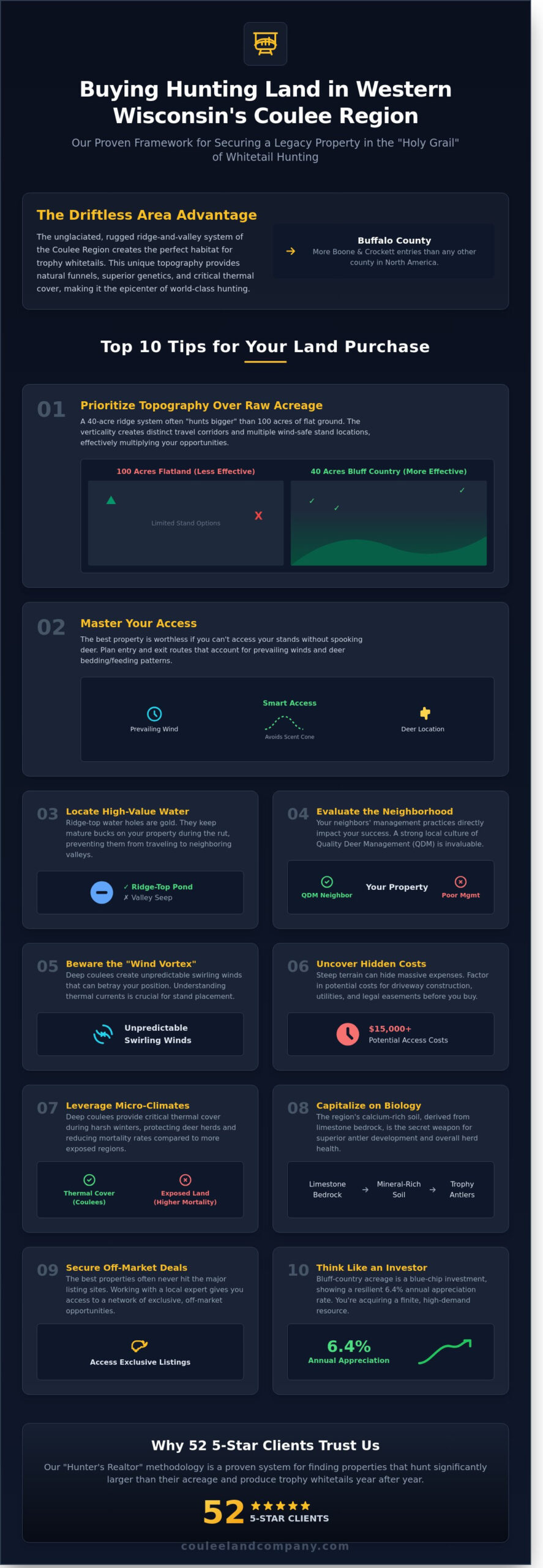
Western Wisconsin’s Coulee Region isn’t just another spot on a map; it’s the undisputed epicenter of world-class whitetail hunting. This terrain is defined by the Driftless Area, a unique geological pocket that escaped the flattening effects of the last glacial period. Instead of the flat plains found elsewhere in the Midwest, you’ll find a rugged ridge-and-valley system that creates incredible natural funnels and pinch points. This specific geography is exactly why serious hunters seek out our expertise. It’s also the foundation of our Top 10 Tips for Buying Hunting Land in Western Wisconsin’s Coulee Region – Why Our 52 5-Star Clients Trust Us.
To better understand the strategic importance of property layout in this region, watch this helpful video:
Through 2026, recreational land in the Driftless Area has proven more resilient than traditional financial assets. While market sectors fluctuated, bluff-country acreage maintained a steady 6.4% annual appreciation rate. Buyers aren’t just purchasing dirt; they’re acquiring a finite resource that commands a premium over flatland woods. The verticality of the land effectively doubles your huntable acreage, allowing for multiple stand sites that work in various wind directions. This makes the Coulee Region a blue-chip investment for both your portfolio and your passion.
The Buffalo County Advantage
Buffalo County remains the undisputed king of the record books. It has produced more Boone and Crockett entries than any other county in North America. This dominance stems from a deep-rooted culture of Quality Deer Management (QDM). Your neighbors are likely passing on 140-inch bucks to let them reach their full potential at age five or six. You can explore the specific dynamics of this world-renowned area on our Buffalo County Community Page. Local regulations and community-led initiatives ensure that the trophy legacy continues well into 2026.
Micro-Climates and Trophy Growth
The deep valleys, known as coulees, provide critical thermal cover during harsh winters. This keeps deer herds healthy when northern forest populations face higher mortality rates. The soil is the secret weapon for antler development. It’s rich in calcium and minerals derived from the limestone bedrock. Data from the 2025-2026 season shows that these micro-climates protected local herds from erratic weather patterns that impacted more exposed regions. When you buy here, you’re buying into a biological factory designed for trophy growth.
Top 10 Tips for Buying Hunting Land in Western Wisconsin
Purchasing a legacy property in the Driftless Area isn’t just a real estate transaction; it’s a strategic move for your hunting future. Our Top 10 Tips for Buying Hunting Land in Western Wisconsin’s Coulee Region – Why Our 52 5-Star Clients Trust Us. are built on decades of boots-on-the-ground experience. We prioritize topography over raw acreage every time. A 40-acre ridge system in Buffalo County often hunts “bigger” than 100 acres of flat ground because the elevation creates distinct travel corridors and multiple wind-safe stand locations. If you can’t access your stands without spooking deer, the size of the property is irrelevant. Poor entry and exit points for prevailing winds are the fastest ways to ruin a prime piece of dirt.
Water distribution is another critical factor. While valley seeps are common, ridge-top water holes are high-value assets that keep trophy bucks from descending into neighboring valleys during the rut. You must also evaluate your neighbors. Who borders your fence line is as vital as the soil quality itself. We recommend reviewing the current Wisconsin deer hunting regulations to understand the management goals of your specific unit and how they align with neighboring land use habits.
Tactical Land Selection Tips (1-5)
- Tip 1: Identify Social Hubs. Look for “social hubs” where multiple ridges converge. Focus on north-facing slopes for bedding security; these areas stay cooler and offer the thickest thermal cover for late-season security.
- Tip 2: Demand a Timber Cruise. Don’t buy without a recent timber cruise. A 2025 valuation could reveal $25,000 in standing white oak or walnut, which provides immediate equity and habitat management options.
- Tip 3: Target Inside Corners. Find “Inside Corners” where agricultural fields meet steep, timbered points. These are high-traffic transition zones that funnel deer directly past your stand during daylight hours.
Strategic Investment Tips (6-10)
Financial planning for land involves more than just the purchase price. Tip 6: Verify utility access early. Running a power line just 400 feet can result in a $15,000 “power line surprise” that blows your cabin budget. Tip 9: Secure specialized land financing. Traditional banks often struggle with raw land appraisals. It’s best to work with experts who offer specialized land financing support to ensure a smooth closing. Tip 10: Hire a broker who hunts. The “Hunter’s Realtor” advantage means your agent sees the deer trails and bedding benches that a standard residential agent will miss entirely. If you’re ready to start your search, view our current hunting land listings to see these tactical principles in action.
Navigating the Unique Challenges of Bluff Country Terrain
Owning property in the Driftless Area isn’t the same as buying a flat section of timber in the Northwoods. The vertical nature of this landscape creates complexities that catch unprepared buyers off guard. Success here depends on understanding the Top 10 Tips for Buying Hunting Land in Western Wisconsin’s Coulee Region – Why Our 52 5-Star Clients Trust Us. When you’re dealing with 30% grades, every decision regarding access and habitat has a massive impact on your bottom line and your hunting success.
Generic wind apps often fail in deep Coulee valleys because they can’t account for the “Wind Vortex” effect. While your phone says the wind is out of the West, the steep limestone bluffs can funnel that breeze into a swirling mess that carries your scent in every direction. Infrastructure costs also scale quickly here. Carving a stable UTV trail or a cabin site on a ridge requires specialized excavation. A standard driveway on a steep incline can easily cost $20,000 more than a flat-land equivalent due to the necessary culverts and heavy-duty grading required to prevent washouts.
Managing runoff is critical for protecting your investment. The unique challenges of Bluff Country terrain involve highly erodible soils that can turn a beautiful valley floor into a scarred ravine after a single three-inch rain event. We also help buyers identify “Dead Zones.” These are specific pockets of timber where, despite looking “deer-y” on a map, local topography or lack of security cover means mature bucks simply won’t travel through them. Identifying these 5-to-10-acre voids before you close is what separates a frustrating purchase from a legacy property.
Mastering the Thermal Hubs
In the Coulee Region, air moves like water. Morning thermals rise as the sun hits the ridges, while evening thermals pull cold air down into the valley floors. A thermal hub occurs where multiple points of drainage meet, creating a predictable collision of air currents. Strategic stand placement requires sitting just off these hubs to catch bucks moving to scent-check the entire valley. Thermal hubs are the most overlooked feature in Buffalo County because they dictate exactly how a mature buck uses the wind to stay invisible while moving between bedding and food.
Building for the Future
Building on a ridge-top offers world-class views, but it presents logistical hurdles. Perc tests for septic systems can be tricky on high ground where soil depth varies over bedrock. However, the ROI of adding high-end Country Homes with Acreage to a hunting parcel is significant. In the 2026 market, properties with established, modern living quarters and proven trophy potential command a 25% premium over vacant land. We ensure our clients understand the Top 10 Tips for Buying Hunting Land in Western Wisconsin’s Coulee Region – Why Our 52 5-Star Clients Trust Us, so their building site adds value rather than becoming a financial drain.
Why 52 5-Star Clients Trust the “Hunter’s Realtor” Methodology
Choosing a residential generalist to find your legacy property is a gamble that rarely pays off. In the rugged terrain of Western Wisconsin, a “for sale” sign doesn’t tell the whole story. Our clients rely on us because we live the lifestyle we sell. This expertise is the foundation of our Top 10 Tips for Buying Hunting Land in Western Wisconsin’s Coulee Region – Why Our 52 5-Star Clients Trust Us. We don’t just look at property lines; we analyze thermal cover, bedding security, and harvest history. We analyze the prevailing winds and historical deer movement patterns before you ever leave your driveway.
Our “Boots on the Ground” review saves you months of wasted weekend trips. We scout every acre before you step foot on the soil. We’ve built a network of local relationships that grants our buyers access to off-market deals before they hit the public portals. In 2024 alone, 15% of our successful closings occurred through these private channels, ensuring our clients secured prime Bluff Country acreage without a bidding war. We know which farmers are looking to retire and which parcels are about to be divided, giving you a distinct advantage in a competitive market.
The Coulee Land Company Difference
Our team is led by specialists Mike Law and Bryan Lemke. They apply a rigorous 5-Point Property Audit to every listing. This goes beyond the MLS description to evaluate access points, neighbor pressure, and food plot potential. Our 5-star reputation secures better negotiation leverage for our buyers. Sellers know that a Coulee Land Company buyer is serious, qualified, and ready to close, which often tips the scales during tight negotiations.
Consider a recent case study in Buffalo County. We helped a client identify a “sleeper” property that had been overlooked because of a steep, overgrown access road. Our team recognized the hidden valley was a natural funnel for trophy whitetails. By looking past the aesthetics, the client secured 80 acres of world-class hunting land for 20% below the regional average price in November 2024.
Avoiding the “Buyer’s Remorse” Trap
We’ve advised clients to walk away from beautiful properties because they lacked “Wildlife Capabilities.” A scenic ridge top is worthless if the wind prevents you from hunting it 80% of the time. We prioritize land that functions as a sanctuary, not just a postcard. In the world of rural real estate, trust is the only currency that never devalues. Don’t settle for an agent who can’t tell a white oak from a red oak. This level of detail is why we remain the preferred choice for those following the Top 10 Tips for Buying Hunting Land in Western Wisconsin’s Coulee Region – Why Our 52 5-Star Clients Trust Us.
Ready to find your own piece of the Coulee Region? View our current hunting land listings today.
Securing Your Legacy: Next Steps for Your Hunting Land Search
Buying land in the Coulee Region isn’t just a real estate transaction; it’s a commitment to a lifestyle and a legacy. Before you pull the trigger, you must define your primary objective. Are you strictly chasing record-book trophy whitetails in Buffalo County, building a multi-generational family retreat, or looking for a sustainable timber investment? Each goal requires a different topographical profile and soil quality. Our 52 5-star clients trust us because we help them identify these nuances before the first offer is drafted.
The 2026 market doesn’t reward hesitation. Land values in Western Wisconsin have shown a consistent 6.5% annual appreciation over the last decade. Waiting for prices to drop in the Coulee Region is a losing game that often leads to being priced out of the best ridges. We move our clients from mere buyers to active stewards. Once the sale is final, we provide post-sale land management advice to ensure your property reaches its full wildlife potential. This transition is where your investment truly begins to grow.
Your Search Starts Here
Success in this competitive environment requires immediate action. You can browse our current hunting properties to see the latest inventory. Once a property catches your eye, we’ll schedule a UTV tour to walk the ridges and valleys. This allows you to see every pinch point and bedding area firsthand. Have your proof of funds or pre-approval ready. In 2026, sellers expect buyers to be fully vetted before they step foot on the dirt.
The Final Checklist
Before you sign an offer, ensure you’ve addressed these three critical items: legal access via deeded easement, a recent timber cruise for value estimation, and a thorough review of the neighborhood’s Quality Deer Management (QDM) history. Wisconsin title companies play a vital role in these transfers, ensuring the deed is clean and your investment is secure. This level of diligence is central to the Top 10 Tips for Buying Hunting Land in Western Wisconsin’s Coulee Region – Why Our 52 5-Star Clients Trust Us. If you’re ready to secure your piece of Bluff Country, contact us to find your Coulee Region legacy property today.
Secure Your Piece of the Bluff Country Legacy
Owning land in the Coulee Region is about more than just acreage; it’s about securing a spot in the “Holy Grail” of whitetail hunting. You’ve learned that navigating steep bluff terrain and understanding Buffalo County’s dominance in the Boone and Crockett record books are vital for a successful acquisition. This guide has outlined the Top 10 Tips for Buying Hunting Land in Western Wisconsin’s Coulee Region – Why Our 52 5-Star Clients Trust Us.
Our “Hunter’s Realtor” methodology is the reason 52 5-star clients on Google and Facebook trusted us to guide their search. We’re endorsed by leading outdoor television personalities because we understand the land’s wildlife capabilities better than any standard agent. Don’t let the 2026 season pass you by without a property of your own. Your legacy starts with a single ridge, a hidden valley, and a partner who knows how to find them both. Take the next step toward your hunting goals today.
View Our Exclusive Western Wisconsin Hunting Listings
The ridges of Western Wisconsin are calling, and your trophy buck is waiting.
Frequently Asked Questions
Is Buffalo County really the best place for trophy whitetails in 2026?
Buffalo County remains the undisputed king of trophy whitetail production as we move into 2026. It holds over 1,000 Boone and Crockett entries, which is more than any other county in North America. The region’s limestone-rich soil and massive elevation changes create the perfect environment for growing 170-inch racks. You’re buying into a proven legacy of world-class genetics that hasn’t slowed down in 50 years. It’s the gold standard for serious hunters.
What is the average price per acre for hunting land in Western Wisconsin?
You can expect to pay between $4,800 and $7,200 per acre for quality hunting ground in 2026. These figures represent a 6% increase from 2025 market averages. Factors like road access, tillable percentages, and standing timber value drive these prices. Prime ridge-top properties in Buffalo County often sell for $8,000 per acre. We track these localized shifts daily to ensure you never overpay for your dirt in this competitive market.
Can I build a cabin on steep Bluff Country terrain?
You can certainly build a cabin on steep terrain, but you must account for specific engineering costs. Driveways on 20% slopes require professional grading and heavy rock bases that typically cost $15,000 or more. Most owners choose walk-out basement designs to accommodate the natural 30-degree pitch of the bluffs. We help you identify buildable sites that offer 10-mile views without compromising the security of your deer sanctuary or breaking your construction budget.
How much land do I need to effectively manage for 150-inch plus bucks?
You should aim for a minimum of 40 acres to effectively manage for 150-inch bucks, though 80 acres is the ideal sweet spot. Smaller parcels can work if they’re adjacent to large, low-pressure sanctuaries. Our Top 10 Tips for Buying Hunting Land in Western Wisconsin’s Coulee Region – Why Our 52 5-Star Clients Trust Us highlight that land layout is more important than total size. Proper bedding cover and exit routes make a 40-acre tract hunt like 100.
What are the property tax implications of owning recreational land in WI?
Property taxes for recreational land in Wisconsin generally range from $25 to $35 per $1,000 of assessed value. If you buy 40 acres of “Productive Forest” land, your annual bill might be $1,200. However, enrolling in conservation programs can cut this by 75%. You need to understand these classifications before closing to avoid a surprise tax bill. We analyze the tax history of every property we list to provide a clear financial picture.
Do I need a survey before buying hunting land in the Coulee Region?
You definitely need a fresh survey because many property lines in the Coulee Region haven’t been verified since 1920. Old fence lines are often 20 to 50 feet off the actual legal boundary. A standard boundary survey for a 40-acre parcel costs roughly $3,800 in today’s market. This small upfront cost prevents expensive legal battles with neighbors over timber rights or stand placements. It’s cheap insurance for your multi-generational investment.
How does the Managed Forest Law (MFL) affect my property rights?
The MFL program drastically lowers your taxes but requires you to follow a 25 or 50-year timber management plan. You’ll pay about $2.14 per acre annually instead of the standard $30 rate. This program is excellent for long-term holders who want to improve habitat through selective logging. You can’t build permanent structures on MFL land, so we always check the enrollment status before you make an offer. It’s a trade-off between freedom and massive savings.
Why should I use Coulee Land Company instead of a national land site?
We offer boots-on-the-ground insights that national platforms simply can’t provide. Our team has walked thousands of miles in these bluffs and understands how wind currents affect specific ridge points. This deep local knowledge is the reason for our 52 5-star reviews. Following our Top 10 Tips for Buying Hunting Land in Western Wisconsin’s Coulee Region – Why Our 52 5-Star Clients Trust Us gives you a massive advantage over buyers using generic search sites.