
For many serious hunters and savvy investors, the search for tillable land for sale wisconsin represents the ultimate union of passion and pragmatism. It’s the dream of owning a piece of the heartland that not only generates income to offset costs but also serves as a private sanctuary for world-class whitetails. Yet, this unique investment comes with critical questions. How do you accurately value productive ground? How can you be sure you’re not overpaying for a property that won’t perform, either in the field or on the balance sheet? Finding an expert who truly understands both sides of this equation-the crop yields and the wildlife capabilities-can feel impossible.
This guide is your solution. As Wisconsin’s Land & Property Sales Specialists, we live and breathe this specific niche. Here, we will equip you with the essential knowledge to confidently evaluate these dual-purpose properties. You’ll learn the key metrics for assessing agricultural value, how to structure a farm lease that enhances your land management goals, and how to identify the tracts where fertile soil and strategic layout create a haven for trophy bucks. Our goal is to empower you to make a sound investment that appreciates over time while delivering the hunting experiences you’ve always dreamed of.
Key Takeaways
-
Understand how Wisconsin tillable land offers a powerful two-for-one investment, generating annual income while creating world-class hunting opportunities.
-
Learn to identify Wisconsin’s prime agricultural and hunting regions to focus your search on properties with the highest potential for both crop yield and trophy wildlife.
-
Our buyer’s checklist provides the essential criteria for evaluating tillable land for sale wisconsin, ensuring you analyze soil quality, access, and habitat like a seasoned pro.
-
Discover why partnering with a true land specialist is critical for navigating the complexities of a land transaction and securing a superior property.
Table of Contents
-
Why Invest in Wisconsin Tillable Land? The Dual-Purpose Advantage
-
The Buying Process: Partnering With a Wisconsin Land Specialist
Why Invest in Wisconsin Tillable Land? The Dual-Purpose Advantage
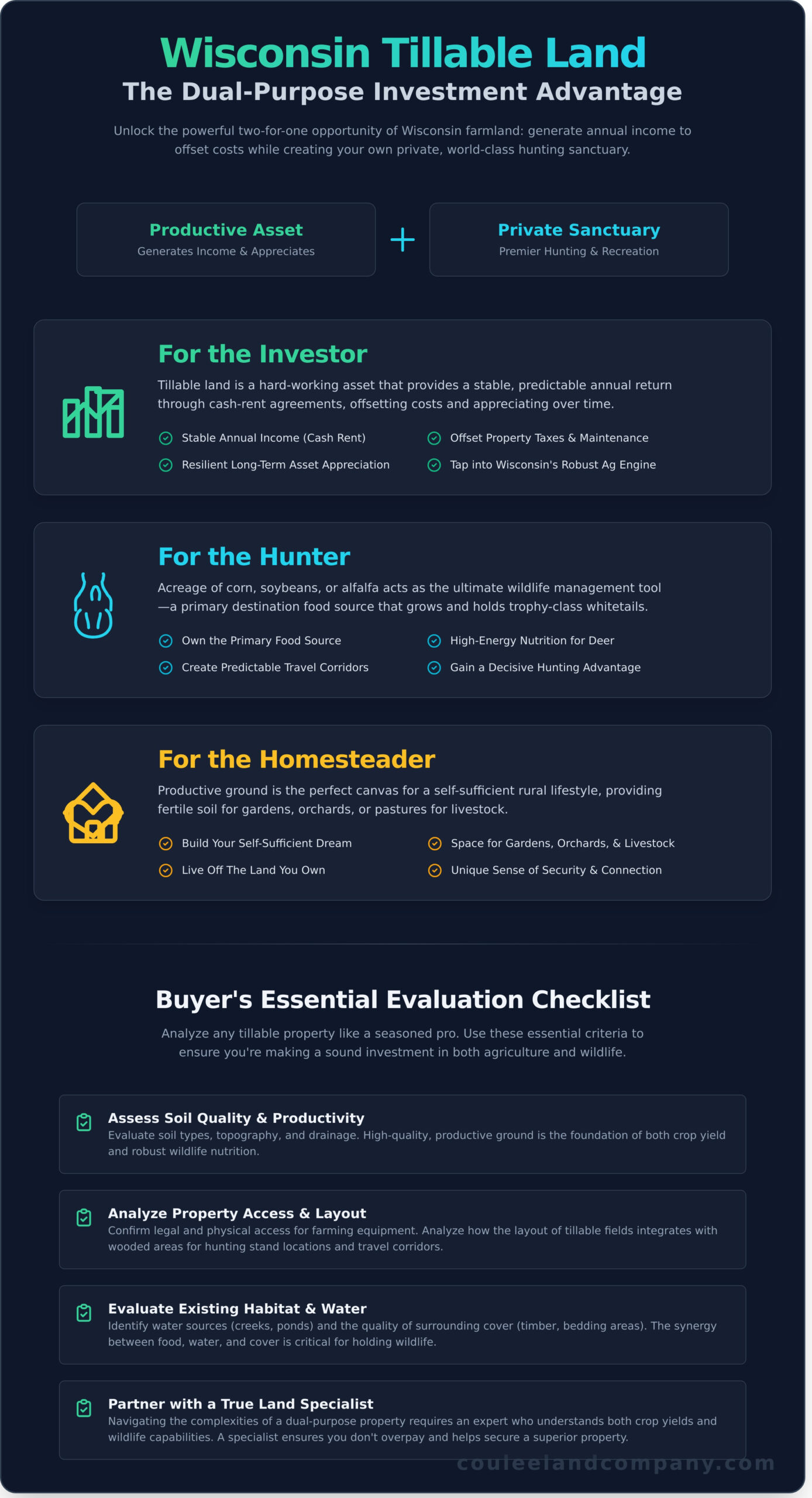
When most people think of owning land, they envision a purely recreational escape-a place for weekend hunts or quiet retreats. But the savviest buyers understand a powerful secret: tillable land transforms a property from a simple expense into a productive, hard-working asset. This is the dual-purpose advantage. Investing in Wisconsin farmland isn’t just about owning a piece of the outdoors; it’s about acquiring a property that can generate income, appreciate in value, and simultaneously create a premier wildlife habitat. This strategy makes land ownership more affordable, more rewarding, and ultimately, a smarter long-term investment.
To see the incredible range of properties available, from modest parcels to sprawling agricultural operations, watch this overview:
For the Investor: ROI Through Cash Rent and Appreciation
From a financial standpoint, tillable acres provide a stable and predictable annual return through cash-rent agreements with local farmers. This reliable income stream can directly offset property taxes, insurance, and maintenance costs, significantly reducing your carrying expenses. Furthermore, agricultural land has historically proven to be a resilient long-term asset with steady appreciation. By investing in farmland, you are tapping into the state’s robust agricultural engine, the foundation of which is detailed in this Overview of Wisconsin Agriculture.
For the Hunter: The Ultimate Food Source for Trophy Bucks
For the serious hunter, tillable acreage is the ultimate tool for wildlife management. Forget small, secluded food plots; imagine owning the primary destination food source for every deer in the area. Fields of corn, soybeans, and alfalfa are magnets for wildlife, providing the high-energy nutrition needed to grow and hold mature, trophy-class whitetails. This is the secret behind the legendary deer of Buffalo County. These agricultural fields create predictable travel corridors and natural pinch points, giving you a decisive advantage season after season.
For the Homesteader: Building Your Self-Sufficient Dream
For buyers seeking a self-sufficient rural lifestyle, finding tillable land for sale in Wisconsin is the first step toward building their dream. This productive ground offers the space and fertile soil needed for expansive gardens, orchards, or pastures for livestock. It’s the perfect canvas for a country home where you can live off the land you own. Having workable acreage attached to your homesite provides a unique sense of security and a direct connection to your food source, fulfilling the ultimate homesteading vision.
Key Regions for Tillable Land in Wisconsin: Where to Look
When searching for tillable land in Wisconsin, it’s critical to understand that not all acres are created equal. The state’s diverse geography, shaped by ancient glaciers and untouched river valleys, creates distinct agricultural regions, each with unique characteristics and investment potential. An investor focused solely on commodity crop returns will look to different areas than one seeking a premier recreational property with income potential. This regional variation is clearly reflected in Wisconsin agricultural land prices, which differ based on soil productivity and location. As Wisconsin’s Land & Property Sales Specialists, we possess an intimate understanding of these regions, particularly the world-class hunting grounds of Western Wisconsin.
The Driftless Area (Bluff Country): Premier Hunting & Unique Farmland
This is the heart of Coulee Land Company’s expertise. The unglaciated topography of Western Wisconsin creates a landscape of dramatic bluffs and deep valleys, with fertile tillable ground typically found on the ridge tops and in the valley bottoms. This unique terrain creates an unparalleled synergy between agriculture and hunting. The ridge-top fields of corn and soybeans act as destination food sources, drawing trophy whitetail bucks from the surrounding wooded hillsides and creating predictable travel corridors. This is the famed whitetail country of Buffalo, Trempealeau, and Vernon counties, where productive Fayette and Dubuque silt loam soils not only generate income but also grow the giants that make the Boone and Crockett record book.
Central Sands & Glacial Plains: Large Tracts and Diverse Soils
In stark contrast to the rugged Driftless Area, the central and southern portions of Wisconsin are defined by vast, level plains left behind by glaciers. This region is home to large, contiguous tracts of farmland ideal for large-scale, efficient production of commodity crops like corn and soybeans. The Central Sands area, with its unique soil composition, also supports a thriving vegetable and potato industry, often requiring irrigation. For investors prioritizing maximum agricultural output and operational scale, this region presents a compelling opportunity.
Eastern Wisconsin: The Dairy Belt and Prime Agricultural Soils
Rooted in Wisconsin’s identity as America’s Dairyland, the eastern part of the state features some of the most productive agricultural soils in the nation. The rich, heavy soils, such as the Kewaunee series red clays, are perfectly suited for growing high-quality forages. Here, the landscape is dominated by fields of alfalfa and corn grown for silage to support the state’s robust dairy operations. While offering excellent recreational opportunities, this region is primarily an agricultural powerhouse, attracting investors focused on strong and consistent rental income from farm operators.
How to Evaluate a Tillable Property: A Buyer’s Checklist
When you’re searching for tillable land for sale wisconsin, the difference between a good investment and a great one lies in the details. True land specialists know that a property’s value extends beyond its acreage. A premier parcel has the right combination of productive soil, practical access, and a functional layout. This checklist provides the framework for conducting your due diligence and evaluating a property with an expert’s eye.
Step 1: Analyze Soil Maps and Productivity Index (PI)
The foundation of any productive farm is its soil. Wisconsin uses a Productivity Index (PI) to rate soil quality based on its inherent ability to produce crops. You can access detailed soil maps for any parcel through the USDA’s Web Soil Survey. A higher PI score directly correlates to higher potential yields and, consequently, higher rental income and overall land value. Don’t just look at the land; look under it.
Step 2: Assess Access, Drainage, and Topography
Superior soil is useless if you can’t work it efficiently. Verify year-round legal and physical access suitable for modern, heavy farm equipment. Assess the property’s drainage-is it naturally well-drained, or does it rely on a tile system? Poor drainage can delay planting and harm crop health. In Wisconsin’s famed Bluff Country, topography is also critical; fields with contour strips and terracing require specific farming techniques that can impact operational efficiency.
Step 3: Investigate Leases and Government Programs
A property’s current agreements dictate your future income and land use. Always request copies of existing farmer leases to understand rental rates, term lengths, and specific obligations. Furthermore, inquire about any government programs the land may be enrolled in. This includes federal initiatives like the Conservation Reserve Program (CRP), which pays landowners to take land out of production for conservation, or state-level programs like Wisconsin’s Farmland Preservation Program, which can provide tax benefits. Understanding these complex agreements is crucial. Our expert land buying agents are specialists in navigating these details to protect your investment.
The Buying Process: Partnering With a Wisconsin Land Specialist
You’ve done the research and understand the immense value of owning tillable land in Wisconsin. Now, it’s time to transition from evaluation to acquisition. This is the most critical phase, where your choice of partner will define the success of your investment. A general real estate agent can sell you a house, but acquiring productive farmland requires a specialist who lives and breathes the Wisconsin outdoors.
Finding the Best Listings (Including Off-Market Deals)
The most sought-after properties-the ones with prime soil, established food plots, and trophy whitetail history-rarely last long on public websites. Many are sold before they are ever listed. A true land specialist operates within a deep network of landowners, farmers, and investors. At Coulee Land Company, we are constantly connected to this network, giving our clients exclusive access to premier hunting properties with tillable acres before anyone else.
Securing Financing for Agricultural & Recreational Land
Financing a large tract of bare land is fundamentally different from securing a traditional home mortgage. Lenders evaluate the land’s productivity, income potential, and intended use. We connect our buyers with agricultural lenders and credit unions that specialize in farm and recreational land loans. Getting pre-approved with the right institution not only clarifies your budget but also positions your offer as serious and credible when the perfect property becomes available.
Why a Land Specialist is Non-Negotiable
When you’re evaluating tillable land for sale wisconsin, a residential agent sees acreage; a land specialist sees potential. This distinction is everything. Our expertise goes far beyond a simple transaction. We understand:
-
Soil composition, productivity ratings, and potential crop yields.
-
The nuances of agricultural leases and how to maximize your ROI.
-
Trophy buck travel corridors and how tillable ground influences herd dynamics.
-
Complex property lines, access easements, and water rights.
A residential agent simply lacks this critical, on-the-ground knowledge. For a transaction this significant, you need an expert who can protect your interests and ensure you’re acquiring a legacy property. Trust an authentic guide like Mike Law to navigate the complexities and turn your vision into reality. Your investment deserves nothing less than specialized expertise.
Your Wisconsin Land Legacy Awaits
Investing in Wisconsin’s fertile ground offers a powerful dual advantage: a stable agricultural asset and a world-class hunting paradise. As this guide has shown, a successful purchase hinges on a strategic understanding of key regions and a thorough evaluation of the land’s capabilities. The search for prime tillable land for sale wisconsin is more than a transaction; it’s the foundation for a legacy of both profit and passion. Navigating this specialized market demands an expert who understands every facet of the land’s value.
At Coulee Land Company, we are those experts. With decades of combined experience, our team possesses unmatched expertise in both hunting and agricultural properties, particularly within Western Wisconsin’s famed Bluff Country. We don’t just facilitate transactions; we provide the insight necessary to secure a property that meets your highest aspirations as an investor and an outdoorsman.
Ready to find your perfect property? View our exclusive Wisconsin land listings today. Your dream of owning a piece of Wisconsin’s finest ground is within reach.
Frequently Asked Questions About Wisconsin Tillable Land
What is a good price per acre for tillable land in Wisconsin?
The price for quality tillable land varies significantly based on location and soil productivity. In prime agricultural regions like Western Wisconsin’s Bluff Country, you can expect to see prices ranging from $6,000 to over $12,000 per acre for highly productive ground. Key factors influencing value include the Soil Productivity Index (PI), field access, drainage, and parcel size. Less productive or more remote parcels will naturally command a lower price, but still represent a solid investment.
How much income can I realistically expect from leasing my tillable acres?
Lease income, or cash rent, is a significant benefit of owning tillable ground. In Wisconsin, annual rental rates typically range from $150 to over $350 per acre. The final rate depends heavily on soil quality, commodity prices, and the local demand from farmers. A well-negotiated lease on productive land provides a consistent, passive income stream that can offset property taxes and ownership costs, making your investment work for you from day one.
What is the Conservation Reserve Program (CRP) and how does it affect a land purchase?
The Conservation Reserve Program (CRP) is a federal program that pays landowners an annual rental payment to take environmentally sensitive land out of agricultural production and plant species that improve environmental health. If you purchase a property with an existing CRP contract, you are legally obligated to honor its terms. This provides guaranteed income for the contract’s duration but restricts your ability to farm, hay, or establish food plots on those specific acres until it expires.
Are property taxes different for agricultural land versus recreational land in Wisconsin?
Yes, the difference is substantial. Wisconsin uses a "Use-Value Assessment" for agricultural land, meaning it’s taxed based on its ability to produce farm income, not its market value. This results in significantly lower property taxes compared to land classified as residential, commercial, or even undeveloped/recreational. This tax advantage is a powerful financial incentive when looking at tillable land for sale in Wisconsin, as it dramatically reduces annual holding costs for the owner.
What are the first steps in converting part of a tillable field into a food plot for deer?
The first critical step is a soil test to determine pH and nutrient levels, which dictates your lime and fertilizer needs. Next, strategically select your location, considering deer travel corridors, wind direction for stand access, and sunlight. Once you have a spot, initial site preparation involves eliminating competing vegetation through spraying or tilling. These foundational steps are essential for establishing a successful food plot that will hold and grow trophy whitetail bucks on your property.
Can I get a conventional loan to buy bare land with tillable acres?
While some conventional lenders offer loans for bare land, it can be more challenging than financing a property with a home. Many traditional banks are hesitant. We typically guide our clients toward specialized lenders and rural credit unions that understand agricultural and recreational land investments. These institutions are more familiar with the asset and often offer better terms, though you should expect to provide a significant down payment, typically in the 20-35% range, to secure financing.