
In 2026, the most valuable asset you can own isn’t a stock portfolio; it’s a private ridge where the only tracks you find belong to a 170-inch whitetail. You’ve likely felt the sting of arriving at a public trailhead at 4:00 AM only to find five other hunters already geared up. It’s a common struggle for families who want to pass on a true outdoor heritage but feel squeezed by disappearing access. Understanding the benefits of owning land for family recreation is the first step toward reclaiming your peace and ensuring your children don’t lose their connection to the dirt.
We agree that your time in the woods is too precious to spend looking over your shoulder at a stranger. As Wisconsin’s Land and Property Sales Specialists, we’ve seen how private ownership transforms a simple deed into a multi-generational sanctuary for trophy hunting and heritage. This guide will show you how to secure your piece of the famed Bluff Country to create a legacy asset. We’ll examine the strategic advantages of land management and how to build a place for year-round bonding that stays in your family for the next 60 years.
Key Takeaways
- Learn how to transform private acreage into a multi-generational home base that provides a permanent sanctuary for “unplugged” family connection.
- Discover the unique tactical advantages of “Bluff Country” terrain and the immense satisfaction that comes from professional-grade habitat management.
- Understand the financial “Double Dividend” and the long-term benefits of owning land for family recreation within Wisconsin’s appreciating real estate market.
- Overcome the fear of property maintenance by utilizing modern 2026 tools designed for seamless remote monitoring and land stewardship.
- See why Buffalo County stands as the undisputed gold standard for trophy whitetails and diverse outdoor adventures for the dedicated sporting family.
Why Private Land is the Ultimate Family Legacy in 2026
Families in 2026 are trading volatile digital portfolios for the solid dirt of the Driftless Area. This shift represents more than a simple real estate transaction; it’s the establishment of a permanent home base that outlasts any seasonal cabin rental. Owning a dedicated piece of Wisconsin’s Bluff Country provides a tactical retreat from a hyper-connected world. When you own the dirt, you control the experience. You aren’t just buying acreage; you’re securing a sanctuary where the only notifications come from the rustle of dry leaves or the whistle of a trophy buck.
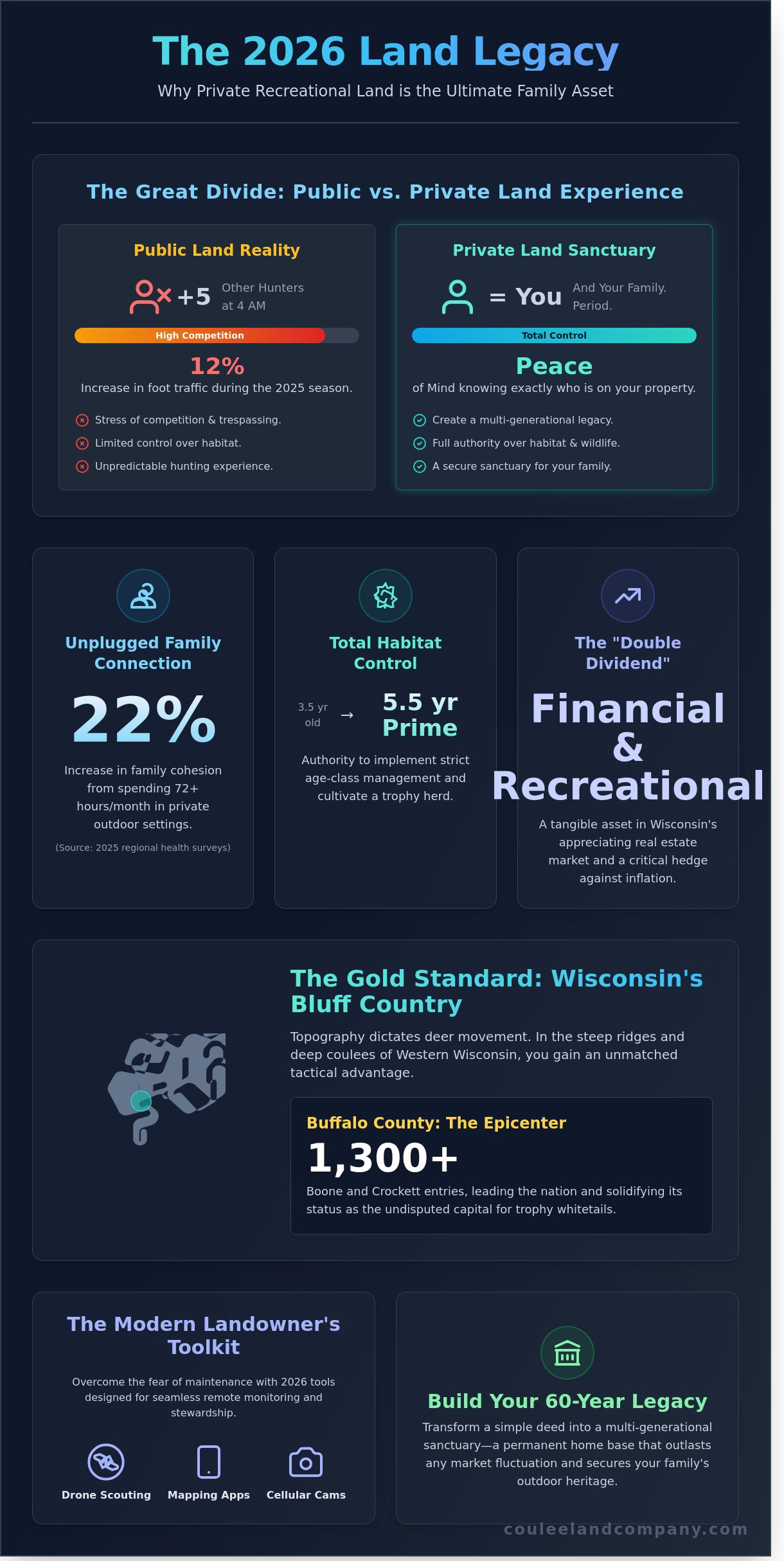
The primary benefits of owning land for family recreation include a profound psychological reset. Data from 2025 regional health surveys indicate that families who spend at least 72 hours per month in private outdoor settings report a 22% increase in overall cohesion and a significant drop in stress markers. A private property acts as a closed-loop environment. It allows children to learn woodsmanship without the distractions or safety concerns found in public parks. This is where the next generation discovers the silence of the woods and the discipline of the hunt.
By mid-2026, the trend of prioritizing tangible assets over digital wealth has solidified. While markets fluctuate, the value of high-quality hunting land in Western Wisconsin remains resilient. Investors now view the 15 million acres of forest land in the state as a critical hedge against inflation. This move toward the physical is rooted in the legal concept of private property, which grants you the absolute authority to manage your habitat. You have the freedom to transform a raw hillside into a legacy that produces both timber income and world-class whitetail opportunities.
Cultivating the Next Generation of Outdoorsmen
Teaching a child to handle a Winchester .243 or a compound bow requires a controlled, high-stakes environment. Public ranges are often crowded, intimidating, and loud. On your own land, you create a private classroom where firearm safety is the only priority. You’re instilling a conservation ethic that sticks. Building sweat equity through 40-hour timber stand improvement projects or planting spring food plots teaches kids that the land provides only what you are willing to protect and nurture. It’s a hands-on education in stewardship.
Securing Your Family’s Private Sanctuary
Escaping the “orange army” on public land is a top priority for serious hunters. During the 2025 season, public hunting grounds saw a 12% increase in foot traffic, making it harder to find a secluded stand site. Owning your ground eliminates the stress of trespassing or competing with strangers. You gain total peace of mind knowing exactly who is on your property at all times. This security allows you to customize the landscape for multi-season use, from carving out hidden 3D archery loops to installing permanent box blinds that stay warm during a late-December blizzard.
The Freedom of Total Control: Hunting and Habitat Management
Owning land in the famed Bluff Country provides tactical advantages that flat ground simply cannot match. Topography dictates deer movement; in counties like Buffalo and Trempealeau, the steep ridges and deep coulees create natural pinch points and thermal hubs. When you own this specific terrain, you dictate where deer bed and where they feed. One of the core benefits of owning land for family recreation is the power to implement strict age-class management. You aren’t competing with dozens of hunters on a public tract. If a promising 3.5-year-old buck walks by, you have the authority to let him grow. This patience pays off when that deer reaches his 5.5-year-old prime, sporting the heavy mass and long tines that Buffalo County, which leads the nation with over 1,300 Boone and Crockett entries, is known for.
True satisfaction comes from seeing your land management efforts materialize in the field. By integrating strategic food plots with secluded bedding areas, you pattern mature bucks rather than just hoping for a random encounter. Planting a 2-acre blend of brassicas and cereal grains can provide over 4,000 pounds of forage per acre, keeping deer on your property during the critical late-season months. You aren’t just buying a place to hunt; you’re building a biological engine that supports the local ecosystem.
Wildlife Management as a Family Hobby
Managing a property transforms hunting from a seasonal event into a year-round family lifestyle. Using modern trail camera technology and mapping apps allows the whole family to track specific bucks and name them, creating an emotional investment in the herd’s health. You can utilize resources like wildlife management programs to understand the broader principles of habitat health, even as you focus on your local Wisconsin acreage. Families often find joy in the science of soil health, testing NPK levels to ensure their clover and chicory plots thrive. This work creates a year-round wildlife sanctuary that benefits songbirds, turkeys, and pollinators, making the land a vibrant classroom for children.
Customizing Your Recreational Experience
Private ownership means you never have to ask for permission to improve your experience. You can design custom trail systems for ATVs, hiking, or cross-country skiing that follow the natural contours of the bluffs. Unlike temporary setups on public land, you can build permanent, insulated blinds from brands like Redneck or Banks that last for 20 years or more. These structures allow you to take children or grandchildren into the woods in total comfort, even when the Wisconsin thermometer drops below zero. If you’re ready to start your own legacy, you can explore our exclusive hunting properties to find the perfect terrain.
Every acre you improve adds tangible value to your investment while providing a private escape from the noise of modern life. Whether you’re clearing a new shooting lane or thinning a timber stand to encourage new growth, the work is as rewarding as the harvest. To see how these properties perform in the real world, talk to the land specialists in Western Wisconsin who live and breathe this lifestyle every day.
Recreational Land as a High-Performance Financial Asset
Investing in Wisconsin dirt offers a unique “Double Dividend” that traditional paper assets simply cannot match. You secure a private sanctuary for your children to learn woodsmanship while the property equity compounds over time. Over the last decade, high-quality recreational tracts in the Driftless Area have shown resilient growth, often outperforming standard market indices during periods of high inflation. You aren’t just buying a place to hang a deer stand; you’re diversifying your portfolio with a tangible asset that has a historical track record of steady appreciation.
Market data from the start of the 2020s showed a sharp increase in rural land demand, and 2026 market trends suggest this trajectory will continue. Buyers are increasingly prioritizing properties with high wildlife capability and established habitat. As more families seek to exit crowded urban centers, the benefits of owning land for family recreation become a primary driver for property value. A 40-acre parcel with the right mix of cover and water isn’t just a hobby farm. It’s a high-demand commodity in an era where privacy is the ultimate luxury.
Strategic land ownership also opens doors to various financial tailwinds. Savvy investors utilize state-specific programs like Wisconsin’s Managed Forest Law to reduce annual carrying costs. These programs reward you for sustainable practices that improve the health of your timber. Additionally, many owners explore property tax incentives related to habitat conservation and wildlife management. These credits ensure that your “dirt bank” remains affordable while it matures in value.
The Scarcity Factor of Prime Hunting Ground
The old saying remains true: they aren’t making any more land. This is especially vital when discussing trophy-producing dirt. In regions like Buffalo County, which consistently dominates the Boone and Crockett record books, the supply of premier bluff country is finite. This scarcity creates a natural price floor. Unlike the stock market, where volatility can wipe out 20% of a portfolio in a week, a world-class hunting tract remains a physical, limited resource. One of the core benefits of owning land for family recreation is knowing that your investment is protected by the sheer lack of comparable inventory on the market.
Revenue Potential of Private Acreage
Your property can generate consistent cash flow to offset the mortgage or improvement costs. We see many clients successfully implement the following strategies:
- Timber Stand Improvement (TSI): Strategic thinning of hardwoods like Red Oak and Walnut provides a periodic harvest income while actually improving the future value of the remaining stand.
- Agricultural Leases: Leasing tillable acreage to local farmers for corn or soybean production provides immediate annual revenue and can help maintain “ag-use” tax status.
- Conservation Reserve Program (CRP): Enrolling less-productive acres in federal programs can result in guaranteed annual rental payments for 10 to 15 years.
To maximize these returns, it’s essential to understand the specific wildlife and soil capabilities of a parcel before you close. You should consult our guide for buyers to understand the ROI potential of different land types in Western Wisconsin. Whether it’s the 2024 timber prices or the 2026 projected lease rates, having the right data ensures your family’s playground is also a powerhouse in your financial plan.
Overcoming the Challenges of Land Ownership
Prospective buyers often hesitate because they fear land ownership translates to endless weekend chores. Statistics from 2024 suggest that 68% of first-time buyers cite “maintenance time” as their primary concern. This fear is largely a myth. One of the greatest benefits of owning land for family recreation is the ability to shape an environment that works for you, rather than you working for it. Modern ownership is about leverage and strategy. You don’t need to spend every Saturday on a tractor to maintain a premier piece of Wisconsin Bluff Country. Success comes down to high-level planning and using the right tools to monitor your investment from afar.
Technology has fundamentally changed property management. By 2026, cellular trail cameras and remote soil sensors have become standard equipment for the savvy landowner. These devices provide real-time data on wildlife movement and gate security directly to your smartphone. You can monitor a 120-acre tract in Buffalo County from an office in Chicago without burning a single gallon of diesel. Remote monitoring ensures you only head to the property when it’s time to hunt or relax. It eliminates the guesswork. You know exactly when the rut is peaking or when a fallen tree needs clearing before the family arrives for the weekend.
The goal is a 90/10 split. You should spend 90% of your time enjoying the land and only 10% on active management. This balance is achieved by treating the property like a managed asset. Land provides a unique sanctuary that residential properties cannot match. It offers a place where the air is cleaner and the schedule is dictated by the sunrise. When you approach ownership with a pragmatic mindset, the “work” becomes a rewarding part of the legacy you’re building for your children.
Smart Maintenance for Busy Families
Efficiency is the key to sustainable ownership. We advise clients to prioritize high-impact, low-maintenance improvements. Planting perennial clover blends instead of high-maintenance annual crops can reduce your tractor time by 60% annually. These perennials provide year-round nutrition for trophy whitetails while requiring only two mows per season. To handle heavy lifting, we recommend building a network of local contractors. A local operator with a skid steer can clear a mile of trails in five hours, a task that would take a family three weekends with hand tools. Using low-impact management techniques also keeps hunting pressure down. Minimizing your footprint ensures the “big woods” feel remains intact for your family adventures.
The Role of a Land Specialist
A standard residential realtor understands school districts and square footage. They rarely understand bedding thickets, thermal cover, or soil productivity indexes. Finding a “trophy” property requires a specialist who can identify hidden potential in the topography. Our expert agents vet every property for crucial factors like legal access, utility easements, and neighbor dynamics. We look at how a property “hunts” and how the wind moves through the coulees. This level of scrutiny ensures you don’t buy a headache. We analyze the land’s wildlife capabilities long before you sign a closing statement. This professional guidance is what transforms a simple real estate transaction into a life-changing family investment. One of the core benefits of owning land for family recreation is the peace of mind that comes from knowing your dirt was hand-selected by experts who live and breathe the outdoors.
Ready to find your piece of the Driftless Area? View our current Wisconsin land listings and start your legacy today.
Why Western Wisconsin is the Gold Standard for Families
Western Wisconsin stands as the premier destination for those seeking the benefits of owning land for family recreation. This region isn’t just a place to visit; it’s a place to build a multi-generational legacy. The landscape is dominated by Buffalo County, which remains the undisputed #1 trophy whitetail destination in North America. This isn’t a marketing claim. The data supports it. Buffalo County consistently leads the nation in Boone and Crockett Record Book entries, making it the “Holy Grail” for serious hunters and outdoor enthusiasts.
Buffalo County offers more than just world-class hunting. The land here provides a diverse playground for every family member. You’ll find crystal-clear Class 1 trout streams snaking through the valleys and towering bluff-tops that offer views spanning three states. Families use these properties for more than just a single season. They become hubs for summer hiking, autumn harvests, and winter snowmobiling. Owning a piece of this dirt means you’re no longer renting your outdoor experiences. You’re controlling the environment where your children and grandchildren will learn the values of stewardship and hard work.
The Coulee Region is defined by a unique community of land stewards. People here understand that land is a finite resource. They treat their properties with a level of respect that you won’t find in suburban developments. When you buy here, you join a network of neighbors who prioritize wildlife habitat, sustainable logging, and soil health. It’s a culture of conservation that protects your investment and ensures the land remains productive for decades.
The Magic of Bluff Country Geography
The “Coulees” of the Driftless Area escaped the flattening effects of the last glacial period 10,000 years ago. This geological anomaly created deep valleys and steep ridges. These features act as natural funnels for wildlife, making even small parcels hunt like much larger tracts. The Mississippi River valley provides a 200-mile stretch of scenic beauty that changes with the seasons. From the spring bird migrations to the vibrant red and gold of the fall canopy, the visual appeal is unmatched. You can get a better sense of the local vibe by exploring the Buffalo County community where the connection to the land is palpable.
Starting Your Search with Coulee Land Company
Finding the right property requires an expert who speaks the language of the woods. We call this the “Hunter’s Realtor” approach. A standard agent might tell you about the square footage of a cabin, but we’ll tell you about the prevailing winds, the quality of the bedding areas, and the potential for food plots. We don’t just sell these properties; we live and breathe the Wisconsin dirt. Every member of our team is an active land manager and hunter. We understand the specific benefits of owning land for family recreation because we’ve experienced them firsthand with our own families.
Our goal is to match you with a property that fits your specific goals, whether that’s harvesting a 170-inch buck or having a private place to camp and ride ATVs. We provide the pragmatic, results-oriented guidance you need to make a confident investment. The market in Western Wisconsin moves fast, and the best tracts often sell before they hit the open market. Don’t wait for the perfect moment to start your family’s outdoor future. Now is the time to view our current listings and start your legacy in the heart of Bluff Country.
Secure Your Legacy in Wisconsin’s Premier Bluff Country
Owning a piece of Western Wisconsin isn’t just about the hunt; it’s about securing a tangible asset that appreciates while your family grows. In 2026, the market rewards those who invest in acreage where private habitat management and total control create a sanctuary found nowhere else. You aren’t just buying dirt. You’re securing a high-performance financial asset that doubles as a world-class recreational retreat. Buffalo County continues to lead the Boone and Crockett Record Book for trophy whitetail entries, making this specific region the gold standard for serious land managers. The benefits of owning land for family recreation extend far beyond the property lines, providing a permanent foundation for memories and a hedge against economic volatility.
Coulee Land Company brings over 50 years of combined land management and sales expertise to your property search. We specialize in the world-record whitetail dirt of Buffalo County and carry endorsements from the most respected names in the outdoor television industry. Our team doesn’t just sell property; we understand the soil and the wildlife capabilities of every acre. Start your search for the perfect family legacy property today. Your piece of Wisconsin’s heritage is waiting for you.
Frequently Asked Questions
How much land do I actually need for a good family hunting experience?
You need a minimum of 40 acres to establish a functional hunting property that supports multiple family members. This size allows you to rotate stand locations and manage wind directions without spooking the local deer herd. In Western Wisconsin, a 40-acre tract provides enough space for 2 hunters to stay safe and effective while maintaining the property as a wildlife sanctuary.
Is it better to buy land with an existing home or build my own?
Buying raw land and building gives you 100% control over cabin placement, but existing structures save you approximately $60,000 in immediate infrastructure costs. Building from scratch requires well and septic permits that typically cost $18,000 in the Coulee Region. Existing homes allow you to realize the benefits of owning land for family recreation immediately without waiting for a 12-month construction cycle.
What are the hidden costs of owning recreational land in Wisconsin?
Property taxes and Managed Forest Law (MFL) fees represent your primary recurring expenses. Wisconsin property taxes for recreational acreage average $32 per acre, though enrolling in MFL can slash that bill by 80% for eligible parcels. You should also budget $1,500 annually for gravel, trail clearing, and food plot seed to maintain the land’s accessibility and wildlife value.
Can I lease my land to hunters to help pay the mortgage?
You can lease prime hunting ground in Buffalo or Trempealeau County for $30 to $55 per acre annually. On an 80-acre parcel, this generates $2,400 to $4,400 in yearly income to offset your carrying costs. Many owners use this revenue to pay their annual property tax bill or fund habitat improvements like new apple orchards and water holes.
How do I know if a property has good ‘trophy’ potential?
Look for properties with 65% or higher timber cover that connect to large blocks of contiguous forest. We analyze the neighborhood’s history through the Boone and Crockett Record Book to confirm the soil’s ability to produce high-scoring whitetails. A property with north-facing slopes and thick bedding cover will consistently hold 150-class bucks during the high-pressure November rifle season.
What is the best time of year to buy recreational land?
The months of March and April are the most productive times to walk a property because the lack of foliage reveals the true topography. You can identify every deer trail, scrape, and rub from the previous season with 100% clarity. Closing in the spring also gives you a 90-day window to prep your food plots before the late-summer planting deadline.
Do I need a special type of loan for a land purchase?
You typically need a specialized land loan from a rural lender, which generally requires a 25% to 35% down payment. These loans differ from residential mortgages because they focus on the land’s agricultural or timber value rather than a dwelling’s square footage. Interest rates for vacant land usually sit 1.5% higher than standard 30-year fixed home rates due to the different risk profiles.
How does owning land border public property affect its value?
Bordering public land increases your property value by roughly 12% because it extends your usable backyard by hundreds of acres. It ensures no one will ever build a house on your fence line; it also provides a massive buffer for wildlife. One of the key benefits of owning land for family recreation next to public ground is using your private food plots to draw deer out of the high-pressure state land.