
Buying hunting land is one of the most significant investments an outdoorsman can make. It represents the culmination of a dream-a private sanctuary where traditions are forged and memories are made. Yet, this monumental decision is fraught with hidden risks that can turn that dream into a costly nightmare. Overlooking critical details like legal access, deed restrictions, or a property’s true wildlife capabilities can lead to years of frustration and buyer’s remorse. That’s why having a proven, comprehensive checklist for buying hunting land is not just an advantage; it is an absolute necessity for making a sound investment.
As Wisconsin’s premier Land & Property Sales Specialists, we’ve seen it all. We’ve channeled our decades of on-the-ground experience into this definitive guide. This article provides the step-by-step framework you need to confidently evaluate any property, ask the right questions, and avoid the common pitfalls that trap so many buyers. Follow this checklist, and you’ll be equipped to secure the perfect piece of Bluff Country-a legacy property that will deliver exceptional hunting for generations to come.
Key Takeaways
-
A successful land purchase starts long before the search; learn how to establish a rock-solid budget and define your specific property goals.
-
Leverage modern digital mapping tools to analyze a property’s terrain, access, and wildlife potential from your computer, saving you valuable time in the field.
-
Our checklist for buying hunting land details the critical ‘boots on the ground’ phase, teaching you how to verify a property’s true hunting potential in person.
-
Protect your legacy investment by mastering the final due diligence steps, a crucial phase that prevents costly and unforeseen mistakes before you close.
Table of Contents
Phase 1: The Pre-Search & Financial Preparation Checklist
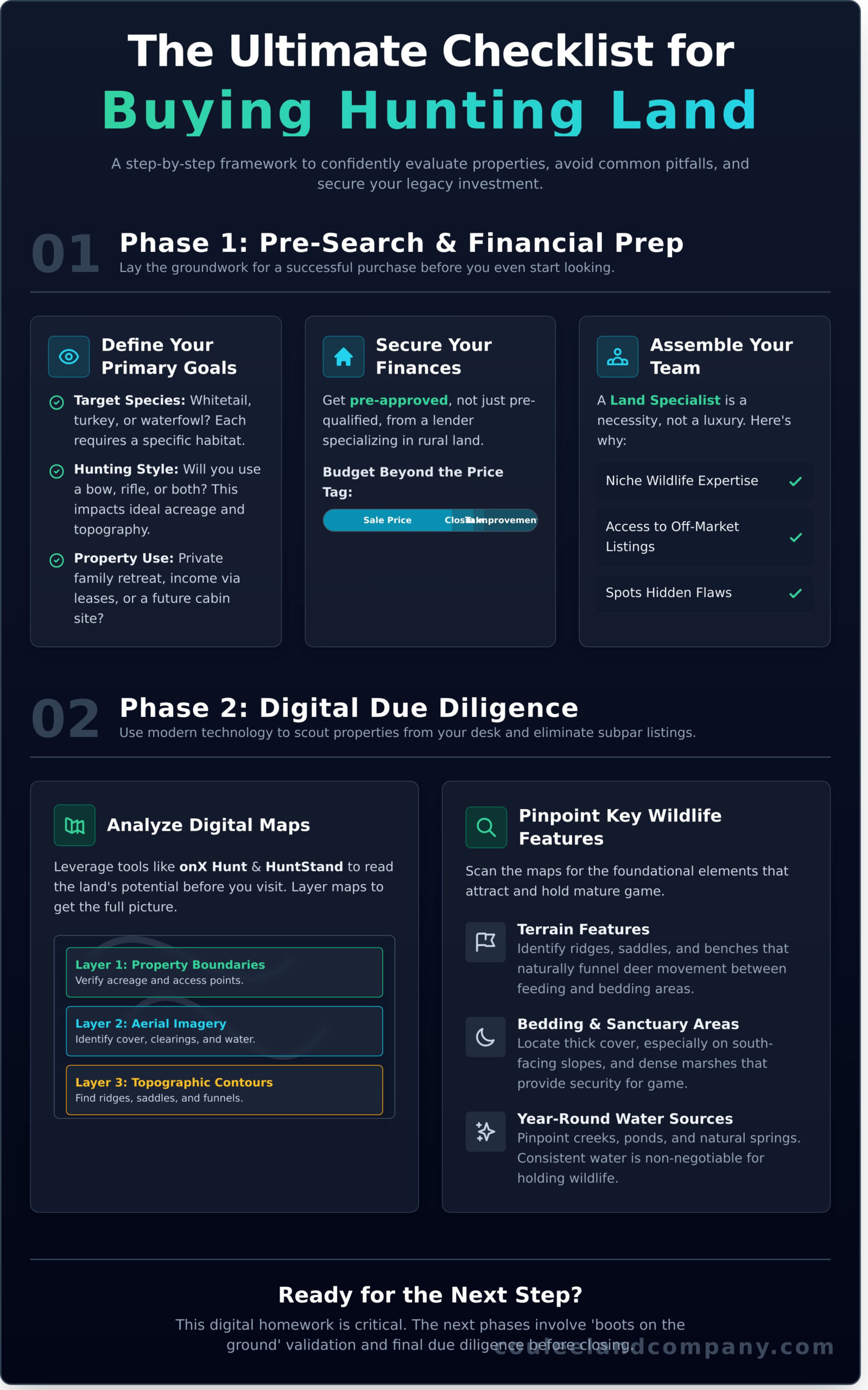
The dream of owning your own slice of hunting paradise is a powerful one, but turning it into a reality requires more than just passion-it demands diligent preparation. Buying hunting land is a major investment, and the success of your purchase is determined long before you ever set foot on a property. This initial phase sets your budget, defines your goals, and assembles your expert team. Completing these foundational steps is the most important part of any checklist for buying hunting land, as it prevents wasted time and ensures you’re positioned for a successful and smooth acquisition process.
Define Your Primary Hunting Goals
Before you can find the perfect property, you must define what "perfect" means to you. This clarity is essential. Your goals will dictate the type of land you search for. Consider the following:
-
Target Species: Are you targeting trophy whitetail bucks, wild turkey, or waterfowl? Each requires a different type of habitat and terrain.
-
Hunting Style: Your preferred method, whether bow, rifle, or all-season, will influence the ideal acreage and topography.
-
Primary Use: Will this be a private retreat for your family, an income-producing property through a hunting lease, or both?
-
Non-Hunting Uses: Think beyond the hunt. Do you envision a future cabin site, a timber investment, or simply a place for family recreation?
Secure Your Finances & Set a Realistic Budget
With your goals defined, the next step is securing your finances. Don’t just get pre-qualified; get pre-approved for a loan from a lender who specializes in rural land, as the process differs significantly from a standard home mortgage. A realistic budget must account for more than the sale price. Factor in the down payment, closing costs, and annual property taxes. More importantly, budget for the future improvements that transform good land into great habitat: food plots, trail systems, and timber stand improvements. Explore financing options tailored for rural and recreational properties to find the best fit for your investment.
Assemble Your Team: Why a Land Specialist is Crucial
A general real estate agent sells houses; a land specialist understands the heartbeat of the land. This distinction is critical. A true land specialist possesses the niche expertise to evaluate a property’s wildlife capabilities, from understanding game flow and topography to identifying the potential for habitat enhancement. They have access to off-market listings you’ll never find online and can spot hidden flaws a generalist would miss. They navigate the unique complexities of rural real estate, from mineral rights to the nuances of Understanding property easements, which dictate legal access. For the serious buyer, partnering with a specialist isn’t a luxury-it’s a necessity.
Phase 2: The Desktop Scouting & Digital Due Diligence Checklist
Before you ever burn a gallon of gas or put boots on the ground, the most critical part of your checklist for buying hunting land begins at your desk. In today’s market, the most successful land buyers are those who do their homework. Modern mapping tools and digital county records provide an incredible advantage, allowing you to uncover a property’s true potential-or its hidden flaws-from your computer. This digital due diligence is the key to efficiently eliminating subpar listings and prioritizing the parcels that genuinely meet your goals for trophy wildlife.
Analyze Topography and Aerial Maps
Modern mapping platforms like onX Hunt and HuntStand have revolutionized how savvy hunters evaluate a property. By layering topographic maps, recent aerial imagery, and property boundaries, you can begin to read the land and its wildlife capabilities. You are looking for the foundational elements that attract and hold mature bucks and other game. These maps allow you to pinpoint potential food plots and sanctuary locations, giving you a preliminary habitat assessment. For dedicated buyers looking to evaluate turkey potential, resources like the National Wild Turkey Federation’s Turkey Habitat Evaluation Guide provide a framework for what to look for once you’re on the property.
-
Terrain Features: Identify ridges, saddles, and benches that naturally funnel deer movement between feeding and bedding areas.
-
Bedding Areas: Locate potential sanctuaries, such as thick cover on south-facing slopes (for warmth) or dense cattail marshes.
-
Water Sources: Pinpoint year-round water sources like creeks, rivers, ponds, and natural springs, which are essential for all wildlife.
Assess the Neighborhood and Surrounding Pressure
A property’s potential is heavily influenced by what surrounds it. Use your mapping tool to zoom out and analyze the adjacent parcels. Is the property bordered by large, unfragmented timber tracts or an expanding subdivision? The answer dramatically affects hunting pressure and wildlife stability. Look for large agricultural fields that provide a destination food source and identify neighboring sanctuaries that may hold deer. Evaluating the regional quality is also paramount; owning land in a place like famed Buffalo County, which dominates whitetail record books, presents a different class of opportunity than in less-managed areas.
Investigate Access, Easements, and Zoning
This is the non-negotiable part of your digital due diligence where legal details can make or break a deal. First, confirm legal, deeded access from a publicly maintained road. A landlocked parcel is a significant liability. Next, check county GIS websites or records for any existing easements, such as utility right-of-ways or access agreements for neighbors, which could impact your use and privacy. Finally, verify local zoning regulations to ensure there are no restrictions on building a cabin or implementing your land management plans. From a hunter’s perspective, analyze the property for multiple access points to accommodate different wind directions-a key tactical advantage.
Phase 3: The ‘Boots on the Ground’ Property Walk Checklist
Digital maps and aerial photos can tell you a lot, but they can’t replace the intelligence gathered from a pair of muddy boots. This is the most critical phase of your evaluation, where you verify everything you’ve researched and uncover the true character of the land. Don’t just walk the easy trails; push into the thickets and climb the ridges. Take detailed notes, hundreds of photos, and drop pins on your mapping app for every significant finding. A thorough walkthrough is the most important part of any checklist for buying hunting land, revealing the property’s real-world potential to hold and grow mature whitetails.
Evaluate Wildlife Habitat and Food Sources
A property’s ability to hold trophy whitetails is directly tied to its habitat. Identify the engine of the property: are there abundant white and red oaks for mast production? Assess the quality of browse and the diversity of security cover, from dense, brushy thickets for bedding to mature pines for thermal protection. Pinpoint those natural clearings that are begging for a clover or brassica food plot to maximize the land’s wildlife capabilities.
Find the Game Sign: Tracks, Trails, and Rubs
The land itself tells a story written in tracks and trails. Look beyond a few prints and search for the highways-the heavily worn deer trails connecting bedding areas to primary food sources. Locate historical rub lines on cedars and map out community scrapes under key licking branches. Don’t overlook signs of a healthy turkey population, such as V-shaped scratching in the leaves and large, mature roosting trees. The quality and concentration of this sign is a direct indicator of the property’s resident herd.
Inspect Access, Boundaries, and Infrastructure
A premier hunting property must also be practical and secure. A thorough inspection of its infrastructure is non-negotiable, and this hands-on evaluation is a core part of the expert guidance we provide at Coulee Land Company. Pay close attention to these key elements:
-
Boundaries: Walk the property lines. Are they clearly marked with paint, posts, or fencing, or will a survey be immediately necessary?
-
Access: Assess the condition of all internal roads and trails. Can you navigate the property with a UTV, or will significant work be needed to create access to key stand locations?
-
Trespassing: Keep a sharp eye out for signs of unwanted visitors, such as old tree stands, litter, or unauthorized ATV trails coming from neighboring properties.
-
Building Sites: Identify level spots with good views and potential access to utilities. Envisioning where a future cabin or lodge could stand is part of realizing the dream.
Phase 4: The Final Due Diligence & Closing Checklist
You’ve located the perfect tract of land-the one that holds the promise of future hunts and family legacies in Wisconsin’s famed Bluff Country. This final phase is about protecting that dream. It involves the critical legal and financial verifications that transform a potential property into your personal sanctuary. Working closely with your land specialist and a real estate attorney during this stage is non-negotiable; these steps are designed to prevent costly surprises and secure your investment for generations to come.
Making a Strategic Offer
Your offer is more than just a number; it’s a strategic document designed to protect your interests. We advise our clients to base their offer on a thorough analysis of comparable sales, ensuring it is both competitive and fair. Crucially, your offer must include contingencies for financing approval, satisfactory inspections, and a clear title. Be explicit about what personal property is included in the sale-from elevated blinds to steel gates. Understanding the nuances of negotiation is where an expert guide becomes invaluable, and your buyers agent will navigate this process to secure the best possible terms.
Conduct Professional Inspections and Surveys
The most critical part of any checklist for buying hunting land is professional verification. Never take shortcuts here. We insist our clients invest in these key diligence items to confirm exactly what they are buying:
- **Boundary Survey:** A licensed surveyor will physically mark your property lines, confirming the exact acreage and preventing future disputes with neighbors.

- **Title Search:** This uncovers any hidden liens, easements, or ownership claims against the property, ensuring you receive a "clear title."

- **Structural Inspection:** If a cabin or outbuilding exists, a full inspection is essential to identify any structural, electrical, or plumbing issues.

- **Percolation Test:** If you envision building a cabin, a "perc test" determines the soil's suitability for a septic system-a must-have piece of information before breaking ground.
Preparing for Closing and Future Ownership
As closing day approaches, the final details come into focus. You will meticulously review the closing statement with your agent and attorney to verify all costs and credits. At the closing table, you will secure two vital forms of protection: title insurance, which defends your ownership rights for as long as you own the property, and property insurance for liability and any structures. This is also the perfect time to discuss long-term stewardship. A knowledgeable land agent can introduce you to land management programs, like Wisconsin’s Managed Forest Law (MFL), that can improve wildlife habitat and provide significant tax benefits, setting you up for success from day one.
Turn Your Dream Property into a Reality
Securing your own piece of hunting paradise is a significant undertaking, but it doesn’t have to be overwhelming. The key is a methodical approach, beginning with financial preparation and digital scouting long before you ever walk the land. By diligently following a comprehensive checklist for buying hunting land through every phase-from the initial ‘boots on the ground’ visit to the final due diligence-you safeguard your investment and ensure the property can produce the wildlife and experiences you’re looking for.
Navigating this complex process requires more than just a list; it demands an expert guide. At Coulee Land Company, we have a proven track record of helping hunters find their dream property. Our specialized expertise in trophy whitetail properties and deep knowledge of Western Wisconsin’s famed ‘Bluff Country’ make us the undisputed authority in the region. Let our team of dedicated hunter’s realtors help you find your legacy property.
Start your search with Wisconsin’s Land & Property Sales Specialists. The deer camp memories and opening day traditions you’ve always envisioned are closer than you think.
Frequently Asked Questions About Buying Hunting Land
How much acreage do I really need for good deer hunting?
This is less about a magic number and more about the quality of the habitat. A well-managed 40-acre parcel with superior food, water, and cover in the right neighborhood can hunt far better than 100 acres of open pasture. In Wisconsin’s Bluff Country, topography and strategic access points are critical. The key is whether the land has the wildlife capabilities to hold mature bucks, not just its total size.
What are the most common hidden costs when buying hunting land?
Beyond the sale price, a smart buyer budgets for several other expenses. Always account for annual property taxes, closing costs, and title insurance. You may also need a new land survey, which can be a significant cost. Future expenses to consider are trail creation, food plot installation, and potential habitat management work. Factoring these into your initial budget is a crucial part of any complete checklist for buying hunting land.
Can I get a traditional mortgage for a raw piece of land?
Financing raw land is different from a typical home loan. Many conventional lenders consider it a higher-risk investment, often requiring a larger down payment-typically 20-50%-and offering shorter repayment terms with higher interest rates. We strongly recommend working with lenders who specialize in rural and recreational properties, as they understand the unique value and can offer more favorable terms for qualified buyers.
What is a land easement and how does it affect my property rights?
An easement grants a specific party the legal right to use a portion of your property for a designated purpose, even though you own it. Common examples include a utility company’s right to access power lines or a neighbor’s right to use a road to reach their landlocked parcel. It is essential to identify any easements during your due diligence, as they can restrict where you can build, hunt, or manage the habitat.
How important is the surrounding neighborhood for my hunting success?
The "neighborhood" is one of the most critical factors for managing trophy whitetails. Your neighbors’ land management philosophies and hunting pressure directly impact the deer herd on your property. A neighborhood of like-minded landowners who pass on young bucks and manage the habitat creates a superior hunting environment for everyone involved. Conversely, intense pressure on adjacent parcels can make it difficult to hold mature deer.
What’s the first thing I should do after closing on my new hunting property?
Before you even think about firing up a chainsaw, your first move should be observation. Spend a full season simply learning the property. Use trail cameras and boots-on-the-ground scouting to understand how deer use the terrain, identifying their bedding areas, feeding locations, and primary travel corridors. This intelligence is the foundation of an effective land management plan and ensures your future improvements are made with purpose.
Is timber value an important factor to consider?
Absolutely. A property with marketable timber presents a significant financial opportunity. A timber harvest can provide a substantial return on your investment, helping to offset the purchase price, cover property taxes, or fund habitat improvement projects. We recommend a timber cruise by a professional forester to assess the current value and long-term potential of the woods, which is a key part of evaluating any premier hunting property.