
The dream of owning your own piece of Wisconsin’s legendary Bluff Country is a powerful one-a place for family traditions, quiet sunrises in the deer stand, and the pursuit of trophy whitetails. Yet, this dream can quickly sour if you uncover hidden access issues, restrictive land use covenants, or poor wildlife capabilities after the deal is done. The difference between a generational legacy and a costly mistake often comes down to knowing the right questions to ask when buying land in Wisconsin. It’s about looking beyond the plat map and understanding the true potential held within every acre.
As Wisconsin’s Land & Property Sales Specialists, we’ve guided countless hunters and outdoor enthusiasts through this exact process. That’s why we’ve developed this ultimate checklist. These 21 critical questions go far beyond the basics, giving you the expert framework needed to evaluate a property’s hunting potential, investment value, and long-term viability. Use this guide to move forward with confidence, secure a superior asset, and finally turn the vision of your perfect Wisconsin property into a hard-earned reality.
Key Takeaways
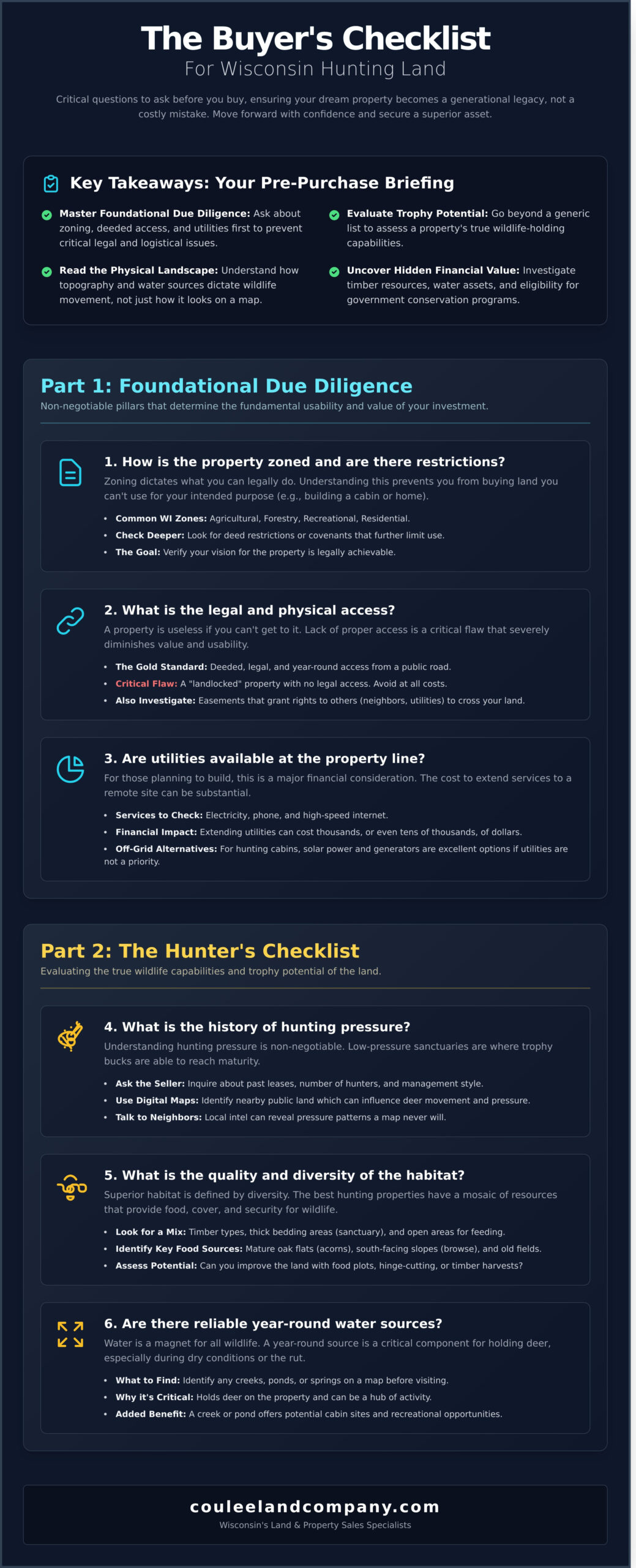
- Master foundational due diligence by asking about zoning, deeded access, and utilities first to prevent critical legal and logistical issues down the road.
- Go beyond a generic list with specific questions to ask when buying land in Wisconsin that evaluate a property’s true trophy potential and wildlife-holding capabilities.
- Learn how to read the physical landscape-from topography to water sources-to understand how wildlife actually uses the property, not just how it looks on a map.
- Uncover a property’s hidden financial value by investigating its timber resources, water assets, and eligibility for government conservation programs.
Table of Contents
- Foundational Due Diligence: Zoning, Access, and Utilities
- The Hunter's Checklist: Questions About Wildlife and Habitat
- The Lay of the Land: Topography, Boundaries, and Environment
- Investment Potential: Timber, Water, and Government Programs
- The Final Steps: Legal and Financial Questions for Closing
Foundational Due Diligence: Zoning, Access, and Utilities
Before you even step foot on a potential property, there are three non-negotiable pillars of due diligence that every serious buyer must investigate: zoning, access, and utilities. These are the most important questions to ask when buying land in wisconsin because the answers determine the fundamental usability and value of your investment. Answering them first prevents costly legal and logistical headaches, ensuring the parcel you buy can actually fulfill your dream of a hunting retreat or family legacy property. Remember, the rules governing rural acreage are vastly different from a suburban lot.
To better understand these core concepts, watch this helpful overview from a fellow land expert:
How is the property zoned and are there restrictions?
Zoning dictates what you can legally do with your land. In Wisconsin, common classifications include Agricultural, Forestry, Recreational, and Residential, each with its own set of rules. A deep dive into the local ordinances is essential for understanding land-use planning and its impact on your goals. Beyond zoning, look for deed restrictions or covenants that could further limit your ability to build a hunting cabin, home, or outbuildings. We always verify these details to ensure your vision for the property is achievable.
What is the legal and physical access to the property?
A property is useless if you can’t get to it. You must confirm there is deeded, legal, and year-round access from a publicly maintained road. A parcel without this is considered “landlocked,” a critical flaw that severely diminishes value and usability. Also, investigate any easements on the property. An easement grants specific rights to others-like a utility company or a neighbor-to cross your land, which is a crucial detail for any landowner to know.
Are utilities available at the property line?
For those planning to build, utility access is a major financial consideration. Determine if electricity, phone service, and high-speed internet are available at the property line. If they aren’t, the cost to extend these services to a remote build site can be thousands or even tens of thousands of dollars. For a simple hunting cabin or a true off-grid experience, this may not be a concern, as solar power and generators are excellent alternatives.
The Hunter’s Checklist: Questions About Wildlife and Habitat
A generic checklist won’t help you find a world-class hunting parcel. For the serious land buyer, the true value is found in the wildlife capabilities and trophy potential. The following questions to ask when buying land in Wisconsin are designed to help you think like a deer, evaluating a property not just for its acreage, but for its ability to grow and hold mature whitetails. A property’s history and its neighborhood are just as critical as the habitat within its boundaries.
4. What is the history of hunting pressure on the property and surrounding area?
Understanding pressure is non-negotiable. Ask the seller directly about past hunting leases, the number of hunters, and their management philosophy. Then, expand your view. Use digital mapping tools to identify nearby public land, which can significantly influence deer movement. Don’t underestimate local intel; a conversation with neighbors can reveal patterns of pressure that a map never will. Low-pressure sanctuaries are where trophy bucks reach maturity.
5. What is the quality and diversity of the habitat?
Superior habitat is defined by diversity. Look for a strategic mix of timber types, thick bedding areas that provide sanctuary, and open areas for feeding. Identify key food sources like mature oak flats for acorns, south-facing slopes for browse, and old fields. The best hunting properties in Wisconsin have this mosaic of resources. Critically assess the land’s potential: can you improve it with strategic food plots, hinge-cutting for bedding, or a select timber harvest?
6. Are there reliable year-round water sources?
Water is a magnet for wildlife. Before walking the property, identify any creeks, ponds, or springs on a map. A year-round water source is a critical component for holding deer, especially during dry conditions or the rut. The presence of a creek also offers potential cabin sites, though it requires diligent planning, such as understanding the guidelines for maintaining a septic system on shoreline property to protect the very ecosystem you’re investing in.
7. What is the evidence of a healthy deer population?
The land itself tells a story. When you walk the property, your eyes should be peeled for last season’s rubs, active scrapes, and well-worn trails connecting bedding to food. This is one of the most important questions to ask when buying land in Wisconsin-what proof exists? Ask the current owner for trail camera pictures from previous years; this provides undeniable evidence of the local herd’s age structure and genetics. A property’s reputation often precedes it, especially in legendary destinations like Buffalo County.
The Lay of the Land: Topography, Boundaries, and Environment
A plat map tells you one story, but walking the property tells you the complete story. Understanding the physical characteristics of a parcel is fundamental to maximizing its potential, whether for hunting, building, or pure enjoyment. The contours, borders, and environmental features dictate how you will use and access your investment. Answering these specific physical-property questions to ask when buying land in wisconsin is non-negotiable for any serious buyer.
8. How does the topography influence deer movement and stand locations?
For the whitetail hunter, topography is everything. You must analyze the terrain for natural funnels that dictate deer movement. Look for:
- Ridges and Saddles: Classic travel corridors that concentrate deer activity.
- Pinch Points and Benches: Natural bottlenecks and rest areas where trophy bucks feel secure.
In Wisconsin’s famed Bluff Country, the steep terrain presents both unique challenges and amazing advantages. The key is determining how you can access potential stand locations using the topography to conceal your entry and exit without spooking game from bedding or feeding areas.
9. Are the property boundaries clearly marked?
Ambiguous property lines are a recipe for neighbor disputes and legal headaches. When you walk the land, actively look for survey stakes, old fence lines, or blazed trees that indicate a boundary. If the lines are unclear or seem questionable, your best insurance policy is a new survey. A certified survey map provides legal certainty, protects your investment, and is an essential tool for planning food plots, trails, and cabin sites with confidence.
10. Are there any environmental concerns like wetlands or floodplains?
Environmental designations can significantly impact your land management plans. We always advise clients to consult Wisconsin DNR maps to identify any designated wetlands, floodplains, or protected areas. These features often come with building restrictions, but they are also magnets for wildlife and can create incredible sanctuary areas. Understanding how a wetland or creek bottom might affect access to other parts of your property is one of the most important practical questions to ask when buying land in Wisconsin.
Investment Potential: Timber, Water, and Government Programs
A superior tract of Wisconsin land is more than a recreational paradise; it’s a hard-working asset that can generate income and build legacy wealth. The value of a property often extends far beyond its acreage. By exploring its natural resources and existing agreements, you can uncover hidden financial potential. These are some of the most critical questions to ask when buying land in wisconsin to assess its long-term investment value. This is precisely where a true land specialist provides immense value over a standard realtor, turning a good purchase into a great one.
11. Is there valuable timber and is there a management plan?
The woods on your property can be a significant financial resource. Identifying the primary tree species-like valuable red oak, hard maple, or stands of mature pine-is the first step. A qualified forester can determine if the timber is ready for a select harvest, which can provide immediate income to offset your purchase price. A well-executed Timber Stand Improvement (TSI) plan not only increases the future value of your forest but also dramatically improves the wildlife habitat, creating the bedding and browse needed to hold mature whitetail bucks.
12. What are the water features and what are the rights?
Water is a prized asset that adds immense recreational and monetary value. If the property borders a creek or river, you must determine if it’s legally navigable, as this dictates public access and your rights to the frontage. For lakefront parcels, understanding your riparian rights is essential-it governs your ability to place a dock, pier, or boat lift. These features create amazing opportunities for world-class fishing and prime waterfowl hunting, making the property significantly more desirable.
13. Is the land enrolled in any government programs (MFL, CREP)?
Understanding government programs is one of the most overlooked yet vital questions to ask when buying land in wisconsin. Enrollment can offer substantial tax savings but also comes with specific obligations that affect how you use the land. Key programs include:
- Managed Forest Law (MFL): Offers a significant property tax reduction in exchange for following a written forest management plan. Some MFL lands must be open to the public for hunting, fishing, and recreation.
- Conservation Reserve Enhancement Program (CREP): Provides payments to landowners who convert environmentally sensitive land to vegetative cover, often through permanent easements that restrict future development.
Navigating these agreements is complex, but the team at Coulee Land Company has the expert knowledge to help you understand how they impact your investment and your vision for the property.
The Final Steps: Legal and Financial Questions for Closing
You’ve walked the property lines, envisioned your deer stand, and found the perfect piece of Wisconsin. Now, it’s time to secure the deal correctly. The final stage of the transaction is where your investment is either protected or put at risk. These are among the most critical questions to ask when buying land in wisconsin, as the answers directly impact your ownership rights and the future of your property. This is precisely where a dedicated land specialist proves their immense value-don’t be afraid to ask these tough questions before you sign.
14. Is a recent survey available or should I get a new one?
A property’s boundaries on a map can be deceiving. A recent, official survey is the only way to verify the exact acreage and boundary lines you are purchasing. A Certified Survey Map (CSM) is a legal document that definitively outlines the property, identifies any encroachments, and confirms access. Lenders will require it for financing, and the county will demand it for building permits, making it an non-negotiable step in your due diligence.
15. Who owns the mineral, water, and timber rights?
Many first-time land buyers are surprised to learn that the rights to what’s below the surface (minerals) and what grows on it (timber) can be sold separately from the land itself. You must confirm that all rights-mineral, water, and timber-are intact and will be transferred to you at closing. Owning the land without owning these rights could severely limit your control and the property’s future value.
16. Will I receive clear title and a title insurance policy?
A “clear title” is one that is free of any liens, claims, or ownership disputes from previous owners. It is absolute proof of your ownership. To protect this, you will receive a title insurance policy. This is a one-time purchase at closing that defends you against any future legal challenges to your title that stem from past events. The expert guidance for buyers you receive should always include a thorough title search to ensure it’s clear before you close.
17. Why should I use a specialized land agent?
A residential realtor sells houses; a land specialist understands the dirt, the habitat, and the dream of owning a legacy property. Unlike a typical agent, a land specialist has deep expertise in complex rural transactions, including timber valuation, wildlife management potential, conservation easements, and navigating rural zoning. They speak the language of the outdoorsman and know what it takes to find and secure a premier hunting property in Wisconsin’s famed Bluff Country. Partner with an expert who shares your passion by visiting us at CouleeLandCompany.com.
From Questions to Closing: Secure Your Wisconsin Legacy
Purchasing property is one of the most significant investments you’ll ever make. This checklist ensures you’re prepared, covering everything from foundational due diligence on zoning and utilities to the specific details of wildlife habitat and investment potential. Arming yourself with the right questions to ask when buying land in wisconsin is the critical first step toward owning your dream property and avoiding costly mistakes.
However, you don’t have to navigate this complex process alone. At Coulee Land Company, we are more than agents; we are a team of passionate hunters and land experts with unparalleled expertise in Western Wisconsin’s famed ‘Bluff Country.’ We specialize in Trophy Whitetail Properties and understand the land’s true potential because we live it ourselves. Let our experience be your advantage.
Ready to turn your dream into a deed? Start your search with Wisconsin’s Land & Property Sales Specialists. Your piece of the Wisconsin outdoors is waiting.
Frequently Asked Questions
What is Managed Forest Law (MFL) in Wisconsin and is it a good thing?
Managed Forest Law (MFL) is a Wisconsin DNR program offering significant property tax reductions in exchange for following a sustainable forestry plan. For the dedicated land steward, it’s an excellent tool for enhancing timber value and wildlife habitat. The critical distinction is between MFL-Open, which requires allowing public access for hunting and recreation, and MFL-Closed, which keeps your land private. Understanding this difference is essential for achieving your ownership goals.
How do I find out about the hunting culture and pressure on neighboring properties?
Gauging hunting pressure requires boots-on-the-ground diligence. We advise clients to speak directly with potential neighbors-their insights are invaluable. Visiting the property during various seasons reveals activity levels. Additionally, contacting the local DNR warden can provide a professional perspective on the area’s hunting culture. Analyzing aerial maps for access points and visible tree stands on adjacent parcels will also paint a clear picture of the surrounding environment.
Is land in Buffalo County really that much better for trophy whitetail hunting?
Buffalo County’s reputation is legendary for a reason; it consistently dominates the Boone and Crockett record books for trophy whitetails. The unique combination of fertile agriculture and steep, wooded bluffs creates the perfect environment for growing mature bucks. While Buffalo County is the epicenter, the surrounding “Bluff Country” counties like Trempealeau and Vernon share this superior habitat and genetic potential, offering amazing opportunities for the discerning hunter seeking a world-class property.
Do I absolutely need a new survey before buying a large rural property?
While not always mandated, we consider a new survey an essential investment for any serious land buyer, especially with large rural tracts. An updated survey provides absolute certainty on boundary lines, preventing costly disputes with neighbors down the road. It definitively identifies legal access, clarifies any existing easements, and ensures you are getting exactly the acreage you are paying for. Forgoing a survey is a risk that a prudent buyer should not take.
What’s the biggest mistake first-time land buyers make in Wisconsin?
The single biggest mistake we see is overlooking the critical importance of access. First-time buyers can be captivated by a property’s habitat but fail to analyze how they will enter and exit for hunting without alerting game. Poor access can render a prime hunting parcel virtually useless. This is why “What is the legal and practical access?” is one of the most vital questions to ask when buying land in wisconsin, ensuring your investment is both usable and valuable.
Can I get financing for raw land, and is it different from a home mortgage?
Securing financing for raw land is a distinct process from a standard home mortgage. Lenders typically view raw land as a riskier investment, often requiring a larger down payment-typically 20-35% or more-and a higher interest rate. It’s crucial to partner with a financial institution that specializes in land or agricultural loans, as they understand the unique value and potential of these properties and can guide you through the process.