
Owning a piece of Buffalo County isn’t just a real estate transaction; it’s a strategic investment in the world’s premier whitetail dirt that requires much more than a simple down payment. While the dream of watching a trophy buck cross your own ridge top is powerful, the reality of the 2026 market means you can’t afford to overlook the true Costs of acquisition and ownership. You likely already understand that the finest Bluff Country properties demand a premium, yet the fear of hidden fees or fluctuating tax rates often keeps serious hunters on the sidelines. We’ve seen too many buyers hesitate because they don’t have a clear picture of the financial commitment beyond the sticker price.
We’re here to eliminate that uncertainty by providing a transparent breakdown of every expense involved in Wisconsin land ownership. You’ll learn how to budget for initial closing fees and understand the specific property tax structures that impact your bottom line. We’ll also show you how strategic habitat management investments translate directly into trophy potential and long-term land value. This guide provides the line-item clarity you need to move from browsing listings to signing a deed with absolute confidence in your ROI.
Key Takeaways
- Master the total acquisition process by identifying the specific closing fees and transfer taxes required to secure your piece of Wisconsin’s legendary hunting grounds.
- Uncover the strategic advantages of the Managed Forest Law (MFL) and how this program can drastically reduce the annual tax burden on your timberland investment.
- Navigate the essential Costs of professional land management, from maintaining secluded access roads to securing boundary lines for ultimate privacy and wildlife security.
- Evaluate long-term ROI by analyzing land appreciation trends in the Driftless Area and exploring ways to generate passive income through agricultural leases.
The Upfront Costs of Wisconsin Land Transactions
Securing a premier hunting tract in Western Wisconsin involves more than just a handshake and a high bid. Many buyers focus solely on the list price, but the total acquisition Costs include title work, state mandates, and specialized due diligence. You’re investing in a legacy, and that requires a clear understanding of the financial landscape before the first trail camera is hung.
Failing to account for these items can stall a closing or lead to expensive surprises after the deed is recorded. Whether you’re eyeing a ridge-top in Buffalo County or a hidden valley in the Driftless Area, the price on the sign is just the starting point of the transaction.
To better understand the scale of these investments, watch this video detailing a premier Wisconsin land offering:
Closing Costs and Transfer Fees in 2026
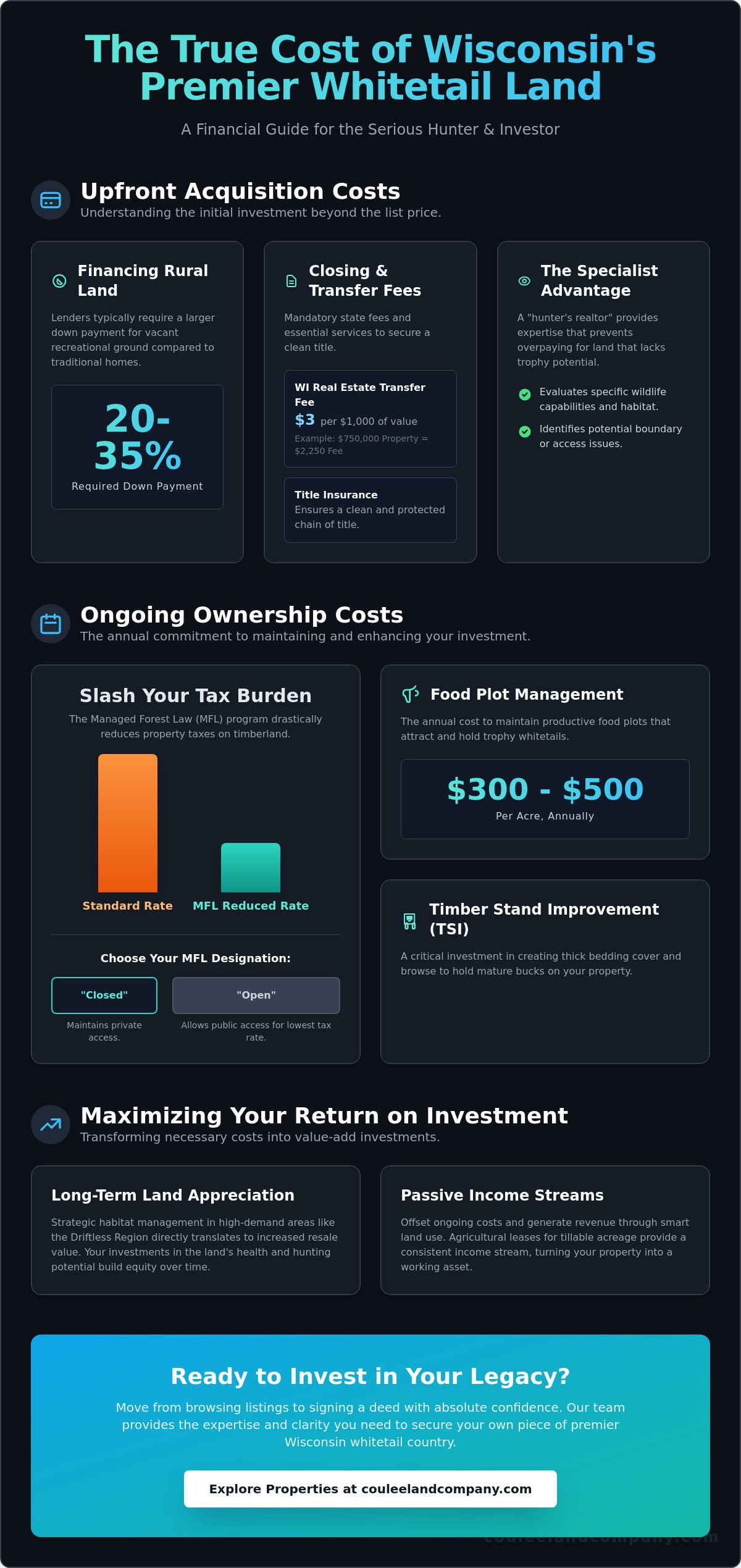
Wisconsin law mandates a Real Estate Transfer Fee, which remains $3 per $1,000 of value in 2026. On a $750,000 Bluff Country property, this results in a $2,250 fee. Buyers should also calculate the impact of property taxes, which vary significantly by county and land classification. Before closing, it’s vital to verify current title insurance rates to ensure the chain of title is clean and protected. You can find a detailed roadmap of these steps on our Buyers Page.
The Value of a Land Specialist
A “regular” realtor often lacks the boots-on-the-ground experience to spot a boundary dispute or evaluate trophy potential. Our team functions as “the hunter’s realtor,” identifying the specific wildlife capabilities of a parcel before you commit. This expertise prevents you from overpaying for land that lacks the necessary habitat or access. Review our hunting properties to see how we evaluate land differently than a standard residential brokerage.
Financing recreational ground requires a different strategy than a traditional home loan. Most lenders in 2026 demand a down payment between 20% and 35% for vacant land. If the property includes tillable acreage, you might secure different terms through agricultural credits. We recommend speaking with lenders who specialize in rural land to avoid the pitfalls of high-interest personal loans. These specific Costs are manageable when you have the right data from the start.
Ongoing Ownership: Taxes, Maintenance, and Management
Owning a piece of the Coulee Region involves more than the initial purchase price. It requires a commitment to the land that ensures your investment appreciates and your deer herd thrives. These ongoing Costs represent the difference between a simple plot of woods and a premier hunting sanctuary. From property taxes to infrastructure, successful landowners plan for these expenses long before the first frost hits.
Managed Forest Law (MFL) and Tax Savings
Managed Forest Law (MFL) serves as Wisconsin’s primary tax-reduction tool for landowners by incentivizing sustainable forestry over residential development. By enrolling in this program, you can significantly reduce the taxes on your wooded acres compared to standard agricultural or residential rates. The program offers a trade-off: “Open” land allows public access for the lowest tax rate, while “Closed” land maintains your privacy for a slightly higher, yet still discounted, fee. Most serious hunters opt for the “Closed” designation to protect their trophy sanctuaries from outside pressure.
Budgeting for Trophy Whitetail Management
High-quality food plots are the backbone of any successful hunting tract in the Midwest. You should budget approximately $300 to $500 per acre annually for premium seed, lime, and fertilizer to keep these plots productive. Timber Stand Improvement (TSI) is another critical investment. While TSI requires either personal labor or hiring a professional forester, it creates the thick bedding cover and browse necessary to hold mature bucks on your acreage. In high-demand areas like Buffalo County, adhering to these management standards is essential for maintaining the property’s elite status and resale value.
Maintaining the price of privacy also requires regular infrastructure work. You’ll need to account for the following recurring tasks:
- Annual grading and graveling of access roads to prevent erosion.
- Repairing perimeter gates and replacing “No Trespassing” signs every 2 years.
- Clearing downed timber from internal trail systems after summer storms.
- Paying for recreational land insurance to provide liability coverage for guests and hunters.
If you want to see how these management strategies look on the ground, explore our current hunting properties to find a tract that fits your goals. Proper planning ensures your land remains a legacy for generations rather than a financial burden.
Maximizing ROI: When Costs Become Investments
Owning a piece of the driftless region is a strategic financial move. Over the last decade, land appreciation in the “Bluff Country” has remained remarkably steady, often outperforming traditional portfolios. These aren’t just ownership costs; they’re capital investments in a finite, high-demand resource. Savvy buyers recognize that documented land management, such as established food plots and timber stand improvements, adds tangible value when it’s time to exit the property. To lower your annual carry, you should utilize the Wisconsin Forest Tax Law Programs. These programs significantly reduce property tax burdens for landowners committed to sustainable forestry.
Income Generation Strategies
You don’t have to shoulder the carrying costs alone. Hunting leases in Western Wisconsin currently command between $25 and $50 per acre, depending on the trophy potential and access. For a 160-acre tract, that’s a substantial annual return. Additionally, the Conservation Reserve Program (CRP) provides steady government payments for taking sensitive land out of production. If you’re eventually selling hunting land in Wisconsin, having these verified income streams on the books makes your property far more attractive to investment-minded buyers.
The Premium of Buffalo County
Buffalo County consistently dominates the Boone and Crockett record books, which creates a unique real estate micro-market. While the entry price is higher, the long-term value is superior. This region holds its worth during market fluctuations because the demand for world-class whitetail habitat is constant. If you want to understand the true market position of your acreage, contact Mike Law for a professional valuation. We specialize in telling the “story” of your land, from the trail cam history to the strategic bedding thickets, ensuring you capture every bit of equity at the closing table.
When you decide to sell, expect a commission structure between 6% and 10%. This fee covers specialized marketing that targets a national audience of serious hunters. We don’t just put a sign in the ditch. We use high-end boots-on-the-ground video and mapping to prove the property’s wildlife capabilities to buyers across the country.
Claim Your Stake in Wisconsin’s Premier Hunting Grounds
Navigating the financial landscape of land ownership requires more than just a down payment. You’ve seen how initial transaction fees and ongoing management expenses define the true bottom line. Understanding the 2026 market means accounting for shifting property tax rates and the specific Costs associated with maintaining superior wildlife habitat. Our team specializes in Managed Forest Law strategies that can reduce property tax burdens by approximately 80 percent for eligible landowners, according to Wisconsin DNR guidelines. We focus our expertise on the legendary Bluff Country, particularly Buffalo County, which consistently leads the nation in Boone and Crockett whitetail entries. This specialized knowledge is why top outdoor TV personalities and serious hunters trust us as their land specialists. Don’t leave your legacy to chance when you can partner with experts who live and breathe the Wisconsin outdoors. We’re here to help you turn a simple purchase into a high-performing asset that delivers both trophy potential and financial security.
Ready to invest? View our exclusive Wisconsin hunting land listings.
Your piece of Wisconsin’s hunting heritage is waiting for you.
Frequently Asked Questions
What are the typical closing costs for a land buyer in Wisconsin?
Wisconsin land buyers should budget between 2% and 4% of the total purchase price for their closing costs. These expenses include title insurance, loan origination fees, and recording fees. On a $400,000 acquisition in the Coulee Region, you’ll likely pay between $8,000 and $16,000 at the closing table. Our team ensures every line item is transparent so you aren’t surprised by hidden fees when securing your hunting ground.
How much does it cost to maintain 40 acres of hunting land annually?
Annual maintenance for a 40-acre parcel typically ranges from $2,000 to $4,500 depending on your specific habitat goals. These costs cover property taxes, food plot seed, fertilizer, and trail upkeep. If you’re managing for trophy whitetail bucks, you’ll spend more on specialized improvements like hinge cutting or native grass plantings. It’s a pragmatic investment that transforms a standard woodlot into a superior wildlife sanctuary.
Does Wisconsin offer tax breaks for recreational landowners?
The Managed Forest Law (MFL) program provides the most effective tax relief for Wisconsin landowners, often reducing property tax bills by 75% or more. Participants follow a written forestry plan approved by the Department of Natural Resources to promote sustainable timber growth and wildlife habitat. By enrolling your acreage, you trade a long-term commitment for substantial annual savings. It’s an expert strategy we recommend to clients looking to maximize their land’s value and wildlife capabilities.
What is the average cost of a hunting lease in Buffalo County?
Hunting leases in Buffalo County currently command between $45 and $85 per acre per year. This premium reflects the county’s status as the top producer of Boone and Crockett whitetails in the United States. High demand for these legendary limestone ridges means a 40-acre lease can easily exceed $3,000 annually. Many hunters find that these rising rates make purchasing their own property a more logical financial decision for the long term.