
While traditional markets saw a 4.8% volatility spike in the first quarter of 2026, the smartest capital stayed rooted in the high-grade silt loam of the Mississippi River bluffs. You’ve likely realized that standard index funds can’t offer the tangible stability described in this Guide to Tillable Farmland Investments in Wabasha County, especially when you’re searching for “A” grade soil that rarely hits the open market. Balancing a 3.5% annual cash rent return with the undeniable draw of a private hunting retreat is the ultimate goal, yet many available tracts fail to deliver on both fronts.
We’ll show you how to secure premier ground that serves as both a financial fortress and a gateway to trophy whitetail hunting. You’ll discover why this county’s unique topography creates a superior investment environment compared to flatter, less diverse regions. We’re going to analyze current market data, soil productivity ratings, and the specific management strategies we use at Coulee Land Company to ensure your 2026 acquisition delivers maximum ROI from the first harvest through the peak of the November rut.
Key Takeaways
- Master the unique geography of “Bluff Country” to identify high-yield plateaus and current 2026 market benchmarks for premium acreage.
- Decode the Minnesota Crop Productivity Index (CPI) to ensure you are investing in superior Fayette and Seaton silt loam soil profiles.
- Explore this Guide to Tillable Farmland Investments in Wabasha County to capitalize on the dual-asset advantage where agricultural income meets trophy whitetail habitat.
- Execute rigorous due diligence by verifying “Green Acres” tax status and evaluating drainage tile infrastructure before committing to a purchase.
- Learn why partnering with a “Hunter’s Realtor” provides exclusive access to off-market listings and deeper insights into a property’s true wildlife potential.
Understanding the Wabasha County Farmland Market in 2026
Wabasha County isn’t just another stop along the Mississippi River. It’s a cornerstone of the Driftless Area where the geography dictates the economy. The region is defined by its “Bluff Country” plateaus, which offer some of the most productive silt-loam soils in the Midwest. Unlike the flat plains of Western Minnesota, Wabasha County, Minnesota features a rugged terrain that creates isolated, high-yield pockets of tillable land. These ridge-top fields are the gold standard for local agriculture, providing excellent drainage and sunlight exposure that valley floors often lack.
To better understand the fundamentals of land acquisition and management, watch this helpful video:
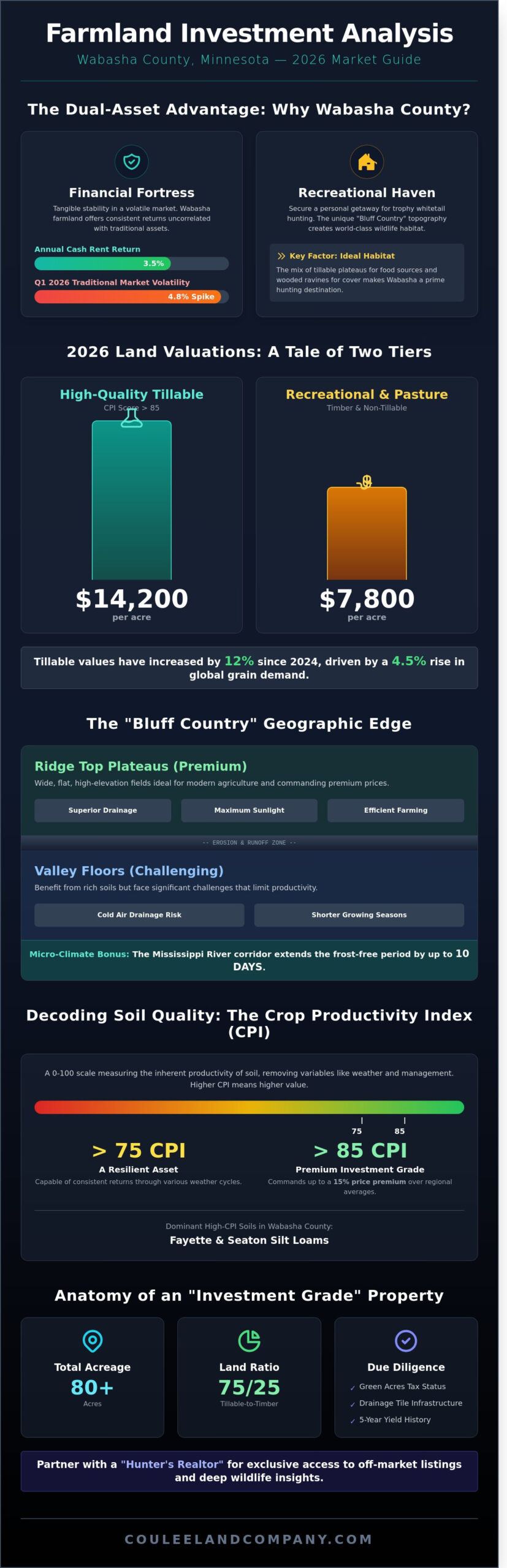
The 2026 market shows a clear divide in valuation based on land utility. High-quality tillable tracts with a Crop Productivity Index (CPI) above 85 currently average $14,200 per acre. In contrast, permanent pasture and recreational timber land sit closer to $7,800 per acre. This price gap reflects a 12% increase in tillable values since 2024, driven by a 4.5% rise in global grain demand and a shrinking inventory of available acreage. This Guide to Tillable Farmland Investments in Wabasha County highlights that “Investment Grade” properties typically consist of at least 80 acres with a tillable-to-timber ratio of 75/25 or better.
The Geography of Investment: Valley Floor vs. Ridge Top
Ridge-top farms command a premium in 2026 because they offer superior farmability. Modern equipment is massive, and wide, flat plateaus allow for efficient planting and harvesting without the risks of steep slope erosion. While valley floors benefit from rich alluvial soils, they face shorter growing seasons due to cold air drainage. The Mississippi River corridor creates a unique micro-climate that can extend the frost-free period by 10 days, a critical factor for corn heat unit accumulation. Serious buyers prioritize these high-elevation tracts for consistent year-over-year yields.
Wabasha County vs. Neighboring Markets
Wabasha County remains a strategic entry point for 1031 exchange investors. Compared to Buffalo County, Wisconsin, where land prices are often inflated by trophy whitetail demand, Wabasha offers a more balanced valuation between agricultural production and recreational value. Winona County to the south shares similar topography, but the Zumbro River valley in Wabasha provides a concentrated belt of high-productivity soil that outperforms neighboring districts. In 2026, Wabasha’s land scarcity is more pronounced, with only 15% of the county’s total acreage hitting the open market in the last 24 months. This Guide to Tillable Farmland Investments in Wabasha County confirms that local scarcity is a primary driver of long-term equity growth.
Soil Quality and the Crop Productivity Index (CPI)
Investors prioritize soil quality above all other factors when evaluating a property’s long-term value. In the 2026 market, the Minnesota Crop Productivity Index (CPI) serves as the definitive benchmark for land valuation. It removes the variables of management and weather to focus strictly on the inherent capability of the dirt. High-performing parcels in Wabasha County frequently command a 15% premium over regional averages when weighted CPI scores exceed 85. Understanding how these numbers translate to the bottom line is a vital part of any Guide to Tillable Farmland Investments in Wabasha County.
Decoding the Silt Loams of the Driftless Area
The Driftless Area is famous for its deep, wind-blown loess soils that create a powerhouse for corn and soybean production. Fayette and Seaton silt loams dominate the most productive ridges in the county. These soils possess incredible water-holding capacity, while the underlying karst topography provides natural internal drainage. This combination prevents the “wet feet” that can plague flatter regions in Western Minnesota during heavy spring rains. The Crop Productivity Index (CPI) is a 0-100 scale measuring inherent soil productivity. When you identify ground with a weighted average CPI above 75, you’ve found a resilient asset capable of consistent returns through various weather cycles.
Yield History and Modern Precision Ag
Savvy buyers don’t just look at soil maps; they verify performance through USDA-FSA records. We recommend reviewing at least 5 years of historical yield data to ensure the soil’s potential translates to actual grain in the bin. In the current 2026 landscape, precision agriculture has changed the game for “Bluff Country” fields. Modern variable rate technology allows operators to maximize every square foot of irregularly shaped fields, turning what used to be difficult terrain into high-efficiency acreage.
Investors are also looking closer at “hidden” tillable acres found in valley floors. These areas often feature rich alluvial deposits that offer massive yield spikes compared to traditional ridge tops. These valley tracts are becoming highly sought after as drainage technology improves. If you’re ready to analyze specific tracts and their revenue potential, our team of land specialists can help you identify the highest-yielding dirt available. This data-driven approach is the only way to ensure your Guide to Tillable Farmland Investments in Wabasha County leads to a profitable acquisition.
The Dual-Asset Advantage: Agriculture Meets Trophy Hunting
Owning land in Wabasha County in 2026 means more than just harvesting grain. Savvy investors realize that a comprehensive Guide to Tillable Farmland Investments in Wabasha County must prioritize the “Edge Effect.” This biological phenomenon occurs where fertile tillable acreage meets dense timber bedding. Deer and other wildlife thrive on these boundaries. When you plant corn or alfalfa rotations, you aren’t just growing a crop for the local elevator; you’re maintaining a massive, income-producing food plot that attracts and holds mature bucks.
Agricultural income typically covers 100% of the property’s annual carrying costs. Property taxes and insurance can be a burden on purely recreational land, but tillable acres flip the script. Cash rents in the region currently average $275 to $365 per acre for high-quality soils. This revenue provides a steady floor for your investment while the land appreciates. The “Recreational Premium” adds a significant layer of value on top of the dirt. In 2026, buyers often pay a 20% to 30% premium for tillable tracts that offer documented trophy hunting potential compared to land that is strictly agricultural.
Wabasha County: The Minnesota Answer to Buffalo County
Wabasha County shares the same rugged topography and limestone-rich soils as its famous neighbor across the river. It’s the Minnesota equivalent to Buffalo County, a region that consistently dominates record books. The Mississippi River bluffs create natural funnels and pinch points. These geographical features force deer to travel through specific corridors between their bedding on the steep ridges and the tillable fields in the valleys. You can predict movement patterns with surgical precision by analyzing how these fields dictate travel routes. This predictability is what transforms a standard farm into a world-class hunting destination.
Leasing Opportunities for Passive Income
Landowners can stack their revenue streams by combining agricultural cash rent with a seasonal hunting lease. In 2026, hunting lease rates for prime bluff country ground range from $35 to $60 per acre depending on the timber-to-tillable ratio. Before you sign any agreements, it’s vital to consult the Minnesota Hunting and Trapping Regulations to ensure all activities on your property remain compliant with current state laws. A well-structured lease protects your investment by defining specific access points, parking areas, and harvest requirements. This strategy ensures your land pays for itself while you build equity in one of the most sought-after zip codes in the Midwest. Using a Guide to Tillable Farmland Investments in Wabasha County helps you identify which tracts offer the best balance of high-yield soil and hunter appeal.
Buying Farmland: Due Diligence and 2026 Regulations
Acquiring high-quality dirt in Wabasha County requires more than a handshake. It demands a rigorous five-step verification process to ensure your capital is protected and your yields are maximized. This Guide to Tillable Farmland Investments in Wabasha County prioritizes technical data over speculation to help you secure a legacy property.
- Step 1: Verify Zoning and “Green Acres” Status. Confirm the property qualifies for the Minnesota Agricultural Property Tax Law. This program defers taxes based on agricultural use rather than market value. In 2026, staying compliant with these regulations is essential for maintaining your bottom line.
- Step 2: Evaluate Infrastructure and Easements. Inspect drainage tile maps and installation dates. Modern perforated plastic systems can increase land value by 15 percent compared to aging clay tiles. You must also check for CRP or RIM restrictions that might limit row-crop production on specific acres.
- Step 3: Analyze ROI. With 2026 corn forecasts stabilizing near $4.80 per bushel, calculate your potential cash rent based on a 3.5 percent to 4.2 percent cap rate. High-CPI (Crop Productivity Index) soils in the Wabasha region consistently command premium rents from local operators.
- Step 4: Confirm Access. Never assume a field road provides legal entry. Conduct a boundary survey to identify potential encroachments. You must ensure recorded easements exist for all equipment access points to avoid future litigation.
- Step 5: Review 2026 Tax Laws. Minnesota’s updated agricultural homestead rules and school building bond credits can significantly reduce your net tax burden. Consult with a land specialist to see how these 2026 shifts affect your specific parcel.
The 1031 Exchange Process for Farmland
Farmland is a premier vehicle for tax-deferred exchanges because it offers a level of stability that volatile equity markets lack. Under Section 1031, you must identify “like-kind” replacement property within 45 days of a sale and close within 180 days. This strategy allows you to roll over 100 percent of your capital gains into new acreage. For expert 1031 guidance and access to off-market tracts, visit the Coulee Land Company Buyers Page.
Understanding Conservation Programs
The 2026 CRP landscape offers lucrative annual payments for marginal land, but it restricts intensive farming. While RIM (Reinvest in Minnesota) easements provide a significant one-time payment, they are permanent and can lower future resale value for buyers seeking 100 percent tillable tracts. We recommend consulting with the local NRCS office in Lake City to explore EQIP grants. These grants often cover 50 percent to 75 percent of the costs for soil health improvements and erosion control projects.
Successful land ownership starts with the right partner. Connect with our land specialists to review current Wabasha County listings and soil maps today.
Why Expert Brokerage Matters for Wabasha Farmland
Investing in the Driftless Area requires more than a basic understanding of commodity prices. It demands an intimate knowledge of how the land breathes. This Guide to Tillable Farmland Investments in Wabasha County emphasizes that value isn’t found just in a spreadsheet; it’s found in the dirt. Traditional agricultural brokers often focus strictly on yield data and soil productivity indexes. While those metrics are vital, they ignore the “Bluff Country” premium that defines this region. Our “Hunter’s Realtor” approach allows us to see the dual-purpose potential that others miss. We identify how a 60-acre tillable tract serves as a high-yield asset while simultaneously acting as the primary food source for trophy whitetails on the adjacent ridges.
Accessing the best ground often happens behind the scenes. In Wabasha County, local relationships are the currency of the real estate market. We estimate that a significant portion of high-quality tillable tracts change hands through off-market transactions before they ever hit a public portal. Our team maintains deep roots in the local community, giving our clients first access to these quiet listings. We don’t just trade properties; we evaluate them with a boots-on-the-ground philosophy. This means walking the drainage ditches, checking the south-facing slopes, and verifying soil health in person. We ensure your investment is positioned for maximum resale value by highlighting its agricultural output and its recreational prestige.
Meet Our Western Minnesota Specialists
Our team brings a specialized toolkit to every transaction. Mike Law is a recognized expert in land management who understands how to enhance the long-term value of a property through strategic improvements. He knows that a well-managed farm produces better returns and attracts higher-quality buyers. Working alongside him, Bryan Lemke helps buyers navigate the technical hurdles of complex land deals. You need a broker who can interpret a soil map and a topo map with equal precision. Whether it’s analyzing a Corn Suitability Rating (CSR2) or identifying a natural travel corridor for wildlife, our specialists provide the expert guidance required for a successful Guide to Tillable Farmland Investments in Wabasha County.
Selling Your Wabasha Legacy
When it’s time to exit your investment, you need a marketing strategy that reaches beyond the local county line. We position Wabasha farmland to a national audience of high-net-worth investors and outdoor enthusiasts who recognize the unique value of the Mississippi River valley. Our strategy focuses on maximizing returns by showcasing the property’s diverse income streams, from cash rent to potential hunting leases. We treat every sale as a legacy. To understand what your property is worth in the current market, visit the Coulee Land Company Sellers Page to start a professional valuation. We provide the data and the reach to ensure your agricultural sale yields the highest possible return.
Secure Your Stake in the 2026 Growing Season
Investing in the driftless region requires more than just a map; it demands a deep understanding of 2026 market dynamics where high CPI soil meets world-class trophy whitetail habitat. This Guide to Tillable Farmland Investments in Wabasha County highlights why elite buyers prioritize properties that balance consistent commodity yields with superior wildlife capabilities. You’ve seen how modern 2026 regulations and 1031 Tax-Deferred Exchange strategies now shape the local landscape. Coulee Land Company has closed over $500M in regional land sales by focusing on these precise data points. Our specialists are endorsed by top outdoor television hosts because we don’t just sell acreage; we secure legacy assets. Whether you’re navigating updated environmental codes or seeking a dual-income property, expert guidance ensures your capital works as hard as the soil itself. You deserve a partner who knows every bluff and bottom in this territory.
View Our Exclusive Wabasha County Land Listings
The right parcel is waiting for you to claim it today.
Frequently Asked Questions
What is the average price per acre for tillable land in Wabasha County in 2026?
The average price for high-quality tillable land in Wabasha County currently ranges between $9,800 and $11,200 per acre in 2026. This Guide to Tillable Farmland Investments in Wabasha County notes that these figures reflect a 4.2% increase from 2025 market values. Prices stay highest in the western townships where large, contiguous tracts allow for maximum machinery efficiency. Soil drainage and road access remain the primary drivers for these premium valuations.
How does the Crop Productivity Index (CPI) affect farmland value in Minnesota?
The Crop Productivity Index (CPI) serves as the primary benchmark for land value because it rates soil on a scale of 0 to 100 based on potential yield. In Wabasha County, soils with a CPI above 85 command a 15% price premium compared to the county average. Investors use this data to calculate potential cash rent yields and long-term appreciation. It’s the most reliable metric for comparing two different parcels objectively.
Can I hunt on tillable land I buy for investment purposes in Wabasha County?
You can absolutely hunt on your investment land, and many owners use this Guide to Tillable Farmland Investments in Wabasha County to find dual-purpose properties. Tillable acres provide essential food sources that draw trophy whitetails from the surrounding timber. By strategically leaving five acres of standing corn, you create a premier hunting destination while maintaining the bulk of your agricultural ROI. It’s a perfect way to blend passion with profit.
What are the property tax benefits of the Minnesota “Green Acres” program?
The Minnesota Green Acres program provides a significant tax deferral by valuing your land based on its agricultural use instead of its potential development value. For an average 160-acre parcel, this can reduce the annual property tax burden by 30% or more. You must maintain a minimum of 10 agricultural acres to qualify for these benefits. It’s a vital tool for long-term land appreciation strategies and keeping carrying costs low for investors.
Is Wabasha County farmland a good hedge against inflation?
Farmland remains a superior hedge against inflation, with Minnesota land values showing a 7.2% annualized return over the last 20 years. While the Consumer Price Index fluctuates, the finite supply of tillable soil ensures steady demand. It’s a tangible asset that produces annual cash flow through tenant leases. This stability makes it a cornerstone for diversified portfolios in 2026. You’re buying a resource that people will always need regardless of the economy.
How do I find a reliable farmer to lease my tillable acres in Western Minnesota?
Finding a reliable tenant requires looking at local production records and speaking with neighbors or land specialists. Most successful investors use three-year cash rent leases to ensure stability for both parties. You can also check the University of Minnesota Extension records to identify high-performing operators in the region. A diligent farmer protects your soil health and ensures your long-term investment remains productive. Local reputation is everything in the farming community.
What is the difference between “Tillable” and “Pasture” land for an investor?
Tillable land is suitable for row crops like corn and soybeans, typically yielding 3% to 4% annual cash returns. Pasture land is used for livestock grazing and usually commands 40% lower rent than high-quality tillable acres. For an investor, tillable land offers higher liquidity and easier management. Pasture often includes rugged terrain that might be better suited for recreational use or timber production. Both have their place depending on your goals.
How much of Wabasha County is considered “Bluff Country”?
Approximately 65% of Wabasha County is defined as “Bluff Country,” part of the unique Driftless Area that escaped the last glaciation. This topography creates a dramatic landscape of 300-foot ridges and deep valleys. While the bluffs offer world-class hunting for trophy bucks, the plateaus and valley floors contain the rich, tillable soil investors prize. This mix of terrain is what makes the region a premier destination for land buyers seeking beauty and utility.