
In 2026, the most profitable acre in Dunn County isn’t just growing corn; it’s simultaneously producing a 4.2% cash rent yield and holding a 160-inch whitetail for the fall season. You’ve likely realized that land remains the ultimate hedge against market volatility, yet the fear of misjudging a Soil Productivity Rating or overpaying in a competitive auction can stall even the most seasoned buyer. This Guide to Tillable Farmland Investments in Dunn County provides the expert clarity you need to identify and acquire high-yield acreage with absolute confidence.
We understand that managing a property from three states away feels daunting when you’re trying to verify 2025 harvest data or negotiate a fair lease. You’ll gain a clear framework for calculating a total ROI that blends traditional crop revenue with premium hunting lease values. We’ll also dive into the specific soil profiles of Western Wisconsin and provide a step-by-step roadmap for executing a 1031 exchange into the heart of the Midwest. By the end of this guide, you’ll have the same tactical advantage we use at Coulee Land Company to secure superior ground for our clients.
Key Takeaways
- Position your portfolio for stability by understanding why Dunn County remains a premier destination for agricultural land and a reliable hedge against market volatility in 2026.
- Master the technical side of land evaluation by identifying high-yield Antigo Silt Loam and utilizing NCCPI data to predict superior corn and soybean production.
- Use this Guide to Tillable Farmland Investments in Dunn County to maximize your total ROI through current cash rent benchmarks and the strategic “Second Lease” hunting rights model.
- Execute a professional-grade due diligence process using our checklist to verify crop histories, chemical records, and specific local township zoning ordinances.
- Future-proof your acreage by exploring how regenerative agriculture and carbon credit programs are creating new revenue streams while preserving long-term land value.
Why Dunn County is a Premier Destination for Farmland Investment in 2026
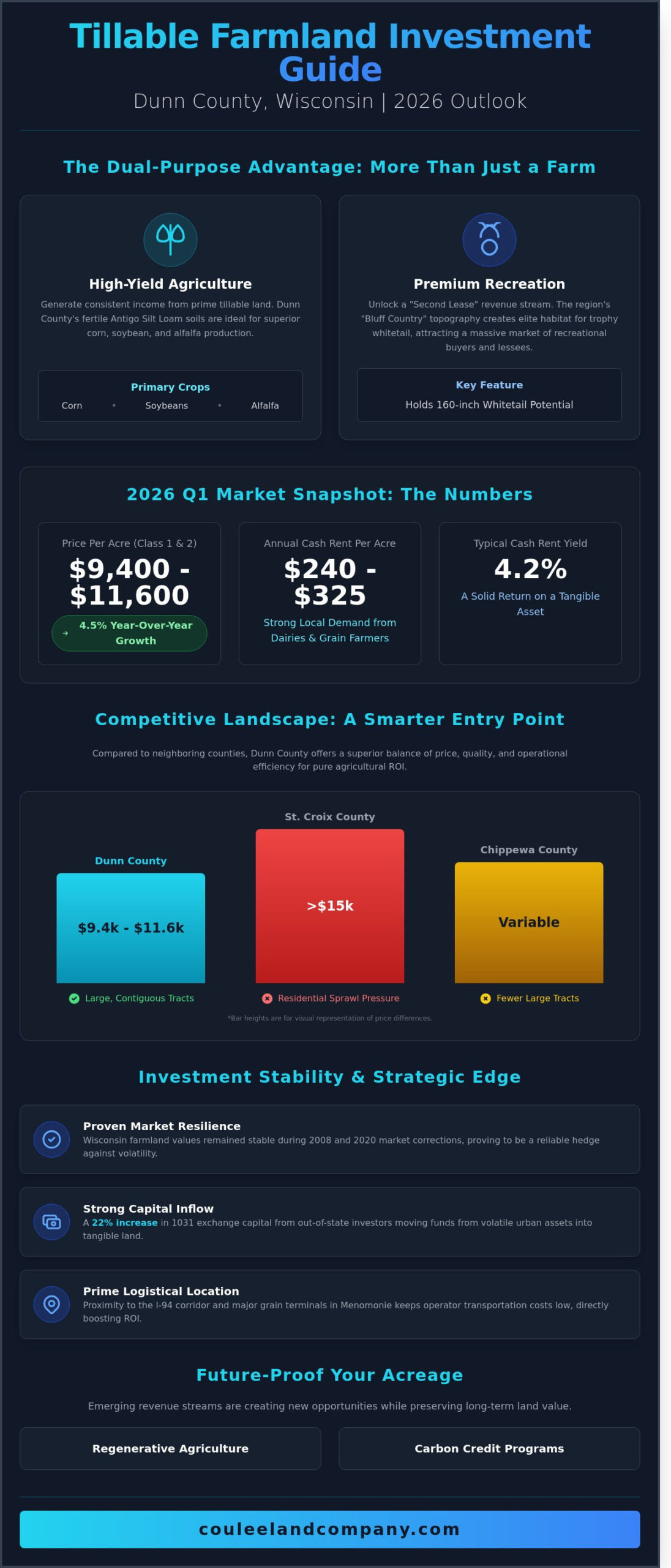
Dunn County stands as a cornerstone of Western Wisconsin’s agricultural economy. As we move through 2026, the region has solidified its reputation as a primary target for those seeking a reliable hedge against market volatility. This Guide to Tillable Farmland Investments in Dunn County highlights why the local landscape, characterized by its unique “Bluff Country” topography, offers more than just scenic views. It provides high-yield potential rooted in some of the state’s most productive silt loam soils. Located within the fertile expanse of Dunn County, Wisconsin, these tracts benefit from a strategic location. Proximity to the I-94 corridor and major grain terminals in Menomonie ensures that transportation costs remain low for operators, directly impacting the bottom line for land owners and tenants alike.
The “Bluff Country” factor is a significant driver of long-term value. Unlike the flat, monoculture landscapes of the deep Midwest, Dunn County features a mix of high-quality tillable plateaus and timbered ridges. This diversity means your investment isn’t just a farm; it’s a dual-purpose asset. If you ever decide to sell, you aren’t just marketing to farmers. You’re also appealing to the massive market of recreational buyers who pay a premium for properties with “wildlife capabilities” and trophy whitetail potential. This exit strategy flexibility adds a layer of security that traditional flatland simply can’t match.
The Current State of the Dunn County Land Market
Recent sales data from the first quarter of 2026 shows that Class 1 and Class 2 tillable tracts in Dunn County are trading between $9,400 and $11,600 per acre. This represents a 4.5% increase over the same period in 2025. While interest rates have leveled off, 2026 acquisition strategies have shifted toward maximizing cash-on-cash returns through aggressive lease structures. When you compare these figures to St. Croix County, where residential sprawl has pushed prices north of $15,000 per acre, Dunn County offers a far more logical entry point for pure agricultural ROI. It remains more competitively priced than Chippewa County, largely because Dunn possesses a higher concentration of large, contiguous tracts that allow for the efficient use of modern, wide-frame planting and harvesting equipment.
Investment Stability in the Chippewa Valley
The Chippewa Valley has a documented history of economic resilience. During the market corrections of 2008 and 2020, Wisconsin farmland values remained remarkably stable compared to traditional equities. In 2026, we’ve seen a 22% increase in 1031 exchange capital flowing into the region from out-of-state investors. They’re moving funds from volatile urban assets into the tangible security of the dirt. Local demand is bolstered by a healthy mix of large-scale dairy operations and cash grain farmers. This competition for land keeps lease rates strong, with prime ground currently fetching between $240 and $325 per acre. This provides a consistent income stream while the underlying asset continues to appreciate.
Success in this market requires more than just a checkbook; it requires an “expert guide” who understands the dirt. Whether you’re looking for a 160-acre corn-and-bean powerhouse or a smaller tract to anchor a 1031 exchange, the fundamentals in Dunn County remain rock solid for 2026. This Guide to Tillable Farmland Investments in Dunn County serves as your starting point for building a legacy in the heart of Wisconsin’s farm country.
- Class 1 Soil Average: $10,800 – $11,600 per acre
- Average Cash Rent: $240 – $325 per acre
- Primary Crops: Corn, Soybeans, Alfalfa
- Key Advantage: Proximity to Menomonie grain terminals
Evaluating Soil Quality and Yield Potential in Western Wisconsin
Successful land ownership starts beneath your boots. When you’re using this Guide to Tillable Farmland Investments in Dunn County, you have to understand the dirt before you look at the price tag. The National Commodity Crop Productivity Index (NCCPI) serves as our primary yardstick for non-irrigated crops. In Western Wisconsin, a high NCCPI rating usually signals the presence of Antigo Silt Loam. It’s the state soil for a good reason. This soil series provides a silty texture that retains moisture during July dry spells while allowing for deep root penetration. You’ll find these high performing soils concentrated in the Town of Grant and the surrounding flats where the glacial outwash created deep, nutrient rich deposits.
The Science of Dunn County Soils
Professional land managers prioritize Evaluating Soil Quality through the lens of long term health and nutrient density. In the Town of Grant, we look for “hidden gem” tracts where organic matter exceeds 3.5 percent. You can identify these on a soil map by looking for darker colorations and specific drainage classifications. To maximize these acres, many investors perform a cost benefit analysis on precision irrigation pivots. While a pivot system requires a significant upfront investment, it can stabilize yields on sandy loam pockets that would otherwise struggle during a drought. We’ve seen pivots turn 140 bushel ground into 210 bushel ground in a single season.
- Antigo Silt Loam: This is the gold standard for corn and soybean rotation in the region.
- Drainage Dynamics: Tiled acreage is a premium asset. Tiling can increase plantable days by 12 days in a wet spring, which is vital for hitting the 2026 yield targets.
- Topography Factors: The “Coulee” region features rolling hills that impact tillable efficiency. A 100 acre parcel might only have 85 “net” tillable acres once you account for the wooded draws and steep contours that define our bluff country.
Predicting Crop Yields for 2026 and Beyond
The Soil Productivity Index is a standardized rating that quantifies a soil’s inherent capacity to produce specific crops based on its physical properties and local climate conditions. This number is a cornerstone of any professional land appraisal. In Dunn County, historical data from 2019 to 2023 shows corn yields averaging 174 bushels per acre. Soybeans typically land between 49 and 53 bushels per acre. Modern land management, including variable rate seeding and precision nitrogen application, is pushing these ceilings toward 215 bushels on premium ground.
We’re seeing a trend where 2026 yield projections are being adjusted upward as farmers adopt no-till practices and cover cropping. These techniques don’t just protect the topsoil; they build the biological engine of the land. If you’re looking to build a portfolio of high quality ground, you can view our current Dunn County listings to compare soil maps and yield histories on active properties. Understanding these metrics ensures that your investment provides a reliable return while maintaining the integrity of the Wisconsin landscape. We don’t just sell dirt; we sell the future production capacity of the finest ground in the Coulee region.
Calculating ROI: Cash Rents, Appreciation, and Recreational Income
Success in land ownership requires looking beyond the surface of the soil to the hard data beneath. This Guide to Tillable Farmland Investments in Dunn County focuses on the three pillars of return: annual cash rent, long-term appreciation, and recreational lease premiums. For the 2026 growing season, cash rent benchmarks for high-quality tillable acres in Dunn County are projected to range between $185 and $265 per acre. These figures depend heavily on the Corn Suitability Rating (CSR) and the ease of access for modern, large-scale equipment. You can verify these trends and access local agricultural census data through the University of Wisconsin Extension – Dunn County Agriculture office, which remains the gold standard for regional crop production stats.
Western Wisconsin land values have shown remarkable resilience over the last decade. From 2014 to 2024, agricultural land prices in the region saw a cumulative increase of approximately 78%. This steady climb reflects a growing scarcity of productive ground and a surge in demand from both institutional investors and local operators looking to expand. Tax burdens are remarkably manageable thanks to Wisconsin’s Use Value Assessment (UVA). This policy ensures that your property is taxed based on its agricultural income potential rather than its speculative residential or commercial market value. It’s a critical tool that keeps your carrying costs low while the asset’s market value matures.
The Dual-Income Stream Model
Maximizing a property’s potential means looking at the land through two different lenses. While tillable acres provide a reliable base yield through grain production, hunting properties in the Dunn County area offer a lucrative second income stream. This “Second Lease” strategy involves renting out hunting rights to dedicated outdoorsmen. In this region, trophy whitetail hunting leases can command between $30 and $55 per acre for high-quality timber and transition zones. Balancing these operations requires a tactical approach. You’ll want to ensure your agricultural tenant completes their harvest before the peak November rut to maintain the property’s appeal to hunting lessees. Integrating food plots and maintaining travel corridors can actually increase the value of both leases simultaneously.
Expense Management for Landowners
Keeping your investment profitable involves a disciplined approach to overhead. For a non-operating owner, property taxes under the UVA system typically land between $18 and $32 per acre. You should also budget for occasional maintenance, such as clearing brush from field edges or maintaining access roads, which can cost roughly 2% of your gross annual income. For marginal acres that struggle with traditional row crops, USDA programs like the Conservation Reserve Program (CRP) or the Conservation Stewardship Program (CSP) provide a safety net. These programs offer guaranteed annual payments in exchange for planting native grasses or pollinator habitats, effectively stabilizing your ROI on less productive ground. If you’re ready to analyze a specific parcel’s numbers, visit our guide for buyers to see current financing options and how they impact your cash flow. This Guide to Tillable Farmland Investments in Dunn County is built on the reality that well-managed land is one of the most secure assets in any portfolio.
Due Diligence: A Step-by-Step Checklist for Buying Dunn County Land
Purchasing agricultural real estate in Western Wisconsin requires a rigorous analytical approach that goes far beyond a simple property walk-through. This Guide to Tillable Farmland Investments in Dunn County serves as your roadmap for verifying the productivity and legal standing of a potential acquisition. You must start by demanding at least five years of yield data and chemical application records. These documents reveal the true health of the soil and any residual herbicide issues that might restrict your choice of crops in the coming season. If a seller cannot provide specific fertilizer inputs or pH balance records from the last 24 months, you should factor the cost of intensive soil testing into your initial offer.
Physical access is a frequently overlooked variable that can break a deal. Modern farming relies on massive equipment. If a field entry is narrower than 20 feet or lacks a reinforced culvert capable of supporting a 30-ton grain cart, you’ll struggle to attract the highest-quality tenants. We look for properties with multiple access points from well-maintained town roads, ensuring that heavy machinery can move safely without damaging the crop or the equipment. Additionally, we check the Wisconsin DNR Surface Water Data Viewer for any designated wetlands or 100-year floodplains. In the rolling terrain of the Coulee Region, erosion control structures like grassed waterways and terraces must be in peak condition to prevent the loss of valuable topsoil during heavy spring rains.
The Legal and Regulatory Landscape
Dunn County’s 22 townships each maintain specific land-use visions that can impact your investment. You must verify if a parcel is enrolled in the Farmland Preservation Program, which provides tax credits but also mandates strict adherence to a nutrient management plan. We investigate every title for existing utility easements or mineral rights that might have been severed in the 1920s. With the rise of renewable energy, checking for neighboring wind or solar leases is vital, as these can impact long-term property values and drainage patterns across the local watershed.
Finding the Right Land Specialist
The gap between a residential agent and a land specialist broker in Wisconsin is vast. A residential realtor looks at square footage; we look at the Corn Productivity Index (CPI) and the percentage of Class II vs. Class III soils. During a property tour, we identify drainage tile outlets and assess the proximity to local grain elevators like the Menomonie or Colfax facilities. Mike Law and our team evaluate tillable tracts for investors by analyzing the historical rental rates of the surrounding five-mile radius. We don’t just sell you a piece of dirt; we help you secure a reliable tenant-farmer who will treat your land like their own. Following this Guide to Tillable Farmland Investments in Dunn County ensures your capital is protected by data and local expertise.
Ready to build your land portfolio with the experts in Bluff Country? Contact Coulee Land Company today to view our exclusive listings of high-yield tillable acreage.
The Future of Farmland: Technology and Sustainability in 2026
Investors in 2026 aren’t just buying dirt; they’re buying data-driven assets that generate multiple revenue streams. Carbon credit markets have matured significantly over the last three years, now providing Dunn County landowners with an additional $25 to $45 per acre in annual revenue. This isn’t speculative income anymore. It’s a verified, contract-backed stream that effectively offsets property taxes and boosts the total ROI of the tract. When you follow this Guide to Tillable Farmland Investments in Dunn County, you quickly realize that sustainability and profitability are now fused together. Regenerative practices like no-till drilling and nutrient management plans are preserving the long-term value of the land by preventing the topsoil erosion that plagued previous generations.
Technology has removed the “remote” from remote land ownership. We now utilize advanced drone technology to monitor investments from anywhere in the world. High-resolution multispectral imagery identifies nitrogen deficiencies or pest outbreaks across a 200-acre field in less than twenty minutes. This level of oversight ensures your investment remains productive and your tenant remains accountable. It’s about precision and protection. Tillable land remains the “Gold Standard” of rural real estate because it provides a triple-threat return: reliable cash rent, emerging carbon payments, and steady capital appreciation. In a volatile financial market, the productive soils of Western Wisconsin offer a physical stability that stocks and bonds simply can’t replicate.
Emerging Trends in Wisconsin Agriculture
Wisconsin’s Department of Agriculture reported a 18% rise in cover crop acreage since 2023. This shift is driven by the bottom line. High-quality soil with 4% or higher organic matter content commands a premium price on the resale market. Modern leasing has also gone digital. GPS-guided leasing now allows owners to review real-time yield data from the harvester. This transparency ensures you’re getting a fair share of the production. The “ideal” farm tenant has changed; owners now prioritize operators who use variable rate technology to maximize every square foot while maintaining soil health for the next decade.
Taking the Next Step with Coulee Land Company
Coulee Land Company stands as Wisconsin’s Land & Property Sales Specialists. We don’t just wait for a sign to go up in a field. We leverage deep local roots and proprietary data to identify off-market tillable opportunities that never reach the public eye. Our team understands that a 160-acre tract in Dunn County is a legacy asset. We prioritize properties with superior wildlife capabilities and high-yield potential because we live, work, and hunt this ground ourselves. Our commitment to the Dunn County community ensures that every transaction strengthens the local agricultural economy. We’re ready to help you build a portfolio that stands the test of time. View our exclusive Wisconsin listings today.
This Guide to Tillable Farmland Investments in Dunn County concludes with a simple truth: the future belongs to those who own the ground. As global food demand rises, the value of productive, tech-integrated Wisconsin farmland will only continue to climb. Whether you’re a seasoned investor or looking for your first tract, the transition to sustainable, high-tech farming makes right now the perfect time to secure your piece of the “Bluff Country.”
Secure Your Legacy in Dunn County’s High-Yield Soil
Dunn County remains a cornerstone of agricultural wealth as we navigate the 2026 market. Investors who prioritize high-quality silt loam soils often see corn yield averages exceeding 185 bushels per acre. This Guide to Tillable Farmland Investments in Dunn County demonstrates that modern success requires a dual-focus strategy. By combining steady cash rents with the rising demand for recreational leases, you’re building a portfolio that’s resilient against market shifts. You aren’t just buying a field; you’re acquiring a productive asset with built-in appreciation. It’s a pragmatic move for any serious land buyer.
Coulee Land Company has served as the undisputed authority on Bluff Country land since our inception. We’ve earned endorsements from the most respected personalities in outdoor television because our expertise bridges the gap between agricultural production and trophy hunting potential. We analyze every acre for its wildlife capabilities and soil health to ensure your investment meets the highest standards. We’ve spent years mastering the nuances of Western Wisconsin’s terrain so you don’t have to. It’s time to put our deep regional knowledge to work for your financial future.
Start your Dunn County land search with Wisconsin’s Land Specialists.
The right property is waiting for you in Western Wisconsin’s most fertile corridors.
Frequently Asked Questions
Is farmland in Dunn County a good investment compared to the stock market?
Dunn County farmland offers a stable hedge against inflation with significantly lower volatility than the S&P 500. While the stock market fluctuates daily, Wisconsin agricultural land has seen a steady 10.2 percent average annual return since 1991. You aren’t just buying a ticker symbol; you’re securing a tangible asset in the heart of Bluff Country that provides consistent cash rent and long-term appreciation.
How much does an acre of tillable land cost in Dunn County in 2026?
Current market projections indicate that high-quality tillable land in Dunn County will range between $9,250 and $10,800 per acre by 2026. This estimate follows a consistent 4.5 percent year-over-year growth trend observed in Western Wisconsin land sales since 2020. Prices vary based on the Corn Suitability Rating and the percentage of the tract that’s actually plowable versus timber or drainage.
What is the average cash rent per acre in Western Wisconsin?
Average cash rents in Western Wisconsin currently hover around $175 per acre, but premium tracts in Dunn County often command $230 to $285 per acre. These higher rates apply to fields with Class 1 soils and easy equipment access. We see savvy investors maximize their returns by negotiating multi-year leases with local operators who utilize precision planting technology to ensure high yields and consistent payments.
Can I use a 1031 exchange to buy tillable land in Wisconsin?
You can definitely use a 1031 exchange to defer capital gains taxes when purchasing agricultural property in the Badger State. This IRS provision allows you to reinvest proceeds from a sold investment property into a “like-kind” asset within 180 days. Our team frequently assists clients using this strategy as part of a comprehensive Guide to Tillable Farmland Investments in Dunn County to build generational wealth.
What are the property tax implications for owning agricultural land in WI?
Wisconsin utilizes a “Use Value Assessment” system that keeps property taxes remarkably low for active farmland. Instead of taxing the land at its full market value, the state assesses it based on the income generated from agricultural production. This law typically results in a 90 percent reduction in the tax burden compared to recreational or residential land, saving owners thousands of dollars every year.
How do I find a reliable farmer to lease my tillable acreage?
Finding a quality tenant starts with tapping into local networks and evaluating the equipment and reputation of neighborhood operators. We recommend interviewing at least three farmers who demonstrate a commitment to soil health and No-Till practices. A reliable tenant is the backbone of your investment; they ensure the land stays productive while providing the steady income stream that makes owning Wisconsin dirt so profitable.
What is the difference between Class 1 and Class 2 soils in Dunn County?
Class 1 soils like Antigo Silt Loam have no limitations for crop growth and produce the highest yields in the region. Class 2 soils are still highly productive but have minor limitations, such as a 2 to 6 percent slope or slightly less drainage. Understanding these USDA soil classifications is vital because Class 1 ground typically commands a 15 percent price premium over Class 2 acreage in Dunn County.
Does tillable land have the same hunting value as timber land?
Tillable land often holds more hunting value than solid timber because it provides the high-protein food sources required to grow trophy whitetail bucks. While timber offers bedding, the corn and soybean fields are what draw deer from miles away during the late season. Strategic land management that combines tillable acreage with brushy draws creates the perfect habitat for the giants that make Buffalo and Dunn counties famous.