
The thrill of finding that perfect piece of Wisconsin land is unmatched. You can already envision the seasons unfolding-frosty November mornings in a deer stand, the first green of a new food plot, and the deep satisfaction of managing your own piece of the wild. But that dream can quickly sour if you’re caught off guard by unexpected expenses. Too many aspiring landowners focus solely on the purchase price, only to become “land poor” and unable to afford the very improvements they dreamed of. That’s why understanding the hidden costs of owning land in Wisconsin is the most critical step in your journey.
Of course, securing the right financing is just as critical as the appraisal itself. Working with a financial partner that understands the nuances of land purchases can make the process smoother. For those in the region, member-owned institutions like First Community Credit Union often provide specialized guidance for land and recreational property loans.
As Wisconsin’s Land & Property Sales Specialists, we’ve guided countless buyers through this exact process. In this complete budget guide, we will pull back the curtain on the real, long-term investment required. We’ll cover everything from annual property taxes and liability insurance to the true cost of land management and potential development expenses. By the end, you’ll have the confidence and a realistic financial blueprint to turn your property dream into a lasting legacy, avoiding the common pitfalls that trap less-prepared buyers.
Key Takeaways
- Secure your investment by budgeting for essential due diligence costs-like land surveys and perc tests-before you ever close on the property.
- Look beyond the purchase price to understand the full financial picture, as property taxes are one of the biggest hidden costs of owning land in Wisconsin.
- Transforming your raw parcel into a hunting retreat involves significant development costs, from installing driveways and utilities to clearing land for food plots.
- Partnering with a true Land Specialist is your best defense against unexpected expenses, providing the expert guidance a standard agent simply cannot offer.
Due Diligence: The Critical Costs You’ll Face Before Closing
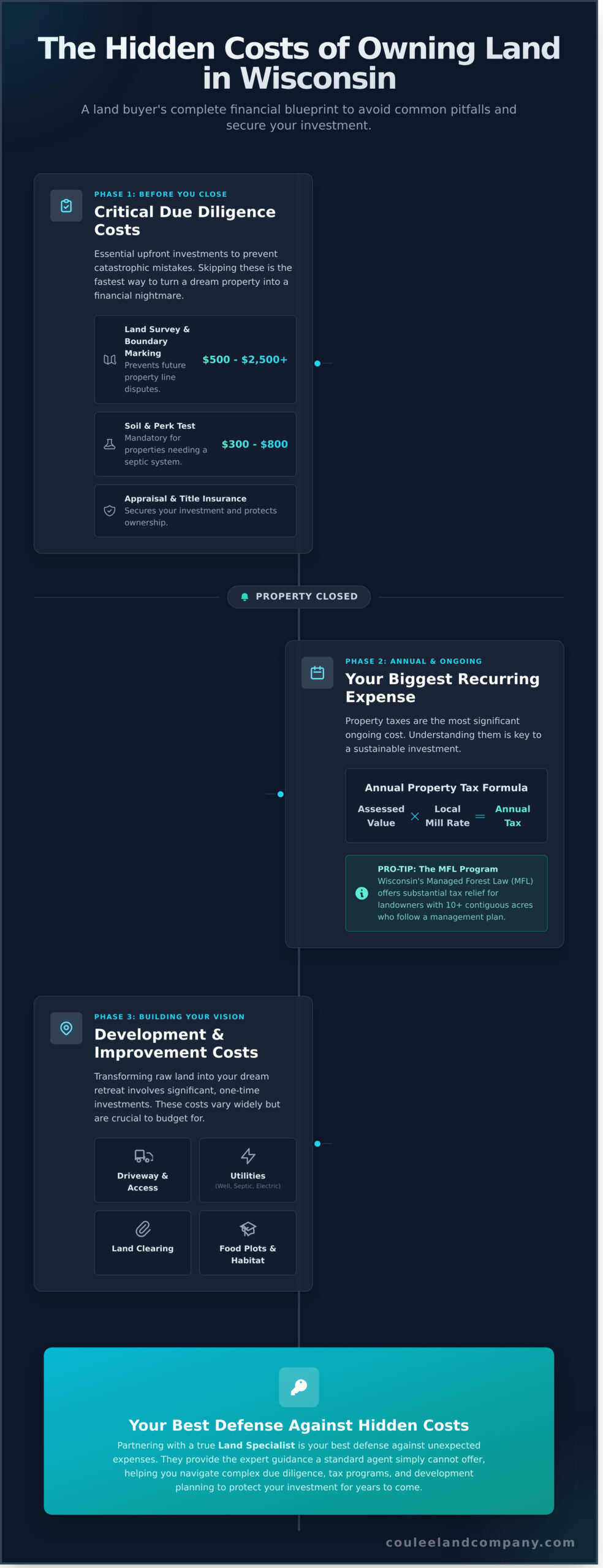
When you finally locate that perfect tract of Wisconsin land, the purchase price can feel like the final hurdle. In reality, it’s just the starting line for your investment. The most critical expenses often arise before you even sign the closing documents. These upfront due diligence fees are not optional add-ons; they are essential investments to prevent catastrophic and costly mistakes down the road. Factoring these into your initial budget is a non-negotiable step for any serious buyer, as skipping them is the fastest way to turn a dream property into a financial nightmare. These are the foundational hidden costs of owning land in wisconsin that every buyer must anticipate.
To get a clear picture of these initial expenses and why they matter, the video below offers a valuable overview from an experienced land professional.
Land Survey & Boundary Marking
Knowing precisely what you own is the bedrock of land ownership. Even if a property has existing markers, an updated survey is crucial. Fences can be misplaced and old markers can be inaccurate. A professional survey, typically costing between $500 and $2,500+ in Wisconsin depending on acreage and terrain, prevents future property line disputes with neighbors-a conflict you don’t want when it comes to a prized treestand location. It also officially identifies any encroachments or easements that could limit your use of the land.
Soil & Perk (Percolation) Testing
If a cabin, hunting lodge, or permanent home is part of your vision, a soil and percolation (perk) test is mandatory before you buy. This analysis, usually costing $300 to $800, determines if the soil can support a conventional septic system. A failed perk test doesn’t always kill the dream, but it means you’ll likely need a far more expensive engineered mound or alternative system, a massive expense that can dramatically alter your building budget and plans.
Appraisals and Title Insurance
While often required by lenders, an appraisal and title insurance are wise investments even for cash buyers. An appraisal confirms the property’s fair market value, ensuring your investment is sound from day one. This valuation is the basis for everything from your purchase price to understanding property taxes in the future. Title insurance is your shield against the past, protecting you from prior ownership claims, liens, or legal encumbrances that could challenge your right to the property. These standard closing costs are essential for securing your legacy.
Taxes and Programs: Understanding Your Biggest Recurring Expense
Once you close on your dream property, the purchase price is behind you. However, property taxes are the most significant ongoing investment you’ll make. These recurring payments are among the most impactful hidden costs of owning land in Wisconsin, and failing to understand how they work can lead to expensive surprises down the road. The tax landscape is complex, with rates varying dramatically by county, municipality, and land classification. Fortunately, for the savvy landowner, Wisconsin also offers powerful programs designed to provide substantial tax relief.
Calculating Annual Property Taxes
Your annual property tax is calculated using two key figures: your property’s assessed value and the local mill rate. You can find this information on county websites or tax bills. It’s crucial to recognize that vacant recreational land is often taxed at a different, sometimes higher, rate than residential or agricultural properties. Tax rates can shift annually, so always budget for a modest increase. The differences across the state are stark; the tax burden for a parcel in a premier whitetail destination like Buffalo County can be completely different from a similarly sized property in the northern forests.
The Managed Forest Law (MFL) Program
For landowners committed to stewardship, the Managed Forest Law (MFL) program is Wisconsin’s most important tax incentive. If you own sufficient acreage (10 contiguous acres of forest for MFL-General) and agree to follow a written forest management plan, you can dramatically reduce your annual property tax bill. This program rewards sustainable forestry practices, enhancing wildlife habitat and timber quality while providing immense financial relief. Be aware that MFL is a long-term commitment (25 or 50 years), and early withdrawal can result in significant penalties.
Timber Tax Basis: The Mistake Most New Owners Make
If your property includes valuable timber, one of the costliest oversights is failing to establish a timber tax basis at the time of purchase. This process separates the value of the timber from the value of the land itself. When you eventually harvest and sell that timber, your established basis can be used to offset the income, significantly reducing your tax liability. Properly documenting this requires expertise, which is why we always advise working with a qualified forester and an accountant. This process is a core component of responsible ownership, touching on principles you might find in advanced land use planning and management education, and it is a critical step that protects your future profits.
From Raw Land to Your Retreat: Development & Improvement Costs
The purchase price is just the entry ticket. Transforming a vacant parcel into your personal hunting paradise or family retreat requires a vision, a plan, and a realistic budget. These development expenses are frequently the largest and most overlooked hidden costs of owning land in wisconsin, capable of quickly eclipsing your initial projections if not managed with expert foresight. Prioritizing improvements based on your primary goals-whether for a trophy whitetail haven or a future cabin site-is essential for success.
Access and Driveways
Getting to your slice of heaven is the first step. Cutting in a new driveway across raw land is a substantial investment, with the final cost depending heavily on factors like length, the steepness of the grade, and your chosen material. Proper installation of culverts and drainage is non-negotiable for long-term stability, preventing washouts during spring thaws and heavy rains. Remember to budget for ongoing maintenance, such as regrading and adding new gravel after harsh Wisconsin winters.
Utilities: Getting On the Grid (or Off It)
Power, water, and waste disposal are foundational costs for any structure. Extending electrical service from the nearest road can cost thousands of dollars per pole, a figure that adds up quickly on remote parcels. For water, drilling a well is the standard, with costs varying based on the depth required to hit a reliable source. A septic system is another major expense, and its design is dictated by a soil percolation test; poor-draining soils often require a more complex and expensive mound system. These are critical calculations for anyone planning to build a country home and turn their property into a permanent escape.
Land Clearing and Habitat Management
Shaping the land to fit your vision is where a property’s true potential is unlocked. This can range from forestry mulching to clear a building site to cutting in a trail system for ATV access and recovering game. For the serious hunter, this is where the real work begins. Establishing productive food plots involves recurring costs for lime, seed, and fertilizer. Furthermore, strategic Timber Stand Improvement (TSI) can dramatically enhance forest health and wildlife habitat. These practices are often a key component of a formal management plan, such as those required by the Wisconsin’s Managed Forest Law Program, which can provide significant property tax advantages in exchange for sound stewardship.
Annual Upkeep: The Ongoing Costs of Land Stewardship
Securing your dream property in Wisconsin’s Bluff Country is just the first step; the real work of stewardship begins after closing. Your financial commitment doesn’t end with the purchase price. These recurring annual expenses are not just line items on a budget-they are crucial investments in maintaining your property’s value and enhancing its wildlife capabilities. Proactive maintenance prevents minor issues from escalating into expensive problems, ensuring your land remains safe, productive, and enjoyable. These ongoing responsibilities are often overlooked but represent some of the most significant hidden costs of owning land in wisconsin.
Liability Insurance
Liability insurance is a non-negotiable safeguard against accidents or injuries that may occur on your property. This is especially critical if you allow friends, family, or leaseholders to hunt or recreate on your land. It can often be added as an affordable rider to an existing homeowner’s policy or secured as a standalone policy for vacant land. For a modest annual premium, you gain invaluable peace of mind, protecting your assets from unforeseen events.
Equipment and Maintenance
Managing a quality land parcel requires the right tools. From a reliable tractor and ATV for creating food plots to chainsaws for clearing trails and managing timber, the initial investment can be substantial. You must also budget for the ongoing costs of fuel, repairs, and regular maintenance to keep your gear in field-ready condition. For specialized tasks, hiring a local operator can be more cost-effective than purchasing expensive machinery. Proper equipment makes managing your hunting property far more efficient and productive.
Property Line and Trespasser Management
Good fences make good neighbors, but active management is what truly secures your investment. This includes the initial cost of clearly posting ‘No Trespassing’ signs and the annual time commitment to walk your property lines, check for encroachments, and replace damaged markers. Many landowners now use trail cameras for security and monitoring. Ultimately, the best preventative measure is building strong, respectful relationships with adjoining landowners-a simple conversation can prevent most issues before they begin.
Understanding these annual upkeep duties is essential for long-term success. These are true hidden costs of owning land in wisconsin that every prospective buyer must factor into their budget for a successful and rewarding ownership experience.
Why a Land Specialist is Your Best Defense Against Hidden Costs
Attempting to navigate the complexities of a raw land purchase on your own is not just overwhelming-it’s a significant financial risk. While a standard residential real estate agent can help you buy a house, they often lack the specialized knowledge required for rural properties. The truth is, land is an entirely different asset class with its own unique set of challenges. An expert land specialist doesn’t just find you a property; they anticipate and mitigate potential issues from the very beginning, protecting your investment and your dream.
A true specialist acts as your guide and advocate, ensuring the property you purchase is perfectly suited to your vision, whether that’s building a cabin, creating food plots for trophy whitetails, or simply securing a legacy property. They understand that the initial purchase price is only one part of the equation.
Expertise in Regional Nuances
Understanding the ground beneath your feet is paramount. A land specialist possesses deep, localized knowledge of zoning ordinances, soil types, and potential development challenges that vary from county to county. They are familiar with specific local programs, timber regulations, and the unique topographical hurdles of Wisconsin’s famed Bluff Country. This expertise ensures you find the right property that aligns with your land management and wildlife goals, not just any property that happens to be for sale.
Connecting You with Trusted Professionals
One of the greatest values a land specialist provides is their vetted network of local professionals. This is where many of the hidden costs of owning land in wisconsin can ambush an unprepared buyer. Instead of spending weeks trying to find reliable contractors, you get immediate access to the best in the business. This network includes:
- Experienced surveyors for accurate boundary lines.
- Reputable excavators who understand the local terrain.
- Skilled well drillers and septic system installers.
- Professional foresters to help you manage your timber.
This guidance is a core part of the service for serious land buyers, saving you immense time and money by avoiding costly mistakes with unproven contractors. By partnering with a dedicated specialist at Coulee Land Company, you transform a complex purchase into a confident investment, securing your piece of the Wisconsin outdoors without the unexpected financial burdens.
Your Wisconsin Legacy: From Dream to Reality, Without the Surprises
The dream of owning a piece of Wisconsin is powerful, but turning it into a successful reality requires a clear understanding of the full financial picture. From critical due diligence and development expenses to recurring property taxes and long-term land stewardship, the total investment goes far beyond the purchase price. Acknowledging these factors is the only way to truly master the hidden costs of owning land in wisconsin and protect your investment for generations to come.
This is where an expert guide becomes invaluable. As specialists in Western Wisconsin’s famed ‘Bluff Country,’ Coulee Land Company has a proven track record of helping buyers avoid costly mistakes. Our unmatched expertise in trophy whitetail and recreational properties ensures you see the complete picture-both the potential and the pitfalls. We don’t just find you land; we help secure your legacy.
Make your investment with confidence and start building your dream today. Don’t navigate the risks alone. View our Wisconsin land listings today.
Frequently Asked Questions About Land Ownership Costs
How much are property taxes on 40 acres of vacant land in Wisconsin?
Property taxes on 40 acres of vacant land vary significantly based on the county and the land’s assessed value. For land classified as “Undeveloped” or “Agricultural Forest,” you might expect to pay anywhere from $800 to over $3,000 annually. Properties with higher assessed values in desirable areas like Buffalo County can be at the upper end of this range. It’s a critical budget item that must be verified for each specific parcel you consider.
What is the Wisconsin Managed Forest Law (MFL) and is it worth it?
The Wisconsin Managed Forest Law (MFL) is a landowner incentive program that significantly reduces property taxes in exchange for following a sustainable forest management plan. For landowners committed to long-term timber and wildlife habitat improvement, it is an exceptional tool. However, it requires a 25 or 50-year commitment and may require allowing public access for recreation, depending on whether you choose the “Open” or “Closed” designation. It’s a powerful financial benefit for the dedicated steward.
Do I really need to get a new survey if the property was surveyed 10 years ago?
We strongly advise it. An outdated survey can create significant problems. A new Certified Survey Map (CSM) confirms exact boundaries, identifies any encroachments from neighbors, and is often required by lenders and title insurance companies. For a hunter, knowing your precise lines is non-negotiable for placing stands, food plots, and access trails legally and without dispute. Consider it a vital investment in protecting your purchase and ensuring peace of mind.
What’s a realistic annual budget for maintaining a recreational property?
A smart budget for maintenance is 1-2% of the property’s value annually. This covers property taxes, liability insurance, and land management activities. For a hunting property, this includes fuel for equipment, seed and lime for food plots, trail maintenance, and potential habitat projects like hinge-cutting or creating waterholes. Factoring in these ongoing expenses is essential to understanding the true hidden costs of owning land in wisconsin and managing your investment effectively for superior results.
How much does it cost to build a gravel driveway in Wisconsin?
The cost to install a proper gravel driveway typically ranges from $5 to $15 per linear foot. The final price depends heavily on the amount of site prep required, the length and width of the drive, and the terrain. In the steep, rugged Bluff Country, costs can be higher due to the need for more extensive excavation and grading. For a simple 500-foot driveway, a realistic budget would be between $3,000 and $8,000 to ensure it’s built to last.
Can I hunt on my own land in Wisconsin without a license?
No, you cannot hunt deer, bear, turkey, or other game animals on your own property without the appropriate Wisconsin hunting licenses and tags. The state requires all hunters to be properly licensed, regardless of land ownership. While there are limited exceptions for landowners hunting small game, you must follow all season dates, bag limits, and regulations set by the Wisconsin DNR. Always purchase your licenses before heading into your woods.
What is the biggest financial mistake first-time land buyers make?
The most significant mistake is underestimating the total cost of ownership. First-time buyers focus intensely on the purchase price and mortgage payment but fail to budget for the complete picture. Ignoring property taxes, insurance, closing costs, and immediate improvement needs like driveway installation or surveying can turn a dream into a financial strain. Understanding all the hidden costs of owning land in wisconsin from the start is the key to a successful and enjoyable long-term investment.