
The dream is vivid: a sprawling tract of Wisconsin’s Bluff Country, where Boone and Crockett bucks slip through the timber at dawn. But for every dream realized, there’s a cautionary tale-a story of buyer’s remorse born from a hidden easement, poor access, or land that simply fails to hold wildlife. This monumental investment is too important to leave to chance. Knowing the common mistakes to avoid when buying hunting land is the critical first step toward securing a legacy property instead of a financial liability.
In this essential guide, we draw on our deep expertise as Wisconsin’s Land & Property Sales Specialists to reveal the nine biggest pitfalls we see buyers encounter. You will learn to sidestep these costly errors, from misjudging a property’s true wildlife potential to overlooking crucial legal details that could derail your plans. Our goal is to arm you with the confidence of an expert, ensuring your investment not only appreciates in value but becomes the hunting paradise you’ve always envisioned.
Key Takeaways
- Master the essential due diligence, from verifying legal access to understanding deed restrictions, to prevent your dream property from becoming a legal nightmare.
- Develop an expert’s eye for reading the landscape, allowing you to identify a property’s true hunting potential and avoid parcels that only look good on paper.
- Navigate the negotiation and closing process like a seasoned pro by recognizing the most common financial mistakes to avoid when buying hunting land.
- Make a legacy investment, not just a seasonal purchase, by evaluating how a property will serve your family and hunting goals for decades to come.
Critical Due Diligence Mistakes: Errors Made Before You Even Walk the Land
Before you ever pull on your boots to walk a property line, the most critical work has already begun. Purchasing raw land, especially prime hunting acreage, is a far more complex transaction than buying a residential home. The legal paperwork-the deeds, surveys, and titles-holds the true story of the property. Overlooking these details is one of the most common and costly mistakes to avoid when buying hunting land. An error made on paper can quickly turn your dream parcel in Wisconsin’s Bluff Country into a legal and financial nightmare, leaving you with a property that is unusable or has virtually no resale value. This is, without question, the most important yet most overlooked phase of the buying process.
To better understand these potential pitfalls, the following video provides a great overview:
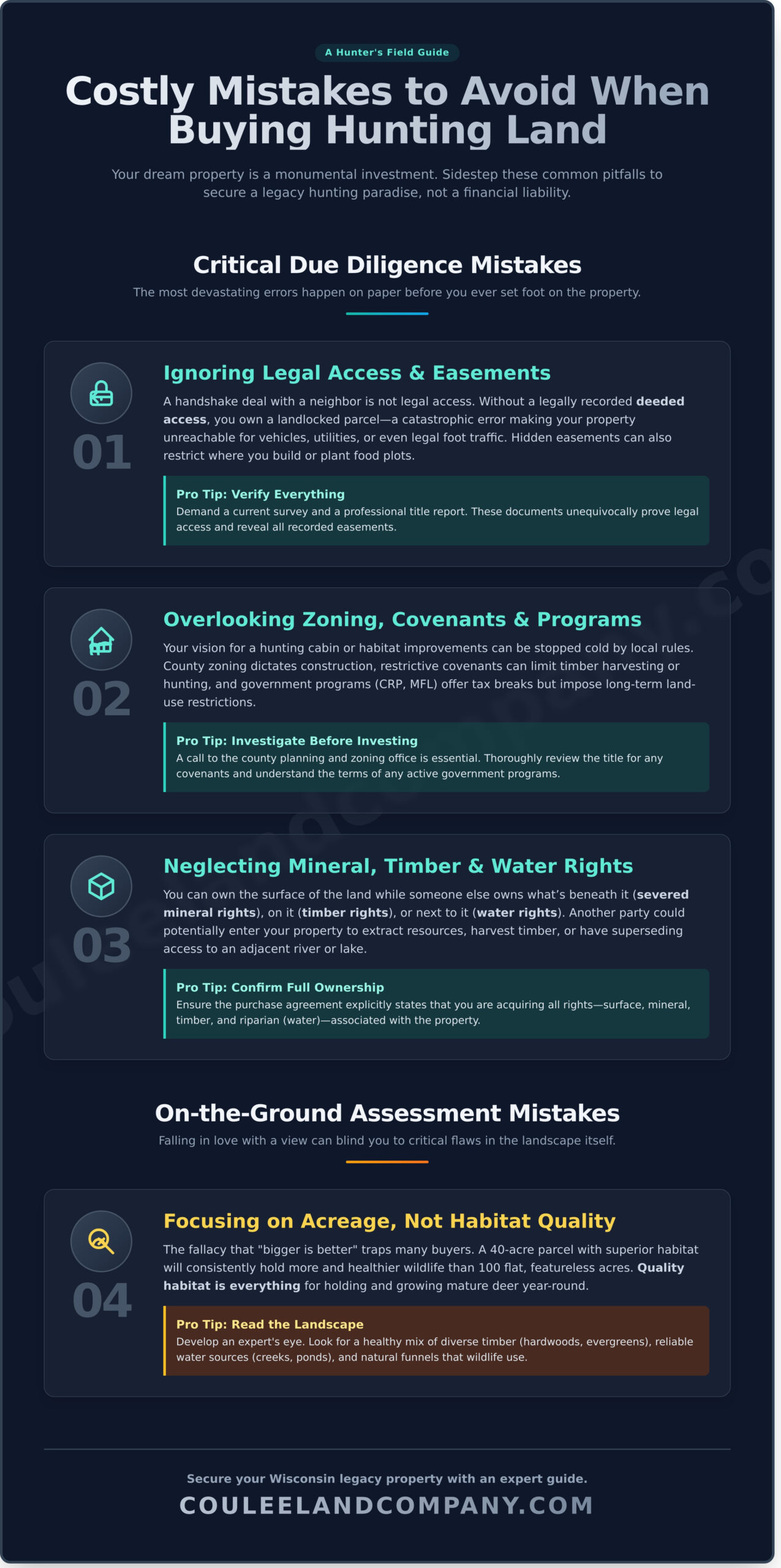
Mistake #1: Ignoring Legal Access & Easements
A handshake deal with a neighbor to cross their property is not legal access. The only access that matters is deeded access, a legally recorded right to reach your land. Without it, you own a landlocked parcel, which is a catastrophic error. You may not be able to drive to your property, run utilities, or legally access it without trespassing. Furthermore, easements-such as a utility company’s right to run power lines or a neighbor’s right of ingress/egress-can impact where you can build or plant food plots. Always demand a current survey and a professional title report to verify access unequivocally.
Mistake #2: Overlooking Zoning, Covenants, and Government Programs
Your vision for a hunting cabin and managed wildlife habitat can be stopped cold by local regulations. County zoning rules dictate what you can build and how you can use the land. Restrictive covenants, often put in place by a previous owner, can limit activities like timber harvesting or even the type of hunting allowed. It’s also vital to check for government programs like the Conservation Reserve Program (CRP) or Wisconsin’s Managed Forest Law (MFL), which provide tax benefits but come with long-term land-use restrictions. Understanding these rules, which are often tied to the principles found in this comprehensive overview of hunting and its management, is non-negotiable. A call to the county planning and zoning office is an essential step.
Mistake #3: Neglecting Mineral, Timber, and Water Rights
In real estate, it’s possible to own the surface of the land while someone else owns the rights to what’s beneath it. These are called severed mineral rights. If another party owns them, they could potentially have the right to enter your property to explore for or extract resources like oil, gas, or minerals. Similarly, confirm who owns the timber rights, as they may have been sold off prior to the listing. For properties bordering rivers or lakes, understanding your water rights (riparian rights) is crucial for ensuring you can use and access the water as you intend.
On-the-Ground Assessment Mistakes: Failing to See the Land for What It Is
A property’s true potential for holding and growing mature whitetails is written on the landscape itself, but you have to know how to read the signs. Too many buyers get ‘buck fever’ for a piece of ground, falling in love with a view or a big field without a critical eye. This emotional rush leads to overlooking physical characteristics that can make or break your hunting dreams. These on-the-ground assessment errors are some of the most critical mistakes to avoid when buying hunting land because they can’t be easily fixed later. An experienced land specialist sees the hidden potential and the glaring problems a novice buyer will almost always miss.
Mistake #4: Focusing on Acreage, Not Quality of Habitat
One of the most common fallacies is that bigger is always better. The truth is, a 40-acre parcel with superior habitat will consistently outperform 100 flat, featureless acres. Quality habitat is everything. A critical first step in evaluating wildlife habitat is to inventory the key features that deer need to thrive year-round. Look for a healthy mix of:
- Diverse Timber: A mix of hardwoods for mast, evergreens for thermal cover, and early successional growth.
- Water Sources: Creeks, ponds, or springs are essential.
- Bedding Cover: Thick, nasty areas like south-facing slopes, clear-cuts, or swamps where deer feel secure.
- Food Sources: Existing browse, nearby agriculture, or areas suitable for food plots.
A monoculture of mature, open timber might look beautiful, but it’s often a ‘deer desert’ offering little food or cover.
Mistake #5: Underestimating Neighborhood and Hunting Pressure
Your property doesn’t exist in a bubble. The activities on surrounding parcels can profoundly impact your hunting success and the quality of your herd. Buying land next to a property with heavy, year-round hunting pressure or trespassing issues can turn your investment into a constant source of frustration. Conversely, having neighbors who practice Quality Deer Management can elevate the entire area. Use plat maps and aerial photos to analyze the neighborhood, identify potential access points for poachers, and understand how the deer will likely use the landscape across property lines.
Mistake #6: Misjudging the Terrain and Topography
Topography dictates deer movement. Ridges, saddles, and benches create natural funnels and travel corridors that concentrate deer activity, giving you a distinct advantage. In a region like Wisconsin’s famed Bluff Country, the steep, rugged terrain creates incredible opportunities for stand placement but also presents access challenges. Land that is too steep or swampy may be impossible to access for hunting or to manage effectively with equipment. Learning to read a topographic map is a non-negotiable skill for identifying these high-potential areas before you ever set foot on the property.
Financial & Transactional Mistakes: Errors That Cost You Money and Opportunity
The thrill of finding that perfect tract of land can be overwhelming. In the heat of the moment, with visions of trophy whitetails and quiet mornings in the stand, it’s easy to let emotion override sound financial judgment. However, the negotiation, financing, and closing processes are precisely where costly errors are made. Some of the most critical mistakes to avoid when buying hunting land are financial ones that can turn your dream property into a financial burden. Avoiding these pitfalls is essential to securing a fair deal and a sound investment. This is where having an expert on your side provides the biggest return.
Mistake #7: Using a General Realtor, Not a Land Specialist
A residential real estate agent is an expert at selling homes in subdivisions, not premier recreational tracts in Wisconsin’s Bluff Country. Their expertise lies in square footage and school districts, not food plots and whitetail genetics. A true land specialist understands the nuances that determine a property’s real-world hunting value-topography, access, water sources, and existing habitat. They have a proven network of lenders who finance raw land, surveyors who can navigate complex boundaries, and land management professionals. This expertise is non-negotiable when you’re investing in high-quality hunting properties.
Mistake #8: Underestimating the Total Cost of Ownership
The purchase price is only the beginning of your financial commitment. A common and costly error is failing to budget for the ongoing expenses required to own and maintain your property. Before you sign on the dotted line, you must account for the total cost of ownership, which extends far beyond your mortgage payment. A prudent buyer creates a detailed annual budget that includes:
- Property Taxes: These can vary significantly based on location and land use programs like Managed Forest Law.
- Insurance: Liability insurance is a must-have to protect your investment and your assets.
- Maintenance Fees: This can include contributions to a shared road or costs for easement upkeep.
- Land Management: The real work begins after the purchase. Factor in costs for seed and lime for food plots, fuel for equipment, trail maintenance, and habitat improvement projects.
Properly forecasting these expenses ensures your hunting paradise remains a source of enjoyment, not financial stress. Partnering with a specialist who lives and breathes this world is the surest way to protect your investment for generations to come.
Long-Term Vision Mistakes: Buying for Today, Not for Your Future
A parcel of hunting land is more than just a place for this fall’s deer camp; it’s a legacy investment meant to serve your family and your passion for generations. A common pitfall is getting caught up in the excitement of the immediate season while overlooking the property’s potential-or lack thereof-for the next decade. This short-sightedness is one of the most significant mistakes to avoid when buying hunting land. A clear, long-term vision ensures the property you purchase not only holds its value but grows into the premier hunting destination you’ve always dreamed of.
Mistake #9: Ignoring the Property’s Management Potential
The most exceptional hunting properties in Wisconsin aren’t just found; they are meticulously crafted. When you walk a piece of ground, you must look past what it is today and see what it could be. Does the property have “good bones”? We’re talking about the potential for strategic food plots, the opportunity for Timber Stand Improvement (TSI) to create better bedding areas, and the ability to enhance wildlife travel corridors. Buying a property with limited potential for habitat enhancement locks you into its current state. A parcel you can actively manage and improve will deliver far greater satisfaction and, ultimately, superior hunting opportunities.
Conclusion: Turning Your Dream into a Reality
Successfully navigating the land buying process means sidestepping critical errors. From ensuring proper legal access and analyzing neighborhood hunting pressure to partnering with a true land specialist, each step is vital. Avoiding these common pitfalls is the key that unlocks the door to a successful and rewarding purchase.
The pride and satisfaction that come from owning your own piece of prime Wisconsin hunting ground are unparalleled. It’s a place to build memories, manage wildlife, and pass down a legacy. Don’t let preventable errors stand between you and your dream. Let our team of dedicated Wisconsin land specialists guide you through every step of the journey. Start your search with experts who understand what makes a property truly great.
Secure Your Hunting Legacy by Avoiding Costly Errors
Purchasing your own slice of hunting paradise is a monumental step, but the path to ownership is filled with potential pitfalls. As we’ve covered, the most critical mistakes to avoid when buying hunting land often stem from incomplete due diligence, a rushed on-the-ground assessment, and a lack of long-term vision. A successful investment requires looking beyond the listing photos and truly understanding a property’s wildlife capabilities, access, and neighborhood dynamics.
Navigating this complex process alone is a risk you don’t have to take. That’s where a true specialist provides undeniable value. At Coulee Land Company, our team is comprised of passionate, lifelong hunters with unmatched expertise in Wisconsin’s famed ‘Bluff Country.’ We live and breathe this land, specializing in the trophy whitetail properties that make this region legendary. We understand the subtle details that turn a good piece of ground into a world-class hunting legacy.
Don’t make these mistakes. View our exclusive Wisconsin hunting properties today. Let our expertise guide you to the property you’ve always dreamed of. Your legacy awaits.
Frequently Asked Questions
How many acres do I really need for good deer hunting?
The ideal acreage is less about a specific number and more about the quality of the habitat. A well-managed 40-acre parcel in Wisconsin’s Bluff Country with diverse cover, food sources, and water can provide a superior hunting experience to a uniform 100-acre woodlot. The key is understanding the property’s wildlife capabilities and how it connects to the surrounding landscape. For archery, smaller, strategically shaped parcels can be phenomenal; for rifle, more acreage provides a larger buffer.
What is the first thing I should do when I find a property I’m interested in?
Before you get too invested, your first call should be to a proven land specialist. An expert who lives and breathes hunting land can immediately help you assess the parcel’s true potential, identify hidden access issues, and understand local zoning or deed restrictions. This initial consultation is one of the most important steps to take. It provides the critical insight needed to avoid costly mistakes when buying hunting land and ensures you’re pursuing a property that truly meets your goals.
Is it a red flag if a property has been on the market for a long time?
Not always, but it demands careful investigation. A property may linger due to being overpriced, having challenging legal access, or lacking key habitat features. However, it could also be a hidden gem that was simply marketed improperly to the right buyers. As your land specialists, we dig into the property’s history and unique characteristics to uncover the real story, determining if it’s a genuine opportunity or a parcel with fundamental issues you should avoid.
How do I find out about the hunting pressure on neighboring properties?
This requires on-the-ground intelligence that goes beyond online maps. Start by studying plat maps to identify owner names, but the real insight comes from local knowledge. A polite conversation with potential neighbors can be revealing. As specialists in this region, we leverage our extensive network. We often know the landowners and the local hunting culture, providing an unparalleled perspective on pressure, QDM practices, and the neighborhood’s history of producing trophy whitetail bucks.
Can I get a traditional mortgage for a raw piece of hunting land?
Securing financing for raw land through a traditional bank can be difficult, as many lenders prefer properties with existing structures. However, specialized lenders and local credit unions that understand the intrinsic value of recreational land are excellent resources. We have cultivated powerful relationships with financial partners who specialize in financing Wisconsin hunting properties. We can connect you with the right people who understand your vision and can help make your dream of land ownership a reality.
What are property taxes typically like on recreational land in Wisconsin?
Property taxes can vary significantly by county and township. However, Wisconsin has outstanding programs designed to support landowners and wildlife. Enrolling your property in the Managed Forest Law (MFL) program, for instance, requires a sustainable forestry plan but can lower your tax liability dramatically. Understanding and utilizing these programs is a key part of our due diligence process, ensuring your long-term ownership costs are predictable, manageable, and optimized for your investment.