
You might think Minnesota’s lower property tax rates make it the obvious choice for your next hunting retreat, but for high-income earners, that assumption is a costly mistake. While Wisconsin is often criticized for its property tax “sticker shock,” Minnesota’s top individual income tax rate of 9.85 percent can quickly drain the budget you’ve set aside for habitat improvements. When you dig into the data, the tax benefits of owning land in wisconsin vs minnesota reveal a different story for those who know how to leverage the right programs. The numbers don’t lie.
It’s frustrating to feel like you’re being penalized just for wanting to own a piece of legendary “Bluff Country.” We understand that you want a clear financial path to owning a trophy-producing property without getting lost in a maze of state codes. This guide promises to show you exactly how Wisconsin’s specialized land use structures often outperform Minnesota for recreational investors. We’ll examine how the Managed Forest Law (MFL) program can slash your property tax bill by up to 95 percent and why Buffalo County remains the undisputed king for both the record books and your bottom line.
Key Takeaways
- Understand the fundamental fiscal differences between the two states and how they impact your long-term investment in the Upper Midwest’s premier hunting grounds.
- Compare 2026 property tax structures and mill rates to uncover the specific tax benefits of owning land in wisconsin vs minnesota for recreational use.
- Discover how Wisconsin’s Managed Forest Law (MFL) acts as a powerful tax shield, offering superior savings compared to Minnesota’s SFIA program.
- Learn why establishing residency in Western Wisconsin can save high-earning landowners five figures annually through favorable income tax and capital gains brackets.
- Evaluate a comprehensive ROI model that combines specialized land-use programs with the unmatched trophy whitetail quality found in Wisconsin’s Bluff Country.
The Great Border Battle: Wisconsin vs Minnesota Land Tax Overview
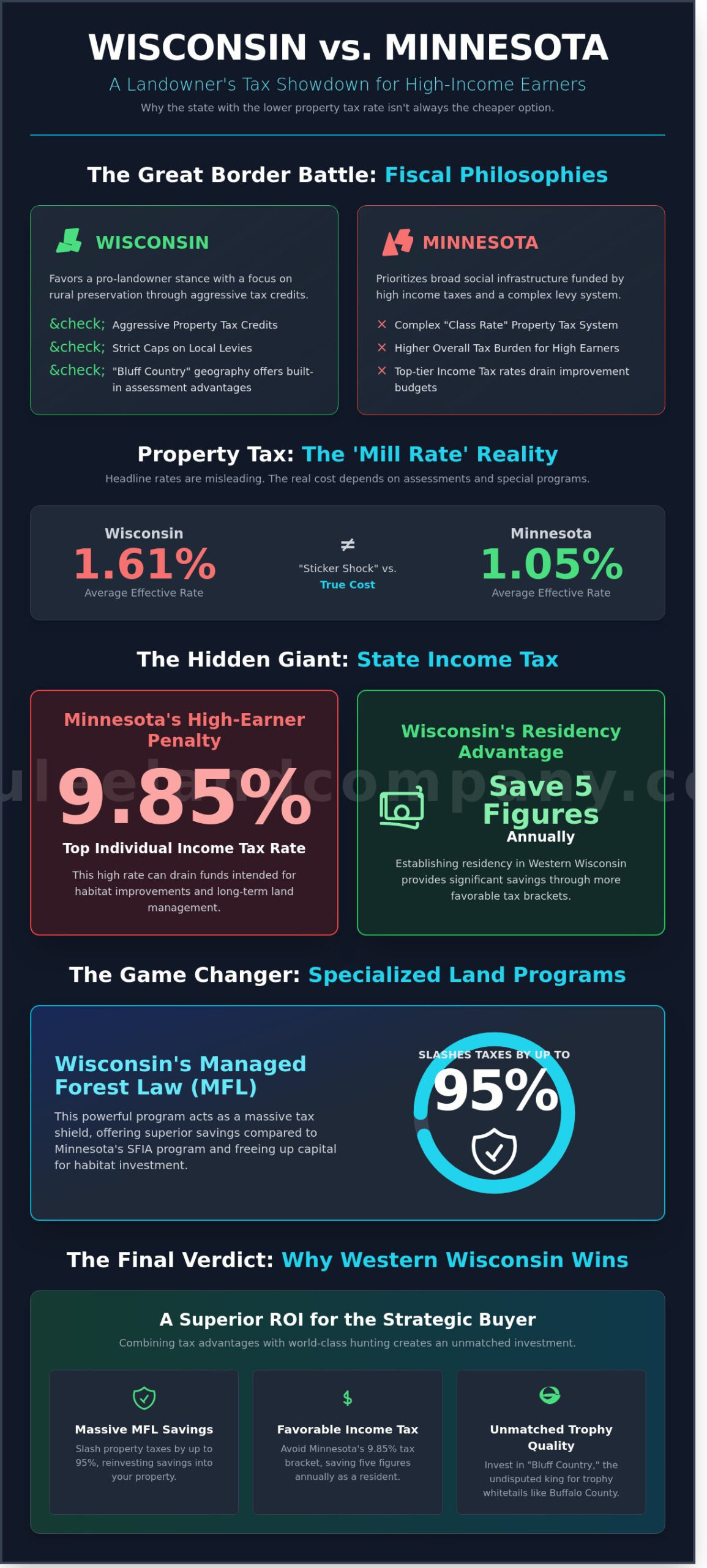
Choosing between Wisconsin and Minnesota for a land investment requires looking past the surface. In 2026, the fiscal philosophies of these two neighbors have diverged significantly. Wisconsin focuses on rural preservation through aggressive property tax credits, while Minnesota prioritizes broad social infrastructure funded by a more complex levy system. For a landowner, this means the property tax bill you see today is only one piece of the puzzle.
In the Upper Midwest, “recreational land” is specifically categorized by state assessors. It’s land used primarily for hunting, fishing, or quiet enjoyment rather than active farming or timber production. Understanding this classification is vital because it dictates your assessment rate and eligibility for various conservation programs. To better understand how these factors play out on the ground, watch this helpful video:
Many buyers make the mistake of comparing mill rates in isolation. This is a trap. You must consider the Total Cost of Ownership (TCO), which includes how state income taxes interact with your land holdings. Wisconsin’s 2025-2026 tax reforms have aimed to lower the burden on non-residents, making it an attractive hub for those seeking the specific tax benefits of owning land in wisconsin vs minnesota. When you factor in state income tax brackets, the state with the lower property tax might actually be the more expensive place to own land over a ten year period.
Wisconsin’s Pro-Landowner Stance in 2026
Wisconsin’s 2026 legislative session solidified its reputation as a haven for rural property owners. Lawmakers expanded the Farmland Preservation Credit and maintained strict caps on local levy increases. The unique “Bluff Country” geography in Western Wisconsin offers a distinct advantage. Steep terrain often results in lower productivity ratings from assessors. This can lead to lower valuations compared to flatter, more tillable ground. This geographical quirk provides a built-in tax shield for hunters who want world-class terrain without the premium tax bill found in Minnesota’s agricultural zones.
The Hunter’s Perspective: Why These States Compete
Serious outdoorsmen often weigh Buffalo County WI land for sale against Minnesota’s river bottom properties. While both regions produce massive whitetails, the tax benefits of owning land in wisconsin vs minnesota often tip the scales toward the Badger State. Wisconsin’s Managed Forest Law (MFL) program remains a powerhouse for reducing annual costs. These savings allow owners to reinvest in high-quality food plots and timber stand improvements. Navigating these differing systems requires a specialist who understands the “hunter’s realtor” mindset. You need an expert who knows how a tax classification affects your ability to grow trophy bucks and maintain long-term equity.
Property Tax Rates: Rates, Assessments, and the ‘Mill Rate’ Reality
Understanding the financial landscape of the 2026 market requires a hard look at the raw numbers. In Wisconsin, the average effective tax rate currently sits near 1.61 percent, while Minnesota averages closer to 1.05 percent. These headline figures often mislead buyers looking for hunting properties or timber ground. The actual tax benefits of owning land in wisconsin vs minnesota depend heavily on how each state classifies your acreage and how local districts levy their dues. While Wisconsin appears more expensive on paper, the state’s unique assessment methods often provide a lower carrying cost for large tracts of recreational land.
Minnesota’s Property Tax Structure
Minnesota utilizes a “Class Rate” system to determine your tax liability. Instead of taxing the full market value directly, the state applies a percentage based on the land’s use. For instance, the first $500,000 of a residential homestead is taxed at a lower rate than a commercial property. The Homestead Market Value Exclusion further assists primary residents by reducing the taxable value of a home by up to $30,400 for properties valued under $95,000, though this benefit phases out as the value increases.
Raw land in Minnesota can carry unexpected local levies, particularly in counties with high infrastructure demands. If you own timberland, you must evaluate Minnesota’s Sustainable Forest Incentive Act (SFIA) to mitigate these costs. This program provides incentive payments to landowners who practice long term forest management, effectively lowering the net tax burden. Minnesota assesses property annually every January 1st, meaning your tax bill reacts quickly to market fluctuations.
Wisconsin’s Mill Rate and Assessment Process
Wisconsin operates on the “Mill Rate” system, which represents the tax amount per $1,000 of assessed value. Your bill is a product of the Assessed Value determined by the local assessor and the Fair Market Value, which reflects the actual price the land would fetch on the open market. In Western Wisconsin counties like Buffalo or Trempealeau, school districts play a massive role in setting these rates. Local referendums for school upgrades can cause the mill rate to spike, impacting non-resident landowners who don’t have a vote in the local district.
The “secret” to the tax benefits of owning land in wisconsin vs minnesota lies in Use-Value Assessment. This law mandates that agricultural land is taxed based on its income-producing capacity from farming rather than its potential for residential development. This results in significantly lower taxes for properties with tillable acreage or pasture. Wisconsin’s 2026 property tax credits, specifically the School Levy Tax Credit, provide a direct reduction on the tax bill that helps neutralize the state’s higher base mill rates. Unlike Minnesota, Wisconsin municipalities typically re-evaluate land values every four to five years, providing more stability in your annual overhead. If you are curious about how these rates affect your specific goals, our team can help you analyze a property’s tax history before you list or buy.
The Game Changer: Wisconsin’s Managed Forest Law (MFL) vs. MN Programs
For serious land managers, the choice between states often boils down to how much the government takes off the top each year. Wisconsin’s Managed Forest Law (MFL) stands as a titan in this arena. It offers a clear path to lower overhead. When you weigh the tax benefits of owning land in wisconsin vs minnesota, the MFL program often tips the scales for those looking to build a legacy in the Driftless Area. It isn’t just a tax break; it’s a strategic partnership between the landowner and the state to promote healthy timber and wildlife habitat.
Slashing Taxes with WI Managed Forest Law
Wisconsin’s MFL program is a powerhouse for affordability. Enrolled owners can see property tax bills drop by 80 percent compared to standard ad valorem rates. To qualify, you need at least 20 contiguous acres that are at least 80 percent productive forest land. You’ll work with a certified plan writer to develop a mandatory management plan. This plan dictates timber harvests and conservation practices over a 25 or 50-year term. For those buying hunting properties, this program makes owning 100 acres in Buffalo County feel like owning 20 acres elsewhere in terms of annual carrying costs. It’s a pragmatic way to secure world-class whitetail ground without the heavy tax burden.
Minnesota’s SFIA and 2c Classification
Minnesota handles forest incentives with a different toolkit. The Sustainable Forest Incentive Act (SFIA) doesn’t lower your property tax bill directly. Instead, the state sends you an annual incentive payment via a check. For 2024, these payments are calculated based on the number of acres and the length of the covenant. While the money is helpful, you’re still responsible for paying the full property tax bill upfront. Minnesota also offers the 2c Managed Forest Land classification. This reduces the class rate to 0.65 percent for eligible land. However, it requires a forest management plan registered with the DNR and is often viewed as more restrictive. The paperwork is dense, and the lag time for rebate payments can frustrate owners who prefer the immediate relief provided by Wisconsin’s system.
The decision on tax benefits of owning land in wisconsin vs minnesota often hinges on public access. Both states use “Open” and “Closed” designations to determine your final rate. In Wisconsin, “Closed” status allows you to keep the public off your land for a slightly higher fee. In 2024, the MFL Closed fee is $11.53 per acre, while Open is just $2.31. Most hunters choose Closed to protect their trophy bucks. Minnesota’s SFIA has a similar hurdle; if you want the highest incentive tier, you must allow non-motorized public access. If you value privacy and exclusive hunting rights, Wisconsin’s MFL Closed status is the superior choice for maintaining a private sanctuary.
Income Tax and Capital Gains: The Hidden Costs of Land Ownership
Property taxes represent only one side of the ledger. For the serious investor or hunter looking to secure a legacy property in the Bluff Country, state income tax structures can make or break the long-term affordability of a parcel. Understanding the specific tax benefits of owning land in wisconsin vs minnesota is crucial for anyone looking to build a legacy in the Driftless Area. While Minnesota maintains a reputation for high social services, the cost is reflected in one of the nation’s most aggressive income tax systems. Wisconsin, conversely, has moved toward a more competitive, simplified structure that rewards high-earning landowners.
Wisconsin’s Progressive Income Tax Advantage
Minnesota’s tax code includes a “5th tier” surtax on high earners that can push state income tax rates toward 9.85%. Wisconsin’s top bracket for 2026 sits significantly lower at approximately 7.65%. For a landowner earning $500,000 annually, choosing Wisconsin residency while owning land can result in over $11,000 in annual tax savings. This isn’t just pocket change; it’s money that can be reinvested into timber stand improvement or food plots.
Many buyers fall for the tax reciprocity myth. They assume that living in Minnesota while owning land in Wisconsin simplifies their filing. In reality, reciprocity only applies to W-2 wages. If you generate income from your land, such as through a timber sale or a lease, you’ll likely file a non-resident return in the state where the land sits. The 2026 Wisconsin school property tax credit provides a nonrefundable credit against income tax liability based on the amount of property taxes paid on a principal residence and associated acreage. This credit acts as a secondary shield for your wealth.
Capital Gains and 1031 Exchanges
When it’s time to trade up for a larger tract of trophy whitetail habitat, the 1031 Exchange is your most powerful tool. This federal provision allows you to defer capital gains taxes by rolling the proceeds of a sale into a “like-kind” property. However, state-level treatment of these gains varies. Minnesota treats capital gains as ordinary income, meaning you could lose nearly 10% of your profit to the state immediately upon sale.
Wisconsin offers a distinct advantage by providing a 30% exclusion on long-term capital gains for most assets held over a year. This means only 70% of your profit is subject to state tax. When selling hunting land in Wisconsin, this exclusion preserves significantly more capital for your next acquisition. When you weigh the total tax benefits of owning land in wisconsin vs minnesota, the Badger State often provides a more favorable environment for preserving capital. Successful land management requires a long-term view, and Wisconsin’s tax code is built to reward those who hold and improve their dirt over decades.
Don’t let state taxes erode your outdoor legacy. Contact our team today to find premium hunting properties that fit your financial and recreational goals.
The Final Verdict: Why Western Wisconsin Wins for the Strategic Buyer
Choosing between these two states involves more than comparing a purchase price. It’s about the long-term carry cost and the ultimate quality of the asset. When you synthesize the property, income, and land-use taxes into a single ROI model, the Badger State offers a more aggressive financial advantage for 2026 investors. Wisconsin’s Managed Forest Law (MFL) remains the heavy hitter here, often slashing property tax bills by 90 percent for qualifying acreage. While Minnesota offers the 2c Managed Forest Land classification, it rarely matches the deep, sustained savings found in the Coulee Region. For the buyer looking to maximize every dollar, the tax benefits of owning land in wisconsin vs minnesota clearly favor the eastern side of the Mississippi River.
The financial side is only half the story. You’re also investing in the caliber of the experience. Wisconsin consistently outpaces its neighbor in trophy production, providing an intangible value that shows up during resale. You aren’t just buying dirt; you’re buying a legacy of land management and world-class genetics. Starting your search for the right Wisconsin hunting land for sale means looking at the total package of tax efficiency and wildlife potential.
Buffalo County: The Ultimate Prize in Bluff Country
Buffalo County isn’t just another location; it’s the gold standard for land investment. This region holds more Boone and Crockett record book entries than any other county in the United States. This biological dominance drives stable land appreciation that ignores broader market volatility. In 2026, the demand for Buffalo County deer hunting ground remains at an all-time high because the geography is irreplaceable. The steep bluffs and limestone-rich soils create natural sanctuaries and high-protein forage that produce 170-inch bucks year after year. These natural features make the region a tax-efficient paradise, as the rugged terrain often qualifies for the most beneficial conservation and forest tax programs.
Your Next Steps with a Land Specialist
Capitalizing on the tax benefits of owning land in wisconsin vs minnesota requires a partner who understands the local dirt. Our Coulee Land Company agents are experts at identifying properties already enrolled in MFL or those with the specific characteristics needed for new enrollment. We don’t just walk the fence lines. We help you navigate the 2026 tax changes and local assessment shifts that impact your bottom line. You can request a custom tax-benefit analysis for any target property to see exactly how the numbers stack up before you make an offer. It’s time to stop dreaming about the bluff country and start owning it.
Claim Your Stake in America’s Premier Hunting Grounds
Choosing between these two states isn’t just about the scenery; it’s a strategic financial calculation. Wisconsin’s Managed Forest Law provides a distinct advantage over Minnesota’s programs. This law can reduce property tax burdens by approximately 80 percent for qualifying landowners. When you analyze the 2026 outlook and the lower mill rates found in rural Western Wisconsin, the tax benefits of owning land in wisconsin vs minnesota favor the strategic buyer looking to maximize their ROI.
You aren’t just buying soil; you’re investing in a legacy. Buffalo County continues to lead the nation, holding more Boone and Crockett whitetail entries than any other county in the United States. Coulee Land Company is endorsed by top outdoor television personalities because we understand the nuances of MFL and land management. We have the expertise to help you secure a property that performs as well in your portfolio as it does in the woods.
View Our Exclusive Western Wisconsin Land Listings
The legendary bluffs are calling, and we’re ready to help you plant your flag.
Frequently Asked Questions
Is it cheaper to own land in Wisconsin or Minnesota for a non-resident?
Wisconsin is generally more affordable for non-resident hunters due to specialized land-use programs that slash annual carrying costs. While Minnesota has a lower statewide average property tax rate of 1.02%, Wisconsin’s Managed Forest Law allows you to reduce your tax bill by up to 80%. This makes owning a 100-acre tract in the Coulee Region significantly cheaper every year than a similar parcel across the river in Minnesota.
What is the Managed Forest Law (MFL) in Wisconsin and how does it save money?
The Managed Forest Law is a long-term agreement with the Wisconsin DNR that trades a written forest management plan for a massive property tax reduction. For the 2024-2027 cycle, landowners pay just $2.34 per acre for “closed” land that remains private for your personal hunting. This program is a primary driver of the tax benefits of owning land in wisconsin vs minnesota, as it provides predictable, low-cost ownership for trophy whitetail properties.
Does Minnesota have a program similar to Wisconsin’s MFL for hunting land?
Minnesota offers the Sustainable Forest Incentive Act (SFIA) and the 2c Managed Forest Land classification to lower taxes on wooded acreage. The SFIA program provides an annual incentive payment, which was a minimum of $10.45 per acre in 2024, but it requires at least 20 contiguous acres. While these programs help, they often involve more complex filing requirements and different land-use restrictions than the straightforward MFL system found in Wisconsin.
How do property tax rates for raw land compare between WI and MN in 2026?
Wisconsin’s average property tax rate sits near 1.61%, whereas Minnesota averages 1.02% across all property types. However, these baseline numbers are deceptive for hunters looking at the tax benefits of owning land in wisconsin vs minnesota in 2026. Raw land in Wisconsin classified as “undeveloped” is assessed at 50% of its full market value. This effectively cuts the tax rate in half before you even apply for additional forestry incentives.
Can I get an agricultural tax exemption on hunting land in Wisconsin?
You can qualify for “use-value assessment” if your land is devoted primarily to agricultural use, such as leasing tillable acreage to a local farmer. This classification ignores the fair market value of the land and taxes it based on the income-producing capacity of the soil. It’s a common strategy in the Bluff Country to keep taxes low on the valley floors while maintaining world-class hunting on the timbered ridges.
Will I pay double income tax if I live in Minnesota but own land in Wisconsin?
You won’t pay double income tax because Minnesota and Wisconsin maintain a long-standing tax reciprocity agreement. This means you only pay income tax to the state where you live, even if you earn income from your Wisconsin land via a timber sale or farm lease. It simplifies the financial side of owning a legacy property across the border and ensures your hunting investment doesn’t create a complex tax nightmare.
What are the 2026 capital gains tax rates for land sales in Wisconsin?
Wisconsin provides a 30% exclusion on long-term capital gains for assets held for more than one year. If you sell your land in 2026, you’ll only pay state income tax on 70% of the profit. This makes Wisconsin an incredibly attractive state for land investment compared to Minnesota, which treats most capital gains as ordinary income at rates that can reach as high as 9.85% for top earners.
How does owning land in Buffalo County, WI affect my property taxes?
Owning land in Buffalo County means you’re holding some of the most valuable hunting ground in the world, which can lead to higher assessed values. However, because Buffalo County is the heart of the Coulee Region’s timber country, most owners utilize MFL to keep their annual taxes under $3 per acre. You get the benefit of owning land that dominates the Boone and Crockett Record Book without the burden of high annual holding costs.