
Most buyers searching for a legacy property in the famed Bluff Country focus on the views and the trophy bucks, but the real wealth of Western Wisconsin is hidden beneath your boots. If you overlook the dirt itself, you risk overpaying for tired soil that cannot support top-tier crops or the nutrient-dense food plots required for world-class whitetails. We understand the fear of investing in a property only to find out its productivity has been depleted by decades of poor management. You need more than a map; you need a strategy to ensure your investment appreciates as fast as the $7,250 per acre average cropland value reported in 2025.
This guide provides the essential Soil Quality Tips for WI Farmland Buyers: Testing and Investment Returns to help you navigate the 2026 market with confidence. You’ll learn how to leverage the $11.00 farm field testing through the UW Soil and Forage Lab to calculate real-world ROI and understand why NCCPI scores are the heartbeat of land valuation. We’ll walk you through a professional due diligence checklist, from analyzing cash rent potential to meeting the October 1, 2026, Farmland Preservation tax credit deadline, ensuring your piece of Wisconsin remains a high-yielding asset for generations.
Key Takeaways
- Learn why relying on a visual inspection is a mistake in the Driftless Area and how modern soil profiles reveal the true biological potential of your acreage.
- Discover how to use 2026 NCCPI scores to accurately project per-acre cash rent and maximize your agricultural ROI in counties like Buffalo and Trempealeau.
- Master the essential Soil Quality Tips for WI Farmland Buyers: Testing and Investment Returns to identify high-performing ground that supports both trophy whitetails and superior crop yields.
- Follow a professional due diligence timeline to uncover hidden red flags in soil reports that can serve as powerful leverage during price renegotiations.
- Understand the “Second Lease” model to boost your annual revenue by combining productive agricultural cash rent with premium hunting rights.
The Science of Wisconsin Soil: What Every Buyer Must Test for in 2026
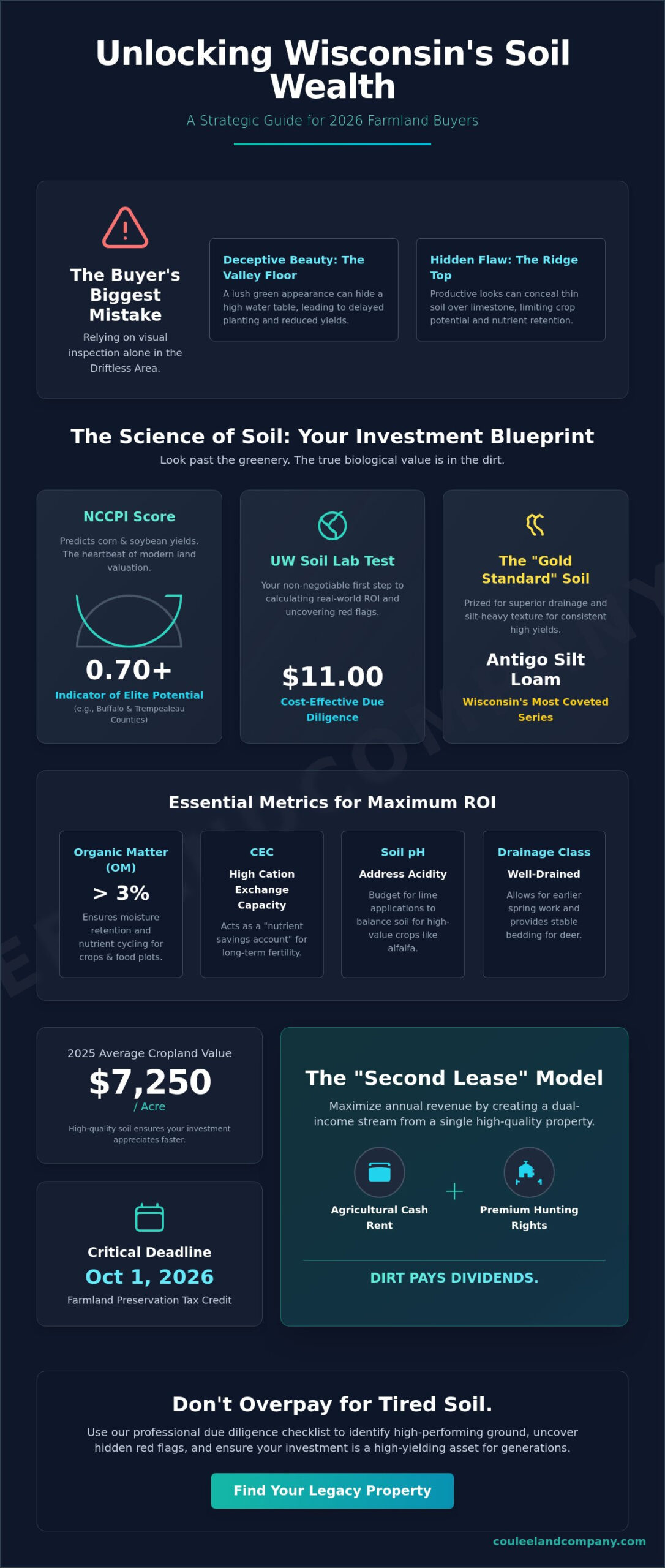
Visual inspection is often the first step for buyers, but in Western Wisconsin’s rugged topography, looks can be deceiving. A valley floor might appear fertile while hiding a high water table that delays planting; similarly, a ridge top may look productive but sit on thin soil over limestone. Understanding The Science of Soil Quality is the only way to verify if a property can sustain high-yield agriculture and premium food plots. These Soil Quality Tips for WI Farmland Buyers: Testing and Investment Returns are designed to help you look past the greenery and see the true biological value of the dirt.
For the 2026 buying season, the National Commodity Crop Productivity Index (NCCPI) serves as a critical benchmark for land valuation. Unlike older classification systems, the NCCPI uses climate and soil properties to predict corn and soybean yields with high accuracy. In regions like Buffalo County, an NCCPI score above 0.70 is a strong indicator of elite agricultural potential, directly impacting what you can charge for cash rent.
To better understand the technical aspects of land evaluation before you make an offer, watch this helpful video:
Serious investors look for the “Gold Standard,” which in Wisconsin is the Antigo Silt Loam series. This soil is prized for its superior drainage and silt-heavy texture, making it the most coveted series for consistent yields. Cation Exchange Capacity (CEC) is a measure of a soil’s long-term nutrient storage capacity. Properties with high CEC levels act as a better “savings account” for the fertilizers and minerals you apply.
Essential Soil Metrics: Beyond the Basics
To achieve maximum ROI, you must look for organic matter (OM) percentages above 3%. This level of carbon-rich material ensures the soil can hold moisture and cycle nutrients effectively for both cash crops and hunting properties. In the Bluff Country, soil pH often trends acidic, which means you’ll likely need to budget for specific lime applications to balance the ground for clover or alfalfa. Drainage class also dictates your planting windows, as well-drained soils allow for earlier spring work and provide stable bedding areas for deer during wet seasons.
Utilizing 2026 Technology: Digital Soil Mapping
In 2026, buyers shouldn’t skip Web Soil Survey (WSS) data. This digital tool allows us to identify hidden limestone ledges or restrictive clay pans that a visual walk-over would miss. While historical yield maps provide a look at past performance, current soil test results are the only way to know if the previous owner has left the ground “tired” or well-maintained. Applying these Soil Quality Tips for WI Farmland Buyers: Testing and Investment Returns ensures you aren’t paying premium prices for land that requires years of expensive remediation.
Translating Soil Health into Investment Returns (ROI)
High-quality dirt isn’t just about bushels; it’s about the long-term strength of your balance sheet. We’ve seen properties with a 10-point lead in productivity ratings command a significant appreciation premium over a decade-long hold. These Soil Quality Tips for WI Farmland Buyers: Testing and Investment Returns bridge the gap between agronomy and real-world financial performance. By securing land with superior biological potential, you create a dual-income stream through the “Second Lease” model. This strategy allows you to collect agricultural cash rent while simultaneously enjoying or leasing out premium hunting rights. Dirt pays dividends.
The Cash Rent Connection: Soil Quality vs. Per-Acre Rates
In the Coulee Region, the difference between Class I and Class II soils often determines your annual profit margin. Buffalo and Trempealeau Counties reward high NCCPI scores with robust demand from local operators willing to pay a premium for consistent ground. Understanding The Economics of Soil Health helps you structure leases that reward soil-building practices like cover cropping. This ensures your ground stays productive rather than being mined of its nutrients over time. A well-structured lease protects the asset and the yield.
Appreciation and the “Hunting Premium” Factor
Marginal soil, which industrial ag buyers might dismiss, is often a secret weapon for whitetail land management. These areas provide the perfect foundation for thermal bedding and security cover that keeps trophy bucks on your side of the fence. Antlers don’t grow in a vacuum. Superior soil in Buffalo County grows bigger antlers because the mineral content in the dirt moves directly up the food chain. Investing in recreational hunting properties with high-quality tillable sites creates a turnkey asset that appreciates faster than neglected timber. If you’re ready to find a property with high-yield potential, explore our current listings to see the best dirt Western Wisconsin has to offer.
Executing Due Diligence: A Field Guide for WI Land Buyers
Closing on a property without a current soil analysis is like buying a truck without looking under the hood. During your contingency period, you have a narrow window to verify the ground’s health before the deal becomes permanent. These Soil Quality Tips for WI Farmland Buyers: Testing and Investment Returns are your safeguard against inheriting a liability. A land specialist broker can identify soil-related risks that a residential realtor would miss, from hidden erosion patterns to historical chemical mismanagement.
Timing Your Soil Tests and Interpreting Results
To get the most accurate ROI projections, aim for fall testing when the soil has settled after harvest. This timing allows you to see the true nutrient depletion levels and plan your 2026 inputs accordingly. Beyond the $11.00 basic lab fee, you should request historical herbicide records. Chemical carryover from previous years can stunt new food plots or specialty crops, creating a red flag that justifies a price renegotiation. Integrating Wisconsin Nutrient Management planning into your due diligence ensures you meet state standards while protecting your bottom line.
Partnering with Land Specialists in Bluff Country
Navigating the diverse terrain of the Coulee Region requires local boots on the ground. Experts like Mike Law or Bryan Lemke understand how a north-facing slope’s soil profile differs from a valley floor. We use this data to help you negotiate from a position of strength, ensuring you don’t overpay for tired ground in our agricultural land listings. If you’re utilizing a 1031 Exchange, rolling your profits into high-quality Western Wisconsin soil is a proven way to secure a legacy asset with high appreciation. Following these Soil Quality Tips for WI Farmland Buyers: Testing and Investment Returns turns a standard land purchase into a strategic investment that protects your capital and your passion for the outdoors.
Secure Your Legacy in the Bluff Country
Owning land in Western Wisconsin is about more than just a property deed; it’s about the biological potential of the dirt under your boots. You now have the roadmap to use NCCPI scores for predicting cash rent and understand how elite soil series like Antigo Silt Loam support both high-yield harvests and trophy whitetails. By following these Soil Quality Tips for WI Farmland Buyers: Testing and Investment Returns, you’re no longer just a buyer. You’re a strategic investor capable of identifying “tired” ground and negotiating from a position of scientific fact.
As Wisconsin’s Land & Property Sales Specialists, we bring deep expertise in Buffalo County and the rugged Bluff Country terrain to every transaction. Our team is endorsed by trophy whitetail experts who know that the biggest bucks are grown from the best soil. Don’t leave your investment to chance when you can partner with experts who live and breathe this land. View our exclusive Western Wisconsin agricultural and hunting land listings today to find a property that delivers both performance and passion. Your piece of the legendary Driftless Area is waiting, and we’re ready to help you claim it.
Frequently Asked Questions
What is a good NCCPI score for Wisconsin farmland?
An NCCPI score of 0.70 or higher is considered excellent for non-irrigated cropland in Western Wisconsin. Scores between 0.50 and 0.65 are common for mixed-use properties in the Driftless Area. While a score above 0.80 represents the top tier of productivity, these parcels are rare and command the highest market premiums. These are the Soil Quality Tips for WI Farmland Buyers: Testing and Investment Returns that help you distinguish average ground from high-yield assets.
How much does a professional soil test cost for a land buyer in 2026?
In 2026, a standard farm field soil analysis through the University of Wisconsin Soil and Forage LAB costs $11.00 per sample. If you’re evaluating land specifically for wildlife food plots, the lab charges $30.00 for a specialized analysis. Additional tests for specific elements like Calcium, Magnesium, or Boron cost $5.00 each. These small upfront costs are essential for any buyer performing due diligence to avoid overpaying for depleted acreage.
Can poor soil quality be fixed, and is it worth the investment?
Poor soil quality can be rehabilitated through consistent nutrient management and cover cropping, though it often takes three to five years to see a measurable change in organic matter. Whether it’s worth the investment depends on your purchase price and long-term hold strategy. If you can negotiate a lower price based on a poor soil report, the ROI on lime and fertilizer applications can be substantial as the land’s productivity and market value climb.
How does soil quality affect the value of hunting land in the Bluff Country?
Soil quality is the foundation of trophy whitetail management because the minerals in the dirt dictate the nutritional value of every plant on the property. In the Bluff Country, high-quality soil supports the protein-rich forage necessary for maximum antler development and herd health. These Soil Quality Tips for WI Farmland Buyers: Testing and Investment Returns prove that land with superior dirt sells for a premium because it consistently produces larger bucks than nutrient-poor timber.