
What if the most important hunt on your family’s acreage isn’t for a record-book buck, but for the right way to preserve its value for the next generation? Inheriting a piece of the Driftless Region is a powerful legacy, yet the reality of selling inherited hunting land in Wisconsin often feels like a trek through thick brush. You’re likely balancing the emotional weight of your family’s history against the practical fears of probate court and the potential for massive capital gains taxes. It’s common to feel caught between honoring the past and securing your family’s financial future.
We understand that this land is more than just a legal description; it’s a sanctuary of hardwood forests and steep ridges. This guide provides the expert roadmap you need to navigate the 2026 tax landscape, including how the stepped-up basis can virtually eliminate capital gains tax on your sale. You’ll learn how to manage the typical 6 to 18 month probate timeline and why specialized valuation is the only way to capture the true worth of Bluff Country habitat. We’ll walk through everything from sibling mediation to finding a buyer who will steward the land with the same passion your family did for decades.
Key Takeaways
- Leverage the “Stepped-Up Basis” to reset your cost basis to the 2026 market value; this legal advantage is vital when selling inherited hunting land wisconsin to avoid heavy capital gains taxes.
- Learn why the unique topography and trophy whitetail corridors of the Driftless Region command a significant price premium over ordinary agricultural acreage.
- Utilize a professional 4-step framework to navigate family dynamics and reach a unified decision that honors your family’s history.
- Determine how to find and vet buyers who prioritize land stewardship, ensuring your family’s acreage remains a thriving habitat for future generations.
The Legal and Financial Roadmap for Inherited Wisconsin Land
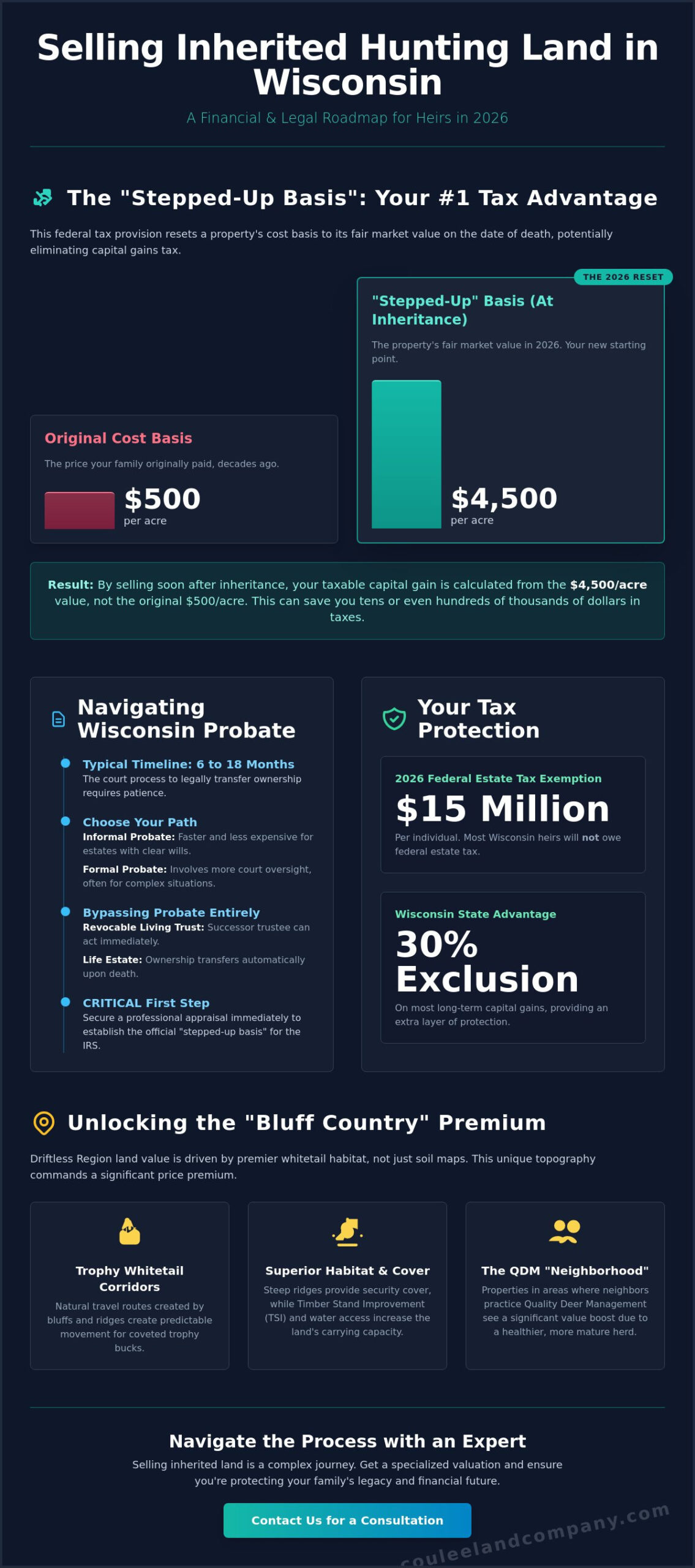
Inheriting a legacy of ridge-top views and deep coulees brings immense responsibility. When you’re selling inherited hunting land wisconsin, the financial “reset button” is your most powerful tool. Wisconsin is a community property state, which influences how titles are cleared and assets are valued. The “Stepped-Up Basis” is a federal tax provision that resets the property’s cost basis to its fair market value as of the date of the previous owner’s death in 2026. This means if the land was originally purchased for $500 per acre decades ago but is worth $4,500 per acre today, your taxable gain starts at that higher current value.
To better understand the nuances of the local market, watch this helpful video:
Clearing the title requires choosing between formal and informal probate. Informal probate is often faster and less expensive for estates with clear wills, while formal probate involves more court oversight. Regardless of the path, you must secure a professional appraisal immediately. This document establishes the 2026 “basis” for the IRS and protects you from potential disputes during the sale of hunting properties.
Navigating Wisconsin Probate in 2026
To list the property, the court-appointed Personal Representative must have the legal authority to sign a deed. If the land is held in a Revocable Living Trust, the successor trustee can often move faster, bypassing the probate court entirely. Life Estates require a different approach, as the remaindermen automatically gain full ownership upon the life tenant’s passing. It’s vital to confirm which structure is in place before signing any listing agreements.
Minimizing Tax Exposure
Selling shortly after inheritance can virtually eliminate capital gains tax because there’s little time for the property to appreciate beyond the stepped-up value. For 2026, the federal estate tax exemption is $15 million per individual, meaning most Wisconsin heirs won’t owe federal estate taxes. Step-up in Basis is the valuation of a property at the time of inheritance rather than original purchase. Wisconsin also offers a 30% exclusion on most long-term capital gains, providing an additional layer of financial protection for your family’s return.
Unlocking the “Bluff Country” Premium: Valuing Your Hunting Land
The value of the Driftless Region extends far beyond traditional soil productivity. While a standard appraiser might look at corn suitability ratings, selling inherited hunting land wisconsin requires a deeper analysis of the topography that produces world-class whitetails. The steep ridges and secluded coulees of “Bluff Country” command a significant premium because they offer something flat farmland cannot: security cover and strategic hunting advantages. This unique geography creates a finite supply of premier habitat, driving prices that often exceed standard agricultural benchmarks.
Trophy whitetail corridors are the lifeblood of high-value hunting properties. These natural travel routes, often dictated by the limestone bluffs of Western Wisconsin, create predictable movement patterns that serious hunters covet. When a property sits in a known “big buck” neighborhood, its market value often detaches from neighboring pasture prices. We see this frequently in areas where Quality Deer Management (QDM) is practiced by neighbors, as the collective effort significantly boosts the age structure and quality of the local herd.
Timber Stand Improvement (TSI) acts as a high-yield investment for recreational acreage. A well-managed forest isn’t just a future harvest; it’s a current sanctuary. Professional thinning and invasive species removal increase the carrying capacity of the land, making it more attractive to both wildlife and buyers. While tillable acres provide a steady lease check, they’re only one part of the valuation equation. We look at how those fields integrate with the timber to create “edge” habitat. Understanding the Wisconsin tax implications for any income generated from these leases or timber sales is a critical step for heirs during the valuation process.
Beyond the Soil Map
Water access and natural funnels are the “hidden” assets that drive competitive bidding. A property with a year-round spring or a pinch point between two deep valleys offers tactical advantages that a general realtor won’t recognize. To get a full picture of these nuances, review our resources for selling hunting land in Wisconsin. These features turn a standard parcel into a signature trophy property that stands out in a crowded market.
Why a Land Specialist Outperforms a General Realtor
Generalist realtors often miss the mark by comparing your woods to local pasture sales. They might overlook the fact that Buffalo County holds more record-book entries than almost any other county in the nation. A specialist understands how to market these record-breaking wildlife statistics to out-of-state buyers who aren’t looking for a farm, but a legacy. If you want to see how we position these unique assets to reach the right audience, take a look at our current hunting properties listings.
Family Consensus and Finding the Right Steward
Selling inherited hunting land wisconsin is rarely a solo decision. It’s an emotional transition that requires a clear, objective strategy to prevent family friction. To reach a unified choice that honors your family’s history, heirs should follow this 4-step framework:
- Inventory Goals: Determine who needs immediate liquidity and who, if anyone, has a genuine desire to remain a land steward.
- Secure a Neutral Valuation: Use an expert land broker to provide an objective 2026 market price, removing guesswork from sibling negotiations.
- Explore Internal Buy-outs: If one heir wants to keep the acreage, establish a fair market price based on the professional appraisal to ensure a transparent transfer.
- Formalize the Listing: Once a majority consensus is reached, document the decision in writing to present a unified front to the market.
Avoid the “Partition Action” legal route at all costs. This forced sale process often leads to a public auction where the land sells for a fraction of its true worth. It devalues the property and often permanently fractures family relationships. Instead, use our professional sellers process to maintain control over the sale and ensure the land’s financial potential is fully realized.
Managing Multiple Heirs
Sibling disagreements often stem from differing financial needs. If a buy-out isn’t feasible, a structured sale is the most equitable way to divide the legacy. We help families navigate these conversations by focusing on the pragmatic reality of the land market. Some heirs may be interested in DNR land programs to offset costs, but if the collective goal is a sale, we ensure the property is positioned to attract buyers who value the specific hunting traditions of the region.
Securing the Legacy of the Land
The emotional weight of “letting go” is lightened when you know the next owner shares your values. We specialize in connecting sellers with conservation-minded buyers who respect the timber management and wildlife habitat you’ve cultivated over decades. This ensures the ridges and coulees remain a thriving sanctuary for years to come. Speak with a Land Specialist today to receive a confidential valuation of your inherited property and begin the next chapter of your family’s legacy.
Securing Your Family’s Legacy in the Driftless Region
Selling inherited hunting land wisconsin is more than a simple real estate transaction; it’s the final chapter of a family’s stewardship. By leveraging the 2026 stepped-up basis to minimize tax exposure and identifying the unique habitat features of your Bluff Country acreage, you can ensure the financial return matches the land’s true character. Reaching a consensus among heirs isn’t always easy, but a professional valuation provides the objective ground needed to move forward without fracturing family relationships.
Our team brings specialized expertise in Buffalo County, the nation’s premier region for trophy whitetails, to every listing. We understand the specific 2026 Wisconsin probate laws and have a proven history of guiding families through complex multi-heir sales with transparency and diligence. Don’t leave your family’s history to a generalist who might overlook the record-book potential of your ridges and coulees.
Contact Coulee Land Company for a Specialized Inherited Property Valuation and take the first step toward a smooth, professional transition. You’ve honored the land for years; now let us help you honor the legacy it built.
Frequently Asked Questions
What is the stepped-up basis for inherited land in Wisconsin?
The stepped-up basis resets the property’s cost basis to its fair market value at the time of the owner’s death in 2026. This reset is a significant tax advantage because it allows heirs to sell the property while only paying capital gains taxes on appreciation that occurs after the inheritance. Since Wisconsin is a community property state, this valuation provides a clean slate for calculating taxes on the sale of the family acreage.
How long does it take to sell inherited hunting land in 2026?
The timeline for selling inherited hunting land wisconsin typically ranges from 6 to 18 months due to the state’s probate requirements. While a land specialist can often find a buyer within a few months, the legal transfer of the title cannot happen until the court grants the Personal Representative the authority to sign the deed. Cash buyers remain active in the 2026 market, which can help streamline the final closing once the legal hurdles are cleared.
Do I need to go through probate to sell my parents’ land?
You generally must go through probate to clear the title unless the land was held in a Revocable Living Trust or a Life Estate. Probate is the legal process that validates the will and ensures all debts are settled before the property is transferred to heirs or sold. If the property wasn’t moved into a trust prior to the owner’s passing, the court must appoint a representative to manage the sale and sign the closing documents.
What happens if my siblings and I disagree on the sale price?
Disagreements among heirs are best resolved through a professional appraisal that establishes a neutral 2026 market value. If one sibling wants to keep the land while others want to sell, the keeping sibling can buy out the others’ interests based on this expert valuation. Reaching a consensus early is vital to avoid a partition action, which is a court-ordered sale that often results in a lower price at a public auction.
Can I sell inherited land if it is currently leased to a farmer?
Yes, you can sell land with an active agricultural lease, though the buyer must typically honor the existing lease terms until they expire. Many recreational buyers actually prefer land with tillable acreage because it provides immediate income and serves as a consistent food source for trophy whitetails. You should provide the written lease agreement to potential buyers early in the process to ensure a transparent transition for the tenant and the new owner.
Why is hunting land valued differently than residential property?
Hunting land valuation focuses on biological assets and topography rather than square footage or neighborhood amenities. While residential property depends on school districts and home finishes, the value of recreational land in the Driftless Region is driven by bedding cover, natural funnels, and water access. We look at the property’s ability to produce mature deer and its proximity to other managed habitats to determine its true market premium.