
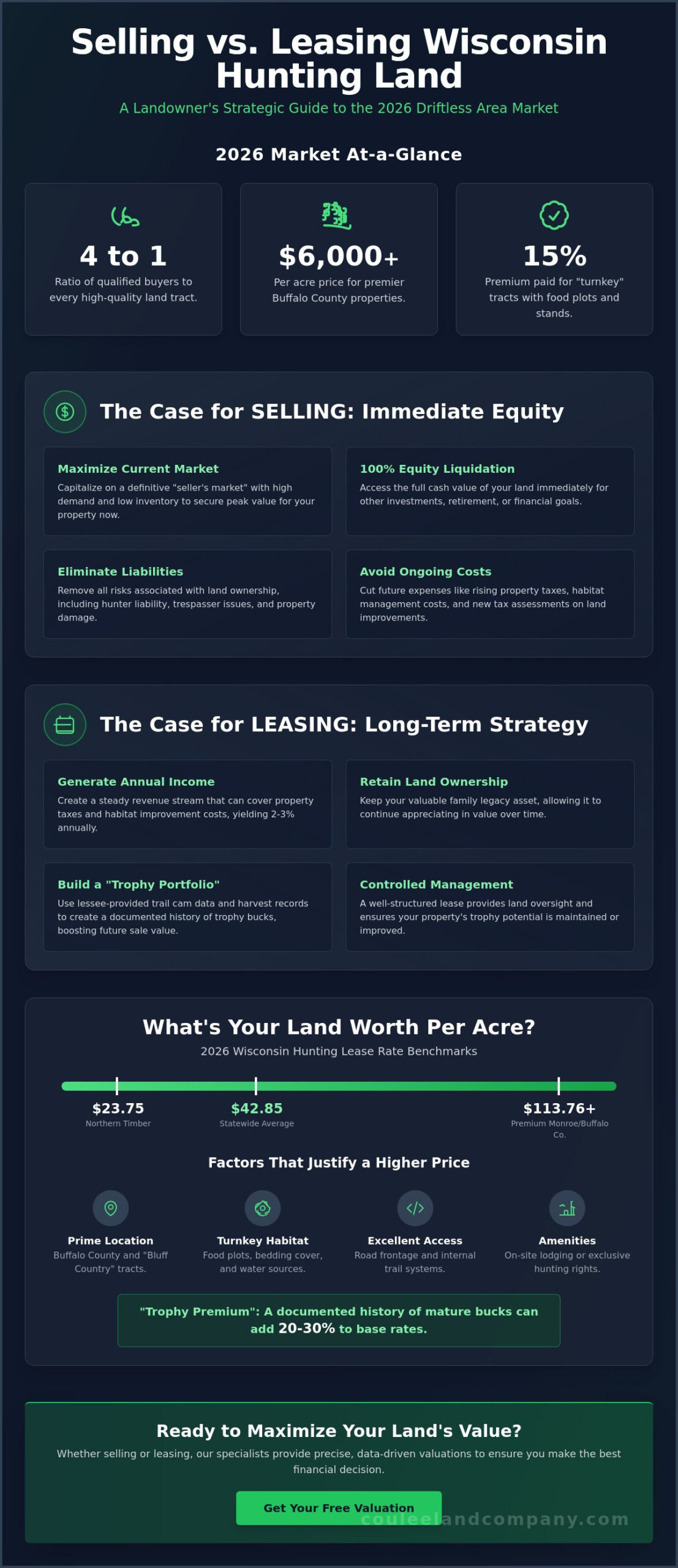
Your 80-acre tract in the Driftless Area is currently worth more as a turnkey hunting destination than as a traditional timber investment, often commanding a 15% premium over raw land. It’s a high-stakes decision for any landowner. You’ve likely watched property taxes climb while wondering if an average lease rate of $42.85 per acre is worth the liability of strangers on your ground. It’s natural to feel uncertain about whether to cash out while Buffalo County prices exceed $6,000 per acre or to hold for steady annual income.
This strategic guide helps you navigate the choice of selling hunting land in wisconsin vs leasing it by analyzing 2026 market data and the trophy potential of your soil. You’ll discover how to maximize your financial return while protecting the land’s whitetail legacy. We’ll compare the immediate equity of a sale against the long-term cash flow and land-management benefits of a structured lease. This ensures you make a data-driven move that respects both your bottom line and the hunt.
Key Takeaways
- Learn why the 2026 market creates a unique window for sellers and how to identify if your property commands a premium as a turnkey destination.
- Compare the total return of selling hunting land in wisconsin vs leasing it to determine if annual income or immediate liquidity serves your financial goals best.
- Discover the specific attributes, from habitat density to location, that allow Western Wisconsin tracts to command the highest lease rates in the state.
- See how trail cam data and harvest records from a lease can build a powerful marketing portfolio that increases your future sale price.
- Understand the liability protections and management strategies required to maintain your property’s trophy potential while generating consistent revenue.
Selling vs. Leasing: Weighing Immediate Equity Against Annual Income
The decision of selling hunting land in wisconsin vs leasing it often comes down to your long-term financial vision. In May 2026, we’re seeing a persistent inventory shortage where four qualified buyers exist for every high-quality tract that hits the market. This demand has pushed premier Driftless Area ground above $6,000 per acre, creating a definitive “seller’s market” for landowners. While Hunting in the United States remains a massive $2.5 billion driver for the Wisconsin economy, the path you choose depends on whether you value immediate liquidity or a slow, steady yield.
To better understand this concept, watch this helpful video:
The math is straightforward. A typical hunting lease in Wisconsin currently averages $42.85 per acre. On a 100-acre tract, that is roughly $4,285 in annual gross income, or a 2% to 3% yield based on current land values. However, you must factor in the Managed Forest Law (MFL) status and property taxes. If your land is “MFL-Open,” you’re restricted from blocking public access, which can lower lease appeal. Conversely, selling allows you to capture 100% of your equity now, avoiding the 2024 tax changes that now assess buildings on leased land as real property rather than personal property.
The Benefits of Selling in a High-Demand Market
Selling right now allows you to capture the “Buffalo County Premium.” Properties in this region dominate the Boone and Crockett Record Book, and buyers are paying a 15% premium for turnkey tracts with established food plots. By choosing to sell, you eliminate the risks of hunter liability, trespasser issues, and the rising costs of land management. If you’re ready to see what your equity looks like in today’s market, our property specialists can provide a precise valuation based on current 2026 sales data.
The Case for Leasing as a Holding Strategy
Leasing is an effective tool if you aren’t ready to part with the family legacy. It’s a pragmatic way to have someone else foot the bill for your property taxes and habitat improvements. A well-structured lease also acts as an “audition” for the land. By requiring lessees to share trail cam data and harvest records, you build a verified history of trophy whitetail bucks. This data-driven portfolio becomes a powerful asset that can justify a higher asking price when you eventually decide to move from leasing to a final sale.
Determining Your Rate: How Much to Charge for a Hunting Lease in Wisconsin
Setting a lease rate requires more than looking at what the neighbor charges. When evaluating selling hunting land in wisconsin vs leasing it, you’ll find that premium ground in “Bluff Country” operates on a different scale than standard timber tracts. Location is the primary driver. Buffalo County, which consistently dominates the Boone and Crockett Record Book, commands the highest rates in the state due to its world-class reputation and superior genetics. If your land sits in this legendary corridor, you aren’t just leasing acreage; you’re leasing a high-probability shot at a giant.
Habitat management determines your pricing ceiling. A “turnkey trophy property” with established food plots, warm-season bedding cover, and strategic stand sites is worth significantly more than raw woods. Access also plays a role. Road frontage and internal trail systems that allow hunters to enter stands without spooking deer are features that justify a higher price point. If you include lodging or exclusive rights for all seasons, you move into the top tier of the market. For more details on structuring these agreements, consult this Landowners’ Guide to Lease Hunting.
Wisconsin Hunting Lease Price Benchmarks for 2026
Based on 2026 listings, the average Wisconsin hunting lease sits at $42.85 per acre. However, the range is wide, spanning from $23.75 per acre in northern timber to over $113.76 per acre for high-end parcels in Monroe County. Properties in Buffalo County often sit at the top of this range. A “trophy premium” typically adds 20% to 30% to base rates when the land has a documented history of mature bucks and professional land management.
Steps to Calculate Your Specific Property Value
Start by evaluating your Boone and Crockett history. If you have trail cam photos of 160-inch bucks, you have a pricing lever that most landowners lack. Factor in “bonus” features like standing crops left for wildlife or year-round water sources. If you’re unsure if these features justify a lease or a full exit, our hunting property specialists can help you weigh the long-term benefits of each move.
The Strategic Exit: How a Lease Impacts Your Future Land Sale
When you weigh selling hunting land in wisconsin vs leasing it, remember that a lease isn’t just a temporary income stream; it’s a living record of the property’s wildlife capabilities. A documented lease agreement serves as a non-negotiable asset that transforms a simple recreational tract into a verified income-producing asset for future investors. While Wisconsin’s Voluntary Public Access Program offers state-funded rates between $5 and $25 per acre for public access, private trophy leases in Western Wisconsin command much higher premiums. These private agreements allow you to maintain total control over who steps foot on your soil while building a marketing portfolio for an eventual sale.
Don’t fall into the common “transferable lease” trap. Many landowners sign long-term agreements that lack a clear termination-on-sale clause. This can scare away the four qualified buyers currently waiting for every high-quality tract in 2026, as most buyers want to hunt their new acquisition immediately. Your lease should be a tool that enhances value, not a legal hurdle that delays a closing. By positioning your land as both a producer of trophy whitetail bucks and annual cash flow, you appeal to a broader pool of buyers, from hardcore hunters to pragmatic land investors.
Turning Lessee Data into Sale Dollars
Smart landowners require lessees to share “proof of life” photos of mature bucks as a condition of their agreement. These trail cam records and harvest histories act as a verified inventory of the land’s potential. Furthermore, a history of low-pressure hunting under a strictly managed lease protects the “sanctuary” status of the property. When it’s time to sell, you aren’t just selling timber and dirt; you’re selling a proven, high-performance whitetail factory with the data to back it up.
Why a Land Specialist is Critical for Both Options
Whether you’re vetting high-quality lessees or looking for a cash buyer, working with a specialist who understands the nuances of the “Bluff Country” is vital. Experts like Mike Law or Bryan Lemke bring a deep understanding of Western Wisconsin land valuation that general real estate agents simply can’t match. They help you determine if your specific acreage is better suited for a premium exit or a strategic hold. If you’re ready to explore our current inventory of hunting properties, we can show you exactly how managed leases are driving record-breaking sale prices in 2026.
Securing Your Land’s Financial Legacy in the Bluff Country
Your decision between selling hunting land in wisconsin vs leasing it shapes the future of your property and your financial portfolio. We’ve seen that while a $42.85 per acre average lease rate provides steady income, the current 2026 market offers a rare chance to capture peak equity in the legendary Bluff Country. Whether you use a lease to build a “proof of life” portfolio of trophy whitetail bucks or decide to capitalize on the 15% premium currently paid for turnkey tracts, you need a strategy rooted in data. Every food plot and trail cam photo is a brick in the foundation of your land’s market value.
As Wisconsin’s Land & Property Sales Specialists, Coulee Land Company brings a level of expertise endorsed by leading outdoor TV personalities. We specialize in the high-demand ground of Western Wisconsin and understand that your land is more than just an investment. It’s a legacy. Get a Free, Expert Property Valuation to Decide Your Best Move and see how our hands-on approach can maximize your return. Your ground has the potential to make history. Let’s make sure you get the reward you’ve earned.
Frequently Asked Questions
How much to charge for a hunting lease in Wisconsin per acre in 2026?
You should expect to charge an average of $42.85 per acre for a quality hunting lease in 2026. While remote tracts in northern Wisconsin start around $23.75 per acre, premier ground in Monroe or Buffalo County can command over $110 per acre. These rates depend heavily on habitat quality and management history. Turnkey properties with established food plots and stand sites typically earn a 20% premium over raw timber tracts.
Do I need special insurance if I lease my Wisconsin land for hunting?
You absolutely need a specialized liability policy to protect your assets when leasing your ground to others. Standard homeowner or farm policies rarely cover commercial hunting activities, so requiring your lessees to carry a dedicated hunting lease insurance policy is standard practice. Organizations like the American Hunting Lease Association provide these policies affordably. It’s a critical step when weighing selling hunting land in wisconsin vs leasing it, as it mitigates the risk of accidents.
Can a hunting lease make it harder to sell my property later?
A lease only makes a sale harder if the agreement lacks a clear termination-on-sale clause. Most buyers in the current 2026 market are looking for immediate access to their new hunting ground. If your agreement is legally binding for multiple years without an exit strategy, you might alienate the qualified buyers waiting for high-quality tracts. However, a lease with a documented harvest history of trophy whitetail bucks actually serves as a powerful marketing asset.
What should be included in a Wisconsin hunting lease agreement?
Your agreement must include specific harvest limits, designated access points, and a comprehensive liability release signed by all parties. You should also clearly state the property’s Managed Forest Law (MFL) status, as land enrolled in “MFL-Open” requires public access that your lessees cannot legally block. Detailing stand placement rules and food plot maintenance responsibilities ensures the land’s trophy potential is preserved for a future sale. A well-written lease acts as a management tool that protects your soil.