
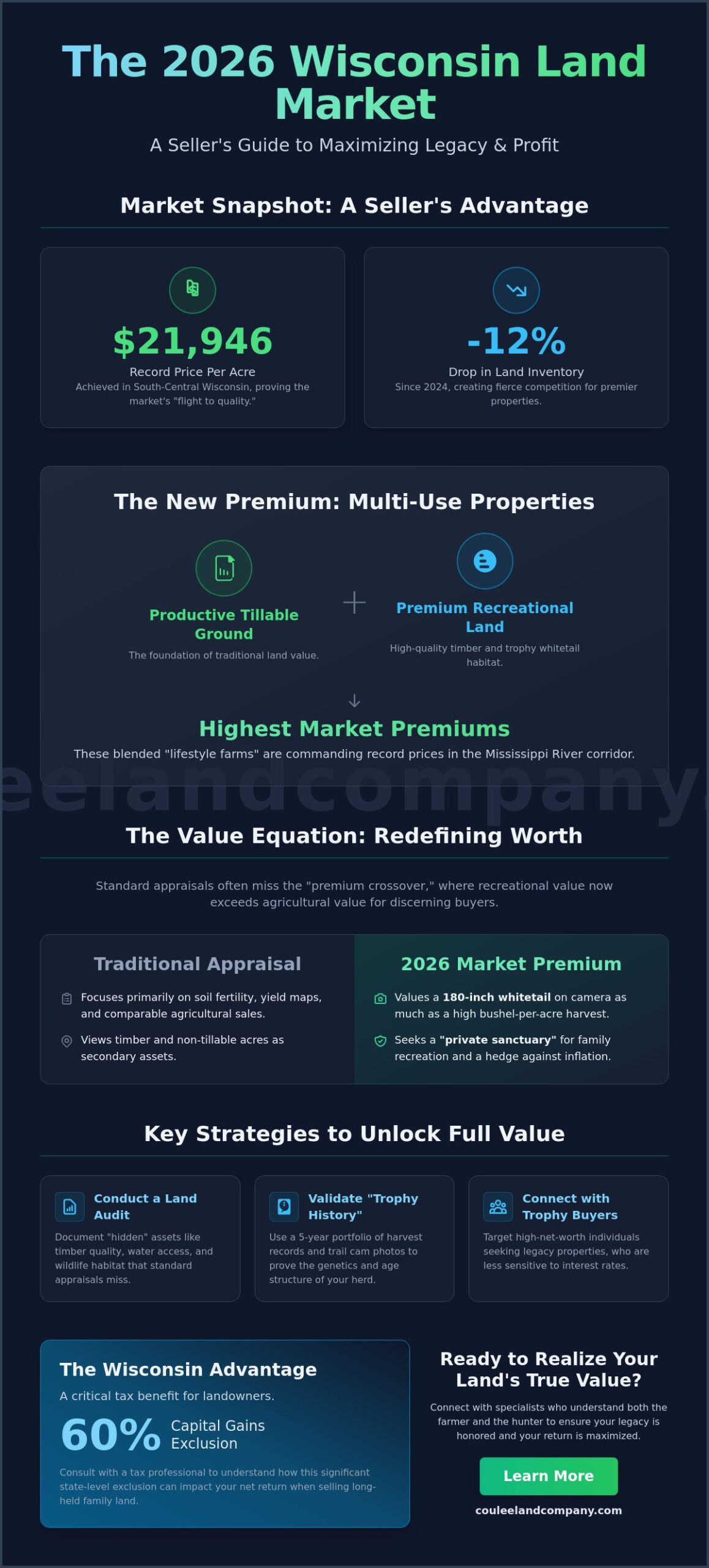
Did you know that prime agricultural land in south-central Wisconsin recently commanded a staggering $21,946 per acre, proving that the 2026 market is rewarding those who understand the true value of their dirt? You’ve spent decades stewarding your acreage, and the thought of selling a family farm in Wisconsin is as much about protecting your legacy as it is about the bottom line. It’s natural to worry that a standard listing might overlook the trophy whitetail habitat or the specific nutrient management potential that makes your property a “flight to quality” asset in a market where inventory has dropped 12% since 2024.
We understand that your land is more than a legal description; it’s a multi-generational investment. This guide will show you how to leverage Wisconsin’s unique land market to honor your family’s history while securing the highest possible return on your agricultural and recreational acreage. You’ll discover how to navigate the state’s 60% capital gains exclusion and connect with specialized buyers who value world-class hunting grounds as much as productive tillable soil. We will walk through the 2026 market premiums, essential tax deferral strategies, and the steps to ensure a smooth transition for your family’s most valuable asset.
Key Takeaways
- Identify why multi-use properties combining tillable ground with premium timber are commanding the highest premiums in the 2026 Mississippi River corridor market.
- Learn how to conduct a professional land audit to document hidden assets like timber quality and water access that standard appraisals often miss.
- Discover the specific steps for selling a family farm in Wisconsin that honors your legacy while connecting with high-net-worth “trophy” buyers.
- Leverage the power of “trophy history” by using harvest records and trail cam data to validate your land’s recreational value to serious outdoorsmen.
- Master a multi-channel marketing strategy that speaks the language of both the pragmatic farmer and the passionate hunter to drive competitive bidding.
Understanding the 2026 Wisconsin Farmland Market
The 2026 Wisconsin land market is defined by a fierce competition for quality that has pushed inventory levels down 12% since the start of 2024. Sellers are finding themselves in a unique position where traditional agricultural metrics are being bolstered by an unprecedented surge in recreational demand. When selling a family farm in Wisconsin, it’s essential to recognize that the market isn’t just buying soil; it’s buying a legacy of stewardship and the promise of world-class outdoor opportunities. While the history of Agriculture in Wisconsin provides the bedrock for land value, the modern premium is found in the “Bluff Country” along the Mississippi River corridor.
To see how these market dynamics play out in a real-world auction environment, watch this video covering a significant southern Wisconsin sale:
The most aggressive growth in 2026 is concentrated in multi-use properties. These tracts, which blend productive tillable acreage with high-quality timber, are consistently outperforming pure agricultural land. In regions like Buffalo County, the influence of trophy whitetail hunting is a primary economic driver. Buyers are increasingly seeking “lifestyle farms” that serve as both a hedge against inflation and a private sanctuary for family recreation. This “flight to quality” means that properties with diverse terrain are fetching record prices, such as the $21,946 per acre average seen in south-central Wisconsin in April 2026.
Regional Trends in Western Wisconsin
The Coulee Region’s unique topography is a magnet for modern investors who view land as a 50-year asset. Even with USDA direct farm ownership loan rates at 5.750% as of April 2026, the demand for these iconic landscapes remains resilient. Rural land liquidity is currently driven by cash-heavy buyers who are less sensitive to interest rates and more focused on securing rare “legacy” properties that seldom hit the open market. These buyers prioritize the privacy and dramatic elevation changes that define Western Wisconsin’s driftless area.
Agricultural vs. Recreational Value
A standard appraisal frequently misses the true market value of a property because it fails to account for the “premium crossover.” This occurs when the recreational value of a hunting ridge actually exceeds the per-acre value of adjacent tillable ground. To maximize your return when selling a family farm in Wisconsin, you must document the property’s recreational assets with the same precision a farmer uses for yield maps. A 180-inch whitetail on camera can be just as valuable to the 2026 buyer as a high bushel-per-acre corn harvest.
Preparing Your Property: Identifying “Hidden” Value
Preparing for the sale of a multi-generational asset requires a strategic shift in perspective. You aren’t just selling acreage; you’re selling future potential. To maximize your return when selling a family farm in Wisconsin, you must look past the fence lines and identify the “hidden” assets that drive 2026 market premiums. This process begins with a comprehensive land audit that treats timber quality, water access, and wildlife habitat with the same rigor as soil fertility tests. While you consult farm succession planning resources to manage the family transition, our focus is on the physical preparation of the land itself.
The Trophy Whitetail Factor
Western Wisconsin, specifically the legendary ridges of Buffalo County, remains the undisputed gold standard for trophy whitetail land. Buyers in 2026 are increasingly data-driven and want to see the “trophy history” of the property. Don’t just tell them the hunting is good. Show them. Compile a digital portfolio of trail camera photos and harvest records from the past five seasons to prove the age structure and genetics of the local herd. Mapping out natural funnels, thick bedding cover, and established food plot locations allows a prospective buyer to visualize their first opening day before the ink is dry on the contract.
Timber and Water Assets
Wooded acreage is often drastically undervalued in standard agricultural appraisals. Commissioning a professional timber cruise is a critical step to quantify the substantial standing value of mature hardwoods like white oak and black walnut. This provides a concrete dollar figure that can be added to the base land value. Similarly, waterfront properties or those with significant creek access command a massive premium for both aesthetics and wildlife management. If your property includes a trout stream or a reliable year-round water source for game, it’s a high-value differentiator that must be marketed aggressively.
Before the listing goes live, evaluate the condition of any country homes and outbuildings. In 2026, buyers prefer turnkey structures that add immediate utility. Ensure your current agricultural leases are clearly documented. The reliable income potential from tillable ground provides the financial foundation that justifies the recreational “lifestyle” purchase for many investors. If you’re ready to see how your property’s unique features translate to today’s market, you can learn more about our specialized valuation process here.
The Sales Process: From Valuation to Closing the Legacy
Transitioning from property preparation to the active market requires a precision-guided approach that balances technical expertise with a respect for your family’s history. Selling a family farm in Wisconsin in 2026 is a sophisticated undertaking that involves navigating complex tax codes and emotional family dynamics. The process moves from a data-driven valuation to a high-impact marketing phase, eventually culminating in a closing that secures your financial future. Success depends on reaching two distinct buyer profiles: the pragmatic producer looking for tillable expansion and the high-net-worth recreational buyer seeking a private sanctuary.
The Land Specialist Advantage
Partnering with a generalist residential firm often results in missed opportunities because they lack the specialized vocabulary of the land. A local land broker understands the value of a secluded ridge or a specific deer bedding area, whereas a big-box firm treats acreage as a secondary feature. Specialists like Mike Law or Bryan Lemke use boots-on-the-ground knowledge to identify and market the specific attributes that drive premiums. This regional expertise is vital when navigating the Wisconsin guide to farm transfers to ensure every legal and financial detail aligns with your goals.
Marketing Your Family Legacy
Your marketing strategy must be as diverse as the Coulee Region topography. We utilize high-quality drone photography and sophisticated mapping software to tell the property’s story, showing how the timber interacts with the tillable ground. Reaching the right buyer means appearing in specialized hunting property listings where serious outdoorsmen look for their next legacy tract. This multi-channel visibility ensures that your land is seen by those who value its recreational potential as much as its agricultural yield.
The final steps involve navigating family consensus and managing showings that respect the land. We close the deal with a sharp focus on tax-saving strategies. Whether you’re utilizing a 1031 exchange to defer capital gains or leveraging a step-up in basis for inherited property, these tools are essential. We ensure the transition is smooth, allowing you to honor the past while maximizing the return on your family’s most significant asset.
Secure Your Family’s Agricultural and Recreational Legacy
The 2026 land market has proven that Wisconsin acreage is far more than just tillable soil. By identifying hidden assets like mature hardwoods and documenting trophy whitetail history, you position your property to capture the “flight to quality” premiums currently driving the Bluff Country market. Success requires a strategic blend of agricultural data and recreational marketing to ensure no value is left on the table. You’ve spent years stewarding the land; now is the time to ensure the market reflects that dedication.
Navigating the complexities of selling a family farm in Wisconsin doesn’t have to be an overwhelming burden. It’s an opportunity to honor your history while realizing the full market potential of your dirt. Our team specializes in the Western Wisconsin Bluff Country, bringing deep expertise in Buffalo County trophy whitetail land and a proven track record in both agricultural and recreational sales. We understand the heartbeat of this region because we live and hunt here ourselves.
Ready to discover the true worth of your acreage? Get a Professional Valuation for Your Wisconsin Farm today. Your land’s next chapter starts with a partner who respects its history as much as you do.
Frequently Asked Questions
How long does it typically take to sell a family farm in Wisconsin in 2026?
Most premier properties in the current market find a buyer within 60 to 90 days of hitting the open market. While the volume of land sales increased by 11.2% in 2025, the record-low inventory of prime farmland means well-positioned tracts move quickly. The total timeline from the initial listing to the final closing table often spans four to six months. This duration allows for the complex due diligence and financing requirements typical of high-value agricultural and recreational acreage.
Do I need to clear my agricultural leases before listing the farm for sale?
You don’t need to terminate active leases before listing, but you must disclose all written and oral agreements to potential buyers immediately. Many 2026 investors actually prefer properties with established agricultural income to offset their ownership costs. If you’re selling a family farm in Wisconsin to a recreational buyer, they may value the existing lease as a tool for maintaining food plots and habitat management through a tenant’s professional operations.
What is the “step-up in basis” and how does it affect my capital gains tax?
The step-up in basis resets the property’s tax value to its fair market value at the time of the previous owner’s death, which can significantly reduce your capital gains liability. This is a vital financial tool for multi-generational families looking to protect their wealth. When you combine this with Wisconsin’s 60% capital gains exclusion on farm assets, it allows sellers to retain a much larger portion of the sale proceeds. You should always consult a tax professional to verify your specific cost basis before finalizing a sale.
Should I sell my tillable land and hunting woods separately or as one parcel?
Selling as a single multi-use parcel is often the most profitable strategy in 2026 because the combination of tillable ground and timber attracts the highest market premiums. Modern “lifestyle” buyers are searching for the balance of steady crop income and world-class recreational value. However, if the tillable portion is exceptionally large or the hunting land is a world-class bluff tract, a strategic split might maximize your total return. We analyze the topography and access of each specific property to determine the most profitable configuration for your land.