
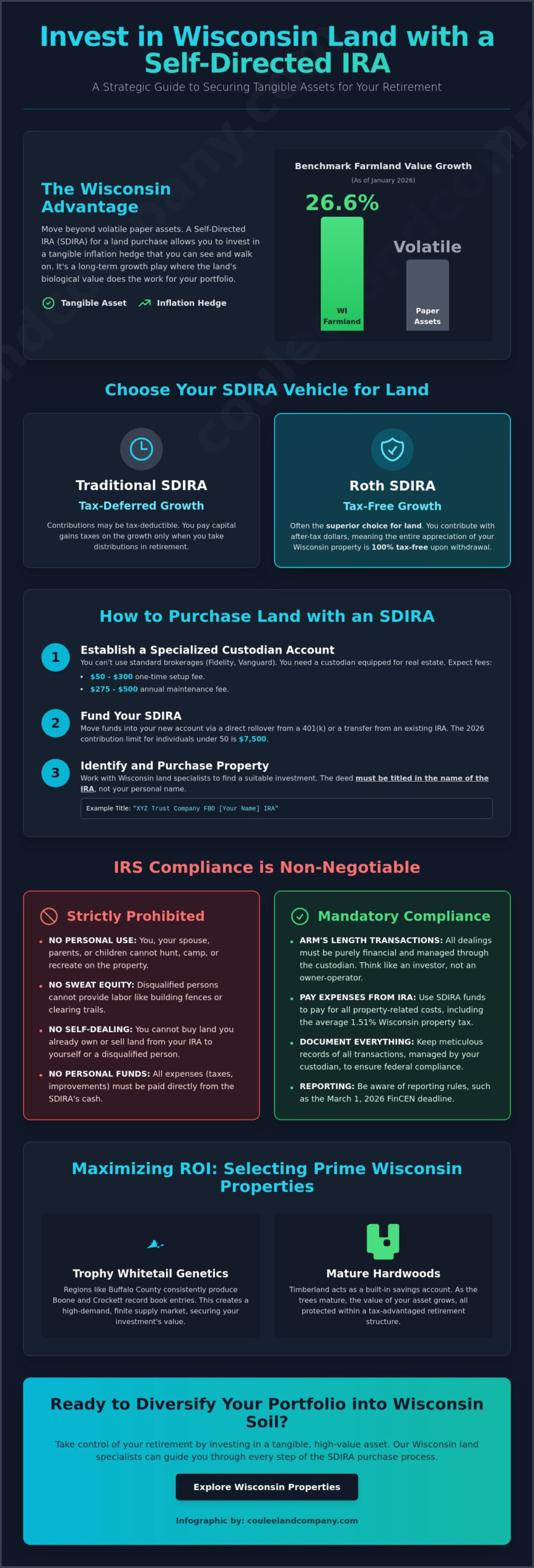
What if your retirement strategy involved tracking trophy whitetails in Buffalo County instead of watching red and green tickers on a screen? You’ve likely felt the sting of stock market volatility and realized that traditional paper assets don’t offer the same security as a tangible piece of Wisconsin’s Bluff Country. It’s frustrating to watch your hard-earned savings fluctuate when you could use a self-directed IRA for land purchase to invest in an asset class that saw benchmark farmland values in Wisconsin jump 26.6% as of January 2026.
We understand the complexity of IRS real estate rules can be intimidating, but you don’t have to let the fear of prohibited transactions stop you. This guide will show you how to secure high-value recreational property while staying strictly within federal compliance. You’ll learn how to manage the 2026 contribution limits, such as the $7,500 cap for individuals under 50, and master the “no personal use” rule. We’ll provide a clear roadmap to diversifying your portfolio into the soil, covering everything from the March 1, 2026 FinCEN reporting rules to the typical $275 to $500 annual maintenance fees you can expect from an account custodian.
Key Takeaways
- Learn how to bypass traditional brokerages like Fidelity or Vanguard by establishing a specialized custodian account designed to hold physical Wisconsin real estate.
- Discover the specific steps to execute a self-directed IRA for land purchase, ensuring your retirement funds move seamlessly through direct rollovers or transfers.
- Identify high-appreciation properties in Bluff Country by evaluating trophy whitetail genetics and Boone and Crockett record book entries as key investment indicators.
- Leverage mature hardwoods as a built-in savings account, allowing your timberland to grow in value while protected within a tax-advantaged retirement structure.
Understanding the Power of a Self-Directed IRA for Land Purchases
A Self-Directed IRA (SDIRA) acts as a powerful financial vehicle that moves your retirement strategy beyond the limitations of Wall Street. By utilizing a self-directed IRA for land purchase, you can secure tangible assets like Wisconsin hardwoods and tillable ground that offer a level of stability paper assets can’t match. This strategy allows you to acquire an inflation hedge in a region where benchmark farmland values surged 26.6% as of January 2026.
You must understand the strict “No Personal Use” mandate before moving forward. The IRS forbids you, your spouse, or any lineal descendants from hunting or recreating on land owned by your IRA. This rule requires you to shift your mindset from a recreational user to a strategic land investor. You’re looking for a 10 to 20 year growth play where the property’s biological value and timber maturity do the heavy lifting for your portfolio.
To see how this process works in the field, watch this breakdown of the investment mechanics:
Tax Advantages: Traditional vs. Roth IRA for Land
Traditional SDIRAs offer tax-deferred growth, which means you won’t pay capital gains taxes until you start taking distributions in retirement. The Roth SDIRA is often the superior choice for land because it’s a tax-free vehicle. Since you’ve already paid taxes on the contributions, every bit of appreciation on that Western Wisconsin acreage is yours to keep. If your property value doubles over two decades, that entire gain stays in your account without an IRS haircut.
Why Western Wisconsin is a Strategic SDIRA Asset
Western Wisconsin, specifically the famed Bluff Country, represents a unique market because the supply of high-quality habitat is finite. Areas like Buffalo County dominate the record books, creating a constant floor for demand. When you hold land in a region that consistently produces trophy whitetails, you aren’t just buying dirt; you’re securing a premium asset that holds its value even when other market sectors falter. This geographic niche is the ultimate safe haven for a self-directed IRA for land purchase.
Step-by-Step Guide: How to Purchase Land with an SDIRA
Opening an account is the first hurdle. You can’t use standard brokerages like Vanguard or Fidelity because they aren’t equipped to hold physical deeds or non-traditional assets. You’ll need a specialized custodian. Investing in Real Estate with a Self-Directed IRA requires a partner who understands the nuances of alternative investments. Expect account setup fees between $50 and $300, with annual maintenance costs generally falling between $275 and $500 as of May 2026. Once the account is open, you’ll fund it through a direct rollover from a 401(k) or a transfer from an existing IRA.
Next, you’ll identify the property. Working with Wisconsin land specialists is vital during this phase. They ensure the acreage meets the investment criteria for a self-directed IRA for land purchase. When you execute the purchase, the deed must be titled in the name of the IRA rather than your personal name. A typical title structure looks like “XYZ Trust Company FBO [Your Name] IRA.” This distinction is critical for maintaining the tax-advantaged status of the asset.
Navigating Prohibited Transactions and Disqualified Persons
The IRS is strict about who interacts with the asset. Disqualified persons include you, your spouse, parents, and children. None of these individuals can live on the property or provide “sweat equity” like building fences or clearing trails. You also can’t buy land you already own or use personal bank accounts to pay the 1.51% average effective Wisconsin property tax rate. All financial interactions must remain at arm’s length to avoid heavy penalties.
Funding Improvements: Food Plots and Land Management
To increase the value of your investment, you’ll likely want to implement land management strategies. Every cent for seed, lime, or tractor rentals must come directly from the SDIRA’s cash reserves. This ensures that the growth of the asset remains entirely within the retirement wrapper. If you’re ready to see what’s available in the current market, our team can help you find the right hunting properties to anchor your retirement portfolio.
Maximizing ROI: Selecting High-Appreciation Wisconsin Properties
Generic land is a poor choice for a retirement portfolio because it lacks the biological alpha found in premium hunting ground. When you execute a self-directed IRA for land purchase, you aren’t just buying dirt; you’re investing in trophy whitetail genetics and a legacy of Boone and Crockett record entries. These factors drive resale value far more than simple acreage counts. Mature hardwoods act as a secondary savings account within your SDIRA. While you wait for the land to appreciate, your timber is literally growing in value, providing a natural hedge against inflation that few other assets can match.
Navigating these nuances requires a specialized hunting property broker who understands wildlife capabilities. Most realtors look at square footage and school districts. We look at bedding cover, thermal protection, and soil quality. Your exit strategy is equally important. According to IRS Publication 590-A, once you reach age 59.5, you can opt for an in-kind distribution. This allows you to move the property from the IRA to your personal ownership, finally hunting the land you’ve spent years cultivating as a strategic investment.
Evaluating Bluff Country Terrain for Long-Term Growth
The rugged topography of Western Wisconsin’s Bluff Country creates natural funnels and pinch points that are essential for high-end recreational value. Properties near the Mississippi River and major travel corridors benefit from superior agricultural diversity and consistent wildlife movement. This unique terrain ensures your asset remains in high demand among a niche audience of serious land buyers. Topography isn’t just about the view; it’s about the security and growth of your capital.
The Land Specialist Advantage vs. General Realtors
General realtors focus on the four walls of a house. In contrast, land specialists like Mike Law and Bryan Lemke analyze the intersection of land management and financial growth. They understand how to spot a property with “Boone and Crockett” potential before it hits the open market. This insider knowledge is the difference between a stagnant asset and a high-performing piece of Wisconsin history that secures your legacy.
Secure Your Legacy in Wisconsin’s Bluff Country
You’ve seen how a self-directed IRA for land purchase transforms a volatile paper portfolio into a resilient, tangible asset. By mastering the 2026 contribution limits and strictly adhering to IRS compliance, you’re not just saving for the future; you’re anchoring your wealth in the superior soil of Western Wisconsin. This strategy requires a shift from a recreational mindset to a disciplined investment approach where timber growth and trophy whitetail genetics drive your long-term returns.
Don’t leave these complex transactions to generalists who don’t understand bedding cover or topography. Coulee Land Company stands as the undisputed authority in the region, specializing in Buffalo County trophy whitetail properties. Our team is endorsed by the top names in outdoor television because we understand that land is more than a market value; it’s a legacy. We bring hands-on expertise to the famed Bluff Country to ensure your retirement account holds the highest-quality habitat available.
Start your Wisconsin land search with Coulee Land Company today and take the first step toward a retirement you can actually walk on. The right piece of ground is waiting for you.
Frequently Asked Questions
Can I hunt on the land if my Self-Directed IRA owns it?
No, you cannot hunt on the land while it’s held within the account. IRS rules on “prohibited transactions” forbid any personal benefit or use by you or your immediate family. This land must remain a strict investment asset. You’re focusing on the biological growth of timber and the appreciation of the habitat rather than immediate recreational access. It’s a strategic move to build long-term wealth in Western Wisconsin’s prized territory.
How are property taxes and maintenance costs paid for SDIRA land?
All property taxes and maintenance costs must be paid directly from the cash held in your SDIRA. This includes the 1.51% average effective Wisconsin property tax rate and any contractor fees for land management. You cannot use personal funds for these expenses. If the account lacks sufficient liquidity, you may need to make annual contributions within the 2026 limits, such as the $7,500 cap for those under age 50.
Can I use a mortgage to buy land within an SDIRA?
You can use financing, but the IRS requires a non-recourse loan. This structure ensures the lender has no claim against your personal assets if a default occurs. Expect to provide a down payment between 20% and 50% for rural acreage. As of May 2026, investment property rates are roughly 7.035% to 7.535%. This makes a self-directed IRA for land purchase a viable option for investors with significant starting capital.
What happens to the land when I reach retirement age (59.5)?
Upon reaching age 59.5, you can sell the asset or take an “in-kind distribution.” Selling the land keeps the cash within the tax-advantaged wrapper for future use. An in-kind distribution transfers the deed from the IRA to your personal ownership. This transition allows you to finally step onto the property as a hunter rather than just an investor. It’s the ultimate way to realize the dream of owning a piece of Bluff Country through a self-directed IRA for land purchase.